

The clue of the coiled c.., p.1
The Clue of the Coiled Cobra, page 1
part #5 of Ken Holt Series


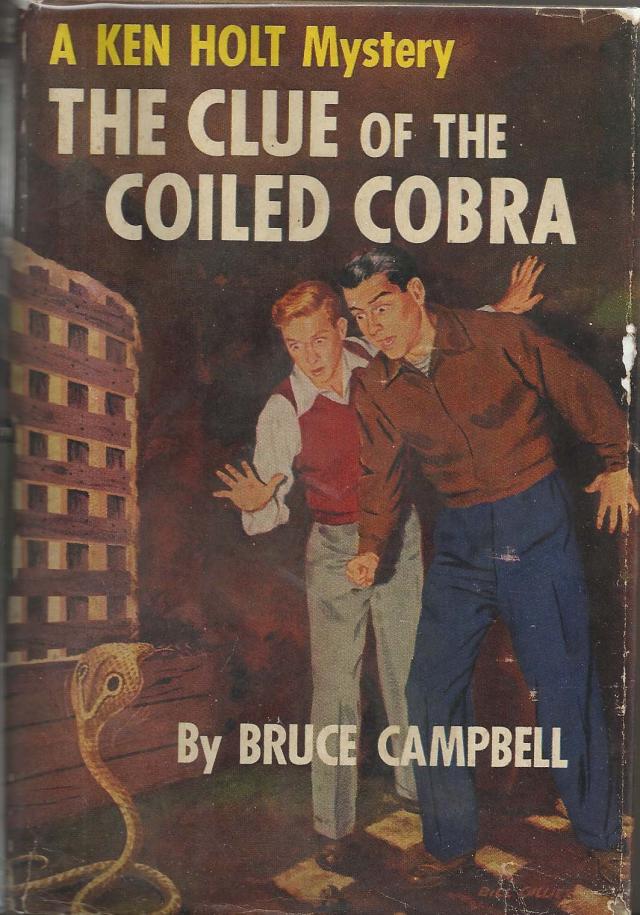
THE CLUE OF THE COILED COBRA
A KEN HOLT Mystery
By Bruce Campbell
The KEN HOLT Mystery Stories
1 The Secret of Skeleton Island
2 The Riddle of the Stone Elephant
3 The Black Thumb Mystery
4 The Clue of the Marked Claw
5 The Clue of the Coiled Cobra
6 The Secret of Hangman’s Inn
7 The Mystery of the Iron Box
8 The Clue of the Phantom Car
9 The Mystery of the Galloping Horse
10 The Mystery of the Green Flame
11 The Mystery of the Grinning Tiger
12 The Mystery of the Vanishing Magician
13 The Mystery of the Shattered Glass
14 The Mystery of the Invisible Enemy
15 The Mystery of Gallows Cliff
16 The Clue of the Silver Scorpion
17 The Mystery of the Plumed Serpent
18 The Mystery of the Sultan’s Scimitar
GROSSET & DUNLAP Publishers
NEW YORK
COPYRIGHT, 1951, BY BRUCE CAMPBELL
ALL RIGHTS RESERVED
FKINTKD IN THE UNITED STATES OF AMBR1CA
CONTENTS
CHAPTER PAGE
I THE HITCHHIKER……. 1
II THE HITCHHIKER IDENTIFIED …. 14
III A FIGHT IN THE DARK…… 23
IV BEATEN TO THE PUNCH…… 39
V FENTON IS FOUND……. 48
VI OUTSMARTED…….. 60
VII THE LIMPING FOOTSTEPS….. 71
VIII THE WARNING…….. 83
IX THE MICROFILE ROOM…… 93
X THE COILS OF THE SNAKE….. 104
XI WET PAINT COMES OFF….. 118
XII THE STATION WAGON AGAIN …. 130
XIII THE RANDS FIND THE TRAIL …. 142
XIV DISCOVERED!……… 152
XV IN THE CAVE…….. 163
XVI TRAPPED!……… 173
XVII COBRA ON GUARD……. 183
XVIII OVER THE BRINK……. 193
XIX FIGHTING WITH FIRE…… 203
THE HITCHHIKER
“Hey!” Ken Holt looked up from the hieroglyphics he was trying to decipher. “If you can’t drive better than that, let me take over.”
Sandy Allen grinned widely and pulled the red car far over to the right as another raucous blast of sound hit them from the back. He jerked his head rearward, his flaming red hair upright in the wind. “Pardner, when a Greyhound bus wants to pass me, I let him. He’s too big to argue with.”
“I see what you mean. I hadn’t noticed it.” Ken winced as the huge bus roared past, its exhaust bluing the air. Then his eyes sought the page of copy paper once more. “Trouble with covering a dog show,” he said, “is that there are so many dogs.”
“The trouble with you covering a dog show,” Sandy amended, “is that you can’t read your own handwriting.” His big hand beat a tattoo on the horn button as he swung the car around a small delivery truck. The Greyhound bus was a thousand feet ahead by now and gaining fast.
“What was the name of that fuzzy little mutt?” Ken asked.
“The one that snapped at you? That was Donna of Fremont Farm. The smaller the dog, the bigger the name, I guess.”
“Ain’t it the truth?”
“Of course,” Sandy went on, “if you want to know about the Doberman, I can—”
“Never mind that one!” Ken interrupted. “One inch more and I’d have been the only reporter at the show without any seat in his pants.”
Sandy laughed. “Wait until Pop and Bert see that picture. Maybe they’ll decide to get out a special edition of the Advance, with—”
“You mean you photographed my stupendous leap to safety?” Ken sounded outraged, but he was grinning. “I’ll bet I broke the international broad jump record that time.”
“Your father would have been proud of you,” Sandy said solemnly. “Come to think of it, he’d probably be relieved—I would be myself—if you limited your enemies to Dobermans for a while. Some of the people you get us messed up with …”
His voice stopped, but both boys completed the thought mentally. Their most recent adventure—the one the newspapers had tagged “The Clue of the Marked Claw”—was still fresh enough in their memories to make them glad they were on a public highway in broad daylight.
“Of course Dad occasionally gets messed up with people—as you put it,” Ken said thoughtfully, after a moment. He was remembering, as he so often did, the grim occasion when Richard Holt, famous foreign correspondent, had been held captive by a vicious gang. His son had been helpless and alone until the oversized, redheaded Allen clan had become his allies. With their help Ken had rescued his father and solved “The Secret of Skeleton Island.” Since that time Ken had been practically adopted by the Allens. Tiny Mom Allen, huge Pop, and equally huge Bert, Sandy’s older brother, were the nearest thing to a family that Ken had known since his mother’s death years before.
“And the Allens haven’t been leading what I’d call completely isolated lives either,” Ken went on, knowing for the hundredth time how impossible it was to put into words the gratitude he felt toward these people who had made his troubles their own, and their house his home. “Ever since I—”
“Ever hear of newspaper men who deliberately isolated themselves?” Sandy broke in brusquely.
Ken glanced at him, but Sandy was staring straight ahead. “You win. I won’t say a word.”
“That’ll be the day.” Having headed off Ken’s thanks, Sandy was his normal bantering self once again. “And you’d better figure out a lead for that story, or you’ll have Pop and Bert doing all the talking.”
“Leave the reporting to me. You’ve got enough to do worrying about the so-called pictures in your camera.” Ken sighed elaborately. “When I think of the money we waste, buying you expensive equipment—”
“My pictures are always good,” Sandy assured him. And then added, “Well, almost always.”
“Especially when you forget to put film in the camera.”
“But that saves money,” Sandy informed him loftily.
“No doubt. No doubt.” Ken was buried in his notes again. “If I could only—hah! Got it!” His blunt pencil stabbed at one of the scrawls. “I kept thinking this said marmalade toast—but it’s Marmaduke the Third. That was the shaggy-haired hound that looked as if he hadn’t been fed for a month.”
“I understand his feelings.” Sandy suddenly threw back his head and howled mournfully.
“O.K.” Ken put his hands over his ears. “I get it. And we’re fresh out of dog biscuit.”
Sandy pointed ahead to the roadside stand where the Greyhound bus had already stopped. A moment later he pulled off the road as the last of the bus passengers were alighting.
“Ten minutes!” the driver was bellowing to his fares.
“Don’t howl again,” Ken said, as Sandy sniffed happily at the odor of food. “You’ll be fed in a minute.”
They went inside and took the only two vacant seats at the long counter already crowded with bus travelers. In the narrow space on the other side of the counter two young men and a girl were rushing back and forth, trying to wait on everybody at once.
“What’ll it be, newshounds?” the waitress asked, pausing briefly before them.
Ken grinned, thinking that Sandy’s appetite had won them a reputation in every restaurant within a hundred miles of Brentwood. “Take care of the others first,” he said firmly.
“Thanks!” The girl flashed him a grateful smile and hurried on down the counter to draw four coffees for as many bus passengers. But a moment later she was back with coffee for the boys. “Just to keep you alive until I can take your order,” she murmured.
Sandy’s freckled face split in a happy smile. “Thank you! I always say it pays to be considerate,” he told Ken, as he spooned sugar with a lavish hand.
“You weren’t considerate,” Ken said. “You just looked as if you were starving to death.”
Sandy took a long swallow. “Good,” he pronounced. “Now if we only had a couple of hot dogs to keep this company, we’d be in fine shape.”
Ken ignored him. “Who’s this Mrs. Chauncey Devers?” he asked, studying his notes once more. “She gets better space on the program than the dogs.”
“Mrs. Devers, my uninformed friend,” Sandy replied, “is the social bigwig of the county.”
“I see. Sort of top dog of the show, huh?”
Sandy closed his eyes as if in pain. “If you don’t get invited to Mrs. Devers’ garden party, you’re finished— absolutely finished—so far as society is concerned.”
Ken nodded solemnly. “So the Allens think they might get invited to the next garden party if they give her dog show a big story. I’ll stop complaining then, now that I know this is all in such a good cause.”
Sandy grinned. “You’ve hit the nail on the head all right. It’s in a good cause. Didn’t Pop explain to you?” When Ken shook his head, puzzled, Sandy continued, “Pop wouldn’t go to one of her parties if she begged him, but he persuaded her to give part of the proceeds of the dog show to that hospital-wing fund he’s so worried about.”
“Oh! So that’s—”
A loud-speaker screeched into life, drowning out his words. “All aboard! All aboard! Next stop Brentwood! All aboard!”
There was a hasty scramble among the bus passengers, to finish the last bite on their plates, to pay checks, and to
stock up on peanuts and chocolate bars from the rack near the cash register. The bus driver stood alertly in the doorway, checking up on his charges as they filed out, and when he sent the last warning through the hand microphone one final passenger swept up his change and bolted through the door.
“I guess that’s it.” The driver hung the microphone on its hook. “If you find any leftovers, keep them in the refrigerator until the next bus comes through.” He waved his hand as he departed, and an instant later the powerful engine rumbled into action and the bus moved back onto the highway.
Behind the counter the three, workers let out sighs of relief. When the waitress had caught her breath, she smiled at the boys and came toward them. “Thanks for waiting,” she said.
“Some mob,” Sandy commented. “How often do you get them?”
“About every hour.” She smiled wryly. “There’s hardly time enough between to brace ourselves for the next invasion.” She handed them menu cards.
Sandy didn’t glance at his. “Just a couple of hot dogs for me. And some more coffee, please.”
“That’ll take care of me too,” Ken added.
“Right.” She moved off.
“I wish you’d told me before why Pop sent us thirty miles to cover a dog show,” Ken said thoughtfully, after a moment. “I’m not sure I’ve got enough stuff here to give the thing a really big splash.”
“Don’t worry,” Sandy assured him. “Just listing the dogs’ names will run to nearly a column. And you ought to know by now that if Global News accepts your stuff, Pop will too.”
“The stories I’ve written for Global have had slightly more interesting subject matter,” Ken pointed out.
“Don’t be so modest.” Sandy grinned.
Global News, the international agency for which Ken’s father worked, had several times bought exclusive stories and pictures of the boys’ own adventures. And although Granger, the New York manager, often referred to Ken and Sandy scathingly as “our foot-loose, screw-loose correspondents,” the boys knew he was a friend who could be depended on.
“Of course,” Ken said, biting into one of the hot dogs that had just been placed before them, “I’ll admit I could do without any more Global assignments for a while.”
“You can’t exactly say Global gives us assignments,” Sandy reminded him. “We manage to get into the middle of these things by ourselves.”
“That’s true. And I’ve also got to admit that while a dog show may be dull, it does have one advantage: with dogs you know where you are. Either they bite you or they don’t. With some of the people we’ve run into—” He abandoned the rest of his sentence in favor of a swallow of coffee.
The restaurant door clicked in the silence, and a man entered and seated himself on a stool near the boys. He was tall and thin, and his dark suit hung on him shapelessly.
“Coffee and blackberry pie,” he ordered. “And put some vanilla ice cream on the pie.”
“Sure.” The counterman hesitated. “Didn’t you come in on that bus?”
The man shook his head, and the counterman glanced curiously through the front window. The boys’ red convertible was still the only car in the parking space.
“Hitchhiked,” the man said briefly, in answer to the unspoken question. “How far to Brentwood?”
The counterman drew a cup of coffee. “About twenty miles,” he said, putting it down before the new customer.
“Any buses?”
“To Brentwood, you mean?” The counterman’s eyes were still narrowed with curiosity. “There’ll be another —I mean, there’ll be a Greyhound in about forty-five minutes.” He scooped ice cream on a wedge of pie and served it.
The boys glanced at each other and then at the man. There was something pathetic about him—about the way he slumped over the counter, about the way his collar gaped around his thin neck.
“Broke.” Sandy mouthed the word silently.
Ken nodded. Poverty and pride might explain his near-rudeness to the counterman, too.
“We’d be glad to take you to Brentwood if that’s where you’re going,” Sandy said, directing his voice along the counter. “We’re going there ourselves.”
The man swallowed before he spoke. “That’s very kind of you,” he said finally. “I wouldn’t want to put you to any trouble, but—”
Sandy cut in. “Fine. If you don’t mind waiting a minute. That pie looks good,” he told Ken. “After all, two medium-sized hot dogs …”
Ken grinned. “All right. I’ll have some too—just to save you embarrassment.”
Five minutes later they were all at the car, and Sandy was moving his bulky camera equipment to one side of the rear seat to give their passenger enough room.
“Please don’t trouble,” the man said.
“Might as well be comfortable,” Sandy answered. “There—guess that’ll do it.”
He tipped the front seat forward to let the man slip past it, and as the boys got into the car their passenger settled down deep into the cushions with a sigh.
“Didn’t realize how tired I was,” he murmured.
Sandy eased the car out into the highway. A moment later, as Ken’s hand reached toward the radio, Sandy nudged his elbow and jerked his head backward. Ken followed his glance, nodded, and withdrew his hand. Their passenger was apparently already asleep. Perhaps he had had no place to sleep the night before, Ken thought, getting out his notes.
But five minutes later Ken looked up again. “What’s with you?” he asked Sandy. “Something wrong with the car?”
Sandy had slowed down to twenty miles an hour, and then accelerated to over fifty around a long curve. He was looking in the rear-view mirror.
He shook his head in answer to Ken’s question. “It’s that lunkhead behind us. I wish he’d pass. Don’t like cars on my tail. Makes me nervous.”
“Well then let him pass,” Ken said reasonably. “He can’t at this speed.”
“I did slow down. But he did too.”
“Anything wrong?” Their passenger had evidently been awakened by the changes in speed, or the boys’ conversation.
Ken twisted around to grin at him. “Not a thing— except that Sandy here doesn’t like other cars to use the same road he’s using.”
Sandy had slowed down once more. “See?” he said.
Ken and their passenger both looked back at the pale-blue sedan a few hundred feet behind, traveling at a speed that matched their own.
“It could be,” Ken said dryly, “that the driver is merely a law-abiding citizen. We just passed a sign that said the speed limit here is thirty.”
The man in the back seat, settling down again, smiled indulgently at the back of Sandy’s head.
“O.K.” Sandy grinned sheepishly. “If he wants to follow us, let him. But I think I’ll suggest to Pop that he write an editorial on the overcrowding of our highways—befouls the fresh ozone, destroys the scenic beauties …” He gestured toward the autumn-red maples lining the road. They had passed through the small village responsible for the reduced-speed zone, and Sandy increased their pace again.
Ken glanced back and saw that the blue car had fallen behind. He grinned, and winked over his shoulder at the man in the rear seat.
The man smiled, and seemed to make an effort to overcome his weariness. “Your father works on a newspaper?” he asked politely, directing his question to Sandy’s image in the rear-view mirror.
Sandy grinned into the glass. “My father is a newspaper—the Brentwood Weekly Advance. With some slight assistance from my brother and Ken here and myself.”
“Oh! I see. I’ve always thought it must be very interesting work.”
“Oh, it is,” Ken assured him. He sensed Sandy’s amused glance at his notes on the dog show and added solemnly, “You meet such interesting people.”
Sandy’s eyes shifted to the rear-view mirror. “That reminds me,” he said to their passenger. “As a reporter, I guess I should be asking you if you’re a newcomer to Brentwood—I mean, if you’re going to be settling down there?”
“Oh, no,” the man said. “Just on my way through. I’m heading for my brother’s place in Ohio. I’ve”—he sounded embarrassed—“had a run of rather poor luck. Been in the hospital for a couple of months. So when the doctor suggested rest and fresh air, I thought I might try hitchhiking. Thought I might toughen myself up enough to be of some use on the farm by the time I arrive.”


