

18 tiny deaths, p.17
18 Tiny Deaths, page 17
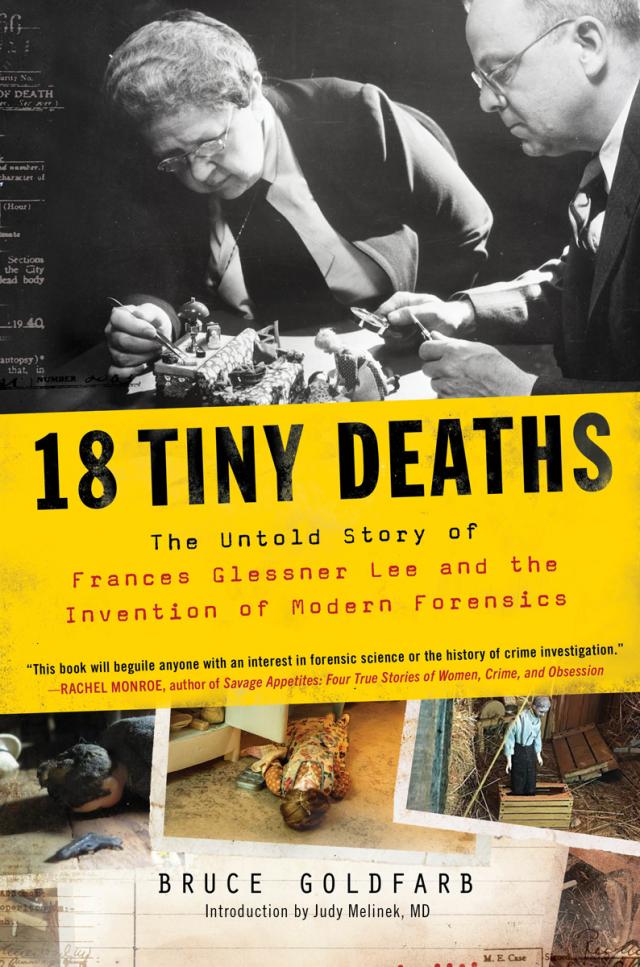


“It is interesting to speculate as to the number of cases of homicide that go unrecognized each year because of incomplete investigation of cases of obscure death,” Moritz wrote in the department’s first annual report.
Along with investigating deaths in Massachusetts, Moritz consulted in the investigation of murder cases in Maine, Rhode Island, and New York. He also maintained an active public speaking schedule, presenting talks on legal medicine to lay audiences, medical societies, and lawyers in Connecticut, Illinois, Missouri, Nebraska, New Hampshire, New York, Ohio, Pennsylvania, and Rhode Island.
Drawing from the knowledge gained during his fellowship in Europe, Moritz also wrote a book, The Pathology of Trauma. He dedicated it to Frances Glessner Lee.
8
CAPTAIN LEE
LEE HAD A DREAM: ONE modern, centralized medical examiner’s office located in Boston for the investigation of all unexpected or suspicious deaths in the Commonwealth of Massachusetts. A facility with a morgue and laboratories equipped for toxicology, microscopic pathology, X-rays, and photography.1
There would be one chief medical examiner for the Commonwealth and several assistant medical examiners at the headquarters and a sufficient number of deputy medical examiners to attend scenes anywhere they occurred. The staff would be civil service employees, removed from influences of politics and corruption. Through its affiliation with Harvard’s Department of Legal Medicine, the office would become the training ground to produce a stream of medical examiners, growing until there were enough qualified professionals for the entire country.
Legal medicine expertise in Boston would be available for investigations throughout New England and across the United States. The agency would serve as a veritable national institute of legal medicine, consulting with local police, coroners, and medical examiners from coast to coast, a forensic medicine counterpart of the Federal Bureau of Investigation.
Dr. Roger Lee asked Lee to sketch out her plan for reorganizing the Massachusetts medical examiner system. He knew people who could get the ear of Governor Saltonstall.2 Lee’s scheme for Massachusetts ran to four typed pages, including a bibliography and a list of more than two dozen people from which an advisory board could be drawn.
As her personal physician, Dr. Lee advised Lee to start taking it easier. At sixty-two years of age, she had an enlarged heart, hyperglycemia, hypothyroidism, glaucoma, hearing loss, severe arthritis of both knees, and an untreated diaphragmatic hernia.3
“I emphatically believe that you ought not to work as hard as you are working; that you should try to do all the work you have to do in two hours; that you ought to be out of doors sitting for two hours and take a drive every afternoon,” Dr. Lee said. His prescription: “You should take a minimum of alcohol. A moderate amount of tobacco is permitted. You ought to have a massage several times a week.”4
Despite the doctor’s warnings, Lee hardly cut back on work. By 1941, she had sold her Chicago residence and was living full-time at The Rocks, much preferring the fresh air and rural way of life. She still maintained an active schedule, traveling throughout New England and the East Coast and frequently visiting her hometown. A modern, centralized medical examiner’s office at Harvard was never far from her mind.
November 28, 1942
The Cocoanut Grove was a popular nightclub in Boston’s Bay Village neighborhood. The club had music and dancing, floor shows, food, and free-flowing post-Prohibition alcohol. Once a speakeasy and mob hangout, the Cocoanut Grove was the place where film stars, athletes, and assorted celebrity seekers went to be seen.5
A former complex of warehouses and a garage, the Cocoanut Grove had been renovated and expanded numerous times. The interior was a confusing maze of corridors, dining rooms, and bars. The club’s newest room, the intimate Melody Lounge, was approached by walking along a corridor and down a flight of stairs.
The Melody Lounge featured a revolving stage and was decorated with a proliferation of artificial palm trees with paper fronds. Like the rest of the Cocoanut Grove, the Melody Lounge decor evoked a tropical resort, with rattan and bamboo accents and silky fabric draped on the walls and ceiling.
On Saturday night, the Cocoanut Grove was packed. Fire erupted in the Melody Lounge. The flames spread rapidly along the decorative material and may have been fueled by a flammable gas used as a refrigerant during World War II. Escape from the inferno was hampered by an inadequate number of exits. The club had only one door at the main entrance, a revolving door that was soon blocked by a crush of bodies trying to escape.
Moritz was involved in the recovery, identification, and postmortem examination of victims from the Cocoanut Grove fire. Officials approached the postfire recovery in a systematic way. A command post was established at the scene for the coordination and control of resources. Bodies were tagged at the scene before they were moved to the morgue.
Four hundred and ninety-two people died in the Cocoanut Grove fire—thirty-two more than the building’s legally authorized capacity. The Cocoanut Grove was the second-deadliest single-building fire in U.S. history after the 1903 Iroquois Theater fire in Chicago.
After the Cocoanut Grove fire, Moritz and Lee discussed methods of using teeth to identify decedents after mass fatality incidents. “Among the victims there were approximately two hundred that were so badly burned that it was impossible to establish identification by their external physical characteristics,” he wrote to Lee. A large proportion of the decedents had dental repairs that were recognized by their dentists and were identified this way, but it was impossible to find dentists to identify every decedent. “It seems that there should be some simple way by which a dentist could leave a code number of some kind on or in a repair so that it could be readily traced.”6
Lee was generous to the Department of Legal Medicine in ways large and small. When they needed $1,000 for stenographic assistance or $500 for the salary of a researcher to complete his investigation of seminal stains, she could be relied upon for the funds.7 Although often happy to give her money away, she was also financially shrewd enough to take full advantage of her gifts when it came to taxes.
In 1942, Lee was reminded by her accountant that she had been paying for the storage of her mother’s Steinway piano for several years. He asked whether she wanted to continue paying that bill. The piano was a Model D Parlor Concert Grand, the second-largest grand piano made by Steinway. The custom-made case, carved and inlaid mahogany, was designed especially for Lee’s mother by furniture designer Frances H. Bacon. Theodore Thomas, the founding conductor of the Chicago Symphony Orchestra, visited the Steinway factory to inspect and approve the instrument before its delivery to the Glessners.8 The piano had particular significance to Lee. Her parents purchased the piano in New York in 1887 on the same trip as her miserable tonsil surgery.
Lee decided to give the piano to Harvard. “I do not play the piano and my small cottage home is too restricted in both size and quality to house an instrument as handsome or as large,” she wrote her friend, Dr. Roger Lee. “It would make me a great pleasure if I could present it to Harvard University for the President’s home.”9 Harvard president James Bryant Conant and his wife, Grace, were pleased to accept the piano.
“You might be interested to know that the piano is safely in Mrs. Conant’s hands but that I was unable to get ‘Department of Legal Medicine’ inlaid on it anywhere,” Lee wrote Moritz afterward. “Perhaps I can do better with the next donation.”10
Lee deducted the value of the piano from her personal taxes as a charitable gift and eliminated the cost of storing the piano. During the war, the Conants were displaced from Harvard’s president’s house, which was given over to the navy. The Conants lived temporarily in a much smaller home next door. They had no room for the piano and paid to keep Lee’s piano in storage for the duration of the war.
A teaching institution needs teaching materials. Books are a good start, and Lee had created a library that was second to none. Other sorts of media are also valuable for instruction—photographs, illustrations, films, models. There weren’t a lot of instructional materials available in the area of legal medicine or, as it was increasingly being referred to, forensic medicine, so Lee took it upon herself to have it created.
Lee was determined that her Department of Legal Medicine would have the latest and best in instructional media. She helped the department acquire photographs and lantern slides that were useful for lectures. Letters between her and Moritz indicate plans to produce an autopsy film for educational purposes. An artist was hired to cast the head of a volunteer to create three models depicting various injury deaths, intended for study. One of the plaster heads illustrated a victim with a gunshot through the temples. The second showed the victim of a hanging, a distinct ligature mark around the neck and the whites of his eyes with pinpoint blood spots, known as petechiae, characteristic of asphyxial deaths. The neck of the third head was severed deeply enough to show underlying structures in sufficient detail for a trained eye to discern that the victim was cut from his left to the right.
For an additional contribution to the teaching materials, a young doctor on his fellowship, Russell Fisher, worked on a “fauna of decomposition” exhibit with preserved examples showing the life cycle of insects commonly found in proximity to dead bodies. Recognizing the stage of development of these insects can help estimate how long a body has been dead.
While on his fellowship at University of Edinburgh, Moritz had told Lee about a collection of photographs of bullet wounds there that were useful for study. This gave Lee an idea. She offered to shoot hogs with a variety of bullet calibers at The Rocks, then have the skin preserved for demonstration of the wounds they produced.
Ultimately, shooting pigs at The Rocks wasn’t necessary. Lee hired an artist to craft rectangular plaster plates, hand-painted to simulate wounds from a variety of ammunition fired from a range of distances. The finely detailed models showed the abrasion and stippling of an entrance wound and the jagged shape common of an exit wound. Forty-four gunshot wound models were fabricated at a cost of $60 per plate. The collection would have cost Lee more than $2,600. This represents a present-day expenditure of about $27,000, a substantial amount for an instructional visual tool.
Although she had grown to respect Moritz’s abilities and intelligence, Lee sometimes wondered whether they shared a vision about the purpose and goals of the Department of Legal Medicine. A pathologist at heart, Moritz was involved in research of burn injury and publishing his results—typical work for a medical academic that Lee considered important but a comparatively lower priority. She was more concerned with training, educating, and pushing the field of forensic medicine forward.
During a visit with Moritz in Boston in November 1942, Lee asked Moritz a series of questions about the Department of Legal Medicine and wrote down his immediate answers. Her intent was apparently to assess the doctor’s grasp of the field of legal medicine and the department he led in order to ensure that their vision and goals were congruent. Lee returned to The Rocks and wrote down her own answers, which she sent to Moritz to review and give a more studied response.11
“I hope you can take time to give me somewhat expanded answers,” she wrote to Moritz. “I don’t mean to be a pest but I’m trying to gather together some material which may be of use later.”12
Question 1: What is the overall picture—the final attainment aimed at?
Moritz’s answer: “A medicolegal Institute covering the County and serving the State as a whole in an authoritative relationship.”
Lee’s answer: “To make available scientific (medical, legal or other) skill and knowledge for the solution of otherwise unexplained deaths, accidents, or those crimes concerned with personal injury and death, in order to determine the cause of death where it is obscure, to recognize preventable hazards of public health and to life, and to clear the innocent and expose the guilty.”
Question 2: By what steps is this to be reached?
Moritz’s answer: “Educate as many of the public as possible that our services are useful, and Watching for political opportunities.”
Lee’s answer:
“By simplifying and improving the Medical Examiner System where it already exists
By providing a Medical Examiner System in place of the prevalent Coroner System.
By improving the quality of Medical and other scientific services available to the State by
•Increasing knowledge and training
•Promoting a higher conception of the ethics of the service
•Actively participating in an effort to pass new laws and amend existing laws governing the service
•Disseminating information and knowledge concerning scientific services already or potentially available to the State
•Promoting and partaking in scientific research”
In all, Moritz’s original responses to Lee’s questions fit on one piece of paper. Lee’s answers run more than three single-spaced typed pages. It was clear that Lee, a woman without a college degree, had a fuller and more comprehensive concept of the mission of the Department of Legal Medicine than the country’s top forensic pathologist. The limited role she was allowed to take in the development and direction of the department she was nearly single-handedly responsible for founding must have been a source of unending frustration for Lee. No doubt Moritz was discomfited by the presumptuousness of a layperson, no matter how gracious and generous, demanding that he take a test.
As a regular presence at Harvard Medical School, Lee had her own office in the Department of Legal Medicine and a key to the elevator in Building E-1. In light of her ongoing involvement in departmental matters, Moritz thought it proper for the university to give Lee an official position. Burwell wrote a letter to Jerome D. Greene, secretary to the Harvard Corporation, recommending the appointment of Lee as consultant to the Department of Legal Medicine. “One of the things which Dr. Moritz and I desire to have Mrs. Lee possess is a type of authentication which will permit her to get into touch with certain organizations and individuals in the country as an individual with a visible attachment to the University and the Department of Legal Medicine,” Burwell said.13
The recommendation was highly unusual, since Lee had no academic credentials. “It will be recalled that Mrs. Lee is a generous supporter of the Department of Legal Medicine, both materially and through her own activities,” Burwell said to Greene in another letter.14
On March 18, 1943, Lee was appointed consultant to the Department of Legal Medicine. Harvard Medical School wouldn’t admit female students for two more years.
Moritz told Lee that the position of consultant was as official as any faculty appointment at Harvard Medical School. “This title would, of course, entitle its holder to use University stationery and to speak as a representative of the University,” he told her.15
Lee thanked Burwell for the appointment. “I shall do my best to have something worthy of being consulted about,” she told him.16
Under ordinary circumstances, an appointment such as Lee’s would be announced in the Harvard Gazette, the university’s newspaper. But word came directly from the office of the secretary of the Harvard Corporation: “Not to be printed.”17
Lee was not identified in the medical school catalog as consultant to the department but rather as honorary curator of the George Burgess Magrath Library of Legal Medicine.18 Whether she was slighted because she was a layperson with no academic credentials or a woman among the all-male medical school faculty or for some other reason was not explained.
One of Lee’s many long-standing interests was forensic odontology—the science of using the teeth and dental records for body identification. The horrors of the Iroquois Theater and Cocoanut Grove fires were never far from her memory. The unknown haunted her. Every time she heard of an unidentified body, she felt a tug at her heart.
The teeth are the hardest, most durable material in the human body. Teeth can tolerate decomposition or submersion in water, withstand temperatures up to two thousand degrees Fahrenheit, and survive explosions and extremes of physical forces. To a skilled eye, a single tooth can provide identifying information—a decedent’s age, dietary habits, sex, and other characteristics. Through patterns of wear, missing or broken teeth, and dental repairs, teeth are as unique as fingerprints.
Lee wanted to take dental identification to a different level with a national database of dental records, much like the FBI’s fingerprint filing system. An unknown body, she reasoned, found anywhere in the country could be identified through this dental record clearinghouse. But for a centralized database to work, for dental records to be classified and filed systematically, there must first be a standardized record, which did not exist at the time. Lee took it upon herself to design one.
In February 1942, Lee sent Moritz a list she called a “plan for unification of dental records”:
1.“Names and addresses [of] principal Dental Schools or Colleges. Names and addresses of Deans or heads of same.
2.Obtain from above several sample blank forms on which they keep Dental Records.
3.Obtain from Federal Bureau of Investigation several blank cards (on which records are kept) which may be sorted by machine. State for what purpose these cards are wanted and ask for suggestions.
4.Send all above cards, information and copies (or originals) of correspondence to F.G.L.”19
At the same time, Lee proposed a dental study for the purposes of researching ways to use teeth to estimate time of death, determine manner of death, and assist in body identification. The study would include research into the following:


