

Kafkas uncle, p.1
Kafka's Uncle, page 1


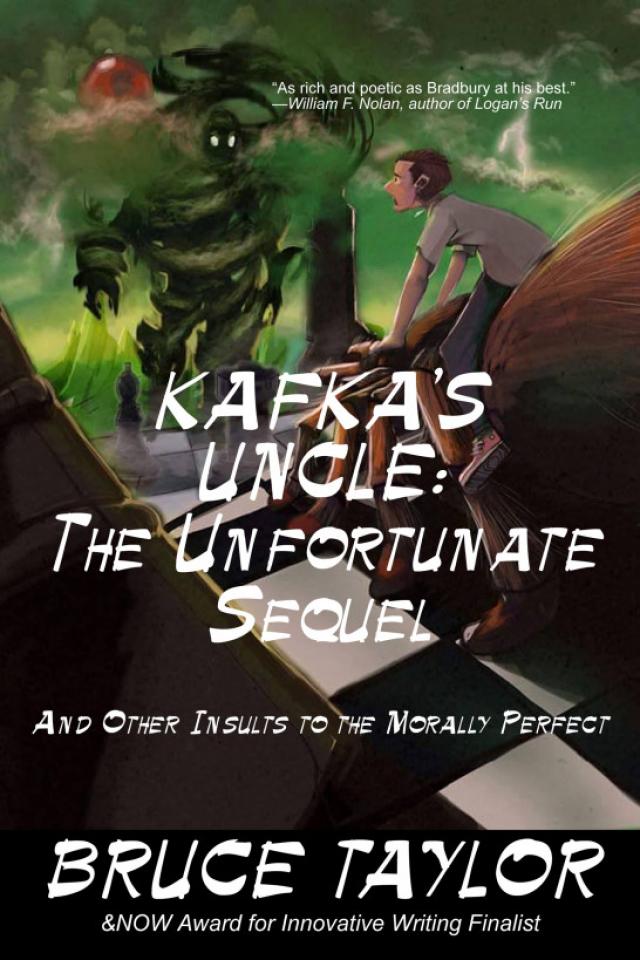
KAFKA'S UNCLE: THE UNFORTUNATE SEQUEL
AND OTHER INSULTS TO THE MORALLY PERFECT
by
BRUCE TAYLOR
Produced by ReAnimus Press
Other books by Bruce Taylor:
Kafka's Uncle and Other Strange Tales
Kafka's Uncle: The Ghastly Prequel
Edward: Dancing on the Edge of Infinity
Magic of Wild Places
Mountains of the Night
© 2016 by Bruce Taylor. All rights reserved.
http://ReAnimus.com/authors/brucetaylor
Cover Art by Jyreme McMillon, with thanks to William Box for procurement of work
Smashwords Edition License Notes
This ebook is licensed for your personal enjoyment only. This ebook may not be re-sold or given away to other people. If you would like to share this book with another person, please purchase an additional copy for each person. If you're reading this book and did not purchase it, or it was not purchased for your use only, then please purchase your own copy. Thank you for respecting the hard work of this author.
~~~
To William F. Nolan, fine friend and great writer. I cannot thank you enough for your generous words about my writing (particularly the collection, THE FINAL TRICK OF FUNNYMAN) That you would compare some of my work to Bradbury is most humbling and deeply appreciated. Thank you!
And to Jason and Sunni Brock: DARKE PHANTASTIQUE is an incredible and stunning tour de force. And that your exposure to magic realism via being published in LIKE WATER FOR QUARKS so intrigued you and played such a part in DARKE PHANTASTIQUE and that you recognized and published my work in that amazing book—honored I am, but more: delighted that you found magic realism so worthy of your attention and so applicable to horror. How grand for all of us who seek new paths of imagination and expression. Thank you!
~~~
Table of Contents
Chapter 1
Chapter 2
Chapter 3
Chapter 4
Chapter 5
Chapter 6
Chapter 7
Chapter 8
Chapter 9
Chapter 10
Chapter 11
Chapter 12
Chapter 13
Chapter 14
Chapter 15
Chapter 16
Chapter 17
Chapter 18
Chapter 19
Chapter 20
Chapter 21
Chapter 22
Chapter 23
Chapter 24
. . . and other insults to the morally perfect
Dusk's Mirror
Snata Claws
Speculations About the Picture of the Man
The Strange, Strange Journey of Mr. N.
Justice in Amerry - Ka
The Box
The Deal
Martian Dreams
The Prey
Of Dinosaurs and Daisies
The Lift
On The Trail
Visitor
Of Diamonds and Facets
Well?
Beast Dance
Charles Out of La La Land
A Child's Christmas in Seattle
Of Tunafish and Galaxies
Four Dreams In Miniature
Out Here
Neptune Blues
Of Ghosts and Good - Byes
City Streets
Acknowledgements
About the Author
Chapter 1
Anslenot In Ruptureland: Choosing not to choose
Beyond the ice mountains, into the regions . . . beyond the ice, Anslenot sails high, high over a vast, white plateau. Slowly the bucket begins to descend and finally, and unceremoniously, hits the ice, skids, topples. Anslenot is dumped out onto the frozen surface. He rolls, then coming to rest on his back, he opens his eyes. White, he thinks, everything is white. The sky is white, my breath is white.
Glancing over to the bucket, he watches as it becomes covered in a thick coating of hoar frost. Everything is white, he thinks again. He pauses to wonder why he isn’t cold. Maybe I’m dead, he thinks, maybe I’m too numb to care. He hears a distant buzz, then sees something entering his field of vision from the extreme right. He stares. A giant dirigible comes into view. Painted red, white and blue, it slows down, and putters about overhead as if Anslenot has become an object of intense scrutiny, curiosity and interest. Anslenot continues to stare at the dirigible and is somehow reminded of the 1930’s German airships, the Graf Zeppelin and the Graf Hindenburg. Abruptly, he sees a window slide open in the gondola and someone dumping out garbage and leaflets. Between apple cores, styrofoam cups, feces, orange peelings, rotten carrots, he also sees flyers fluttering about him with simple, declarative sentences: “You are with us or you are agin’ us,” “Ignorance is strength,” “Juden Go Home,” “Only good Injun is a dead Injun,” “Freedom is slavery,” “Freedom is on the march,” “Liberty and Justice For All,” “Coloreds Only,” “Slant eyes,” “War is Peace.” The garbage and flyers snow down on Anslenot and soon he is literally buried beneath a pile of rubbish. He holds his breath; the stench is overwhelming and he desperately and simultaneously wants to breathe and throw up. Wildly, he thrashes about and manages to get out from beneath the trash, and looking up to the sky again sees the dirigible puttering away, continuing to dump out flyers and garbage as if having a bad case of existential diarrhea.
“Whoo, messy.”
Anslenot, now in a sitting position, turns around. The tarantula is back.
“What a mess, eh pardner?” says the spider.
Anslenot, stupefied, just stares, and finally is able to say, “Wh—what are you doing here?”
The tarantula comes closer, squats and regards Anslenot with its eight eyes. “Got lonely,” it says.
“Where are we?”
“My guess,” says the tarantula, “is that we’re in the regions beyond the ice mountains.”
Anslenot is suddenly aware that the numbness has abruptly left and he does indeed feel the cold. He blows on his hands. “Where’s that?”
The tarantula doesn’t say anything for a minute, but then finally says, “You can guess. You can guess or I can tell you and you can have your worst fears confirmed immediately.”
“I have a choice?”
“Of course you have a choice.”
“What choice do I really have?”
“What choice do you really want?”
Anslenot shrugs. “I guess the best choice.”
“What if there is no best choice?”
“Then there is no best choice. Then what?”
“So you choose given the choices you have.” All eight of the spider’s eyes focus on Anslenot.
“What if I choose not to choose?”
“Your choice.” The tarantula’s voice is matter of fact, as if talking about the stock market or socks and underwear for sale.
Anslenot blows on his hands again. “So I can choose to guess where we are or I can choose to have my worst fears confirmed. That’s it.”
“That’s it.” As if to emphasize, the tarantula spits. “But,” the tarantula continues, “there may be another choice after all.”
Anslenot stares at the spider, to the eight eyes, and cannot fathom what he sees. At last he says, “You said there weren’t any other choices.”
“Did I say that?” says the spider.
“You did. Are you choosing not to remember?”
The tarantula continues to squat there, saying nothing for a few minutes.
Finally it says, “I’m choosing to say nothing.”
“That’s impossible,” says Anslenot, “you just said something.”
“It’s how you choose to interpret it. Your fault. But that’s beside the point.” The tarantula lowers itself as if sharing a guilty secret. “You may have a choice in how you think about all of this.”
“What’s that?” says Anslenot, looking warily at the spider.
“You can choose to be unaware and unconscious.”
Anslenot nods. “I like that.”
“So be it,” says the spider.
“And I can always come back to where I am right now by choosing to become conscious and aware of the choices I can make and no harm will be done.”
“Never said that,” says the tarantula.
“I choose not to hear that,” says Anslenot, getting to his feet. He picks off the worst of the garbage but the flyers are sticky on one side and he cannot peel them off so easily. Looking like a walking poster board, Anslenot surveys the scene.
“Like a ride?” says the tarantula.
Anslenot says, “Sure,” and he climbs aboard his existential horror pony and they start off. “Where are we going?” he asks.
“Your choice,” says the arachnid.
“Go,” says Anslenot.
“Where?” asks the tarantula.
“Don’t know,” says Anslenot, “just go.” He manages a smile. “Your choice.”
Without saying another word, the tarantula starts walking.
Chapter 2
The Dreamscape
Anslenot realizes that he is tired. The undulating movement of the tarantula makes him tired. So tired, so sleepy.
“You should probably go to sleep,” says the tarantula. “You must be tired.”
“Yes,” says Anslenot, “I must be tired.”
“You are very tired,” says the spider.
“Yes,” says Anslenot, “I am very, very tired.”
“Sleepy.”
“Ver y sleepy.” The undulation of the spider, the bland whiteness of the snowscape, and for some incomprehensible reason, Anslenot feels a warmth.
“I bet you’re feeling warm,” says the tarantula.
“I do feel warm,” says Anslenot. He looks down to his stained trousers, his dirty, threadbare jacket. He shouldn’t be warm. But he is.
“I can’t be making you warm,” says the spider “We arachnids are cold blooded.” And, after a pause, it adds, “Cold—blooded indeed.”
Drifting into a deeper sleep, Anslenot says, “I know this. I don’t know why I am warm. And sleepy.”
“And sleepy,” says the spider. “Very sleepy.”
Anslenot feels his chin suddenly touch his chest and—he’s gone. He hears the spider as if from a place a long, long way away from where he is: “ . . . choose carefully, choose so carefully. Choose a dream but choose carefully . . . “
. . . all the ways to choose, thinks Anslenot. All the freedom to choose yet how do you choose given that you can’t know all the choices available, what the consequences at any given time—the gentle undulation of the spider, the warmth, and he goes deeper.
“ . . . deeper,” says the tarantula, . . . just—go deeper. The rocking of the ride, the sound of my voice . . . “
Anslenot thinks, . . . since when could spiders hypnotize? How can I trust this—but he helped before . . . suddenly a scene comes to him, a scene of himself on a bluff overlooking an ocean. The flowers around him are red, the sun, white, the sky, the ocean, blue. And as he looks around, those are the only colors he sees. He senses movement, and turning, sees the spider, wearing a floppy hat with alternating red, white and blue vertical bands of color. He hears the spider sigh, “We have met the enemy and he is us.”
“Pogo,” says Anslenot. “Walt Kelly.”
“Correct,” says the tarantula. “And can you guess who said this? ‘Those who do not remember the past are condemned to repeat it’?”
“Santayana,” says Anslenot.
“You’re doing well.”
“Thank you,” says Anslenot. He turns away. e, but seated upon it, dressed in red, the blue eyes calculating, the hair so white—
“Stalin—” says Anslenot.
“Yes,” says Stalin, “yes, I said that.”Then he hears, “And who said this? ‘Those who cast the votes decide nothing. Those who count the votes decide everything’.”
Anslenot glances back. The spider is still there. But seated upon it, dressed in red, the blue eyes calculating, the hair so white——
“Stalin——” says Anslenot.
“Yes,” says Stalin, “yes, I said that.”
Then he hears, “Sleep. Sleep. Just sleep. And forget. Forget it all.”
The vision vanishes and Anslenot, in his sleep, asks, “Wh—why are you having me remember this—know this if you want me to forget it?”
“. . . fun. . . “ comes the voice of the spider. “ . . . fun . . . how much are you willing to give up your perceptions to listen to the perceptions of others so that their opinion becomes yours?”
Anslenot drifts and asks in his sleep, “. . . why. . . why would I want to do that . . .”
“ . . . don’t have to think. Don’t have to know. Don’t have to take responsibility. All you have to do is . . . sleep. . . “
“. . . sleep,” whispers Anslenot. “. . . sleep. How do I—sleep.”
“Apparently quite well.”
“Yes,” says Anslenot, “yes—I—” He goes deeper asleep. Then he has a scene open before him. He sees a chorus line of men, dressed in pink ballerina tutus; some of them are bearded, some balding, one on the end has a bottle of Moosedrool beer in his hand; they dance to the music from the musical, A Chorus Line and as they kick out, their booted feet connect with boys and girls, children, dressed the same way. Some of the children cry, others turn about in rage and the fathers look to each other, with surprise, like they just can’t figure out why the kids are crying. And suddenly, in Anslenot’s mind he can hear them: “What’s wrong with Billy?” “I don’t know.” “I don’t know why Samantha is upset.” “Kids.” “God knows.” “Treatin’ ‘em no different than I was treated.”
The chorus line of males turn and, facing a chorus line of women, some dressed as men, some women, obviously having been beaten up or God knows what else, dressed in straitjackets, the chorus lines, facing each other, kick the crap out of each other. And Anslenot can hear the women: “He’s just like that.” “He’s just had a bad day.” “He didn’t mean it,” and then Anslenot hears the men: “Must be her period.” “What a bitch.” “Just like her mother.” “Don’t know what her problem is.” And then he sees the children run into the middle of the melee and he can hear their voices, “Mommy, Daddy, don’t fight! I’ll be good.” “Don’t leave me!” and “I know it’s my fault! Please stop hitting each other.”
Anslenot stands back and watches children being kicked and flying through the air, hears the smack of fists against faces, feet into ribs, the cracking of bones, the tearing of clothing—and soon—all that’s left are two rows of raw and bloody hamburger, mingled with shreds of clothing and small blobs of shuddering flesh over here, over there.
In horror, Anslenot steps back. Distantly he hears, “. . . just sleep deeply—”
In the dreamscape, Anslenot says, “How can I sleep, seeing this?”
“Everyone else sleeps seeing this. Why not you?”
“How can I sleep knowing this?” says Anslenot.
“Everyone else sleeps knowing this,” comes the reply, “why not you?” A pause. “Just relax. This is normal. Just go deeper, deeper asleep.”
Anslenot fights the urge, but succumbs—
Chapter 3
Dreamscape 2
—and so succumbing, Anslenot goes deeper and wonders distantly about the strangeness of sitting on a tarantula, in the middle of a featureless and icy world, going into a spider—induced hypnotic trance. He remembers, distantly, about false memories but knows that these are coming from him, and he’s at once assailed by the disappointment that these aren’t false memories, yet he has a strange sense of freedom that he knows that what he sees does come from him yet he’s frightened that if it does come from him, what does it mean?
As if able to read Anslenot’s mind, the tarantula muses, “What does it mean, indeed? Indeed, indeed, what does it all mean? Such a mys—hiss—tory.”
“—I don’t want to—” whispers Anslenot. Something black and vile moves within him. “I—I don’t want to—”
“You don’t have to . . .” comes the voice. “Your choice.”
“I can’t—” whispers Anslenot.
“You can,” says the tarantula.
“I want to come out—”
“Then come out.”
“I can’t—choose—”
“Maybe something is choosing for you,” comes the silky whisper of the spider.
Anslenot sits on the tarantula, the sky is white, the white snows stretch level and far away and Anslenot sits, chin to chest, there, but everywhere, still, but moving, conscious but so unconscious, courageous but so afraid, wanting to come back out but so needing to go deeper in. He whispers, “What part is choosing for me—”
“Don’t know,” comes the voice, “what part chooses for you—”
Suddenly, Anslenot drops onto a chess board. He looks about. Then, kneeling, he places a hand on the black square on which he kneels. It’s cool to the touch. Marble, he thinks, black and white marble squares. He stands, looks around. A black king is checkmated in a corner by a gleaming white bishop and knight. The king looks beseechingly at Anslenot. “Can’t help you, son, I’m stuck. Victim of bad choices, bad moves.”
The bishop and king look at Anslenot. “We can’t help either. We have to stop this Black Menace—or is it Yellow Peril? We don’t know, nor do we know why we are doing this. We just must. Duty and obligation over conscious choice and free will, though on some level, we did choose what we are. Now we’re stuck, however conscious or unconscious that may be.”
Anslenot is about to ask what it is he needs help from and then he sees Something. The blue sky above abruptly clouds over, the sunlight grows dim and a cold wind blows and a twilight comes on. In the distance, funnel clouds drop, lightning rips the sky and Something steps onto the chessboard. Anslenot feels his hair rise on his neck, his heart racing and a feeling of lightheadedness. His mouth becomes dry and he hears, “I am your nemesis. I am your nightmare.”


