

Warhammer vermintide, p.15
Warhammer - Vermintide, page 15
part #1 of Warhammer: Vermintide Series
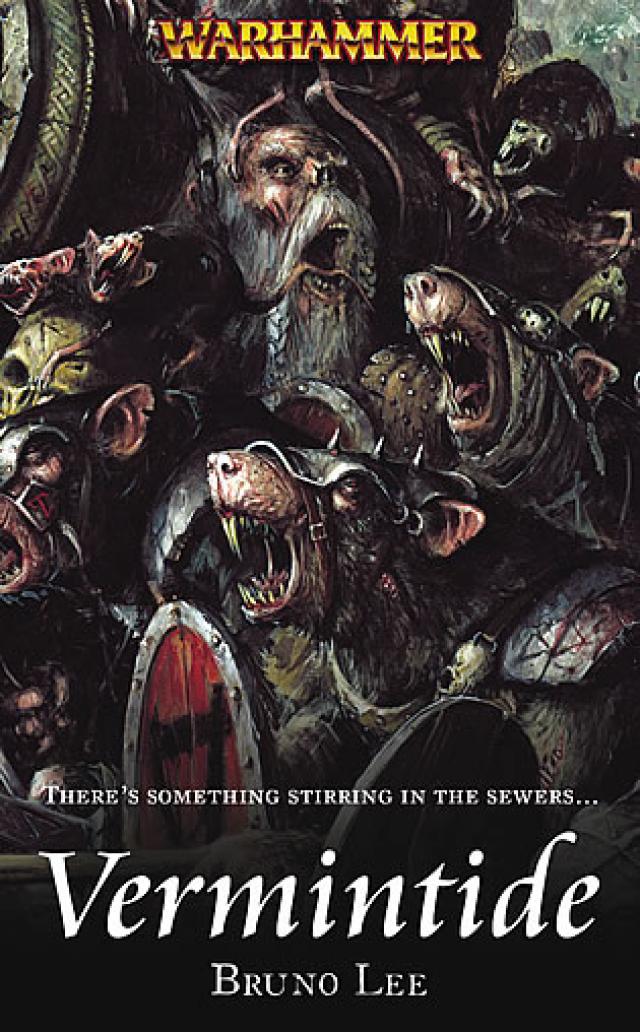


In happier times, when the kingdom of the dwarfs had been at its height, Peak Pass had been an important trade route and Karak Kadrin a place where goods from the western dwarf settlements might be bartered with those of their eastern cousins. But such pleasantries were but a distant memory recorded in the dwarfs’ Book of Grudges. Darkness had swept across the land, the shadow of gods malevolent and obscene. The dwarf settlements along the eastern border of the mountains had fallen, the lands beyond them decaying into a vast realm of death. Hordes of orcs and goblins had swept out from the wasteland to devour the holdings of the dwarfs, thwarted only by the mountains; But there was a hole in the jagged wound of Peak Pass, a place wide enough to move an army at speed, passing deep enough through the mountains to leave the civilised world at the mercy of its timeless foes from beyond.
Karak Kadrin had adopted the role of fortress and bulwark, in place of its former role as a hub of trade and commerce. The walls had grown thicker, the gates stronger. When Heiko first laid eyes upon the towering steel doors that guarded the main entrance into the cavernous city, he had felt diminished. How could his race boast of their accomplishments, of mighty castles and grand cathedrals, when the dwarfs had been capable of such colossal feats of architecture back when men still made their forts of mud and spit? Even Erwin seemed in awe of the overwhelming magnificence of the fortress. The main hall alone seemed to have enough stone blocks fitted into its floor to build another Altdorf.
High overhead, Heiko could see the arched ceiling dwindling into the gloom. He could feel the weight of the mountain pressing down upon him, the air growing heavy as he sucked it into his lungs. He could see that Erwin, too, was discomfited by their surroundings. Looking at their escort of trollslayers, however, Heiko saw a very different change. There was a carelessness in their manner that Heiko hadn’t noted before. Perhaps that was the biggest difference between man and dwarf: a dwarf actually enjoyed the feeling of a mountain pushing down on his head.
The city itself branched off from the great hall, its numberless tunnels extending deeper into the mountain. Thogri explained that some of them led to enormous forges where iron ore and copper from the mines beneath the city were smelted into steel and bronze. Other tunnels led to vast smithies where steel and bronze were beaten into axes and armour, others to the artisans and craftsmen who painstakingly etched and engraved the work of the smiths, endowing even the simplest axe with the most fabulous adornment. The greatest weapons and armour were taken to the rune priests in the temple district, where some might be marked with mighty runes of power, ancient letters that carried potent magic.
As Thogri described the layout of the city, Heiko likened him to a proud father. He found his eye draw again and again to the dwarfs who shot questioning glances in their direction. Many wore armour and had the look of soldiers about them, but he also saw fur-clad trappers and hunters, soot-stained workers from the forges, or grimy miners with lanterns swinging from their belts. He even saw a few women, squat, broad shouldered dwarf ladies with plaited hair and plump faces. Occasionally they passed other slayers, grimly fanatical figures who sometimes nodded respectfully to Thogri and his companions, but who might also stride past them in silence, their minds fixed upon whatever shame had brought them so low.
As soon as they had set foot within the city, Heiko noticed its air of sorrow. The beards of most dwarfs they saw had been stained a chalky black, he guessed with soot or ash. The women had laced black beads into their hair. The slayers had left their beards dyed red, but had laced black beads into them. So gripped was he by this strange custom that he asked Thogri about it, before he had time to consider that the question might be indiscreet.
“They are in mourning for the War-mourner,” Thogri replied. “The men stain their beards black to display their sorrow. The women have no beards to show their honour, so they string beads through their hair.” Improbably, Thogri’s voice seemed to grow grimmer. “A slayer’s beard has no honour, just as a slayer can have no honour. A slayer can show his sorrow only at the Shrine of Grimnir, by begging the priests to give him beads, that he might string them through his beard like—like a woman.”
The smouldering fire in Thogri’s eyes suggested to Heiko it would be prudent not to press him further. There were no trolls or giants around to deflect his anger.
The slayers left the two men in the great hall before continuing to the Shrine of Grimnir. Before he left, Thogri pointed a hand in the direction of an inn where the two men would be able to find lodging. He also promised to pass word on to the court of Karak Kadrin’s ruler. Over the course of their journey through the mountains, Heiko had told the slayers their story, but the keen interest of the suicidal dwarf warriors was far from comforting.
The inn was situated in a vast tunnel branching off from the Great Hall. Like all the dwarf buildings they had passed, it was built into the tunnel wall itself, carved from the rocky flesh of the mountain. The stout innkeeper, a gruesome-looking dwarf with a bronze rod where his right leg should have been, was not overly interested in whatever tales Heiko had to spin. Only the colour of gold was going to secure the men a room. The innkeeper gnawed at the Imperial crowns, his black teeth chewing on the metal. Then he nodded, motioning for a grubby-looking young dwarf boy to show the two men to their room. Apparently, human guests weren’t unknown in Karak Kadrin. They were given long beds and tall chairs. It was a respectable enough place in which to wait, and, with his wide experience of Imperial courts and politics, Heiko expected that their wait would be a long one.
It turned out that Heiko was wrong, though he was hardly going to complain. It was on the very next day, in the early hours of morning that the men were awakened by their peg-legged host who conducted a messenger from the king’s court. They were to follow the messenger back to the court of Ungrim Ironfist.
Heiko thought he was growing accustomed to the intimidating architecture of the dwarfs. The reception hall put the lie to such beliefs. The gigantic columns that rose from the floor were wider around than most of the buildings in Waldenhof, stretching upwards in great pillars of rune-etched marble until they vanished into the gloomy darkness far overhead.
The court of Ungrim Ironfist was assembled about a set of immense stone tables arrayed to form an enormous “U”. Heiko gasped to himself at the wealth displayed by the dwarfs in their gold pectorals, jewelled rings and silver armbands. Guildmasters, runepriests, engineers, it seemed that the elite of the entire city was assembled within the hall. And yet, mixed in among their number was a small group of grubby, barbaric-looking dwarfs, the table they occupied set apart from those of the others. As Heiko was conducted toward the assembly, he caught the eye of Thogri Ironbelly, regarding him from the table where the slayers were allowed to sit. The dwarf’s beard was plaited with black beads now, though little had been done to attend the injuries sustained fighting the Chaos trolls.
At the head of the tables, flanked by his closest advisors, was the golden throne of Ungrim Ironfist, the almost legendary Slayer King of Karak Kadrin. The king wore black robes, their edges picked out in silver thread designs almost as esoteric as the sorcerous symbols of Erwin von Fautz’s robes. The king’s humble raiment was at odds with the massive, horned helmet he wore, a golden crown encircling its bejewelled surface. More disconcerting was the mane of hair, dyed the same bright orange as the spiked crests of the shaven-headed slayers. The king’s face was as harsh and brutal as that of any mountain, and his beard, for all the gold rings that bound it, was dyed the same vivid hue as that of the lowliest slayer.
Heiko could feel the authority of the king as he stepped forwards, but could also see the pain and loss that shone in Ungrim’s eyes, a hurt too deep even for a king’s might to conceal.
One of the dwarfs seated beside the king stood up. He was impossibly ancient-looking, his long white beard of such length that it was tucked beneath the silver belt that circled his waist. The old dwarf motioned for the men to stop. He lifted his voice, saying something in the guttural Khazalid tongue, clearly intended for the assembled dwarfs. Then he looked once more at the two men. “Word has reached the ears of His Highness that you desire audience with him.” Heiko could not be certain, but it seemed the old dwarf’s voice carried with it a trace of derision. “That you bear tidings of some new peril that threatens the Empire of men.”
“Not the Empire alone,” Heiko interrupted, drawing scowls from some of the seated longbeards and a sharp, drunken laugh from where the slayers were seated. “This threat is one that endangers both our lands. It will not trouble itself about where one ruler’s dominion ends and where another’s begins, nor will it spare its attentions from either dwarf or man.” Heiko wished he knew more about the proprieties involved in exchanges with dwarfs, not least with one of their kings. But he knew they were direct and blunt in their speech, with little patience for perfumed words and empty flattery.
The old dwarf’s face fell into such a scowl that Heiko found himself wishing the beard covered more of it. There was no mistaking the contempt in his voice when next he spoke. “Why is it that our allies always find their problems are also ours? Our lands are already imperilled; we have no need to march far to take battle to our enemies. The ruin of Vardek Crom’s army hides in our mountains. The obscenity,” the long-beard paused, making some warding sign with his fingers, a gesture Heiko had seen dwarfs invoke before when someone mentioned the restless dead, “walks unhindered in the plains beyond the foothills. The grobi burrow their way into our mines. We have enemies enough to test our axes, we have no need to seek more.”
“With all respect,” Heiko said, fighting to maintain calm, “this is not an enemy you can ignore. Will you wait until the skaven are gnawing at the gates of this city? Will you wait until it is too late?”
“Enough!”
Heiko flinched as the deep voice boomed through the hall. Even the longbeard seemed taken aback, hastily bowing his head and wilting down into his seat. The pained eyes of Ungrim Ironfist settled upon those of Heiko like a hawk dropping upon his prey.
“This court has heard such words before,” the king said. “Your countrymen stood where you stand now and warned of the mighty armies of the north that ravaged your land. Even as we fought our own battles, they asked for our help and we gave it to them. We gave them the War-mourner.” Heiko could see the king’s hand trembling before it smashed down upon the stone surface of the table. “We gave your people everything honour demanded of us. We will give no more while we have our own battles to fight.”
“But it will be!” Heiko protested. “I have read the histories. I know of the long and terrible wars the dwarfs have fought with the underfolk.”
“This time it is not our fight,” Ungrim repeated in a voice of steel. The king looked away from Heiko, gazing instead at the smaller table where the slayers were seated. “Tell him,” the king commanded. One of the slayers slowly extracted himself from his seat. He was immensely muscled, his shoulders almost impossibly broad. His short beard had been left white, though the black beads woven into it left no question that he was a slayer, as with the crest of brightly dyed hair that stood from the slit in his leather cap. Heiko was surprised to see a double-headed Imperial eagle standing out among the swirling tattoos that marked the dwarf’s body.
The slayer took one last pull of the brew that filled the leather jack he held, then fixed his eyes on Heiko and Erwin. When he spoke, it was with such an accent that it took Heiko a moment to realise he was indeed speaking Reikspiel and not some peculiar Khazalid dialect. “Ah had a look on that rune ye give tae Thogri here. Ye ken it said ‘rat’ or some such, eh? Weel, it dinnae. It’s an auld rune, an’ it means ‘skaven’.” The slayer’s lip twisted into a sneer of disgust. “No joost any skaven, though. This rune means a very particular type o’ skaven. ‘Clan Skryre’ it means, an’ I fancy tha’ they be some sort o’ engineers.” The slayer’s words caused the dwarf engineers in the room to mutter angrily into their beards.
“You say these ratmen are engineers?” Heiko asked. Though he’d read about the horrible weapons the skaven were able to craft, his mind still resisted the suggestion that the creatures were capable of such things. “Why would they need to steal from others if they can simply build their own weapons?”
The question brought strained laughter from some of the dwarfs, more oaths and curses from others.
“Ye got lots tae learn aboot skaven, big man,” the slayer told him. “They steal from anywin and everywin ’cause they’re too lazy tae make their own. Ain’t clever er innovative enough tae figure things fer theyselfs. They tak from others an’ they twist it aroun’ intae sumthin’ nasty an’ horrible.” The slayer paused, lifting his hand to his head, scratching at his scalp where it stood exposed from the slit in his cap.
“Noo, it seem tae me that this time sumthin’ peculiar is in the works. An’ ye can believe Malakai Makaisson seen enough o’ the skaven tae say that lightly.” The dwarf stepped away from the table, staring hard at the cluster of dwarf engineers sitting to the right of the king. “Ah telt ye that this felt wrong.” Makaisson pointed at Heiko. “The big man here said the skaven stole one o’ our guns from this museum. I’ve been in that place, an’ there’s more there than joost one gun. Why’d the, skaven joost take win gun when they could o’ skittered off wit a dozen? They dinnae even so much as look aet that steam tank whit they got there!”
“Are you saying you have some idea why the skaven stole just that particular gun?” Erwin asked.
Makaisson nodded. “I do,” he stated. “They were after sumthin’ built by dwarfs, but sumthin’ built by dwarfs whit wae light enough fae whit they need it fae.”
Heiko felt his pulse quicken. For weeks now he’d been racking his brain, trying to come up with some idea of what was behind the thefts. Now it seemed this strange-speaking dwarf had put the pieces together and come up with a notion of what the ratmen were up to.
“Why would the weight of the gun be important to them?” Heiko asked. Makaisson chuckled darkly.
“Ye sade they stole canvas an’ a bellows, rudders an’ bits from win o’ our steamships. It sounds tae me like they’re buildin’ some sort o’ airship.”
The dwarf’s remark provoked a commotion from several dwarf engineers who were clearly not convinced, but the glowering gaze of their king soon caused them to fall silent. “Aye, ah said an airship!” Makaisson repeated. “They tried tae steal ma ship an’ couldnae do it, so noo they got the notion tae build their own.”
Heiko shook his head. An airship? He’d heard stories about the dwarf airship that came to the aid of Praag during the most recent attack upon the Kislevite city, but he’d never credited such tales with much credibility. To hear the dwarfs discussing such a wonder of engineering was a marvel, but to hear Makaisson’s words about the skaven building their own was chilling beyond description.
“From what I understand, these monsters can make their own weapons,” Heiko pointed out.
“Aye, bloody good ones, tae,” Makaisson conceded reluctantly, stroking what looked like a burn scar across one of his biceps.
“Then why would they go to such lengths to steal these things? I mean, they would have crossed the length and breadth of the Empire to gather every thing they’ve stolen. Surely it would have been much faster to build their own?” Heiko clutched at the argument like a drowning man grasping at the slippery shore. He couldn’t believe the skaven were building an airship. It was too loathsome to contemplate.
The slayer was silent for a moment, glancing in the direction of the engineers. “I’ve given that a fair bit o’ thinkin’ tae. Skaven dinnae like fightin’ their own fights. They like tae get others tae do the fightin’ fae them an’ then sweep in an’ kill both sides. It’s some ratty divil behind this, ye ken be sure o’ that. He’s making the airship look like it were dwarf work! No doubt tae fool yer people. No dwarf wudae be tricked by such.”
“Then it is your problem!” Heiko protested. He explained the history of Waldenhof, and Rudolph’s intense hatred of dwarfs, his unending attempts to force his brother to muster the Stirland army against them. It was all so clear now: the skaven would attack Waldenhof, making it look as though the dwarfs were responsible. In retaliation, Rudolf would lead the army into war. And afterwards the skaven would return and eradicate the exhausted victor.
“Karak Kadrin has stood for thousands of years,” the booming voice of Ungrim Ironfist reminded him. “Your arrogance is great indeed if you think any army of men could ever breach this city! If your people are witless enough to fall for skaven trickery, then they will suffer for it! We will not help you. The names of the Maeckler clan are not unknown to us, they are recorded in our Book of Grudges for the theft of Thane Orgri’s gyrocopter. Let the skaven have them, it is more than they deserve. Your elector count is not unknown to us either, and the Haupt-Anderssen clan is also named among our grudges. I would rather see this mountain crumble into dust than lift my hand to help faithless oathbreakers such as the Haupt-Anderssens! I have granted you this audience because your actions upon the mountain deserved some courtesy. Now you have heard our answer. Do with it what you will, for you will have no more aid from my people. This audience is at an end. Leave us now.”
Heiko had never felt more dejected, even when he was removed from the post of chamberlain and had his name dragged through the mud. He had come to the dwarfs with such desperate hopes, only to have them razed by their stupid, stubborn prejudices. It was not that they didn’t believe him, or felt the threat that the skaven posed was inconsequential. It was that they clung to old feuds and grievances, refusing to help because they felt they had been dishonoured by the rulers of Stirland.


