The ultimate dracula, p.1
The Ultimate Dracula, page 1


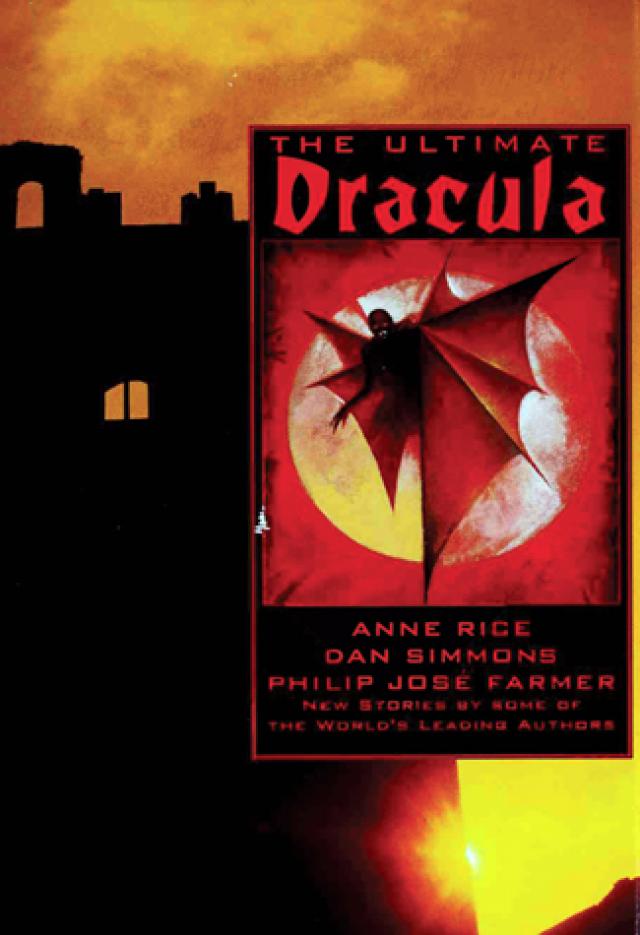
THE ULTIMATE
Dracula
Byron Preiss, Editor
David Keller & Megan Miller Associate Editors
Illustrated by David Johnson Book Design by Fearn Cutler
A Byron Preiss Book
Published by Dell Publishing
a division of Bantam Doubleday Dell Publishing Group, Inc.,
666 Fifth Avenue, New York, New York 10103
If you purchased this book without a cover you should be aware that this book is stolen property. It was reported as "unsold and destroyed" to the publisher and neither the author nor the publisher has received any payment for this "stripped book."
Design: Fearn Cutler
Associate Editors: David Keller, Megan Miller
Copyright © 1991 by Byron Preiss Visual Publications, Inc.
"Introduction" © 1991 Leonard Wolf
"The Master of Rampling Gate" © 1985 Anne O'brien Rice
"All Dracula's Children" © 1991 Dan Simmons
"A Matter of Style" © 1991 Ron Dee
"Selection Process" © 1991 Ed Gorman
"The Vampire in His Closet" © 1991 Heather Graham
"The Tenth Scholar" © 1991 Steve Rasnic Tem and Melanie Tem
"Nobody's Perfect" © 1991 Philip Jose Farmer
"Dracula 1944" © 1991 Edward D. Hoch
"The Contagion" © 1991 Janet Asimov
"Sugar and Spice and ..." © 1991 Karen Robards
"Vampire Dreams" © 1991 Dick Lochte
"Much at Stake" © 1991 Kevin J. Anderson
"The Name of Fear" © 1991 Lawrence Watt-Evans
"The Dark Rising" © 1991 W.R. Philbrick
"Los Ninos de la Noche" © 1991 Tim Sullivan
"A Little Night Music" © 1991 Mike Resnick
"Mr. Lucrada" © 1991 John Lutz
"In the Cusp of the Hour" © 1991 John Gregory Betancourt
"Children of the Night" © 1991 Kristine Kathryn Rusch
"Selected Filmography" © 1991 Leonard Wolf
All rights reserved. No part of this book may be reproduced or transmitted in any form or by any means, electronic or mechanical, including photocopying, recording, or by any information storage and retrieval system, without the written permission of the Publisher, except where permitted by law.
The trademark Dell is registered in the U. S. Patent and Trademark Office.
Printed in the United States of America
Published simultaneously in Canada
Leonard Wolf
INTRODUCTION: "Happy Birthday, Dracula!"
Anne Rice
The Master of Rampling Gate
Dan Simmons
All Dracula's Children
Ron Dee
A Matter of Style
Ed Gorman
Selection Process
Heather Graham
The Vampire in the Closet
Steve Rasnic Tem & Melanie Tem
The Tenth Scholar
Philip Jose Farmer
Nobody's Perfect
Edward D. Hoch
Dracula 1944
Janet Asimov
The Contagion
Karen Robards
Sugar and Spice And...
Dick Lochte
Vampire Dreams
Kevin J. Anderson
Much at Stake
Lawrence Watt-Evans
The Name of Fear
W.R. Philbrick
The Dark Rising
Tim Sullivan
Los Ninos de Lo Noche
Mike Resnick
A Little Light Music
John Lutz
Mr. Lucrada
Gregory Betancourt
In the Cusp of the Hour
Kristine Kathryn Rusch
Children of the Night
Leonard Wolf
Selected Filmography
HAPPY BIRTHDAY, DRACULA!
LEONARD WOLF
▼▼▼
There is probably no film image of fear as widely known and as profoundly frightening as that of the monster Dracula. Into most people's minds, when they hear the name spoken, there rises the image of Bela Lugosi in Tod Browning's 1931 film "Dracula." Nineteen ninety- one marks the sixtieth birthday of that film. It is an occasion for rejoicing.
Universal Pictures' "Dracula," though it has achieved immortality, is far from being a great film. It creaks, it stutters, it splutters. Because it follows the Hamilton Deane-John Balderston play, the film "Dracula" relies too heavily on what, at this distance, seem like corny comic interludes. But what the film has going for it is that it is unforgettable. More than that, it has the main thing: Lugosi's trade-mark rendering of the King Vampire.
The decision to put Lugosi in the title role has to be seen as one of the more brilliant casting choices in the history of film. Harry Ludlam writes:
There could hardly have been another actor with a background more superbly fitted for the role that was to stamp him for a lifetime. . . . Lugosi's cold, sepulchral voice; his deep-socketed, slightly almond-shaped eyes that stabbed out from the screen; his aquiline nose and high cheek-bones; his commanding height, over six feet, made him seem at once synonymous with Bram Stoker's fantastic creation.
[A Biography of Dracula, pp. 172-173]
But Lugosi had more than his appearance going for him. To this day, his Hungarian accent invokes all that is sinister to American ears, and the look in those almond eyes of his continues to tell us just how deeply his Dracula understands and is devoted to infinite evil.
With all of its weaknesses, the film has its moments of grandeur among which the opening sequence is surely one of the finest: we watch Renfield (in the novel, it is Jonathan Harker), the callow young English estate-agent, travelling by train to Transylvania and then from Bistritza by coach in search of Castle Dracula. We follow the progress of his coach as it climbs ever higher through a craggy landscape.
Then the camera gives us a glimpse of the castle, followed by a couple of quick cuts in which we see a hand emerging from a coffin; then, in a sort of languid snap shot, we catch a glimpse of the Count and his harem. Now, we cut back to Renfield, whose coach is approaching the Borgo pass. The coach stops; the driver, refusing to go any farther, unceremoniously dumps Renfield's luggage onto the road.
An instant later a coach, with a coachman whose face we cannot make out, appears. It is the Count's coach and Renfield obeys a signal from the coachman to get in. There is a lot of lurching and bouncing as the camera lets us see that there is a bat flapping over the heads of the horses, driving them. By contemporary standards, that bat, fake and fumbling beyond belief, is a pathetic attempt at a special effect.
At the castle, Renfield gets down from the coach. A creaking door opens and he moves to enter the castle while the camera roams over the ancient stonework revealing bats and whole draperies of spiderwebs—as well as a couple of armadillos! Then we hear Lugosi's voice, unctuous and sinister, saying, "I am Dracula," and we have heard the first unmistakable thumping beat of the Heart of Darkness.
And who can forget the delicious moment when Renfield, who has just drunk some of Dracula's fine wine, asks his host, "Aren't you drinking?" The question is followed by a long silence after which Dracula says suavely, and oh so ambiguously, "I do not drink . . . wine."
Another fine moment, unmatched in the subsequent hundreds of Dracula—or Draculesque—films, is the shot of Renfield laughing maniacally as he comes up out of the hold of the ship bringing Dracula to England. That laugh has never been duplicated. It is a "low, low chuckle beginning deep in the bowels and rising unwillingly through stages of pain until it leaves the mouth, bedraggled, helpless, lonely."
Where did that compelling image of the vampire on the screen come from? From what dark corner of history or the human mind did he emerge and how did he come to occupy the commanding place that is now his in the contemporary imagination?
To begin with, there really was a Dracula: a figure of flesh and blood named Vlad Tepes (pronounced Teh-pesh). Vlad, also known as Vlad the Impaler, was a Wallachian prince who ruled his Transylvania princedom at intervals in the years 1448-1476. The very first thing that needs to be said about him is that he was not a vampire. He was an ordinary mortal, with no trace in him of the supernatural. On the other hand, he was, as were many rulers of his age, supremely cruel. And it is his acts of cruelty that have mythologized him.
Vlad was very wicked indeed. His behavior both in defence of his homeland against the Turks and against his own people can only be seen as pathological. He is called "the Impaler," for instance, because of his practice of impaling his victims alive on long stakes and then leaving them to die a slow death. There is a well-known line drawing that shows Vlad at his favorite amusement which was to dine al fresco in the midst of a forest of such burdened stakes.
He had other sadistic whimsies. He is said to have executed six hundred merchants because they were too rich. His way of dealing with the problem of beggars in his domains was to invite the beggars to a banquet and then, at the height of the festivities, to set fire to the hall. On another occasion, when a couple of Turkish ambassadors refused to remove their turbans in his presence, he had the turbans nailed to their foreheads.
Ironically enough, Vlad is honored to this day in Romania as a patriotic figure, a symbol of Romanian nationalism, who fought valiantly against his Turkish overlords.
It was the figure of Vlad the Impaler that Bram Stoker, the ambitious Irish theatrical manager and hack writer (1847-1912), came upon in his readings in the British Museum and which he used as the basis for the novel Dracula that he published in 1897.
Stoker was fortunate in another way. Transylvania, Vlad's homeland, was (and remains) an intriguing exotic landscape. Transylvania (the name means The Land Beyond the Forest) was formerly a Romanian province. It is now divided between southern Hungary and northern Romania. Here is how Stoker, who was never there, describes it:
Beyond the green swelling hills of the Mittel Land rose mighty slopes of forests up to the lofty steeps of the Carpathians themselves. Right and left of us they towered, with the afternoon sun falling full upon them and bringing out all the glorious colours of this beautiful range, deep blue and purple in the shadows of the peaks, green and brown where grass and rock mingled and an endless perspective of jagged rock and pointed crags, till these were themselves lost in the distance, where the snowy peaks rose grandly.
Stoker's imaginary landscape is considerably more imposing than the real thing. Transylvania does indeed have mountains and rushing streams, but a traveller who has not had his or her expectations supercharged by a reading of Stoker will find the real landscape benignly beautiful. Life in the towns and villages of Transylvania has considerably more snap and vitality than one finds in the rest of Romania. What is chiefly missing in contemporary Transylvania is either much interest in, or knowledge of vampires.
Stoker, however, was the beneficiary of a fine amateur study of Tran- sylvanian folklore written by an indefatigable traveller, Emily Gerard. Gerard, married to a Romanian army officer, had a keen eye for detail and an attentive ear. Her book, The Land Beyond the Forest (1888), provided Stoker with the sorts of details a novelist needs to create verisimilitude. The Land Beyond the Forest is charming for its own sake and it continues to be indispensable for any student of Transylvania, of Stoker, or of vampire lore.
In the quiet confines of the British Museum, Stoker found the raw materials he needed for his fiction: a wicked nobleman, a country with a wild and exotic landscape and a bizarre folk tradition about vampires. He was ready to begin.
But first, because Dracula is a novel in the Gothic tradition, a few words about that literary genre may be useful.
The Gothic novel, so-called from the pervasive use by its authors of medieval stone locales (monasteries, convents, cemeteries, castles, ruins) enters English literature in the eighteenth century when Horace Wal- pole, in 1764, published his The Castle of Otranto.
Walpole, a middle-aged neurasthenic with a passion for medieval bric- a-brac that he housed in a fanciful structure of his own called Strawberry Hill, is usually credited with imposing on the genre its characteristic themes and design. The Castle of Otranto has, as Harry Ludlam has observed, doors with rusty hinges, a trapdoor, and lamps extinguish- able in a wink. It had a superb villain in Manfred, who, discovering his only son dead on his wedding morning— dashed to pieces beneath an enormous helmet—determined to marry his son's bride, Isabella, so that his line should not become extinct. His own wife, Hippolita, he planned to confine in a convent.
The Castle of Otranto is not what contemporary readers and hasty reviewers would call a good read. Its plot is frequently ridiculous and it lacks character development. Just the same, it is an enduring landmark on the landscape of literary history, and no one really interested in scary fiction can afford to overlook it.
Ann Radcliffe's The Mysteries of Udolpho (1794), and her even better The Italian (1797) are altogether more accomplished works which display all the characteristic marks of Gothic fiction. Each of them has a beautiful heroine of impeccable sensibility who is pursued by a tall, dark villain who intends to do her (primarily sexual) harm. To avoid a fate worse than death, the heroine flies from the villain and her flight takes her through a variety of dark, dismal and perilous places from which, at the penultimate moment, she is rescued by a handsome, well-bred and sexually unthreatening young man.
Radcliffe's novels are frightening despite her reliance on stereotyped characters and her unfortunate habit of de-mystifying her mysteries. What makes her stories work is the tension between her impeccable prose and the sexual horrors that are her real theme. We cannot quite shake the sense that "reason maintained in the presence of [so much depravity] can only be the face of madness frozen into a semblance of logic." (A Dream of Dracula, p. 157)
If the demon of incest is the horror glimpsed behind the decorous veil of Radcliffe's prose, it prances before us unashamed and undisguised in Matthew Lewis's The Monk (1796). Written in a ten-week rush, The Monk has all the urgency of an adolescent's vision of a sexual apocalypse as Lewis chronicles for us the progress to damnation of his master creation, Friar Ambrosio.
We follow Ambrosio, a thirty-year-old monk who is a paragon of virtue, as, step by step, he learns to do the devil's work. His malefic career begins with rape, moves through matricide and incest and ends in a terrific scene in the desert where the devil comes to collect Ambrosio's immortal soul. The demon grasps Ambrosio's skull in one of his claws and, flying upward, drops the monk from so appalling a height that ". . . the caves and mountains rang with Ambrosio's shrieks . . ." Ambrosio's body is battered among rocks, and is bruised by the rushing waters of the river below. He takes a long time dying as Lewis orchestrates the delay so that readers, who have been aching for Ambrosio to get his just deserts, can savour the retribution he has earned.
Charles Maturin's Melmoth the Wanderer (1820) is probably the greatest of the early Gothic fictions. Miltonic in the grandeur of its conception, Melmoth is an extraordinary tapestry in which is depicted a full range of the ways in which mankind can be a beast to man. Edith Birkhead, in The Tale of Terror, (p. 87) writes of Melmoth: "We are presented with sybils and misers, parricides, maniacs in abundance, monks with scourges pursuing a naked youth streaming with blood; subterranean Jews surrounded by the skeletons of their wives and children; lovers blasted by lightning . . And much much more. The novel is an elaboration of "the best theology—the theology of utter hostility to all beings whose sufferings may mitigate mine." As Maturin makes clear, with a theology like that, there is no need to search for hell. It is precisely beneath our feet.
Curiously enough, there are hardly any images of vampires in early Gothic fiction. The first vampire of note appears in John Polidori's novel, The Vampyre: A Tale (1819). Polidori, Byron's lover and physician, lived a short unhappy life and died a suicide at the age of twenty- six. The Vampyre is a wooden fiction without much literary merit. It does, however, give us the prototypical image of the nobleman vampire. His Lord Ruthven "was aloof, brilliant, chilling, fascinating to women, and cooly evil." (A Dream of Dracula, p. 163). The problem with Polidori's novel is that, unable himself to feel the power of the image he has invoked, he cannot create a prose exciting enough to engage his reader. The result is a work with the trappings of fear which moves, us, if it does at all, to a polite yawn.
Varney the Vampire (1847), on the other hand, is one of the world's most wonderful badly written books. Forget literature; forget prose style, forget characterization and settle for action, action, action, much of it violent and on occasion so prurient that it borders on pornography. James Malcolm Rymer's Varney is gorgeously bloodthirsty: "I was . . . ruminating what I should do, until a strange feeling crept over me that I should like—what? Blood!—raw blood, reeking and hot, bubbling and juicy, from the veins of some gasping victim." Varney's victims, one should say, are mostly voluptuous young women described in the full incandescence of their semi-clad nudity.