

Nightborn, p.1
Nightborn, page 1


Novels by C. S. Friedman available from DAW Books
The Coldfire Novels
BLACK SUN RISING
WHEN TRUE NIGHT FALLS
CROWN OF SHADOWS
NIGHTBORN: COLDFIRE RISING
The Outworlds
THIS ALIEN SHORE
THIS VIRTUAL NIGHT
The Magister Trilogy
FEAST OF SOULS
WINGS OF WRATH
LEGACY OF KINGS
The Dreamwalker Chronicles
DREAMWALKER
DREAMSEEKER
DREAMWEAVER
THE MADNESS SEASON
IN CONQUEST BORN
THE WILDING
* * *
THE DREAMING KIND
(available from csfriedman.com)
Copyright © 2023 by C. S. Friedman
“Dominion” copyright © 2012 by C. S. Friedman
All rights reserved. Copying or digitizing this book for storage, display, or distribution in any other medium is strictly prohibited. For information about permission to reproduce selections from this book, please contact permissions@astrapublishinghouse.com.
This is a work of fiction. Names, characters, places, and incidents are products of the author’s imagination or are used fictitiously. Any resemblance to actual events, locales, or persons, living or dead, is entirely coincidental.
Jacket illustration by Jeszika Le Vye
Jacket design by Adam Auerbach
Edited by Betsy Wollheim
DAW Book Collectors No. 1941
DAW Books
An imprint of Astra Publishing House
dawbooks.com
DAW Books and its logo are registered trademarks of Astra Publishing House
Library of Congress Cataloging-in-Publication Data
Names: Friedman, Celia S., 1957- author.
Title: Nightborn: coldfire rising / C.S. Friedman.
Description: First edition. | New York : DAW Books, 2023.
Identifiers: LCCN 2023012593 (print) | LCCN 2023012594 (ebook) | ISBN 9780756410926 (hardcover) | ISBN 9780698404403 (ebook)
Subjects: LCGFT: Fantasy fiction. | Science fiction. | Novels.
Classification: LCC PS3556.R5184 N54 2023 (print) | LCC PS3556.R5184 (ebook) | DDC 813/.54--dc23/eng/20230317
LC record available at https://lccn.loc.gov/2023012593
LC ebook record available at https://lccn.loc.gov/2023012594
First edition: July 2023
Contents
Cover
Also by C. S. Friedman
Title Page
Copyright Page
Dedication
Acknowledgments
Nightborn (Year 1)
One
Two
Three
Four
Five
Six
Seven
Eight
Nine
Ten
Eleven
Twelve
Thirteen
Fourteen
Fifteen
Sixteen
Seventeen
Eighteen
Nineteen
Twenty
Twenty-one
Twenty-two
Twenty-three
Epilogue (Year 2)
Dominion (Year 613)
For Joshua Starr,
unsung hero of DAW Books
First and foremost, thanks to my editor, Betsy Wollheim, and my copyeditor, Marylou Capes-Platt. The insights and suggestions they offered were invaluable. An author could not ask for better editors.
As always, my beta team provided valuable criticism, in addition to emotional support through some rough spells. That’s David Williams, David Huffman-Walddon, Carl Cipra, Cathy Deignan, Jennifer Eastman, and Jeszika Le Vye. Thanks, guys!
Deanna Briggs set up a Discord channel for me on Patreon and hosted events so I could meet my fans. We’re all grateful to you.
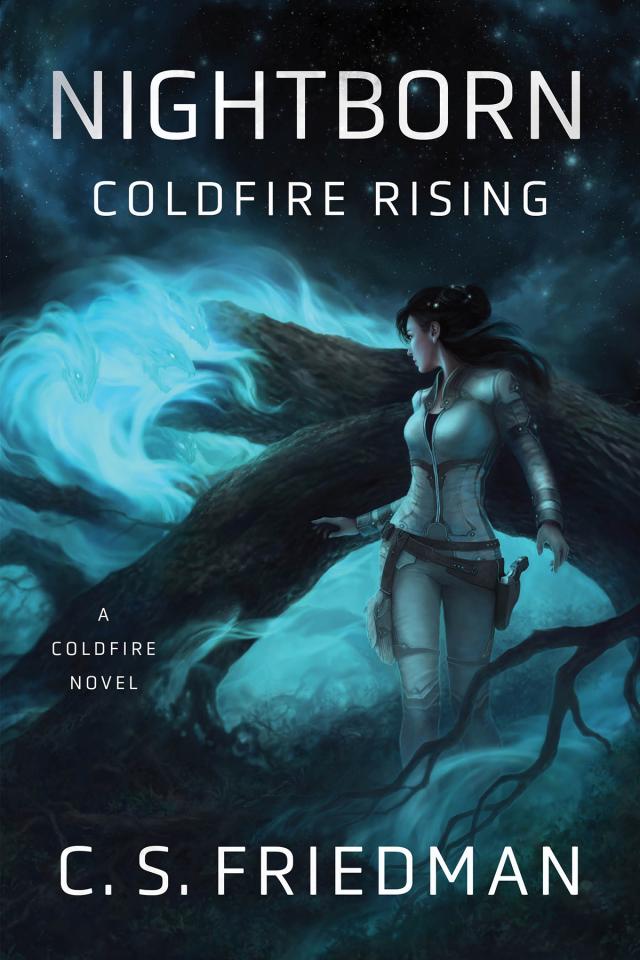
To Jeszika Le Vye, for Nightborn’s beautiful cover painting, my heartfelt gratitude. From the day I first saw it, it has served as inspiration for me. (Do check out the rest of her art at jeszika.com—it really is breathtaking.)
Thanks to those who have supported me on Patreon, including Ben Barlow, Kai Ellis, Natarajan Krishnaswami, Zora McBride, Matt Platt, Rebekah Russell, Toni Rose, Tim Rosenberg, and David Huffman-Walddon. Your support helped keep me going during a difficult year. And also to my readers on Facebook, who provided information and helped with creative decisions along the way.
A big thank-you to Jon Goff, who saved me from computer hell several times.
And lastly, extra special thanks to Kim Dobson, who gave me her computer when mine crashed the weekend before my manuscript was due, and Larry Friedman, who spent hours getting it set up properly so I could make my deadline. Without you guys I don’t know how I would have gotten this project finished. I love you both.
Where am I?
She floated in a void, only semi-aware, confused.
Who am I?
Darkness parted slowly, misty images appearing that she struggled to identify. Echoes of memory in search of context. Fragments of identity gathered and coalesced in her mind, fitting together like pieces of a puzzle. She blinked hard, trying to bring her vision into focus, and details of the world around her slowly began to take shape. She was in some kind of tubular corridor with a single human figure floating in front of her. Everything was washed in a dim, icy light that made the world look frozen.
She knew who she was.
She knew where she was.
The figure floating in front of her was a man, but the chill blue light robbed his dark skin of color, making him look more like a shadow-creature than a human being. “You awake?” he asked gently.
The last thing she remembered was going into stasis. How long ago had that been? It was hard to think clearly. She managed to nod and whisper, “Yes.”
The shadow-creature was coming into focus now: Leon Case, Colony Commander of the Erna exomigration. She remembered she’d almost slept with him, back in Orientation. She couldn’t remember clearly why she hadn’t.
“Name, origin, assignment?” he pressed.
“Annalise Maria Perez. From Phoenix, Arizona.” The final pieces of memory were falling into place now. “Chief medical officer of Erna Colony.”
She could make out details of the ship’s stasis chamber now, a long, tubular corridor lined with sealed pods, each with its own silent sleeper tucked inside. Two hundred men and women who headed out into the depths of space, trusting that somewhere in the darkness there would be a new world to colonize, never knowing where or when they would awaken. Now here they were. Ancient explorers on Earth had made similar voyages, setting out upon seemingly endless seas in the hopes of finding uncharted lands to claim. But those seas had been made of mere water, and those explorers had been awake to experience their journey. Her sea was comprised of darkness, frothed with starlight instead of waves, and the time required to cross it was so great that one could only do so in a sleep akin to death.
Not everyone who surrendered to that sleep survived it. Five percent of those who entered stasis never woke up. But that was a risk one accepted, to cross the sea of night.
“Are we there yet?” she asked. A child’s query, fishing for reassurance.
He hesitated.
His answer should have been yes. An easy yes, because the ship had been programmed to wake its passengers when a planet suitable for colonization was found, and not before that. So if Leo was awake, and she was awake . . . then there must be a planet, right? But looking at his expression—mouth tight, eyes narrow—she felt a spark of panic. Stories were told about colony ships that stalled out in the depths of space, and about the crew members who had to be awakened to try to save them. Those stories never ended well.
“There’s a planet,” he said at last. “Help me wake up the others so I can fill everyone in at once.”
It was a reasonable enough request, but the delay was frustrating. She focused on trying to release the straps that held her in place. Her motor control was returning, but slowly; he had to help her. Finally she was free, and she pushed herself out of the pod to float in the chill air of the ship. Her hand instinctively reached out for the nearest grip to steady herself. The reaching hurt. Everything hurt.
Leo waited until she was settled, then handed her a glowing tablet. “You wake the first four on the list. I’ll take care of the other five. We’ll meet in Observation.”
She looked at the names on the tablet and frowned. “This isn’t normal protocol.”
“No,” he agreed. His voice sounded tired. Strained. “But these are the people I need to talk to before anyone else wakes up.”
Again that spark of panic flared; this time it was harder to ignore. “Is something wrong, Leo?”
For a moment he didn’t respond. “We’re alive. The ship’s intact. There’s a habitable planet beneath us. That’s good enough for now.” He nodded toward the tablet. “Wake everyone up, then I’ll brief you all.”
He pushed off against a grip and floated down the corridor before she could ask him anything more.
Medics, engineers, data analysts: those were the people who were supposed to be awakened first. Medics to bring everyone out of stasis safely, engineers to confirm the ship was functioning as it should, analysts to review the data the ship had collected and identify any factors of concern. But there was only one engineer on Leo’s wake-up list, one analyst, and no other medical personnel besides herself. Looking at the names he had given her, Lise shoo k her head in bewilderment. Ian Casca was a botanist. Why would one of those be needed now, while they were still in space? Ted Carver was an ecologist, so the same question applied there. And Pravida Rakhi was a xenobiologist. Unless aliens had boarded the ship, what purpose could she possibly serve? All those people should have been stage two revivals, to be awakened when it was time to descend to the planet. Not now.
The last name on the list, Danika Lin, was the most concerning. She was the colony chaplain, a person whose job it was to offer comfort when things went wrong. Lise couldn’t think of any reason why Leo would need her awake right now unless something had, in fact, gone wrong.
Stop imagining disasters, she told herself. You’ll learn what’s going on soon enough.
All four of her subjects returned to consciousness successfully, which was a relief. Ted Carver grinned as he pushed himself out of his pod, laughing as he spun head over heels, fumbling to catch hold of a grip to stop himself. Like a happy child. When he finally managed to stop spinning, he winked at her. They’d all trained for weightlessness back in their home system, and those lessons had been serious enough, but now that they were out here, light-years from Earth, answering to no one but themselves, outer space was a private playground. She tried to smile back.
When everyone on her list was fully functional, they all followed behind her, swimming through the chill air like a school of fish, to the observation chamber. The viewports there were still sealed tight, armored for the journey, but Leo had switched the room lights on and turned up the heat, so at least it was more comfortable than the frigid stasis chamber had been. Lise imagined she could hear the ship’s hull groaning as its interior warmed for the first time in decades. Like them, the ship ached as it came back to life.
One by one the new arrivals found grips to anchor them. Leo smiled as he watched, but it was a strained expression that didn’t reach his eyes. The others were too distracted by the excitement of the moment to notice.
Finally they fell silent, and all eyes turned to him.
“The good news,” he said—and there was a hint of a genuine smile now—“is that we appear to have arrived at a habitable planet.”
Ted whooped, and others laughed and clapped and cheered. Lise just waited, watching Leo. His smile had faded, and his lips were tight once more. Not good.
“Well, can we see it?” Ted demanded, and Ian said, “The suspense is killing us!”
Leo held up a hand to quiet them. “Halos III turned out to be unsuitable for human habitation. It was smaller than Colony Control had predicted, and the atmosphere turned out to be too thin to support an open-air colony. So our seedship refueled and moved on, to search for a better planet.”
“Which it found,” Anna Jaziri said. She was the only programmer present. “Or we wouldn’t be standing here, right?”
“Floating here,” Ted corrected her smugly.
“It did,” Leo told them “but only after many tries. Each time it found a new planet it surveyed the ecosphere, sent down drones to take samples, and eventually decided it wasn’t right for us. So it used that sun to refuel and headed back out. Farther from Earth each time, always farther, seeking the perfect world for us to colonize.”
Joshua Indal—the one engineer present—looked at him sharply. “How much farther?”
In answer, Leo reached out to the control panel and activated the viewing ports. The heavy shielding that had protected the seed ship during its long journey slid back on one side of the ship, allowing them to see what was out there.
“Holy fuck,” Ian swore. Then quickly, “I’m sorry—”
“No need to apologize,” Leo told him. “I said the same thing when I first saw it.”
The planet before them looked the way Earth must have in its youth, before humanity had smothered the homeworld in dust and concrete. Pristine white clouds framed the crisp blue of seas and the rich green of living continents. So much green! But much as one’s eye would like to fix on that, it couldn’t. The thing that was behind the planet, rising into its sky like a second sun, compelled attention.
A galaxy.
Its glowing center, almost too bright to look at directly, was like a vast eye peering directly at them. Gemstone streamers swirled outward from the core, and the ship was high enough above the galactic plane that their spiral formation was visible, albeit at a sharp angle.
“Holy shit,” Joshua whispered. “Please tell me that’s the Milky Way.”
Lips tight, Leo nodded. “It is.”
“And that we’re not just dreaming.” Tia Reyes was one of the colony’s geologists, a striking young woman with wide-set eyes that tipped up at the outer corners, like bird wings. “It doesn’t look real.”
Leo smiled faintly. “There’s nothing I could say in answer to that which a dream-Leo couldn’t also say. So sure, for what it’s worth, you’re not dreaming.”
“People don’t dream in stasis,” Lise reminded them. She couldn’t take her eyes off the view. “This is real.”
“How far out are we?” Johnny Kanoska asked. He was probably already mapping and measuring the new heavens in his head.
“Forty thousand light-years from Earth,” Leo said. “Give or take a few.” He looked back at them. “We’re alone out here, folks. There’ll be no updates from Earth, no supplies, no second wave of colonists. As far as we’re concerned, Earth no longer exists. And this ship has been travelling for so long, who knows? Earth may not even exist anymore. Humanity may have finally destroyed itself, or its homeworld. Or both. We’ll never know.” He gestured toward the planet. “Beyond this system is nothing but darkness. That’s where our ship would have gone searching for another planet, had this one failed to qualify. Out into the void between the galaxies, where it would have become our tomb.”
“But this planet’s good for us, right?” Dani gestured toward the amazing view. “I mean, the ship woke us up. That means this planet is habitable. Yes?”
Lips tight, Leo nodded. “But the ship was supposed to take five years to determine that. Observe global weather patterns from orbit, send down drones to collect data and samples . . . you all know the process. But it didn’t take five years.” He paused. “It took ninety.”
Smiles were fading now, as the implications of that sank in.
“You think—” Lise hesitated. “That, what? It couldn’t decide?”
Leo sighed heavily. “I don’t know. Maybe there was data it didn’t know how to interpret. This isn’t an ideal planet, that’s for sure. Tectonic activity is high, so there are frequent earthquakes. There’s a chain of volcanos running down the center of one ocean—on the far side of the planet right now—that’s like a wall of fire dividing the waters in two. That, plus frequent earthquakes, means frequent tsunamis, so the shorelines will be hazardous. And there are three moons—one orbiting opposite the other two—so tidal patterns are likely to be extreme. But all of that could have been evaluated on a normal schedule. There’s got to be something more. Something the ship didn’t know how to interpret.” He shook his head in frustration. “I woke you all up first so you could help me figure out what it is. Then we can decide what to do next.”
“Meaning what?” Joshua looked at him sharply. “Fatality rate for second stasis immersion is eighty-six percent, so it’s not like we have the option of going back to sleep while the ship looks for a better planet.”
“No,” Lise said quietly. She’d just realized what Leo intended. “We don’t have that option.” There were exactly five men and five women in this group, she realized, and they represented a genetic diversity that was too perfect, too planned. The colony had gone out of its way to recruit people of varying heritage, but a random group of ten colonists shouldn’t so perfectly mirror that plan, unless the diversity was intentional. From Ian with his blazing ginger crown to Tia with her dark honey skin, from Johnny’s rugged Native American features to Leo’s Nigerian darkness, the group could not have been more genetically diverse if they’d been chosen just for that. Which is what you would do if you thought a small group might have to go it alone, with all the risk of inbreeding that entailed. She looked at Leo. “You’re thinking we ten might have to disembark and let the rest of the colony go on without us. Aren’t you?”
“Let’s hope it won’t come to that,” Leo said quietly.
“You said there were volcanos,” Tia offered. “If they expelled enough ash into the atmosphere it could cool the whole planet for a while. That happened on Earth a few times. Five years wouldn’t have been enough time for the ship to evaluate that kind of threat.”


