Outcaste, p.9
Outcaste, page 9
part #1 of Alterra Undiscovered Realms Series
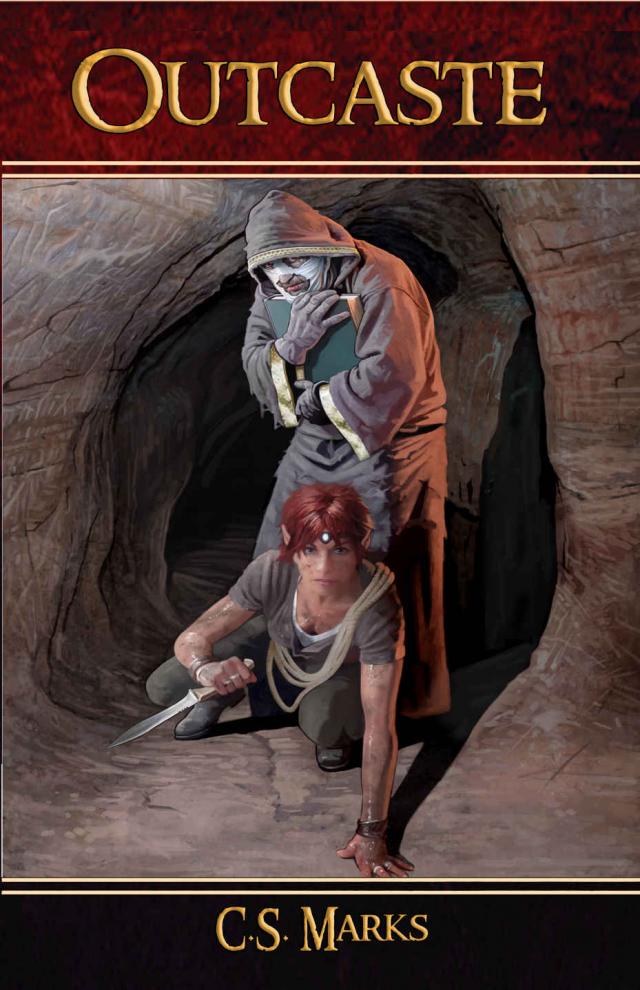


Neither Wrothgar nor his dark scholars could explain it. Somehow, the forces of nature were shaping the Ulcas as they did everything else, allowing them to revert into beings of free will and conscience. That could not be allowed to happen. At least the numbers of altered Ulcas were small…only one isolated population was known.
Wrothgar had sent forces out to exterminate them twice already, but each time they had gotten wind of it and moved on. The aberrant Ulcas had to be eliminated at all costs—the aberration must not be permitted to spread. Wrothgar had been advised that, in all likelihood, the change would only be spread via breeding…it was not a contagion in the strict sense. But any likelihood of spreading was intolerable. Obviously, something had favored this trait in the rogue population.
Wrothgar therefore ordered these “Outcastes” destroyed on sight. He had captured one many years earlier; at first fascinated by the presence of eyelashes and rudimentary eyebrows, as proper Ulcas are entirely hairless. When he discovered the undeniable changes in the personality of the Outcastes, Wrothgar knew he had to deal with the problem as soon as he could manage it.
The Outcastes had only survived this long because Wrothgar’s forces were diminished both in strength and in numbers. But now, as that strength was rebuilt, the days remaining to the Outcaste Ulcas were numbering fewer and fewer. Deep in their isolated, dark refuges, they knew it.
Errno’s people were set upon by the forces of Light as well as Darkness, with no allies to be found. There would be no point in reasoning or pleading with Lord Wrothgar—their only hope lay in the very difficult and unlikely prospect of convincing the enlightened races to aid them.
Errno, known as something of a visionary among the Outcastes, had been a chieftain among them. His intelligence and powers of reasoning were greater than most, and his will was stronger than many. He was, without question, one of the most courageous. Hence he had been chosen to bring his people’s plight to the attention of their former enemies, knowing this would be a nearly impossible case to make. The more he learned of the terrible damage his ancestors had done, the more hopeless it seemed. If not for Ordath, he would have abandoned the effort.
Errno could not help cringing, and he still liked raw flesh. He was undeniably ugly, and he snarled and bared his teeth when conflicted. He appeared to be an animal dressed in finery and taught to speak, but there was no denying his courage. Courage is a trait which no Ulca truly has, but which Errno would need in double measure as the Council of the Wise reconvened at sundown.
The expressions on the faces of the councilors ranged from skeptical, to disgusted, to downright hostile. Errno’s unfortunate reaction consisted of shifting in his chair, his upper lip twisting uncontrollably into a snarl, exposing strong, if crooked, yellow teeth.
The Asari were difficult to read, their faces nearly expressionless, though one could still detect Duinar’s affability and Ordath’s empathy. Shandor was, of course, completely inscrutable.
Errno was beginning to emit a rather unpleasant aroma, not surprising considering the state of his nerves. Gaelen had already taken notice, despite being seated at the far end of the same table. She shook her head, wondering why it had taken her so long to unmask him.
In hindsight, Errno smelled like an Ulca. She had denied the possibility of an Ulca in Mountain-home because it was so preposterous, yet apparently it was not as preposterous as she had thought. She sighed and shook her head again.
The Elf who had been set to record the proceedings need not have troubled himself. One only need look at the poised quills in the hands of the lore-masters to know it. They had rested, and now had procured fresh parchments and full ink-bottles, awaiting whatever befell. Despite their negativity toward Errno, they all had to admit that this was one of the more interesting events they had witnessed. Gaelen, who liked to make sketches, had rendered an excellent likeness of Errno during the earlier meeting. She had made a present of it to Fima, who had been pleased to add it to his notes.
Ordath rose again, extending her hands, filling the room with the same warm, soft light as before. Gaelen was surprised to notice that Errno almost looked genuinely human until the light faded, and the illusion was broken.
“Now then,” Ordath began. “Errno has come to us asking for aid. What thoughts have you given this matter during your respite? Speak, that your voices may be heard.”
“My question is this,” said Beori. “What sort of aid is he expecting? Does he want us to destroy Lord Wrothgar for him? Would he have us rise up against those among his kind who threaten him?”
“Address your questions to the one who must answer them, and not to me,” said Ordath. “Errno has a voice, and yet you behave as if he is not here.”
Beori flushed a sort of pinkish-crimson, contrasting rather unfavorably with his dark auburn beard. Of course, Ordath was right, but Errno was the last person Beori wanted to actually speak to. “All right, then. Well? What sort of aid are you expecting, Ulca?”
“Do not address me as Ulca, please,” said Errno. “I am no longer welcome among Ulcas. I am Outcaste…so named by Lord Wrothgar and all who serve him. If you wish to avoid showing me the respect of using my name, you may call me Outcaste.” He rose and stood as tall as his courage would let him, moving to stand on the central podium.
Errno was most uncomfortable under the gaze of so many eyes, many of which were either glowering or flashing at him. He decided to pick out the least hostile person at each table and keep his eyes fixed there. He selected Ordath, Fima, and Rogond. “I do not expect any of those things you mentioned—no wars, no uprisings. Wrothgar and his Ulcas have been hunting us for years now…always we have gotten wind of it and managed to move to a new hiding place before being overtaken. But now we are running out of hiding places. My people do not travel well, and we know almost nothing of these lands other than the deep-caverns and the tunnels beneath the mountains. What we need…what we are asking for is…is sanctuary.”
There was a flurry of discordant voices, all talking at once. Sanctuary? Whatever does he mean by that! Does he actually expect that any respectable society would harbor such an unsavory race? It would be unthinkable. Ulcas overrunning dwarven-realms? Ulcas strolling about Tal-sithian? Absurd! Laughable! Not to be tolerated. Talk about vain hope…
“Wait a moment!” shouted Estle, rising to her feet to be heard over the din. “You are all reacting when you don’t really even understand what he is asking for.” She turned to Errno. “How many of you are there? How great are your numbers? And, are there children?”
“We number nearly a thousand now,” said Errno. “Our numbers have increased since we made a law against killing one another.”
“A…what?” said Ri-Ariun in an astonished tone. “Did you say you had actually made a law?”
Errno drew himself up tall. “We have laws. There is a law against killing, and a law against stealing, and a law against harming your neighbor or your family, unless, of course, they have done something to you first, in which case you may do whatever you like to get even.”
“Well, Errno, I must say that is most uncharacteristic of Ulcan society,” said Fima. “You have made significant progress…except for that part about getting even”
“And what’s wrong with getting even?” growled Hallagond.
“One should not seek to harm others,” said Nelwyn. “That’s all Fima is saying.”
“In that case, then it should not be permitted for the Elves of the Greatwood to slay my people on sight, as they do,” said Errno, trembling a little at his own audacity. “Ulcas and Outcastes alike are killed just for trespassing, even when they have done no harm.”
“Based on my experience with Ulcas, harm is what they will do if given the opportunity,” said Gaelen, though her voice was gentle. “I have slain countless numbers of Ulcas, Errno, and I apologize for none of them. If, however, things are changing, I might have to rethink my position. I admit that I have slain Ulcas on sight, whether in the Greatwood or not, if there is the slightest chance they will bring harm.”
“There is one small problem with giving sanctuary to the Outcastes,” said Astor. “Even if we could guarantee that, for example, the men of Hearndin’s realm would learn to accept such beings and live in harmony with them, Wrothgar wants them exterminated. Wherever they go, he will pursue them. They will bring great risk to anyone who shelters them.”
“I know,” said Errno in a quiet voice, “it is much to ask.”
“Too much to ask,” said Beori, folding his arms.
“Just think on this for a moment,” said Rogond. “If Errno’s people are allowed to flourish, the changes they are experiencing might well affect the other Ulcas. Perhaps they will become numerous enough that their kind will supplant the loyal servants of Wrothgar. That would not please him at all, and would be a boon to the Light. You must each ask yourselves—are Errno’s people worth saving?”
“Depends on the cost involved in saving them, in my opinion,” said Hearndin, who had just been treated to the mental image of Errno’s people overrunning Dûn Bennas.
“I would charge you all with the task of further considering this question before our debate continues,” said Ordath. “Right now you are all overwhelmed by the notion that your homes are about to be colonized by Outcastes. I submit that we will accomplish very little else until the Council agrees on a single question: Will you aid the People of Errno, or will you condemn them to death at Wrothgar’s hands? Once you have agreed, then we will consider what is to happen next.”
This was not a question that could be answered—not yet. Ordath knew it. She adjourned the Council until sundown of the following day, knowing that every member would discuss, mull over, consider, and debate until then. There would be time for private outrage, the expression of deep inner fears, and hopefully the development of some empathy. Ordath knew that such things were not likely to happen in the Council-chamber. As she watched the various members depart, she remained with Shandor and Errno, who appeared to be on the verge of exhaustion.
She approached him, took his misshapen hands in her own, and smiled at him. “I believe that went very well, considering,” she said. Errno’s face, at first puzzled, broke into a slight smile.
“You’re right,” he said. “It could have been worse.”
Chapter 7: The Decision
Errno was not present at the Council on the following day. Ordath had persuaded him to remain in his own chamber, having given him a book of poetry and another of herb-lore. “Who is the Elf seated next to the tall man at the leftward table?” he asked, just as Ordath made ready to leave him.
“That is Gaelen Taldin, of the Greatwood realm. She was introduced to you, as were they all. Why do you ask about her?”
“Because she knew of my presence long before the Council. She stalked me in the library on several occasions,” said Errno. “I believe she guessed my nature, and yet she kept silent about it. And there is something else about her…I believe she holds a greater understanding of my people than anyone else in the room except yourself. Yet Wood-elves have always been our ruthless enemies. I don’t understand.”
“First, Wood-elves are no more ruthless toward Ulcas than are any other Elves,” said Ordath. “Second, Gaelen has been given unique…insight…which is all I will say for now. I would advise you to stay away from her, even though she seems more sympathetic than most. Stay away from her for the time being.”
“What insight? From who did she gain it?” asked Errno. “And why should I stay away from her? Not that I’m remotely tempted...”
“From whom,” said Ordath. “Not at this time, my friend. I will reveal some things of her when, or if, you are to remain in her company, but not until then. I must go now…I would not arrive late. There is much to be decided tonight. Try not to worry.”
Errno settled back with the volumes Ordath had given him. He opened the book of poetry first, to a verse entitled The Fall of Aincor Fire-heart. That was certain to be much too depressing, so he turned instead to the herb-lore. Errno had developed a fascination with things that grow, as he had had so little experience with them in his familiar, dark haunts. It was grand to see so many green things that were useful—they could be eaten, or used for medicine, or even used to poison an enemy. Until he came to Mountain-home, he had rarely thought of them as anything other than stuff to be trampled beneath his feet.
“First, we should all vote on the matter of whether we favor aiding Errno’s people at all,” said Ordath. “You must understand what your vote will mean. If you vote ‘no,’ then you basically condemn the Outcastes to living in hiding until Wrothgar’s Ulcas finally overtake them. But if you vote ‘yes,’ then you are committing not just yourselves, but the people you represent, to the task of helping preserve Errno’s folk.” She looked around the circle. “Will all who are prepared to vote please stand?”
All Council-members in attendance, excepting the Asari, rose to their feet.
“Why will you not stand?” asked Hearndin, looking over at Duinar and Shandor.
“We are abstaining from this vote,” replied Shandor. “This matter is for you to decide. We will support your decision, regardless.” He looked straight ahead then, his blue eyes hooded and expressionless.
“Very well,” said Ordath. “Each table will vote from left to right. First let us hear from the Lords, beginning with Ri-Aruin.”
“I feel some empathy for Errno,” said Ri-Aruin, “and his plight touches me. But I do not trust his people to be civilized enough to not pose a threat. As much as it pains me, I must say ‘no.’” He sat back down, exhaling a long breath.
Hearndin spoke next. “I will not even entertain the notion of a thousand Ulcas, or Outcastes, roaming the streets of Dûn Bennas. I must vote ‘no’ as well.”
Lords Airan and Beori added their voices, and the tally stood four votes to none.
The rightward table was next, beginning with Astor. Though he did not wish to vote against King Hearndin, he had seen things in Errno that would not allow him to vote ‘no.’ Four votes to one. Galador made it five to one.
Nelwyn voted in favor of Errno. “Anyone who has risen above lawlessness must be encouraged,” she said. “I doubt Errno expects to be roaming anyone’s streets.”
Fima voted with her. The tally was now three in favor to five against.
Hallagond remembered too well the last battle, in which Ulcas had taken the life of one of his dearest friends. He had struggled against them for far too long and in far too unpleasant a manner. “No.” Farin, apparently, had engaged in similar struggles. The vote was now three to seven.
Ula voted ‘yes,’ as did Estle, who voted her own conscience despite having been reminded of Azori’s death. Five votes to seven.
Gowen made it five to eight. “You can dress him up and teach him to be eloquent. That doesn’t make him a man.”
Rogond voted in favor of Errno. He knew what it was like to be the target of assumptions made by one race about another.
Gaelen voted last. “No one is beyond redemption,” she said simply. “I say yes.”
Ordath sighed. The vote was seven in favor to eight against. “I am not willing to abandon an entire people based on the difference of one vote,” she said. “This is as nearly equal as it can be, given our number.” She turned to Shandor. “What, then, shall we do?”
Shandor flared with harsh, silver light, his silken hair stirring in the breeze his own energy had created. “I believe there is a simple solution,” he said in a voice so cold that it made Gaelen’s hackles rise. He looked around the council-tables again. “Do not say a word, and do not react to what I am about to do. You must trust my judgment in this—all of you. I will brook no contradiction. Do you understand?” He turned to Lady Ordath. “Now fetch the Ulca here.”
Ordath bowed submissively before her mighty sire, who did not acknowledge her. She then left the chamber to fetch Errno, who, of course, had no idea that he was to be summoned. Soon she returned with the justifiably frightened Errno in tow. Shandor was in no mood for pleasantries or delays.
“Ulca!” Shandor intoned, his deep voice filling the chamber with foreboding. “Stand before me now. Know that the Council has voted, and they have not seen fit to favor your people with aid. Now you must die. It is the decree of the Council.”
Everyone sat in shocked silence. They had not expected Shandor to deal out such a punishment. None of them had been involved in any such decree. It is a test, thought Gaelen. It must be. That’s why Shandor insisted that we not contradict him. She looked over at Rogond, whose expression told her that he had come to the same conclusion.
Errno began to tremble, and his face grew visibly paler. His knees weakened, threatening to buckle from beneath him. Still he faced Shandor, frightened tears welling in his eyes.
“Have you anything to say?” said Shandor.
“All I wanted was to protect those I care for,” squeaked Errno, whose voice was leaving him along with his strength. “I did not realize that my life would be forfeit when I agreed to abide by the decision of the Council. I regret having spent so long away from my family…and when I do not return, they will lose all hope. That is my greatest regret….the loss of hope.”