

Why do horses run, p.1
Why Do Horses Run?, page 1


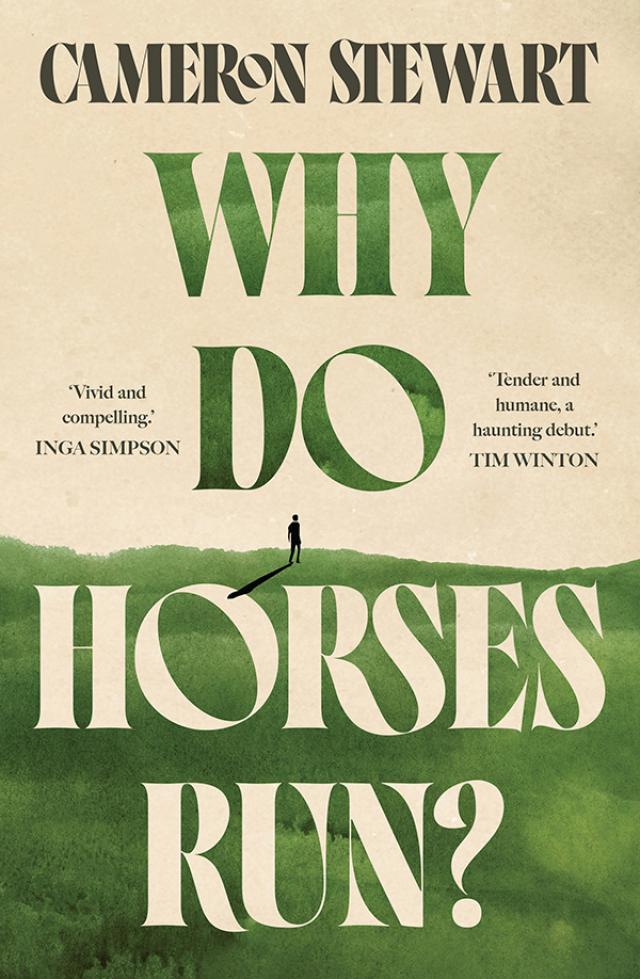
Praise for Why Do Horses Run?
‘Wise, exquisite, unforgettable and almost radically courageous, Why Do Horses Run? will leave you gasping—at the shocks that keep coming, and the generosity on every page. How rare it is to read a novel of such unashamed hope.’
Nigel Featherstone, author of My Heart is a Little Wild Thing
‘Reading this novel is like being immersed in the Australian landscape … I feel every drop of rain, hear every cockatoo that passes overhead. But the novel concerns much more than the natural world, which in any case is ultimately as dangerous as it is comforting—it is a lament for lost family, an acknowledgement of human resilience, and a tribute to the surprising kindness of strangers.’
Debra Adelaide, author of The Household Guide to Dying
‘Vivid and compelling. Walking into the landscape alone and seeking erasure inevitably brings life into clearer definition.’
Inga Simpson, author of The Last Woman in the World
First published in 2024
Copyright © Cameron Stewart 2024
All rights reserved. No part of this book may be reproduced or transmitted in any form or by any means, electronic or mechanical, including photocopying, recording or by any information storage and retrieval system, without prior permission in writing from the publisher. The Australian Copyright Act 1968 (the Act) allows a maximum of one chapter or 10 per cent of this book, whichever is the greater, to be photocopied by any educational institution for its educational purposes provided that the educational institution (or body that administers it) has given a remuneration notice to the Copyright Agency (Australia) under the Act.
Allen & Unwin
Cammeraygal Country
83 Alexander Street
Crows Nest NSW 2065
Australia
Phone:(61 2) 8425 0100
Email:info@allenandunwin.com
Web:www.allenandunwin.com
Allen & Unwin acknowledges the Traditional Owners of the Country on which we live and work. We pay our respects to all Aboriginal and Torres Strait Islander Elders, past and present.
ISBN 978 1 76106 965 9
eISBN 978 1 76118 896 1
Typeset by Midland Typesetters, Australia
Cover design: Christa Moffitt, Christabella Designs
Cover illustrations: Shutterstock
For Inger
Contents
BEFORE
NOW
1 back roads
2 darkness
3 flecks of gold
4 lotte
5 taxonomy
6 kåsa
7 ghosts
8 hilda
9 we fell
10 I have a plan
11 treasure
12 lotte’s first memory
13 mick
14 hell’s gate
15 dead things
16 he was gentle
17 the high priest
18 everything went black
19 girl in the A-frame
20 earning his keep
21 it’s a funny thing
22 postcard from god
23 noises
24 rain
25 how long have I lived?
26 convalescence
27 she’d been watching
28 stories
29 fruit-picking
30 converging lines
31 liquid
32 driving slow
33 incineration
34 coma
35 ticking
36 absence
37 not a detail I don’t remember
38 husk
39 winter
40 isobel
41 fears
42 cycads
43 longship
44 distraction
45 missing
46 what do you see?
47 and yet …
48 I know men like you
49 dream
50 weather rock
51 foot on my chest
52 rainfall
53 spider
54 where are you?
55 we first met
56 finished
57 birthday
58 rodeo
59 luminescence
Acknowledgements
THE CANOPY SWAYED overhead and showered Ingvar with winter rain. He didn’t flinch. He pulled out a hand lens and leaned forward for a closer look. Hidden beneath the leaf litter were three glistening flower heads, each the size of a large coin. Each flower was made up of a series of creamy white bracts, splotched with purple, and bunched together in a spiral of inward-facing rows. The inflorescence released a sweet smell that resembled vanilla. Ingvar thumbed some dirt from the corner of his left eye and blinked. His heart was racing. Before him one of the world’s rarest plants—Rhizanthella slateri, a subterranean orchid, able to germinate, grow and flower without ever rising above the surface of the earth. Using a small trowel, he scraped away more dirt. Beneath the waxy flower heads sat a fleshy white underground stem, growing from a horizontal rhizome. There were no roots. Ingvar was struck by the utter strangeness of the plant. He recalled a passage from an early book on naturalism, which described how an atheist attended an orchid show and left later believing in the existence of the devil. A burst of cold wind shifted through the trees and Ingvar lifted his head. A raven watched on from a wet branch. The rain had stopped but it was getting dark. He turned his attention back to the orchid and pulled out his phone to snap off some photographs. Then he got to his feet and recorded the GPS coordinates. Time to get back to the city. Back to his home.
1
back roads
NOW I EAT ROADKILL. When I’m desperate for food I drag dead animals off the road. Rabbits, kangaroos, goannas—as long as the carcass hasn’t stiffened, if it still flexes, then it’s edible. After gutting them, I check for parasites. I roast bits of meat on the end of my knife or on green sapling sticks. Ravens cook well on embers.
When I’m forced to walk into towns to get supplies I see people. I see people shopping or running errands, eating in cafes or waiting in lines. They study their phones or stand around and talk or drive cars around the streets. I see other people jogging. Some walk their dogs or ride bikes. When I stand outside schools, I watch parents pick up their children and help them with their bags. They hug them and talk to them about their day or ruffle their hair. Sometimes I see them laughing. These images scare me more than anything. I see them gliding along in a rowboat, laughing and waving, not knowing they are floating towards a deadly waterfall.
But I don’t stay in towns for long, they make me jumpy. I walk country roads. Back roads. I walk until I’m too tired to go on. Day or night, it doesn’t matter. I’m not picky about where I rest—on open ground, in ditches, under bridges or in long grass beside rotting logs. These are my beds now. I watch green clouds of budgerigars kaleidoscope across the sky, then night falls and my mind goes to places where I don’t want it to go, so I get up and keep walking. I’m hit by the wind of passing trucks. When I pass roadside memorials I touch them with my hand.
Last night, I walked north along a back road, and tectonic plates and Tasmanian tigers entered my mind. The moon cast a bright glow, the air was cool and I must have covered thirty kilometres before dawn. I can walk for hours without thinking of much. Some days are completely blank. But last night I thought about how I was walking north over a land that was itself moving north.
When Gondwana broke up, the Australian continental plate drifted north at a rate of around six centimetres a year for fifty million years. After covering roughly three thousand kilometres, it finally collided with the Pacific oceanic plate and forced it into the hot mantle of the earth. Rocks were folded and melted, the earth buckled and mountains were formed. This collision shaped the high mountain ranges of Papua New Guinea as well as the waters of the Torres Strait that now separate it from Australia.
Then, around thirty thousand years ago, when the Ice Age began and sea levels dropped by more than one hundred metres, a landmass emerged that stretched all the way from Tasmania to Papua New Guinea, and Tasmanian tigers, or thylacines, roamed the entire region. Fossilised remains have been found in New Guinea, in mainland Australia and Tasmania. There are even rock paintings of them way up in the Kimberley region of Western Australia.
Over the next six thousand years or so, as the ice melted and sea levels rose, water flooded Bass Strait, and Tasmania became separated from the rest of the continent. It was during this period, it’s thought that Asian seafarers brought the dingo to Australia, and its introduction coincided with the dying out of the thylacine on the mainland. But in Tasmania, because of the impassable Bass Strait, thylacines survived at the top of the food chain.
By the time of European settlement in the early 1800s, it’s estimated around five thousand thylacines inhabited the thickly forested island. Distinctive dark stripes led to their common name, but despite the fearsome title they were timid creatures and avoided contact with humans. Most captured thylacines gave up without a struggle. Some died of shock. Not much is known about their behaviour, but it’s thought they were a social species that hunted in pairs. Blamed for killing sheep, the Tasmanian government placed a bounty on their heads, and over two thousand thylacines were hunted down and shot. (Later studies showed they probably lacked the jaw strength to take down large animals.) Another seven hundred and fifty specimens were shipped off to overseas museums, and a further two hundred live animals were transported to zoos. Many perished in transit. In Tasmania, the remainin
In 1933, the last known Tasmanian tiger was trapped in the Florentine Valley and sent to the Hobart Zoo. It’s not known if the animal had been separated from its family or was living alone when it was captured. Forty-three seconds of film still exist of ‘Benjamin’ pacing up and down his small enclosure. Benjamin paced his cage for three years. On 7 September 1936, the last-known thylacine died on a concrete floor after being locked out of his sleeping quarters during a very cold night. And then there was nothing. This is what it’s like living without you.
2
darkness
INGVAR HEADED EAST. Along the range and into the cold night. The highway cut through open forest and he walked along the edge of the road and pulled an army blanket around his shoulders for warmth. When trucks hammered by with blinding light and buffeting wind, he tilted his head towards the ground, and in the strangely serene silence that followed, he walked not feeling he was connected to the earth, but on the edge of something he couldn’t reach. He pushed on through mist and darkness and clutched the blanket tight under his neck with his bony fist. Nothing in the darkness could scare him. He was darkness itself.
At the top of a rise, he branched off the highway onto an old road that connected the range to the sea, more than two hundred kilometres away. If it were daylight he would have had sweeping views over rugged valleys and wild rivers, but it was night, and the bitumen turned to dirt. The sound of trucks from the highway receded as he pressed on. The road had been cut by wool haulers and timber cutters in the early years of settlement, however the land he walked across was ancient. At one point, he thought he heard howling rise out of the forest but when he stopped to listen there was silence. Pulling a water bottle from his rucksack, he took a drink. Then he got going again. All he could hear was the scuff of his boots in the dirt and the panting of his hot breath.
The road narrowed, and after a series of inclines he crested a hill and wound down a steep range through a series of switchbacks cut into cliffs. Moonlight shone through the latticed canopy and then disappeared behind cloud, and the thin skirt of dawn appeared, pale on the horizon.
When the first spits of rain blew over the range he quit the road and crossed a hillside in search of shelter. The open forest gave scant cover and it turned bitterly cold. Flurries of drizzle swirled through the trees like plastic bags in the wind and Ingvar hurried towards a buttress of rock that jutted from the slope. Under the granite overhang, he swept leaf litter into a pile against a wet log and hunched over a struck match like a man in prayer. Cupping his shaking hands around the tiny flare, he laid it against the damp mulch. The mulch smouldered and curled black and ran orange up the edges, then seemed to die until, with his steady breath, it glowed bright and broke into flame. He fed in more twigs and piled on dead branches until a blaze raged and the wet log steamed and hissed. Slaters and ants scurried out of the smoke.
The wind and rain passed. Ingvar stared into the bones of the fire while light danced across his hawkish face. When warmth finally returned to his body, he draped the blanket over a nearby shrub, unzipped his rain jacket and shook off the moisture in a fan of droplets. Wrenching off his boots, he jacked up his feet on a fallen tree. Steam poured off his socks. Out of his rucksack he pulled a tin of beans and a strip of jerky. Setting the beans by the fire, he leaned against a slab of granite and chewed slow on the strip of dried meat. A thick branch pulsed with white heat and broke up. Apart from water dripping from trees, nothing in the forest stirred. After a time, Ingvar dragged the beans out of the embers with a stick and ripped off the lid. He slurped up the contents in one go. He ate out of necessity. Like an animal.
Hours passed and the fire died down. The early light was grey and promised nothing for the day ahead. Up the slope, a wallaby hopped silently across the wet forest floor and Ingvar’s gaze followed the small animal as it vanished behind a large ironbark. Staring back was the face of a screaming man and Ingvar leapt to his feet. No, not a man. Just the gnarled trunk of the tree.
After pushing earth over the remains of the fire, he set off. He smelled of dampness and smoke. The mountain air was cold and clean.
Other than a vague notion to walk towards the coast, Ingvar had no fixed destination but he was determined to stay on the move. To remain stationary was to dwell and he didn’t want that. During daylight hours he walked across the countryside to avoid people, but at night he stuck to roads so he wouldn’t trip over uneven ground or run into fencing. So much of the country was fenced.
He crossed a rocky hill and headed into a shallow basin. Bloodwoods and stringybarks towered overhead and the first rays of sun leaked through the canopy. At the base of the depression, a trickle of cold water ran over a narrow shelf of rock. Ingvar pulled two plastic bottles from his rucksack and filled them before moving on.
The gravel road wound down the gorge and, as the day warmed up, a wedge-tailed eagle soared high in the thermal updraft. Ingvar knotted his jumper around his waist and watched the bird drift over the steep ridge. Then he continued his descent. Approaching noise sent him scurrying off the road, and he crouched behind a tree as a four-wheel drive with a pair of red kayaks tethered to the roof drove by. As soon as the car disappeared, he got to his feet. Further into the undergrowth, a small tree stood out from the muted surroundings. Luminous green. A native cherry. Ingvar broke off a few of the bright red fruits. He didn’t particularly like the sweet taste but was aware of the nutritional benefits.
Towards the bottom of the gorge, a shaded creek crossing bore the serrated ruts left by cars and motorbikes. Downstream were remnants of rainforest and dappled light, a flutter of honeyeaters and a red-browed finch. Torn banks and granite boulders hinted at the savagery of past floods, and an immense sodden trunk lay in the shallows, lined with fungi. Ingvar picked up a pebble and lobbed it into a dark pool. The sun flickered behind the top of the western ridge as it fell.
By noon the next day, after more creek crossings and the odd farmhouse, Ingvar reached the lower stretch of the mountains and the valley widened. The road trailed alongside a widening river and the tension of having to find water lifted. In the heat of the day he stopped at a clearing by a river bend. The bank was lined with casuarinas, and stretching out beyond the watercourse was open forest with an understorey of dogwood and heath. Ingvar filled his bottles and found some shade. Hours passed as he stared into the swollen river. So much water. This wasn’t always the way. Only months before, way out west, he had run dry and been forced to mop up morning dew with his T-shirt and wring out the moisture into his mouth. Then after waiting out the hot day under a tree and walking all night, he had finally found the highway and hitched to the nearest town. Not today, he thought, as he got to his feet. Today I’m full to the gills.
Down the road, isolated letterboxes and dirt driveways hinted at habitation and then, as Ingvar rounded a corner, a mob of horses burst across the road and briefly filled the air with energy and noise, before they disappeared into woodland. Ingvar walked on and the woodland receded. After he passed some dilapidated cattle yards and an abandoned dance hall, a war monument loomed. Bordered by a small wrought-iron fence, each metal pole capped with a fleur-de-lis, the concrete and stone cenotaph stood ten feet high. Ingvar stepped closer. Marble plaques bore the names of thirty local men who’d died in the Great War. Five from the one family. He ran his hand through the wild grasses trapped within the fence.
The road continued east and birdsong increased as the light dimmed. As it grew dark he felt for the gravel road with his boots. A crescent moon emerged and threw a wash of pale light over the landscape.
3
flecks of gold
AT NIGHT, WHEN the stars emerge and the patterns of the cosmos spread out before me, when I realise that the moon I look at is the same moon that has been gazed upon by Aristotle and Cleopatra and Charles Darwin and by others not recorded in books, I come to a brief agreement with the logical side of myself that it is hard, maybe even selfish, to remain desolate for too long, given the enormity of the universe, and that throughout time all living things, not just humans, have suffered just as much or more than me. In fact, there is nothing remarkable at all about suffering and death. Love and hope are merely flecks of gold in a seam of quartz. The moon has seen all manner of tragedy on earth. I wonder what it sees for me?


