

Its all in the game, p.1
It's All in the Game, page 1
part #6 of Crete Sloan Series


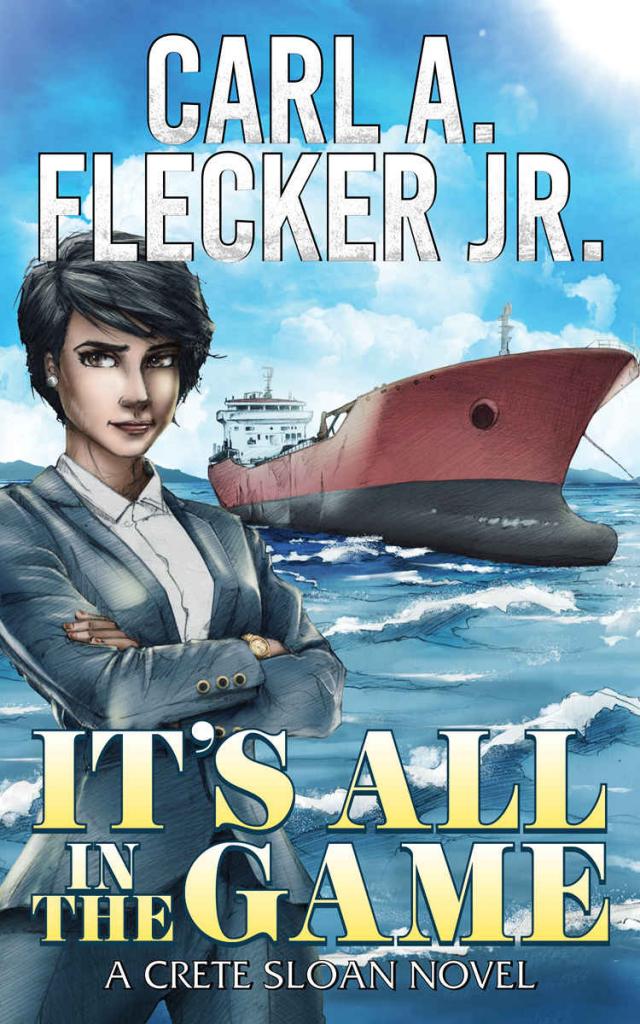
IT’S ALL IN THE GAME
A STORY OF AN INTERNATIONAL MERCENARY, A KIDNAPPED DAMSEL, OIL LEASES UP FOR GRABS, ORGANIZED CRIME, AND ONE MAN’S QUEST TO CONNECT THE DOTS
A CRETE SLOAN NOVEL
By
Carl A. Flecker Jr.
Word Association Publishers
205 Fifth Avenue
Tarentum, Pennsylvania 15084
www.wordassociation.com.
1.800.827.7903
It’s All in the Game
Copyright © 2019 by Carl A. Flecker Jr.
Visist the author’s website: www.cretesloan.com
Cover Illustration by Chris J. Flecker
www.chrisflecker.com
All rights reserved. Published 2019. Printed in the United States of America.
No part of this book may be used or reproduced in any manner whatsoever without written permission of the author.
This book is licensed for your personal enjoyment and yours alone. It may not be re-sold, given away to other people or reproduced except for brief quotations in a review. If you would like to share this book with another person, please purchase an additional copy for each recipient.
The characters and events in this book are products of the
author’s imagination. Any semblance to real persons, living or dead
is coincidental and not intended by the author.
DEDICATED TO ANAHITA RADJY
For suggesting Baku, Azerbaijan as the venue.
CHAPTER
1
It was July in the Bahamas. The winter tourists were all back home in New York, Pennsylvania, Maine, and all the other cold-winter states. The forecast was for a hot summer, but, with the breeze off the Bahama flats and the air conditioning indoors, it would be a good one for me. I had no specific plans. Just a lot of lying around, bloody mary breakfasts at the Gin Mill, gimlet lunches, a ton of reading, afternoon swims in the ocean, pre-dinner naps, and quiet nights under starlit skies.
Home for me is a shack on a grassy knoll just above a long stretch of white beach on an uncharted island in the Bahamian Atlantic. A deep, wide covered porch spans the front of the shack and overlooks the sea. I had just come out onto the porch with a twenty-ounce mug of black coffee and the iPad. First coffee of the day. The idea was to sip it and punch up reading material on the tablet. I slumped into my favorite chair, an upholstered Adirondack with wide arms and a matching upholstered ottoman. It was early. The sun had only crested the horizon, and I knew the day would be good. There was a slight chill in the air, but that was okay. I had on a sweatshirt over a T-shirt, white canvas slacks, and docksides. Off shore, not far out, I could see the boats of the early risers, the serious anglers headed west toward the Gulf Stream. The deep-sea fish were out there just waiting for those guys.
That’s when I saw him.
He was tall, almost as tall as I am, and lean in the sense that he was not skinny but appeared to be mostly muscle, at least from where I sat. His hair was brown with streaks of gray, and tousled. He wore Buddy Holly-type glasses. Looked like a Bill Gates out of his element.
A visitor? At this hour of the morning?
“Good morning,” he called. “I’m looking for Crete Sloan.”
“You found him,” I said.
“May I approach?”
“Approach away,” I called back and motioned for him to come up onto the porch. I set the iPad aside and rose to greet him. He wasn’t dressed right for the island, but that was okay—visitors seldom are. He wore a blue button-down shirt under what appeared to be a navy cashmere sweater and blue jeans pressed with a sharp crease that told me he was probably precise, behaviorally rigid, and finicky. Alligator loafers with a little tassel.
It was obvious, because of the hour, that he had found me for a reason. He had not just been wandering by.
“I came over on the air taxi last night,” he said. “Stayed in one of the upstairs rooms at the Gin Mill. A rather interesting experience. A fellow named Stubby Dane said I’d find you here. He said you’d be up at this early hour and explained how to get here, although it’s not the least bit complicated. Just up the coral path from the Gin Mill.”
I extended a hand. “Crete Sloan,” I said. “Call me Sloan.”
He took my hand in a firm grip. “Frank Marcella,” he said. “Frank will work.”
“Coffee?” I said.
“Thank you, no,” he said. “The Dane fellow fed me full of it.”
He looked around the porch with interest, as if taking inventory. The porch faces south, receives the sun all day, and has a panoramic view of the Atlantic. It is roofed over, screened in, and has a daybed in the west corner where I occasionally sleep outside in the night air.
“Sit,” I said and pulled one of the other Adirondacks around to face mine.
We both sat. I sipped my coffee.
“I have a problem I’d like you to address,” he said. “Do you have the time? If not, I can return when it would be convenient for you.”
He said the words calmly and with courtesy, as if he were concerned more about my convenience than his, but his eyes told another story. Intense, firm, direct. In them, in the eyes, I could see he was a man used to getting his own way. And behind that, perhaps, a tough character.
“Do you like living like this?” he said. “Alone on an uncharted island?”
I nodded. Pulled on the coffee. Did not speak. He was beginning his test, which was fine with me, except it was screwing up my morning of solitude.
“I had you checked out,” said Frank Marcella. “As much as is possible, which isn’t much. You have a reputation out there that is firm but slim.”
“Out there?” I said.
‘“On the street,’ I believe is how you’d put it.” He said it firmly, as if this manner of conversation was not new to him.
“In the back alleys of normal living,” I said. “Who recommended me?”
“I’d rather not say. He simply said you were a fuckin’ recluse and the only reason you’d come out to play is for a good scrap. His words, not mine.”
I noticed that the fishing boats had covered a good bit of distance since I’d last looked. They were well into their Hemingwayesque day at sea. The water was calm and green. The boats white.
Marcella smiled. “You were in the mob some years back.”
“A lot of years,” I said.
“And you were a cop.”
“Pittsburgh.”
“Why did you quit the police?
“I was going to be fired. It was easier to quit.”
“I heard,” he said. “Are you married?”
“No.”
“Are there any women in your life?”
He was sizing me up. This wasn’t my first turn at home plate. He would gather as much background information as he thought necessary; then, if I qualified, he would present me with a job he’d like me to do.
“None of your business,” I said.
CHAPTER
2
Frank Marcella chuckled. “I like a man with spirit,” he said. He looked around the porch. “Why do you like living like this?”
There was no harm in playing along, so I said, “It seems to me you are a businessman. By your appearance and your demeanor, I assume you are a successful businessman. If so, you are free in a very limited manner.”
I shifted in my chair.
“On the contrary: you are not free at all. You are tethered to contracts, partners, quarterly reports, subcontractors, vendors, bank accounts, licenses, federal, local, and state governments, OSHA, the IRS, employees, investors, and other stakeholders. Everyone has a piece of you. You’re public property and others control your life.” I spread my arms to encompass the porch. “I am free,” I said. “You are tied to the collective out there, chained to the plow, bound to a structured society. I am not. It’s the way I like it. Why I live like this.”
He had leaned forward on the Adirondack, elbows on knees.
“But you have no need for people, for companionship?”
He was searching now, curious as to how my life could be as it is.
“Of course I do,” I said. “But only companions of my choosing.”
“You answer to nobody?” he said.
“Only on my terms.”
“You have a scar there on your neck,” he said.
“Indigenous to my line of work.”
“Which is what?” he said.
“Frank,” I said. “I realize I’m taking an exam here, but let’s cut the crap. You’re here because you think you may need my services, and you already know how I operate.”
His eyes softened somewhat and he looked down. He was on unfamiliar turf. On his field, he was always the dominant player. Here, he was not. Not the dominant player, not the alpha male in the room. He would need to forfeit some machismo, proceed on my level. For guys like Marcella, situations like this often create rancor and bitterness, but Marcella seemed to buck up under the circumstances.
He looked up. “You are familiar with the name “Marcella Petroleum?”
“Big oil,” I said.
“Not big, but yes, oil. Not up there with ExxonMobil, Royal Dutch Shell, China National, and the like. We’re much smaller, but still big business. Home office in New Orleans. Drilling rigs around the globe. I’m Marcella.”
I nodded. Behind Frank, out on the water, seagulls chased the fishing charters. The sun had risen higher. The day was warming.
“You are not impressed,” he said.
â
“Yes,” he said. “Well…”
He was quiet for a minute, thinking, his face lit by the sun streaming through the screening. I was looking forward to breakfast down at the Gin Mill on the harbor. Maybe a light omelet with hash browns and toast. Or maybe Stubby’s Mess, a sizable plate of scrambled eggs, bacon, mushrooms, sweet peppers, sweet sausage, and onions all mixed together as you would toss a salad. A bloody mary of my own design. Yes, that’s what I was thinking.
“This is not easy for me,” he said. “Coming to you. I am self-sufficient, able to get things done on my own or with my own people. I don’t believe in hanging out personal dirty laundry or making public personal aspects of my life. I hashed over coming to you, but in the end had no other place to turn. You come highly recommended.”
At this point, I was wondering recommended for what?
“My daughter has been kidnapped,” he said. “I want you to find her.”
Ah. It was more a command than a request, but I chalked it up to his nature. In his world, he didn’t ask; he told.
“Your daughter,” I said. “How old is she?”
“Twenty-four.”
“So she’s an adult. Missing how long?”
“Since Friday.”
“This is Tuesday,” I said. “Three days. Long time for a five-year-old, but not long for an adult. Not long enough to be technically missing. You sure she’s not just off on her own somewhere?”
“She’s missing,” he said. “Her cell phone is turned off or the battery is dead. Not like her. The appropriate people in Baku checked her condo. I checked her condo. She is not there.”
He said it with a sense of finality that made me curious. I was beginning to assume he wasn’t a stranger to “the street,” as he had put it.
“Baku?” I said.
“Azerbaijan,” he said. “I’m working on an oil deal there. Maria—that’s my daughter—is working with me. She is two years out of college and has joined the company. That’s where you’ll be going.”
“If I take the job,” I said. “But for now you and I are going to walk down to the Gin Mill, and I am going to have breakfast. You may join me if you’d like.”
CHAPTER
3
The Gin Mill is a quaint Cheers-type place where the island folks hang out. The food is good, and the booze is better. Moderately large but not fancy. Driftwood and stone, old beams, wood floors, and a few rooms upstairs that serve as a makeshift hotel. It sits on a small rise at the U-end of the harbor and has a broad, covered porch that spans the front and wraps the sides, offering a view of moored boats and, beyond the boats, the breakwater. Out beyond that, the green sea. Green because the Bahama Flats are shallow, and the plankton colors the water.
Frank Marcella and I climbed the wide, well-worn wooden steps to the porch and entered through the screen doors. Thirty or so feet inside the front door, the bar stretches across the room left to right, and generous booths line the front windows that overlook the porch. Small four-top tables fill the space on each side of the bar, and an ornate billiards table sits in the far right corner.
This morning, as most mornings, island folks filled the booths and barstools. Constable Bobby Helms and sea captain Tom Edwards were at one of the booths up front. A wide, squat man stood behind the bar. Stubby Dane. Bald on the top, close-cut rim of brown-gray hair, wearing a black bib apron over a white T-shirt. Harper Tuck sat on the stool in front of the Dane. Tuck runs the air taxi service, one of them, that operates between the islands and the Florida mainland. He turned as we approached.
“Harp,” I said.
“Sloan,” he said.
I gave the Dane a chin nod.
“He found you,” said the Dane, indicating Marcella.
I turned to Tuck. “Mr. Marcella here,” I said, nodding toward Marcella. “You brought him in on the last flight last night. He needs to get back after we have breakfast. You do it?”
“Be right here,” said Tuck.
I indicated to the Dane that we’d be on the porch. Would we like to order? Yes. Marcella asked for a light omelet, coffee, and orange juice. I went with Stubby’s Mess, a side of small buckwheat cakes, plenty butter and syrup, and a double bloody mary in a tall glass with no ice. It made me think of a lovely young lady in Chicago who condemns my eating habits.
We sat on the porch at a round driftwood table that looked out over the harbor. We small-talked the weather and the boats bobbing at their moorings, killing time until we would get back to the subject at hand: Marcella’s daughter.
Presently, the Dane brought the breakfast orders and set them in front of us, then left. I liberally salted Stubby’s Mess, sprinkled some pepper, took a spoonful, shoveled it in, and washed it down with my custom-made bloody mary.
“Find your daughter,” I said, returning to our original conversation. “First, some background. How is her mother—your wife—dealing with this?”
“Maria’s mother died in childbirth. Maria’s birth. I never remarried.” He hesitated. “Or, rather, I’ve been married to my work. It’s all I want to do. Maria was raised by nannies.”
I winced. He noticed.
“It’s not like that,” he said. “I’ve been a decent father. We have a good relationship. The absence of a mother has not been a deterrent to her development.”
I don’t have children, but I do have an idea of a decent father. Or at least I think I do, and I assume it means someone who is around while the kid is growing up. Maybe Marcella—the workaholic—figured out a way to deal with that. No problem with the absence of a mother?
I chewed on those two things for a minute.
“Okay, so why would someone kidnap your daughter?” I said.
His cell phone rang. He took it. “No, no,” he said into the phone. “Much too far over budget. Deal with it. I don’t want to come over there.” He closed the line.
“Ceyhan, Turkey,” he said to me. “We will need an office there to arrange for the movement of oil from pipelines to supertankers for the trip to the Gulf of Mexico. It is Maria’s job to set it all up, but, as you know, she’s not available.”
He forked some of the omelet.
“Where were we?” he said.
“Why would someone kidnap Maria?” I said.
“I’m in a bidding war for the lease of oil fields in the Caspian Sea. My chances are good.”
“Good,” I said.
“Good chance of landing the leases.”
I watched him closely. Looked for signs of insincerity or shiftiness, something that might tell me the guy was off center or lying. I found none. He kept his brown eyes on mine. His disheveled hair was thick and trimmed neat around the ears. Nose neither big nor small, eyes wide-set, prominent cheekbones, slight blush to the cheeks that gave him a boyish look.
“And you think someone kidnapped your daughter to force you out of the bidding process?”
“That would be my guess.”
“Any ideas?” I said.
“None. Marcella Petroleum explored for this Caspian field and discovered it. Then everybody came running. The biggest global companies are not involved. They’re all in a consortium working bigger fields around the globe. We are up against one other company that is roughly our size. A particularly aggressive company.”
“Which is?”
“Donner Enterprises.”
“And Donner is aggressive because Donner wants the same leases,” I said.
Marcella hesitated.
“Yes,” he said.
The voice said yes, but the inflection and the eyes said something else. I noted it and let it ride.
Marcella continued. “As you may know, the price of oil has been depressed for over a year now. We are up against it, leveraged out and in dire need of cash. We need this lease. If we get it, we can get both credit and equity against future drilling that will ensure we stay in the game.”
“Somebody wants you out of the game?” I said. “Why not go to the cops? CIA, Interpol?”


