Her smile, p.1
Her Smile, page 1


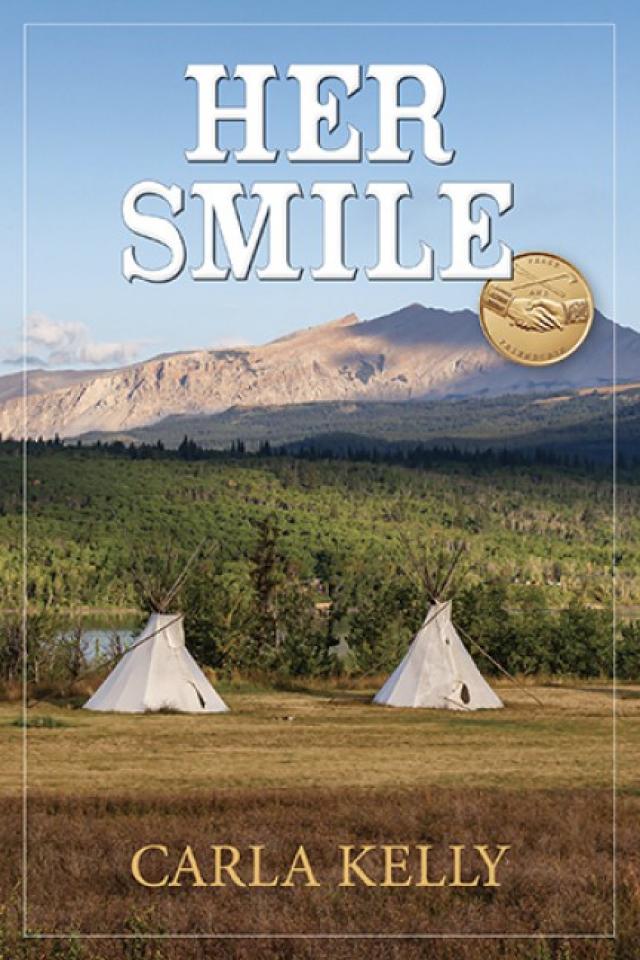
Her Smile
By Carla Kelly
Kenmore, WA
A Camel Press book published by Epicenter Press
Epicenter Press
6524 NE 181st St. Suite 2
Kenmore, WA 98028.
For more information go to:
www.Camelpress.com
www.Coffeetownpress.com
www.Epicenterpress.com
www.generontalbooks.com
www.carlakellyauthor.com
All rights reserved. No part of this book may be reproduced or transmitted in any form or by any means, electronic or mechanical, including photocopying, recording, or any information storage and retrieval system, without permission in writing from the publisher.
This is a work of fiction. Names, characters, places, brands, media, and incidents are the product of the author’s imagination or are used fictitiously.
Design by Rudy Ramos
Her Smile
Copyright © 2021 by Carla Kelly
ISBN: 9781603811903 (trade paper)
ISBN: 9781603811910 (ebook)
Printed in the United States of America
To Mary Ruth Kelly Huerta
Thanks for reminding me about this little novel.
And thank you for your abiding faith in my writing.
Books by Carla Kelly
Fiction
Daughter of Fortune
Summer Campaign
Miss Chartley’s Guided Tour
Marian’s Christmas Wish
Mrs. McVinnie’s London Season
Libby’s London Merchant
Miss Grimsley’s Oxford Career
Miss Billings Treads the Boards
Miss Milton Speaks Her Mind
Miss Wittier Makes a List
Mrs. Drew Plays Her Hand
Reforming Lord Ragsdale
The Lady’s Companion
With This Ring
One Good Turn
The Wedding Journey
Here’s to the Ladies: Stories of the Frontier Army
Beau Crusoe
Marrying the Captain
The Surgeon’s Lady
Marrying the Royal Marine
The Admiral’s Penniless Bride
Borrowed Light
Enduring Light
Coming Home for Christmas: The Holiday Stories
Regency Christmas Gifts
Season’s Regency Greetings
Marriage of Mercy
My Loving Vigil Keeping
Double Cross
Marco and the Devil’s Bargain
Paloma and the Horse Traders
Star in the Meadow
Unlikely Master Genius
Unlikely Spy Catchers
Safe Passage
Softly Falling
One Step Enough
Courting Carrie in Wonderland
A Regency Royal Navy Christmas
Unlikely Heroes
A Hopeful Christmas
The Necklace
“We will find a way to make
a way out of no way.”
john r. lewis (1940-2020)
When I was working with Oscar-winning film director Alejandro Gonzales Iñárritu on the film, The Revenant, Alejandro said to me he wanted to create a film that tells a story. As I read Carla Kelly’s novel, Her Smile, I started to visualize another story where a woman’s journey came to life as she experienced changes within her own understanding, along with her friendship with the Nez Perce.
My former colleague Carla Kelly opened a doorway to the life and experiences of Elizabeth Ann Everett, who finds herself pitchforked into the savage conflict of the Nez Perce Nation’s flight to the Canadian border. As a scholar of nineteenth century western history, Carla allowed for this woman’s perspective, which is rarely seen or recorded, to be told. It reaches the heart of westward expansion: the changing of the West between the United States and Native American relations. These changes of westward expansion and whites moving into these traditional homelands came at a high price for the indigenous people who had lived in those areas for millennia. Broken treaties, land grabs, forced removal, colonization and dependence became the norm.
Loren Yellow Bird, Sr.
Arikara and Plains Indian Historian
Trenton, ND
Prologue
September, 1904
Near La Grande, Oregon
I never planned to write an account of my summer with the Nez Perce, that summer of 1877. Even after all these years, scarcely a day passes that I don’t think of the flight, but I never seriously thought to commit the whole thing to paper.
At least I didn’t until last week, when my husband Duncan went to Washington state to visit his relatives. My daughter Millie was newly settled in town, and our two sons still at home were busy getting in the last cutting of hay. Nothing of importance was pressing on me, a rare occurrence. What to do?
I was looking forward to several weeks of relative calm in order to catch up on some reading, and to make those green tomato preserves Duncan likes so well. Knowing that Duncan loses track of time when he visits relatives, I really didn’t expect to see him anytime soon.
You can imagine my surprise during dinner five nights later when he opened the back door and came into the kitchen. I stared at him in surprise. He limped, so I knew rain was coming soon. He kissed me on the top of my head and sat down in his usual place.
As I got up to get a plate and fork for him, he reached out and held my arm as I walked past him. “Sit down, Smiley. I have something to say.”
Our sons sat there, too, waiting for him to speak, since he wasn’t one to make pronouncements. He kept holding my hand, not unusual for him, but somehow different.
“He’s dead.”
He could only mean Joseph. Silent, we looked at Duncan, hoping he would tell us more. He said nothing, but got up and went to the foot of the stairs. We watched through the kitchen doorway as he took off his Jefferson peace medallion and hung it on the newel post.
He gazed back at me. Through the years I have become better at reading his expressions, but not this time. “It’s over,” he said. “I mean, it’s really over.”
He went upstairs slowly, hand over hand on the railing. I heard the door to our bedroom close. The medal on its leather strip swung slowly back and forth. My boys looked at each other. I knew they didn’t understand why their father had done that, and I knew I couldn’t explain it to them in a sentence or two.
Duncan was right. It is really over. I must now write the story as I remember it.
Chapter One
In the morning, lying so close to my good man, I asked him where I should start. He suggested the beginning, which earned him a pillow over his head but only briefly. Husbands are so helpful, aren’t they?
“I may get some of the details wrong,” I said, when the pillow was behind his head again. “Will that upset The People? I’m no Nez Perce scholar.”
“They won’t mind. You’ve done some tribal good, Smiley. That matters more.”
Here goes. My name is Elizabeth Ann Everett Stuart, named after my maternal grandmother Elizabeth Casey, of the Albany, New York brewery Caseys. I was born in Monroe, Michigan, May 19, 1859. Monroe’s chief claim to fame is as the home of George Armstrong Custer, late – very late – of the Seventh Cavalry. My daughter Millie says that books about Custer sell well, but I have only a little to say about him in this account, and none of it flattering. I trust you are not disappointed.
The Civil War broke out in 1861, when I was not quite two years old. Father volunteered, of course. He never sought active combat, but he served in a Michigan volunteer regiment as a supply officer and eventually regimental quartermaster. He attained the rank of major before Appomattox, so I assume he was reasonably proficient.
Duncan, who is – rightfully so – of a more cynical turn of mind than I am, insists that Father’s rank was more likely due to his extortionist capabilities. In view of Father’s subsequent career, I suspect this could be so.
My father made a number of important connections during the late conflict, his most fortuitous with General Grenville Dodge of the Union Army. After the Civil War ended, Dodge became chief engineer of the long-proposed transcontinental railroad. By the time the dust settled at Promontory Summit in 1869, Father found himself treasurer of the Union Pacific Railroad. At the age of ten, I found myself in Omaha, Nebraska, UP headquarters.
We lived in a three-story brick house on McDermott Street. It used to be in the best part of town, but as Omaha has grown, the neighborhood has begun its decline. Many of the large homes have been cut up into apartments for the less fortunate. (I could state that I was one of the less fortunate even when the Everett house was still a mansion, but why quibble?)
Our house is no longer standing. I was traveling through Omaha five years ago on one of my lobbying trips to Washington, D.C., when I was informed that several of the houses on McDermott Street were being torn down to make way for a Catholic church (Italians inhabit the neighborhood now).
I woke early the next morning, long before my train was due for departure, and walked to McDermott Street. I arrived in time to watch my childhood home under demolition.
The workmen had pulled down the back part of the house, scattering bricks every
I would have thrown a third brick, and probably could have obliterated the stained-glass cornucopia etched in the front door, but a constable chanced along. He told me to mind my manners or he would run me in. I walked away, laughing to myself. Not everyone has a chance to fulfill a childhood dream.
When I say we lived in that house during my growing up years, I mean precisely that. We lived there. By we, I mean Mother, Father, me, my brother Philemon and my sister Eugenie. We ate and slept there, took our piano and voice lessons there, greeted company there. We never had much fun there, and I don’t recall much laughter. We grew up in that house. I don’t believe any of us children ever felt any emotion but relief when we left.
My mother gets most of the credit, or the blame. She did everything that a genteel mother of that era was supposed to do for her children, except that she did not love us. Granted, there were times when our own children were growing up and Duncan and I were more or less confined to our ranch that I would gladly have traded them for magic beans. But I loved my four rascals, and they knew it. We could usually end a fraught day amicably enough, sitting on the corral fence watching Duncan train one of his horses.
Mother was different. It seemed to me then that she spent a lot of her time trying to pretend we were not there. This wasn’t difficult in our house, with its three stories and broad porches. After birth, she relinquished me to a wet nurse and a nanny, who gave way in time to a governess, a tutor, a dancing master and an Italian instructor. La penna è sul tavolo. Indeed.
Phil, Eugenie and I often went days without seeing Mother. She would get an occasional burst of motherly feeling and instruct the governess to bring us downstairs to visit with her after we finished our dinner in the nursery. These visits never lasted longer than twenty minutes, in which Mother asked us how we did. Later on, she inquired about our studies and asked if we needed anything. When conversation thinned and vanished, she put her hand to her forehead and looked at the governess, who hustled us away until her next motherly feeling.
I mustn’t leave out the obligatory kiss. We lined up according to age, with the governess always cautioning us not to step on Mother’s dress or muss her hair. We bent over her with our hands behind our backs and kissed her cheek, which she tilted forward slightly. I was never kissed on the mouth until much later. (That’ll make Duncan raise his eyebrows and grin.)
One time when it was my turn to kiss Mother, I teetered off balance and fell into her lap. She stood up and dumped me on the floor, declaring in a high voice that I had wrinkled her taffeta.
I could continue, but you can gather from this backward glance that my childhood was not all bliss. As much as we dreaded Mother, we worshipped her, too. She was so beautiful. I have before me now a tintype taken when she in her thirties, a decade she claimed for twenty years, which must have been rewarding for her.
Tall and slender, she wore her chestnut hair swept up on her head and anchored there with a diamond pin. She had high cheekbones, and an elegant sneer. I once drew a picture of her and penciled in a bone through her nose. My governess was so horrified that I had to suffer bread and water in my room for the rest of the week. It was a good likeness, though.
Mother had the most extraordinary eyes, blue with a darker rim around the iris. Always observant, I noticed that she cultivated a wounded look in them whenever Father was around that enabled her to get whatever she wanted. Her eyes could fill with tears at the slightest provocation, real or imagined. Shortly after our marriage, I tried that look on my husband. Duncan just laughed at me. I know I must have left something out.
I am told that I look the most like Mother, with less height. I do hope to goodness I have never sneered at anyone.
My father must also receive his due for our constrained homelife, if only because he was away from McDermott Street so often that we never had much opportunity to get to know him. He spent long hours at his office, and we saw him mainly on weekends. After I learned something about life, I wondered if he kept a mistress in Omaha or its environs. Once could scarcely blame him. He helped me through a tight spot later, so I shouldn’t be too censorious.
I sometimes had the feeling that he would have liked to know us children better. On occasion he came to the nursery to play checkers with my little brother. Mother considered checkers lowbrow.
Our family consisted of a modest three children: my two-years-younger brother Philemon Edward, and my little sister Eugenie, four years my junior. Phil survived a series of childhood diseases that plagued him until he started school. All through our nursery years he broke out with hives, bumps or spots. To this day, I can’t look at calamine lotion without thinking of Phil and his sundry afflictions.
He was a good-natured boy who used to sit outside my door and read to me when I was confined to quarters for one or another infraction. We got through The Man in the Iron Mask that way. I’m smiling as I write this. Even Phil got into trouble when he pronounced the author’s last name as Dumb-Ass rather than Dumas. And wouldn’t you know it? I never could remember the correct pronunciation, which meant my own children still get the giggles over Dumb-Ass, even though we are all old enough to know better. Such is the trajectory of family jokes.
I last saw Phil, an Omaha attorney, a few years ago when he took a roundabout trip to San Francisco on business, via Oregon. My husband and I took him around the ranch, showed off the horses, and introduced him to all the children then currently home. He kept nodding and smiling. When we saw him off, he squeezed me tight around the middle and said, “You know, Liz, you have something awfully nice here.”
Poor Phil. Strangely enough, he married a woman like Mother. His children barely tolerate him. I expect to see him more often as we all age.
By rights I should have hated my sister Eugenie. She was short and plump like Father, with an extravagant array of dimples and an honest-to-goodness beauty mark next to her right eye. Her hair was naturally curly. She was frequently called upon to entertain visitors with “Horatio at the Bridge,” or “The Wreck of the Hesperus.” Heavens, she clasped her hands and rolled her eyes upward and really ripped into that old Longfellow poem.
Eugenie turned into a lovely woman. I am told that her come-out was the highlight of the 1882 Omaha social season. (It had been prudently postponed from the 1881 debut calendar to give the gossip and scandal time to fade away. More about that later.) Eugenie wasn’t exactly covered over with intelligence, but she was always comfortable to be around, and knew which fork to use. More important, she loved me no matter what.
That was our family, or nearly so. Let me add this about my maternal grandmother Casey: Grandpa Casey made his fortune in beer, a fact which Mother preferred to overlook. In her letters to me, Grandma Casey chuckled at Mother’s snobbery. “Money’s money, Lizzie, and don’t you forget it. Damned stuff comes in handy.”
Before she died, she turned into a true eccentric, reading French novels and the Police Gazette and sleeping in the altogether with the windows wide open (the drapes, too, if you can believe her neighbors). She admired my latent independence and helped me out beyond measure when I really needed it. On the anniversary of her death, Duncan and I toast her with beer. She would have liked that.
Other relatives came and went, but none of them are of sufficient interest to include here. I might add that any relative staying with us for at least six months at a stretch was entitled to a free lifetime pass on the Union Pacific. We had lots of company.
That enough about my family for now; they will show up again in this narrative. I believe you get the gist, if you have been paying attention, and I need to get on with my story.
I should state here that I never would have spent nearly eight weeks with the Nez Perce if I hadn’t developed a bosom.
Chapter Two
My story is what Duncan refers to as “the ultimate tourist experience.”
I blame it all on my bosom. Mother never held out much hope that my bosom would exceed or even match the ordinary, and I shared her fear. I gangled though my early teen years until Something Happened. My freckles vanished, never to return, and my nose – granted, a somewhat commanding specimen – finally began to fit my face. Then, lo and behold, after years and years of staring down at my chest and waiting for some sign of maturity, I developed breasts.