

Before she was a finley, p.1
Before She Was a Finley, page 1


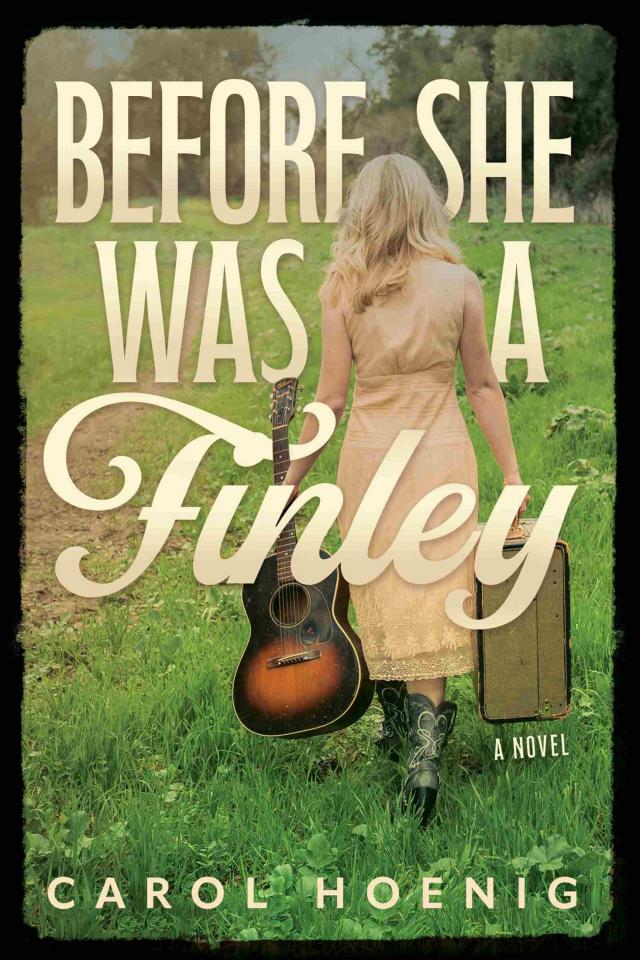
BEFORE SHE WAS A FINLEY
A NOVEL
CAROL HOENIG
Words of Praise for Without Grace
“We need more North Country novels like Without Grace, novels with a keen sense of place.”
—North Country Public Radio
“I so completely enjoyed your novel. Got completely hooked on it, loved Vicky especially—of course with my food obsessions, of course I would—but got very involved with her journey. She’s a wonderful heroine and the ultimate encounter with her mother is powerful. Congratulations to you for writing such a moving book.”
—Delia Ephron, author of Siracusa
“Like Scout Finch and Mattie Ross and Ellen Foster before her, Vicky Finley has grit and will and insight, a wry eye for the world around her, and a deeply engaging way of finding there a place of her own.”
—Michael Malone, author of Handling Sin
“Without Grace is the story of a girl’s search for her mother, a subject that cannot help but make the reader, and this reader, wonder what is going to happen next.”
—Rona Jaffe, author of The Best of Everything
“If you begin reading Carol Hoenig’s Without Grace at the start of the workday, you might as well call and tell your boss that you are engaged in a work that transcends the day. A meal, it is as smooth as lobster bisque, a grand main course, and what a dessert! What more can we want in a book? Get it and plan to take the day off.”
—Malachy McCourt, author of A Monk Swimming
“Without Grace is a story of tragic loss and subsequent self-discovery. Vicky Finley’s tale is haunting and unforgettable, as Hoenig’s narrative deftly draws us into the drama of her character’s life.”
—Susan Shapiro Barash, author of The New Wife
“Searching, soulful … Without Grace is a heartfelt exploration of that small town in all of us, our bittersweet Place of Angels.”
—Arthur Kent, journalist, filmmaker and author of Risk and Redemption
“This book is dynamite—literature as it was meant to be: at its finest. Keep your eye on this one—that is, when they’re not glued to the pages inside.”
—PODDY Mouth
“All the while I was reading, I kept thinking this is as good, if not better, than Isaac Bashevis Singer. You took life, and articulated it as if you were one of Robert Heinlens, “Fair Witnesses.” It was about the evolution of a human being, and the sometimes agonizing decisions we are forced to make on our drives to center ourselves.”
—Shawn Phillips, award-winning rock pioneer
Words of Praise for Of Little Faith
“Two sisters and a brother are bound to a dark past by their shared interest in the family home. Painful memories render them unable to come to an agreement that would open the door to the possibility of healing. Hoenig skillfully shifts between four narrators to tell this gripping story, avoiding excess sentimentality. A real page-turner I found hard to put down.”
—Anna Jean Mayhew, author of The Dry Grass of August
“Brutally frank and devastatingly real, this exceptional novel explores the dynamics of a dysfunctional family while calling attention to hypocritical behavior.”
—Foreword Reviews
“Serious and heartfelt, and highly readable.”
—Meredith Sue Willis, author of A Space Apart
“Reactions by this novel’s readers may depend on one’s beliefs or lack thereof, but it cannot be denied that the essence of compassion is the theme brilliantly shining through this poignant story. The reader’s feelings evolve parallel to those of the characters. Change and honest caring were the by-products of the ’60s, all of which the reader experiences in a wondrous way that remains long after the story and its afterword are finished. Excellent historical fiction and highly recommended.”
—Historical Novel Society
This novel is dedicated to my fellow Wildflowers podcasters, Judith Vaughan and Peggy Zieran, who helped bring Before She Was a Finley to where it needed to be. Their encouragement, friendship, and support is something every writer should experience.
CONTENTS
Prologue
Part One
Chapter 1
Chapter 2
Chapter 3
Chapter 4
Chapter 5
Chapter 6
Chapter 7
Chapter 8
Chapter 9
Chapter 10
Chapter 11
Chapter 12
Chapter 13
Chapter 14
Chapter 15
Chapter 16
Chapter 17
Chapter 18
Chapter 19
Chapter 20
Part Two
Chapter 21
Chapter 22
Chapter 23
Part Three
Chapter 24
Chapter 25
Chapter 26
Chapter 27
Epilogue
Acknowledgments
Copyright
PROLOGUE
It was the first assignment for Adele Thibeau’s summer journalism workshop. There were only seven students in the course, though it had begun with eleven. The call of the warm breeze and rhythmic lake’s laps were so enticing that some of the students dropped out to enjoy the short season in Upstate New York; summers always seemed brief in the rural area skirting the Canadian border. But Adele refused to be distracted. Instead, she envisioned receiving the Pulitzer for reporting one day, and, even though she wasn’t terribly intrigued by what the teacher assigned, she figured she’d make the best of it.
With her notepad and pen at the ready, Adele waved goodbye to her father as he drove away and walked through the main doors of Franklin County Nursing Home with a sense of purpose. She’d never been in such a place before. Not only that, but at seventeen years old, she’d never had much cause for talking to old people, or they with her, if she was honest with herself. She went up to the front desk where a woman was seated, her head bent over paperwork.
“Excuse me,” Adele said.
The woman looked up, giving her the once-over. Adele, in her ripped jeans and loose-fitting t-shirt, knew she didn’t look the part of any journalist she’d seen on camera, but since she wasn’t going to be on camera, she figured her appearance wouldn’t matter. After all, that’s what Mr. Wilson had told her when she’d asked how she should dress to do the interviews.
“Half of the people there are probably blind, so I don’t think it matters much,” he’d said.
“Are you sure there’s nothing else I can write about?” she’d whined. How could she possibly earn an A with such an assignment?
“Well, find a local business and see how they started out, if you prefer,” Mr. Wilson replied.
Since she had to rely on her father to drive her, she decided it would be easier going to one location instead of trying to seek out a business that would be willing enough to be interviewed, so she took the nursing home assignment.
“Yes?” the woman from behind the desk said.
“I’m Adele Thibeau. Mr. Wilson sent me here to interview some of the patients for a class assignment.”
Looking over the top of her glasses, the woman said, “Well, they aren’t patients.”
“They aren’t?”
“No. We refer to them as guests.”
“Oh,” Adele said, tucking a strand of curly dark hair behind her ear.
“Patients are sick. These people are just old.”
Adele liked the quote and mentally took note.
“So, who are you here to see?”
Adele shrugged. “I don’t know.” Mr. Wilson had told her to find out if any of the people at the nursing home had fought in the war. She wasn’t sure which war that would be.
“Or maybe they suffered a major loss and had to start from scratch,” Mr. Wilson continued. “That happened to a lot of the farmers around here.” He must have seen Adele’s dubious expression because he said, “Or maybe finding out how they were affected by how fast the world was changing.”
“In what way?” Adele had said.
Growing exasperated, Mr. Wilson said, “Believe it or not, Miss Thibeau, there was a time women couldn’t even entertain the thought of working outside the home and had to depend on a man to support them. Women were, well, second-class citizens.” He scooped up his papers, and as he walked out of the classroom, snapped, “It’s up to you to find the story and write about it.”
Now she said, “I’m looking to interview someone who had an interesting life.” When the woman looked confused, Adele added, “I want to be a journalist,” as if this would suddenly make everything clear.
Just then a middle-aged man dressed in all white came around the corner pushing an old man slumped in a wheelchair. As they passed by, the woman behind the desk said, “That’s Earl Duprey. Not the orderly, but the old man. He loves to talk.”
“Oh!” Adele said. “Would it be okay, if—”
“—Go right ahead,” the woman said with a chuckle.
Adele dashed down the hall chasing after the orderly. “Excuse me! Excuse me!” she called out, waving her notepad and pen. “That lady told me I could interview him.” Adele pointed to Earl.
The orderly looked from Adele to the old man and down the hall toward where the lady was sitting behind the desk. “She did?”
Adele nodded, hoping Earl Duprey would be a “get” and her story would be written in no time. Then she’d be able to join her frie nds at the lake.
“Follow me. I’m bringing him to the solarium.” As the orderly started to roll the wheelchair down the hall, he said loudly, “Earl, this pretty young thing is here to talk to you!”
Earl began mumbling and, to hear what he was saying, Adele had to practically run to stay abreast of the rolling wheelchair. She scribbled the date on the first page of her notebook: July 9, 2013.
“Thing is they gotta be milked twice a day. Otherwise, they die.”
“Excuse me?” Adele said, leaning in so he could see her.
“Buddy, be sure to lock up tonight.”
Adele looked at the orderly, who said, “Oh, he’ll talk all right. Never makes any sense, though. I think June was pulling your leg.”
“Who’s June?” Adele asked.
The orderly nodded back down the hall. “The woman at the desk. Earl ain’t made a lick a sense since he’s been here.”
“How long has that been?” Adele asked.
“Going on about three years.”
Adele studied the old man as he continued to mumble, slumping further into his wheelchair while the orderly brought him into the solarium. He parked him near a table next to several other elderly people and nodded at Adele before leaving Earl in the warm sunlight streaming in through a large window.
Adele turned to survey the room. There were two women sitting in front of a television, though neither of them seemed interested in the soap opera that was playing. There was another man, who didn’t look as old as the others, sitting at a table with a deck of cards spread out in front of him. Another elderly woman was nearby, but she was being entertained by a young child calling her Grandma. Adele figured it was useless to get any sort of story from the confused man in the wheelchair, so she went over to the man who was playing cards and introduced herself.
“Adele?” he repeated. “That’s a pretty name. You’re pretty. Wanna go out tonight?”
She laughed and said no, but once she rebuffed his advances, he wanted nothing to do with her and wouldn’t answer any of her questions. It seemed none of the people that were in the room wanted any sort of interruption to their day. She then decided to check out the place. After all, she would need to give the reader of her article a sense of the surroundings. However, if she had to describe it, one word came to mind: depressing. It soon became apparent that for the guests there was only one means of escape.
She wandered out of the solarium, leaving Mr. Duprey mumbling about nothing that made sense to her, and took a right. The smell of disinfectant mixed with stale odors filled the air as she strolled down the hall. She passed one room after the next, reading the names in the little slots in the wall outside each door. After peeking inside, she would then keep going. Some had a television blasting, others were curled up in bed, their mouths slack, eyes closed. She couldn’t help but wonder how Leslie Stahl and Cokie Roberts got their stories. Getting her assignment complete so she could enjoy some time at the lake might take longer than she’d hoped.
She reached room 120 and looked in to see a woman in a wheelchair facing a window. Her hair looked to be nothing more than thin white fluff, and Adele studied her for a few moments, the woman unmoving, perhaps gazing at the empty field beyond the window. It was also possible that she was sleeping. Adele poked her head in further, noticing that someone else was in the bed closest to the door, the nightstand covered with photos and cards.
Adele stepped back out into the hallway and read the two names next to the entranceway: Mary Patnode and Grace Dormand.
“Margaret, that you?”
Adele took a hesitant step into the room. The woman in the bed sat up, her eyes wide open, anticipating.
Adele replied, “No, no, I’m Adele Thibeau.”
“Oh, thought you might be my daughter, but come on in!” The woman shifted as if to make herself more comfortable for a visitor.
“I’m doing a story for my journalism class.”
The woman leaned to one side. “What kind of story?”
Adele wasn’t sure how to answer, but said, “Just something people would want to read about.” Adele pointed to a chair next to the woman’s bed. “May I sit?”
“Oh, that’d be nice,” the woman said, reaching around and plumping up her pillow.
Adele glanced over to the other side of the room, noticing that the woman with white fluffy hair hadn’t budged, leaving her to wonder if she’d already begun making her journey into the afterlife. Adele took a chair and said, “Which one are you? Mary or—”
“Oh, I’m Mary. Mary Patnode. I got nine, no, ten or more grandchildren. Five great grandchildren.”
Adele started writing on her notepad, even though Mary hadn’t said much of anything worth writing about yet. She went on to say that she’d raised her kids and took care of her husband who had worked at the aluminum plant in Massena. “Traveled back and forth every day, no matter the weather. Died September 26, 1994. Sure do miss him.” Despite this detail, Mary’s life didn’t seem all that remarkable. Adele decided to nudge her a little.
“Did you ever do anything out of the ordinary?”
Mary squinted, thinking. “Once when I went to town, I bought myself two pairs of the same shoes ’cuz I liked them so much. Figured when one pair wore out, I’d have a second.”
Adele smiled and then pushed a bit harder. “Well, did you do anything that most women back then didn’t normally do? Or did you ever want to?”
“Like what?”
Adele shrugged. “I don’t know. Did you have a job?”
“A job!” Mary snorted. “I had five children to take care of. One of them so slow, I had to keep him home.”
“Where is he now?”
“Living with his sister in Ellenburg. People loved my banana nut bread. I used to make about twelve loaves every Christmas and give ’em as gifts.” Mary stopped and studied Adele. “You’re not writing.”
“I … I’m looking for more of a story. I mean, something with some drama.”
“Drama?” While Mary took a moment to consider this, the fluffy white-haired woman wheeled herself around and stared at Adele.
Adele felt as though the woman wanted to say something, so she said, “How about you?”
The woman’s expression was hard, but her voice weak and quivery when she replied, “Drama? Like walking out on your two babies and husband?”
Adele gazed at her, stunned.
“That’s Grace Dormand,” Mary said. “That’s the first I ever heard her speak.”
Part One
CHAPTER 1
It had been about a week since that young girl first barged into the room and began nosing around and she hadn’t stopped since. When Mary had been quick to ask, “What kind of mother would do something like that?” Grace wasn’t sure why she’d volunteered such a reply in the first place, especially when she hadn’t been spoken to; not right away, anyway. She never talked of her past and tried to avoid thinking about it. So she turned around to face the window again, but it wasn’t enough to make the girl leave her alone.
“Ma’am?”
Even at her age, Grace never considered herself old enough to be called “Ma’am.” However, maybe it had been the need to unload the guilt she’d been carrying all these years, so when the girl kept returning day after day prodding, “May I ask you a couple of questions,” Grace started to wonder if her answers would be her penance. Perhaps that’s why she hadn’t died yet. Maybe she wasn’t going to be allowed to go to her grave without first acknowledging her sins.
She turned her wheelchair around. “What did you say your name was?”
“Adele. Adele Thibeau.”
Thibeau was a surname she’d recognized. She probably knew of Adele’s family, or the ones who’d passed on, anyway. “Adele,” she mumbled, “what do you wanna know?”
Adele edged down onto a chair that was in the corner. She turned a page in her notebook, and said, “So, you, um … left your family?”
Grace stared off and then nodded.
“Why?” Adele said.
Grace looked away. She’d never given voice to the real reason and still wasn’t sure she could.
“Um,” Adele said, “where’d you go? What’d you do?”
“Do? I played my guitar in different honkytonks.”
Adele had her notebook opened and pen ready. She looked up. “Honky what?”


