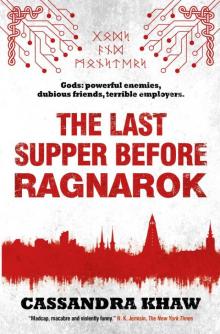
The salt grows heavy, p.1
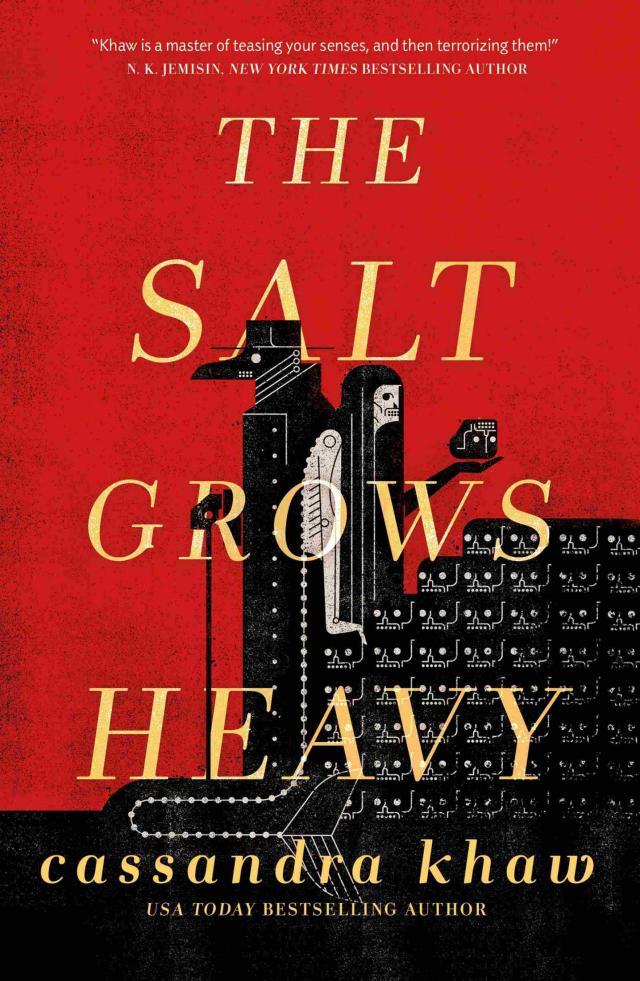
The Salt Grows Heavy, page 1


Begin Reading
Table of Contents
About the Author
Copyright Page
Thank you for buying this
Tom Doherty Associates ebook.
To receive special offers, bonus content,
and info on new releases and other great reads,
sign up for our newsletters.
Or visit us online at
us.macmillan.com/newslettersignup
For email updates on the author, click here.
The author and publisher have provided this e-book to you without Digital Rights Management software (DRM) applied so that you can enjoy reading it on your personal devices. This e-book is for your personal use only. You may not print or post this e-book, or make this e-book publicly available in any way. You may not copy, reproduce, or upload this e-book, other than to read it on one of your personal devices.
Copyright infringement is against the law. If you believe the copy of this e-book you are reading infringes on the author’s copyright, please notify the publisher at: us.macmillanusa.com/piracy.
For Jeff Solomon,
this is what you get for not giving up on me
I
The First Night
“Where are you going?”
I pause. In the penumbra, the fading dusk gorgeted by coral and gold, you could be forgiven for mistaking the ruined house a ribcage, the roof its tent of ragged skin. The foundation, at a careless look, could pass for bones, the door for a mouth, the chimney a finger crooked at the sky, or at a wife who would not be a savior.
Ash sleets from the firmament in soft handfuls of black, gathering in gauzy drifts around my ankles. The sky is ink and seething murk, whispering secrets to itself, the clouds snarled like long, dark hair. I glance into the house. Two of my daughters look back, eyes shining. They are seated astride a twitching form, its limbs too small to have belonged to an adult. Like cats, they croon to one another even as they nibble their fins and fingertips clean. My breath snags. Only days old but already, they are the best of their parents. They have their father’s full lips, his blue eyes, his supple sun-warmed skin.
And they have my teeth, my deepwater hair, like the lures of the anglerfish spun into thick coils. Nothing sticks to those radiant strands, no amount of gore or mud. Which is fortunate, given how messily my offspring eat.
One fishes a gnawed-down fingerbone from her maw, flicks it to the ground. The other pounces and for a moment, I glimpse the fair circle of their victim’s face; its eyes gouged, its cheeks flensed, its skull emptied of sweetbreads. Mermaids—especially those born half-prince—leave nothing to waste.
“Of course. I forgot. You can’t speak. My apologies.”
I look back. The plague doctor flutters a hand, voice strange behind their mask. Today, they are dressed most austerely: plain black robes; a broad-brimmed hat; the half-skull of a vulture, carefully bleached, unornamented save for a single hieroglyph embossing its brow. Alone of my husband’s people, what few remain after the apocalypse of my children’s hunger, the plague doctor is not afraid. Has not ever been afraid. “Do you know where you’re going?”
I consider the question. I’d toyed with the idea of going home. In my dreams, I still swim that soundless black, still travel its eddies of salt and cold nothing. My sisters are alive in these nocturnal fantasies: colorless, resplendent, their hair floating like a frothing of wedding veils.
But those are just baseless images pieced together by the unconscious, invoked by a longing that has since had time to turn septic. I have been on dry land for too long; the depths would devour me the way they would any creature of the air.
“Well?” The plague doctor steps closer, fearless. Eyes green as the humid, hated summer.
I shrug.
To my astonishment, they laugh.
“Such a pair we make. I don’t know what I’m going to do either, what with the kingdom being eaten to nothing.” The look they slide me—heavy-lidded and coquettish—is so audacious that I soundlessly laugh in spite of myself. “If you don’t know where you’re going, do you at least know what you plan to do?”
I shrug again. Over the snow-gilded mountains, I know there are kingdoms without number, pastoral and beautiful, each ruled by another prince or king, another czar and his court of calm-eyed lackeys. Another man like my husband: beautiful and terrible and cocksure in the magic he’d thieved from his bride.
There. I could go there, perhaps. Find another sovereign who’d fish a mute from the waters, who’d marry her, bed her, murder her sisters for a superstition, and then pry the teeth from her gums for the sake of caution. I could find one of those again, maybe, and wait until my daughters come to gnaw his country down to its bones.
As though conscious of my musings, the plague doctor nods, their voice hollowed by the fluted bone. Even after all this time, I cannot tell whether they are male, female, neither, both, some gradient wicking between definitions. “And you shall know her by the trail of dead.”
A harpy phrase. I smile at the music of it.
“How do you feel about company?”
I cock my head.
“A doctor is always useful,” they tell me, fox-sly. “What do you say?”
I say nothing, of course. My husband cut the tongue from me when he discovered I was pregnant; braised it with five-spice and saffron before feeding me the tender slivers. Animal meat was forbidden, but assisted autosarcophagy, his soothsayer had crooned, would ensure pliance.
But I smile, nonetheless, and it is answer enough for my new companion.
* * *
We burned the kingdom to cinders. Pillars of choking smoke rose from the bodies we’d heaped into neat stacks, stinking fattily, saltily of crisping pork. The plague doctor had insisted. To leave the bodies as they were was to invite disease, an epidemic that would rot the soil, infect the waters.
“What is the point of revenge if you can’t enjoy it?” The plague doctor chuckled as they led me and my chocolate-stippled horse—my husband’s last gift before our children made a feast of him: a sullen gelding who loathed him as much as I did—from the smoldering ruins.
I offered no reply and instead watched the smoke, like warnings of what would be.
* * *
In winter, as in the spring, the taiga is beautiful. Pine trees and white spruce scrape at the firmament, skeining the snow in strange patterns. There are smaller plants too, aspen and alder and birch, even colonies of withered ferns. Occasionally, I catch sight of wolves in the tree line, shark-sleek and grey; of bobcats glaring yellow-eyed from some desecrated barrow; of foxes, their muzzles sodden and dripping with red.
The plague doctor’s breath plumes through the air as we walk. Mine does not. Though I hold no particular affection for it, the cold has never been a thing I fear, a fact that once amused my husband’s court to no end. They made me promenade through the winter, my naked skin irridescing with frost. Still, my companion insists on swaddling me in fur: woolly gloves and a bearskin coat of unusual pallor.
“It would look strange if you weren’t dressed for the weather,” the plague doctor says in way of explanation as I fondle my gifts, the lining smelling of musk and frankincense oil. The fur itself is almost satiny, a delight to massage between my fingers. “People would ask questions.”
I scan the wilderness. There is no one but the hares and the badgers here, nothing but the trees and the quiet, the hawks and the wights—the unsleeping dead, burning forever, unable to rest—pacing spindle-limbed through the gloom. If there are men concealed in the boughs, they harbor no interest in our acquaintance. For fear of my plague doctor, perhaps.
Or me.
The plague doctor laughs, arsenic-sharp, a bark of a noise, before crunching into a bright red apple. “A stranger is an easy target, easier still when they are as strange as you. If you had believed our former kingdom cruel, a place of treachery, let me assure you that it was the finest of its neighbours. The rest of them—”
Something of a smile emerges, a private amusement.
“Anyway. Yes. The furs should help. At least until you smile. Your teeth will give us away immediately,” the plague doctor murmurs as they chew, their voice softer, kinder. “I’m surprised that your tongue didn’t grow back with them.”
I shrug. The physiology of my species is protean, unme- tered by logic. When we breed with angels, our children accrete feathers. When we lay with hurricanes, we birth storms, wind-spirits with the voices of dead sailors. A thousand mythologies contributed to my conception. Who can say which of them was responsible for this miracle? I stroke the stump of my tongue—enough has regrown so that I might separate bitterness from salt, might savor the taste of muscle, briefly seared—over my back teeth, tracing the needle-thin growths, and shrug again, more empathically than before.
In answer, the plague doctor guffaws, a vulpine sound this time. There is no more conversation after that. We stop, once or thrice, to attend to the little shrines that dot the woods, half buried in the snow. Wax clogs their hearts like colored tendons, the corpses of a thousand candles. Food rots without, untouched by the forest.
“I don’t believe in souls,” the plague doctor whispers at one point, voice husked, and I suspect the words are intended for someone else, sometime else, a place and a moment as distant from the present as I am from the sea. They extract a feather—black as pitch save for its meridian of fire—from a satchel and place it atop the melted tallow. “But just in case: a feather to help them fly home.”
&
And besides, who am I to speak on this? All of my kind are just souls with a cloak of skin and scales, barely tethered to the act of living.
We walk until the moon reaches its zenith, a cataracted eye glowering from the star-drowned sky. Then, at a clearing, a square of land jagged with old cairns and vacated graves, its denizens either cannibalized by the forest or changed by it, my travelmate declares:
“We’ll stop here.”
I dismount with the plague doctor’s assistance, out of courtesy rather than any actual need. Parturition has not weakened me. If anything, it has done the reverse. But these small courtesies seem to please my companion so I perform these rites as a small concession. A trade for services rendered.
In the distance, something moans, low and displeased; a wolf, maybe, or a daughter of mine, sharp-teethed and jeweled with onyx scales, already grown bored of her butchered kingdom. The stars blink out, one after another, eaten by the rising fog.
Still, whatever it might be, the plague doctor evidences no interest in its existence, divvying up our responsibilities with a noncommittal authority. I am placed in charge of the fire, of this evening’s meal. The plague doctor tasks themself with everything else: defenses, the replenishment of our rations, the ablutions of my mount.
Mine are easier duties than I’d anticipated despite my inexperience with the world, my husband having kept me cloistered: a bloody jewel swaddled in the dark. I have an unerring sense of which branches serve better as kindling, and which are still green and wet at their heart. The fire comes quickly too, a flash of orange-gold, lunging for me like a lover thrice denied.
For food, I roast us the trout that the plague doctor supplies. The meat is clumsily seasoned: some dried thyme, some basil crushed under a jag of rock, a rich spill of peppercorns, before it is then cooked with too much eagerness, too little skill, and not enough sense.
“It’s edible. I wouldn’t worry too much,” remarks the plague doctor later as they pick chunks of black-burnt meat from their share; first examining the charred meat by the darting flame-light before tossing it into the snow. Once they have whittled the ash away, they eat. I devour mine whole, ash and bones and all.
When we finish eating, we lapse into silence, one watching the other. The fog deepens and the firelight smears orange across the plague doctor’s mask.
“What?” They laugh, low and rich.
I rap the bridge of my nose.
Fingers rise to the vulture beak, trace the wicked swoop of its mandible. “The mask?”
I nod. In all the time we’ve known one another, I’ve never seen the physician without the cover of another creature’s shell. They laugh, the sound refracted by keratin. Without a word, the plague doctor removes their mask and their hat, dragging fingers through a dense mass of close-cropped black curls. The face underneath is raptorial: sharp angles, a mouth predisposed towards wryness, the eyes glittering and thick-lashed. Not unattractive, not unhandsome, but curiously barren of the phenotypes that mark the human species, androgynous in a way that makes me think of dolls and polished, hand-carved things.
When the plague doctor turns their head, I see something else: careful stitching along their jaw and cheekbones, the hollows of their orbital sockets. Stitching so fine that it could be invisible. Almost.
They grin at me, knowing. Their voice too could belong to anyone, any gender. “You have questions?”
I take the mask from their hands and rotate the polished rostrum, finger mapping its topography of ravines and muslin netting. Once, this might have held camphor and dried flowers, a fragrance of cinnamon. Glass in the eye sockets. But for some reason, the plague doctor saw fit to maim the design. I wonder what the halving of it symbolizes.
“I’ll trade you.” The plague doctor slithers closer, their robes dragging across the snow. I inhale their scent: a dry, faint potpourri of herbs, bone-meal, frangipani, and old leathers. When they place their hand on mine, their flesh is warm. Strange how natural this feels, this configuration of phalanges and dermis. With my husband, buried now in the guts of our brood, it had always felt like a violation, even his most innocuous caress. “One question for one of my own.”
I nod, letting go of the mask so I might lace our fingers together.
“You first.”
I cup the plague doctor’s chin with the hand I have free, taking care to stroke the sutures ridging the flesh, and they laugh in easy reply.
“These,” they ask.
They detach my grip—so gentle, so cautious of where and how our bodies fit—and place their fists on their lap, body slanted away, the long column of their frame held perfectly still. The plague doctor does not even breathe. “Did you ever wonder why I took an interest in your person? It is because we are not unlike, you and I. We are both manufactured beings.”
Manufactured. Understanding frissons. With new eyes, I contemplate the variegation in their complexion, how some swathes of skin are infinitesimally lighter than their neighbour, how their fingers share no commonality in texture. No, we are not very different at all, even if one is fashioned with thread and dried sinew, the other cleaved and then conjugated by magic.
“My turn. What is your name?”
I breathe the cold, deep.
And I place the sound—a guttural exhalation made coherent by what little magic glitters still inside me—into the plague doctor’s keeping.
* * *
Myths are full of lies.
This is not one of them.
Names are like selkie-skins, often carelessly attended, left in view of those who would misuse them. Utilized correctly, though, they can kill a man, can turn a girl to a thing of teeth and dead eyes, an appetite to devour worlds; can make infernos of maidens, phoenixes of bones who have been asleep for so long they’ve forgotten the shape of rage.
Names have so much power.
Enough even to hide a soul in the curl of a stranger’s tongue.
* * *
“That is hard to pronounce.”
I shrug. The language of the deepwaterbasal, marrow-deep—does not require air, or tongue, or even lips to mold. But their indignance—inflected in the rueful bend of their mouth, the restless way they carve furrows through their hair, over and over in nervous repetition—extracts a smile from me. I’d missed the plague doctor, I realize. My husband hoarded my pregnancy, its moments and movements, the waxing of my womb an aching minuet, choreographed to his amusements, his ambitions. I was permitted no company save for what he’d curated, no conversation but his.
“No matter. I—”
A shriek. Two boys explode from the woods, one in pursuit of the other. The former is taller, paler, whipcord-muscle beneath a mantling of fur. He holds an iron stake in one hand, the jut of polished metal rested against his hip. The tip is black.
His quarry is smaller, gangly as a puppet, barely more than gristle lashed to growing bones, and peculiarly naked despite the winter. He runs with his hand pressed to his belly, the flesh gashed open. Behind his palm, I see grey intestine, membrane bulging between the slats of his fingers. The snow blooms red beneath his feet, a splotching of color like bloodied tongues. Saliva wells in the room of my mouth.
The taller one leaps.
For the frame of a second, there is only silence, only the taiga holding its breath, only the firelight reflected against the wet of the stake as it thrusts through the gap between two ribs. A sharp intake of air as the stake burrows into organ matter. A scream gurgling through punctured lungs. They slam into the frozen soil, fur and gore and pasty flesh. Snow fountains.
The plague doctor is on their feet before I can react, shouting furiously, their hood shucked, their mask replaced. Their words churn, meaningless, in my ears. I am spellbound. I watch as one boy rises, triumphant, over the corpse of the other. He grins at me, his eyes jellyfish-light, the pupils swollen, before punching his stake into the air.