

The curious kidnapping o.., p.1
The Curious Kidnapping of Nora W, page 1


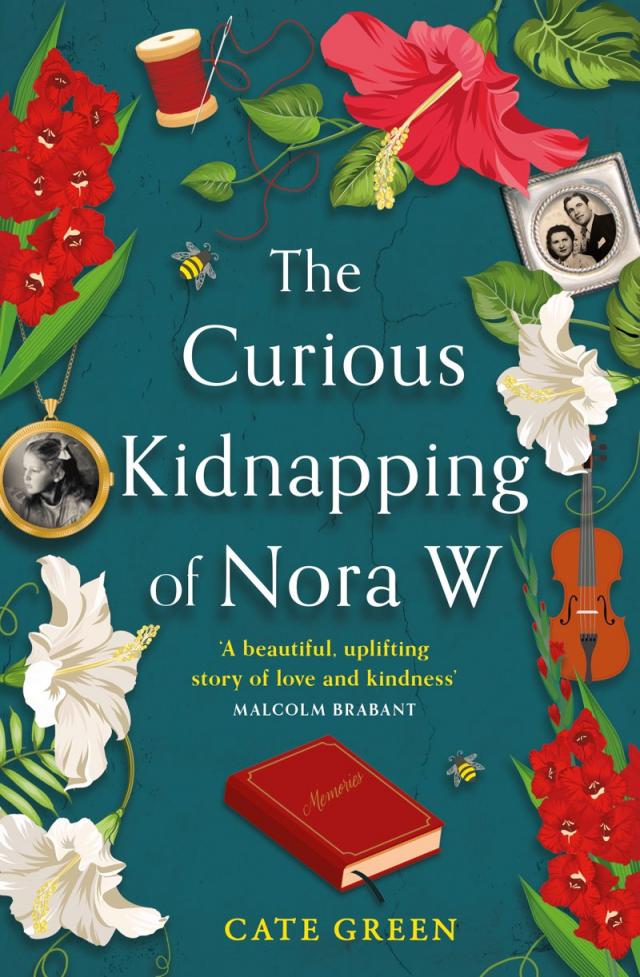
THE CURIOUS KIDNAPPING OF NORA W
CATE GREEN
One More Chapter
a division of HarperCollinsPublishers Ltd
1 London Bridge Street
London SE1 9GF
www.harpercollins.co.uk
* * *
First published in Great Britain by HarperCollinsPublishers 2023
* * *
Copyright © Cate Green 2023
* * *
Cover design by Lucy Bennett © HarperCollinsPublishers Ltd 2023
Cover photographs: Shutterstock.com
* * *
Cate Green asserts the moral right to be identified as the author of this work
* * *
A catalogue record of this book is available from the British Library
* * *
This novel is entirely a work of fiction. The names, characters and incidents portrayed in it are the work of the author’s imagination. Any resemblance to actual persons, living or dead, events or localities is entirely coincidental.
* * *
All rights reserved under International and Pan-American Copyright Conventions. By payment of the required fees, you have been granted the non-exclusive, non-transferable right to access and read the text of this e-book on screen. No part of this text may be reproduced, transmitted, down-loaded, decompiled, reverse engineered, or stored in or introduced into any information storage and retrieval system, in any form or by any means, whether electronic or mechanical, now known or hereinafter invented, without the express written permission of HarperCollins.
* * *
Source ISBN: 9780008562526
Ebook Edition © July 2023 ISBN: 9780008562519
Version: 2023-05-25
For Rose, Claire, Ruby and Maya, the next generation, with love.
Author’s Note
The initial inspiration for The Curious Kidnapping of Nora W was my late mother-in-law, Norma Celemenski née Kryger. Norma was born in 1925 in Lodz. She was still living in the city at the time of the Nazi invasion of Poland and was walled up inside the ghetto there along with her family and tens of thousands of other Polish Jews. Her father died there of starvation in 1943. Just over a year later, she and her mother were deported to Auschwitz. Her mother was shot and killed on the platform as she got off the train. Norma became a slave worker because she was deemed to have the young eyes and hands necessary for making precision bombs. One of her brothers was also murdered in the Holocaust. Another brother and her sister survived.
After the war, Norma became a refugee and later a nurse in Sweden. She eventually left to find her sister in France and then sailed with her husband, Heinryk, and their two young children to Montreal, where they ran a shop very much like the one in this novel, open 7 days a week (except for the Jewish New Year and Yom Kippur) and also called Henry’s Fruit.
Like Nora in the novel, Norma was resilient, determined - and stubborn. She lived well into her nineties and, towards the end of her life, some began to wonder if she might not actually be indestructible. It was her resilience and spirit that gave me the idea of writing about a survivor, a woman who might take a personal revenge against the perpetrators of the Holocaust by becoming the oldest person in the history of the world.
Two other women are also part of the inspiration for the book: Mahbubeh and Imane, both refugees from Iran and Syria respectively, who shared my family’s home for a few months when they arrived in France and who have become dear friends. Like Norma, they are paragons of resilience. Because of war and religious intolerance, they have been forced to leave their home, their country, most of their family and their friends. Yet rarely have I ever seen them with anything other than a smile on their lips.
The Curious Kidnapping of Nora W is not a historical novel. It is not a novel about the victims of war and injustice. It is a novel about survivors of war and injustice and their lives as ordinary people with an extraordinary past. The friendship between Nora and Arifa is a small tribute to the three women who inspired it.
Contents
1. Eighteen days and counting
2. Eighteen days more
3. Eighteen days and counting
4. Eighteen days and counting
5. Seventeen days more
6. Seventeen days more
7. Seventeen days and counting
8. Sixteen days more
9. Sixteen days and counting
10. Fifteen days more
11. Fifteen days and counting
12. Fourteen days more
13. Fourteen days and counting
14. Fourteen days more
15. Thirteen days and counting
16. Thirteen days and counting
17. Twelve days more
18. Twelve days and counting
19. Eleven days and counting
20. Eleven days and counting
21. Ten days more
22. Ten days and counting
23. Ten days more
24. Nine days and counting
25. Nine days and counting
26. Eight days more
27. Eight days and counting
28. Seven days more
29. Seven days more
30. Six days and counting
31. Six days and counting
32. Six days more
33. Five days and counting
34. Four days more
35. Four days more
36. Three days and counting
37. Three days and counting
38. Two days more
39. Only one day and counting!
40. Oy such a day!
What’s in a name
Acknowledgments
Credits
Thank you for reading…
You will also love…
About the Author
Subscribe to the OMC Newsletter
About the Publisher
ONE
Eighteen days and counting
Morning
My great-grandmother has only eighteen days to go. There’s no need for alarm though. The doctors have not predicted her precise date of death, nor has she threatened hyper-geriatric suicide on that specific date. No, in eighteen days’ time she will become the world’s oldest person. Ever.
Dinora Wojnawski was born on 10th November 1896 and if she makes it to 24th April 2018 (and her doctors are confident) she will be 122 years and 165 days old. Thus demolishing the record set by Jeanne Calment, who was born in Arles in romantic Provençal France and died there too, in August 1997. The records state that in 1888, Mademoiselle Calment was the last living person to have knowingly met Vincent van Gogh. The story goes that he came to her father’s shop a hundred years before to buy canvas for his paintings and that our thirteen-year-old Jeanne found him particularly ugly. At the time, nobody thought to ask the hideous painter customer to pay for his supplies in artworks, but since Mademoiselle married into money, she had little, if any, regrets on that score. These are just a few facts that differentiate Jeanne Calment, currently the oldest person the world has ever seen, from my great-grandmother.
Dinora (known to her intimates as Nora and to all her grand, great-grand and great-great-grandchildren as our traditional yiddisher Bubby) was born in Lodz, Poland in the relatively carefree days before the two world wars. Less romantic than Provence, you will agree. It seems certain that she will die in Pinner, Middlesex, since that is where she now resides, in the Cedars Care Home, conveniently located on the Metropolitan Line with fast trains into central London and not a majestic conifer in sight. As far as we know, she has never met any world-famous painters, living or dead, although Elton John did come to the Cedars for her 120th birthday celebrations (Wikipedia notes that Elton, aka Reginald Kenneth Dwight, was born and raised in Pinner). He sang the rather inappropriate ‘Candle in the Wind’. I suppose he was thinking of all the ones on the cake.
A little less than a hundred years and a thousand miles separate Nora from Lodz today and her life has been at least as full as Jeanne Calment’s, if rather less sheltered. Although much of that is another story entirely.
A further important difference between these two supremely senior citizens is that my great-grandmother did not marry well. By that I do not mean, as her remaining family apparently believed, that my great-grandfather was a good-for-nothing. Rather that he had little or no pockets, let alone any zlotys, left when he arrived in Britain fresh from the war (note the ironic use of the word fresh) and failed to earn much more than a pittance in the grocery that he and his wife ran just off Brick Lane, until retiring to the flat above the shop. (Henry’s Fruit, as it was called, is now a trendy street art café, rumoured by some to belong to Banksy.) Money was certainly scarce back then, but these days there is uncertainty, not to say speculation, among her grand, great-grand and even great-great-grandchildren about just how much we all stand to inherit, if and when mortality finally catches up with the apparently indestructible Nora. An old miser is how my mother has been known to describe her, but then she’s always claimed the Wojnawski side of the family welcomed her with less than open arms. Careful, Bubby would say. Careful enough for the happy couple to put their hard-earned savings to one side to buy a rental flat here, a rental flat there, so she must have cashed in big time thanks to the East End of London’s soaring property prices when, several years after Henry’s death, the family gently suggested she sell up and move to the Cedars. And that makes the guess-how-many-zeroes game even more of a puzzle. I’m not
Yes, it is I, Debs Levene, née Wojnawski, and the family’s go-to party organiser/peace negotiator who hath been tasked with project managing, nay choreographing, the celebrations to mark this miracle of miracles:
Set the date – piece of cake [check]
Book the rabbi (no service planned, but of course – as my mother is at pains to remind me – no self-respecting North London Jewish World Record party would be complete without a rabbi) – [check]
Choose and book the venue (another piece of cake since the Cedars only has one function room) – [check]
Liaise with the UK and worldwide keepers of the records of records at guinnessworldrecords.com – [check]
Book the caterer without causing a fatal family feud – (just about) [check]
Select and send the invitations – (and I stand by my choice of design, tasteful yet Jewish) [check]
Contact Elton John’s manager re reprise (but with different song) – but Elton unavailable [check]
Direct rehearsals of choral performance by great-great-grandchildren to replace Elton [ongoing]
You get the picture. There will be the twenty-one direct descendants. These include Grandpa David wheeled down from his studio on the fifth floor of the Cedars (Bubby is on the third floor, closer to the medical facilities) and a big contingency from Canada, my aunts Judith and Sarah having headed to the far north with their families, leaving pretty much all elderly relative considerations to Daddy, me and (if there are martyrdom points to be scored) Mummy. Likewise, my brother Adam, who, as befits a good Jewish son, will be bidding a brief farewell to his New York law firm for the occasion. Then there will be at least a minyan from each of Bubby’s synagogues in East London and Middlesex, none of her own friends (all dead) and instead, apparently, the family of her favourite carer, Arifa. Arifa, like most of the other care professionals at the Cedars, recently arrived in Britain from somewhere in the south where Judaism is definitely not the official religion. Unlike some of my immediate family members (OK, Mummy and Adam) I do try to keep the centuries-old animosity between our peoples out of the equation, but I did almost say when hell freezes over to that one. I mean, Arifa may be Bubby’s latest hero, but she’s paid to have gentle hands and be patient, isn’t she? She doesn’t spend hours shopping around to bring her her favourite herring and gladioli, listening to her ramble on about the old days in the East End or complaining that her son never comes to visit. I do. And I do it out of love and family loyalty and, with the relatives on the other side of the Atlantic and my parents mostly at loggerheads (if and when they communicate at all), I seem to have become the family glue. But then you can’t refuse the not-quite-deathbed wishes of your own great-grandmother, can you?
Anyway, today is my turn (again) to visit Her Royal Bubbyness. And to administer the weekly pop-in on Grandpa David too. A quick round of pleasantries with the usual suspects in the lift and the doors open at floor three. Dinora Wojnawski lives in studio 318. An auspicious address under any circumstances (eighteen is a lucky number in the Jewish tradition, for those of you who are not of the faith) and especially today, with eighteen days to go before we raise our glasses of Guinness. (Champagne too expensive. No, just kidding!) The residents’ names are neatly written on pieces of card that are slotted into little holders next to their door. Handier to remove and change than engraved brass plaques, though, given the price of a month at this place, the real thing would have been more elegant. They are also allowed to hang something personal on their door, other than a mezuzah, obviously, and Bubby has pained James, my husband, by refusing to replace her chosen decoration with an exquisite wax crayon rendering of the Cedars’ grounds by our daughter, Amelia, aged five. She has clung on to a cheap, wood-mounted, pastel-coloured photograph of a square in lovely Lodz.
I knock, just hard enough for Lodz to wobble precariously, and go in without waiting, because the little light above her door that saves visitors from personal hygiene moments is green. And there she is. And it gets me every time. This tiny figure, swallowed up by the sheets and protective pillows of her medical bed. Tiny, but with steel in the bones that carried her first from Lodz to unthinkable places and then to London. And after that, when the doctors said she was far too old and infirm for home care (not to mention the cantankerous behaviour that made it impossible to find home carers), here to this bed that she says she hates but where we have said she must stay because we love her. I love her. I press my hand to my mouth to keep my voice steady and then, ‘Hello, Bubby,’ I call.
‘Who is it?’ she says, turning her head towards me.
I don’t know if Arifa is on duty today, but whoever it is has remembered to put her wig on, and despite her hollow cheeks and almost lightless eyes, there is our Bubby. The matriarch who has made it to the age of 122 years and 147 days. Who has driven us all mad, told us our chopped liver needs salt, taught every single one of us over the age of fourteen to play poker and who will probably outlive us all. I reach for the tissues in my bag.
‘It’s me,’ I say and hope her old ears don’t pick up on the lump in my throat, ‘Deborah. I’ve brought you flowers.’
‘Who?’
‘Deborah, little Michael’s daughter. You know, your favourite foolish girl.’
‘Oh, that one. And why have you brought me flowers? Haven’t you got any vodka in your bag?’
‘Bubby! You know you’re not allowed to drink anymore. I can get you a cup of tea, if you like.’
‘Ho!’ Her laugh is thin and shaky and catches in her chest. ‘I know I’m not allowed vodka before sundown, you foolish girl. I’m not senile. Thank goodness one of us has a sense of humour.’
I laugh too. I run some water, put the gladioli in her washbasin and then sit on the chair next to her bed. I kiss her cheek. Warm, crumpled paper. Paper, scissors, stone. Paper beats stone and Bubby has a wig to hide the various victories of scissors, fear and very old age.
‘So does my favourite horrible old lady want a cup of tea?’
‘No tea. I don’t want to be calling for a bedpan while you’re here, do I? Just a chat with you will be lovely. How are your little ones?’
I’m pretty sure Bubby remembers which of her eight great-grandchildren I am when she tries, but she makes no pretence of knowing how many great-greats she has, who they belong to and what they are called. And frankly, why would she?
‘You mean Amelia, Bubby. She’s fine. She made you another drawing, can you see? It’s her cat, Domino.’ (I will put the masterpiece in the recycling on the way out.) ‘Those are its ears and there’s its tail and I think those black blobs are its paws.’
‘I hope she’s better at maths than drawing.’
Bubby is not known to mince her words. Even where five-year-old family artists are concerned. It’s one of the long list of faults my mother (her granddaughter-in-law) finds in her and one of the many things that I hug her for on the rare occasions she lets me.


