Our john willie, p.1
Our John Willie, page 1


OUR JOHN WILLIE
Catherine Cookson
Contents
The Catherine Cookson Story
Our John Willie
1852
Chapter 1
Chapter 2
Chapter 3
Chapter 4
Chapter 5
Chapter 6
Chapter 7
Chapter 8
Chapter 9
Chapter 10
Chapter 11
Chapter 12
The Catherine Cookson Story
In brief:
Her books have sold over 130 million copies in 26 languages throughout the world and still counting…
Catherine Cookson was born Katherine Ann McMullen on June 27th, 1906 in the bleak industrial heartland of Tyne Dock, South Shields (then part of County Durham) and later moved to East Jarrow, which is now in Tyne and Wear.
She was the illegitimate daughter of Kate Fawcett, an alcoholic, whom she thought was her sister. She was raised by her grandparents, Rose and John McMullen. The poverty, exploitation, and bigotry she experienced in her early years aroused deep emotions that stayed with her throughout her life and which became part of her stories. Catherine left school at 13, and after a period of domestic service, she took a job in a laundry at Harton Workhouse in South Shields. In 1929, she moved south to run the laundry at Hastings Workhouse, working all hours and saving every penny to buy a large Victorian house. She took in gentleman and lady lodgers to supplement her income and took up fencing as one of her hobbies. One of her lodgers was Tom Cookson, a teacher at Hastings Grammar School, and in June 1940, they married. They were devoted to each other throughout their lives together. But the early years of her marriage were beset by the tragic miscarriage of four pregnancies and her subsequent mental breakdown. This took her over a decade to recover from, which she did, often by standing in front of a mirror and giving herself a damn good swearing at!
Catherine took up writing as a form of therapy to deal with her depression and joined the Hastings Writers’ Group. Her first novel, Kate Hannigan, was published in 1950. In 1976, she returned to Northumberland with Tom and went on to write 104 books in all. She became one of the most successful novelists of all time and was one of the first authors to have three or four titles in the Bestseller Lists at the same time.
She read widely: from Chaucer to the literature of the 1920s; to Plato’s Apologia on the trial and death of Socrates (she said that here was someone who stuck to his principles even unto death); to history of the nineteenth century and the Romantic poets; to Lord Chesterfield’s Letters To His Son and the books and booklets that abounded in her part of the country dealing with coal, iron, lead, glass, farming and the railways. She disliked it when her books were labeled as ‘romantic.’ To her, they were ‘readable social history of the North East interwoven into the lives of the people.’ For the millions of her readers, she brought ‘an understanding of themselves’ or perhaps of their dear ones. Her stories do not bring in a realism in which the worst is taken for granted, but a realism in which love, caring, and compassion appear, and most certainly, hope. ‘This type of realism does exist,’ Tom Cookson said of her writing. There is nothing sentimental about her writing; she is unrelenting in the strong images she invokes and the characters she portrays. They were born of her formative years and her personal struggles. Many of her novels have been transferred to stage, film, and radio with her television adaptations on ITV, lasting over a decade and achieving ratings of over 10 million viewers.
Besides writing, she was an innovative painter, and she believed that her father’s genes fostered the strength to work hard, but also, in rare moments of freedom, to strive to better herself. Catherine was famed for her care of money but had given much to charities, hospitals, and medical research in areas close to her heart and to the University of Newcastle upon Tyne, who set up a lectureship in hematology. The Catherine Cookson Charitable Trust continues to donate generously to charitable causes. The University later conferred her the Honorary Degree of Master of Arts. She received the Freedom of the Borough of South Tyneside, today known as Catherine Cookson Country. The Variety Club of Great Britain named her Writer of the Year, and she was voted Personality of the North East. Other honours followed: an Officer of the Order of the British Empire in 1986, and she was created Dame of the British Empire in 1993. She was appointed an Honorary Fellow at St. Hilda’s College, Oxford in 1997.
Throughout her life, but especially in the later years, she was plagued by a rare vascular disease, telangiectasia, which caused bleeding from the nose, fingers, and stomach, and resulted in anemia. As her health declined, she and her husband moved for a final time to Jesmond in Newcastle upon Tyne to be nearer medical facilities. For the last few years of her life, she was bedridden and Tom hardly ever left her bedside, looking after her needs, cooking for her, and taking her on her emergency trips, often in the middle of the night into Newcastle. Their lives were still made up of the seven-day week and twelve or more hours each day, going over the fan mail, attending to charities, and going over the latest dictated book, with Tom meticulously making corrections line by line, for Catherine’s eyesight had long faded in her 80s.
This most remarkable woman passed away on June 11th, 1998 at the age of 91. Tom, six years her junior, had earlier suffered a heart attack but survived long enough to be with her at her end. He passed away on 28th June, just 17 days after his beloved Catherine.
Catherine Cookson’s Books
NOVELS
Colour Blind
Maggie Rowan
Rooney
The Menagerie
Fanny McBride
Fenwick Houses
The Garment
The Blind Miller
The Wingless Bird
Hannah Massey
The Long Corridor
The Unbaited Trap
Slinky Jane
Katie Mulholland
The Round Tower
The Nice Bloke
The Glass Virgin
The Invitation
The Dwelling Place
Feathers in the Fire
Pure as the Lily
The Invisible Cord
The Gambling Man
The Tide of Life
The Girl
The Cinder Path
The Man Who Cried
The Whip
The Black Velvet Gown
A Dinner of Herbs
The Moth
The Parson’s Daughter
The Harrogate Secret
The Cultured Handmaiden
The Black Candle
The Gillyvors
My Beloved Son
The Rag Nymph
The House of Women
The Maltese Angel
The Golden Straw
The Year of the Virgins
The Tinker’s Girl
Justice is a Woman
A Ruthless Need
The Bonny Dawn
The Branded Man
The Lady on my Left
The Obsession
The Upstart
The Blind Years
Riley
The Solace of Sin
The Desert Crop
The Thursday Friend
A House Divided
Rosie of the River
The Silent Lady
FEATURING KATE HANNIGAN
Kate Hannigan (her first published novel)
Kate Hannigan’s Girl (her hundredth published novel)
THE MARY ANN NOVELS
A Grand Man
The Lord and Mary Ann
The Devil and Mary Ann
Love and Mary Ann
Life and Mary Ann
Marriage and Mary Ann
Mary Ann’s Angels
Mary Ann and Bill
FEATURING BILL BAILEY
Bill Bailey
Bill Bailey’s Lot
Bill Bailey’s Daughter
The Bondage of Love
THE TILLY TROTTER TRILOGY
Tilly Trotter
Tilly Trotter Wed
Tilly Trotter Widowed
THE MALLEN TRILOGY
The Mallen Streak
The Mallen Girl
The Mallen Litter
FEATURING HAMILTON
Hamilton
Goodbye Hamilton
Harold
AS CATHERINE MARCHANT
Heritage of Folly
The Fen Tiger
House of Men
The Iron Façade
Miss Martha Mary Crawford
The Slow Awakening
CHILDREN’S
Matty Doolin
Joe and the Gladiator
The Nipper
Rory’s Fortune
Our John Willie
Mrs. Flannagan’s Trumpet
Go Tell It To Mrs Golightly
Lanky Jones
Bill and The Mary Ann Shaughnessy
AUTOBIOGRAPHY
Our Kate
Let Me Make Myself Plain
Plainer Still
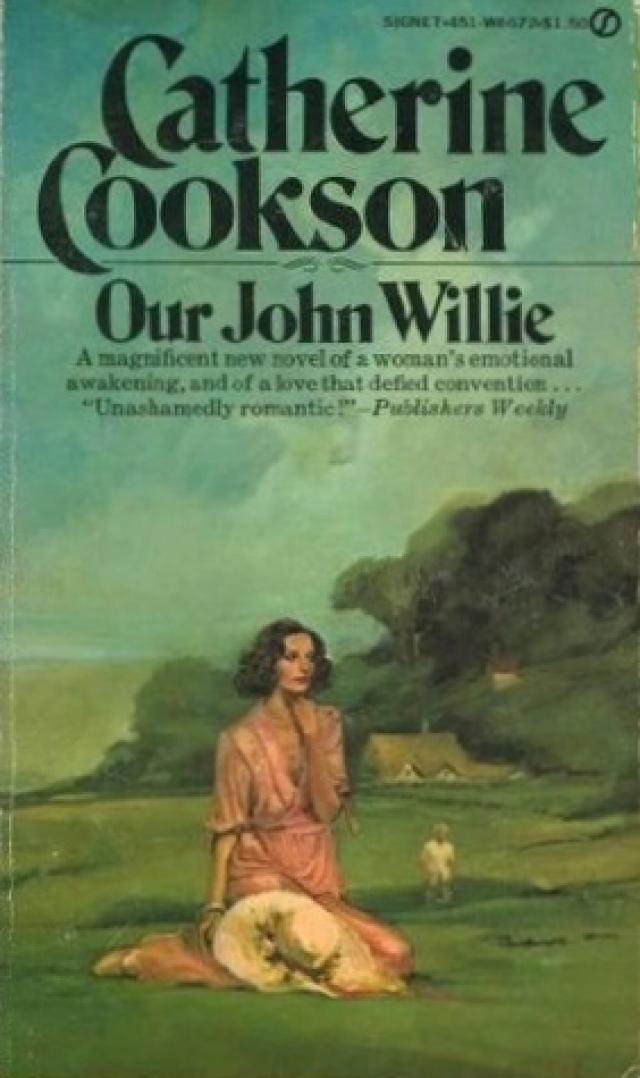
Our John Willie
Davy and his deaf and dumb younger brother, John Willie, find themselves homeless after their father is killed in a mining accident. Eccentric Miss Peamarsh offers a chance for a new future—but then Davy stumbles across a horrifying secret from Miss Peamarsh’s past and it could ruin everything…
Copyright © The Catherine Cookson Charitable Trust 1974
The right of Catherine Cookson to be identified as the Author of the Work has been asserte d by her in accordance with the Copyright, Designs and Patents Act 1988
This book is sold subject to the condition it shall not, by way of trade or otherwise, be lent, resold, hired out, or otherwise circulated without the publisher’s prior consent in any form.
ISBN 978-1-78036-087-4
Sketch by Harriet Anstruther
Except where actual historical events and characters are being described, all situations in this book are fictitious and any resemblance to living persons is purely coincidental.
Published by
Peach Publishing
To Patricia aged 12, whose ambition,
so far, is to have two white Rolls-Royces
at her wedding.
1852
Chapter One
The water rushed at them. It was as if the floor of the pit had opened and the sea were pouring in. Davy Halladay couldn’t believe it was water; even in the light of the swinging lamps the top of it still looked like the floor of the pit because it was covered with coal dust; only the dead chilliness around his legs, then his thighs and now his waist told him it was water all right. He was yelling to his father, ‘Da! Da! Where’s John Willie? Da! John Willie…he’s gone.’
His voice was lost amid that of others, men yelling directions as they grabbed at pit props supporting the roof while others clutched at the great rocks that the props supported.
‘Da! Da! Aw!…’
The filthy water rushing into his mouth choked his next cry. As he lost his hold on a prop the last thing he saw in the light of the only remaining lamp before being drawn into the melee of struggling bodies was his father’s head going under the black scum. And then he was being borne forward, thrashing, fighting, gasping, amid arms and legs and strange terrifying sounds, and he knew now he was about to die and go to hell, as Miss Peamarsh said he would.
Twice within the last month Miss Peamarsh had prophesied that he would go to hell: first, when she had caught him red-handed stealing an egg; the second time he should have known that her prophecy would come true because she had said it on a Sunday.
It was when he pulled their John Willie through a gap in her wall, a gap she knew nothing about because it was hidden by brambles. He had only gone into her grounds to gather blackberries, for in the great massed tangle that had once been a garden, the bushes were laden with fruit that was going rotten…And then he had seen her cow.
She kept only one cow but everybody knew it gave more milk than she could swallow, so he had crept up to the animal and, putting the tin basin that he had brought for the berries underneath it, had stroked her teats. She just turned her head and looked at him as if she were thankful he was relieving her, and he had laughed and said to John Willie, ‘Here, sup that up,’ although their John Willie couldn’t hear him, nevertheless, he always spoke to him. Three times he half filled the bowl and John Willie drank the lot.
He’d always had the idea that had John Willie had the right food he wouldn’t have continued to be deaf and dumb. He had the idea that the right food would have loosened something at the back of his tongue and in his ears, for he had never heard of rich people’s children being deaf and dumb.
When Miss Peamarsh had come upon them suddenly he hadn’t dropped the bowl and run, he had stood with it gripped tight in both hands while she glared down on him. She hadn’t spoken for a long time, a full minute, and then she had said, ‘You’ll go to hell, boy, you’ll go to hell, and he along with you.’ She had pointed to John Willie.
She had stared a long time at John Willie, and he at her. People always stared at John Willie; his eyes seemed to fascinate them. He had beautiful eyes had John Willie, like a doe’s.
… God! God Almighty! God Almighty! Don’t let me go to hell! He was dying. Da! Da! John Willie! …
But instead of his body being drawn downwards he felt it being dragged clear of the cold swirling water. Something had caught hold of his hair.
When the water gushed from his mouth he gabbled and yelled out against the mixture of pains he was suffering, the rock as it scraped his bare legs and the front of his body, and his hair that was being torn from his head…And then he was clear of the water, lying flat on his face, gasping, groaning, crying. He felt hands moving over him and it was some time before he realised whose hands they were. Then with a heave he turned onto his side and groped at the hands in the darkness. His own quickly travelled up the arms to the face and head, and now he spluttered as he cried, ‘John Willie! Oh, John Willie!’
Since John Willie was a small child he had been in the habit of passing his hands over Davy’s face, very like a blind person might do. Often Davy would be awakened from much needed sleep by this strange brother of his stroking his hair or tracing the outline of his nose and mouth with his finger. And this was how Davy now recognised John Willie in the darkness. And he recognised him also, not only from his face, the thin, fleshless face that held the over-large eye sockets, but from his hair; even though now it was wet and clogged with coal dust, it retained here and there its silkiness. And then of course there was its length. If only his body had grown at the same rate as his hair his brother, Davy knew, would have been a giant, not an undersized deaf mute, not ‘Halladay’s idiot’ as he was called by many.
But John Willie, Davy knew, was no idiot. Behind the silence of his tongue and the deafness of his ears there was a knowing. But it was only he himself who seemed to recognise the knowing; even his father looked upon his younger son as an idiot, not simply because he was unable to communicate as an ordinary boy would, but because he was puny in strength.
At nine years old John Willie should have been able to earn a shilling a day down the pit. Boys of his age did horses’ work; where the roofs were too low to allow for the passage of the pit ponies the boys were harnessed with an iron chain between their legs to the bogies, and, going on all fours, dragged them through the low passages. But John Willie was no good for that kind of work, he was no good for nothing, his father said.
Although John Willie came down the pit with his father and Davy, he wasn’t on the payroll; he was allowed to come down with them by courtesy of the butty, and this had come about only through the insistence of Davy, not of his father. Davy had dared to stand up to his father and say he wouldn’t go down unless he could take John Willie along with him, for to leave him up above meant leaving him to the mercy of the villagers. Some were all right towards him but others, those who were apt to believe in omens and signs, pelted him whenever he crossed their path.
Mrs Coxon’s lot were the worst. There were ten Coxons and whenever possible they would make sport of John Willie. It was their Sunday game, the only day in the week when they could play, when they weren’t working in the fields, or down the mine, and if there wasn’t much to do they hunted out John Willie and, making a circle round him, pushed him from one to the other.
His da and Mr Coxon had had a stand-up fight one Sunday. That was the only time Davy had really been proud of his da, for on that day his da had defended John Willie with his fists for the first time.
But now where was his da? And where was he? Where were they? Somewhere just above the waterline on a shelf in an old working likely. He tried to think. He couldn’t remember any passage going off into an old working with a shelf as high as this.
He was clinging as tightly to John Willie now as John Willie was clinging to him. He was experiencing fear as he had never known it before, well, not since his seventh birthday, the day on which his father first brought him down below. The only thing that remained of that memory was the stupefying tiredness on him at the end of twelve hours of picking up pieces of coal and carrying them to a corfe, which had appeared to him then like a gigantic shopping basket. He couldn’t remember how many he filled that day, he only remembered the renewed terror that wiped away the great weariness when he entered the iron bucket-like structure and was hauled up into the world again, the world that although dark appeared bright compared with the blackness of the pit.
But this fear on him now was taking him back not into the past but into the future, the short future in which lay death, death by drowning in the water he couldn’t see, only feel lapping now about his feet; and if not that way, by starvation and cold. Both their bodies, although pressed close, were shivering with the cold. Like the fear, it was a kind of cold he hadn’t experienced before.