The garment, p.1
The Garment, page 1


THE GARMENT
Catherine Cookson
Contents
Cover
Titlepage
The Catherine Cookson Story
Books by Catherine Cookson
Description
Copyright
PART ONE
PART TWO Chapter 1
Chapter 2
Chapter 3
Chapter 4
Chapter 5
Chapter 6
Chapter 7
Chapter 8
Chapter 9
Chapter 10
Chapter 11
Chapter 12
Chapter 13
Chapter 14
Chapter 15
PART THREE
The Catherine Cookson Story
In brief:
Her books have sold over 130 million copies in 26 languages throughout the world and still counting…
Catherine Cookson was born Katherine Ann McMullen on June 27th, 1906 in the bleak industrial heartland of Tyne Dock, South Shields (then part of County Durham) and later moved to East Jarrow, which is now in Tyne and Wear.
She was the illegitimate daughter of Kate Fawcett, an alcoholic, whom she thought was her sister. She was raised by her grandparents, Rose and John McMullen. The poverty, exploitation, and bigotry she experienced in her early years aroused deep emotions that stayed with her throughout her life and which became part of her stories. Catherine left school at 13, and after a period of domestic service, she took a job in a laundry at Harton Workhouse in South Shields. In 1929, she moved south to run the laundry at Hastings Workhouse, working all hours and saving every penny to buy a large Victorian house. She took in gentleman and lady lodgers to supplement her income and took up fencing as one of her hobbies. One of her lodgers was Tom Cookson, a teacher at Hastings Grammar School, and in June 1940, they married. They were devoted to each other throughout their lives together. But the early years of her marriage were beset by the tragic miscarriage of four pregnancies and her subsequent mental breakdown. This took her over a decade to recover from, which she did, often by standing in front of a mirror and giving herself a damn good swearing at!
Catherine took up writing as a form of therapy to deal with her depression and joined the Hastings Writers’ Group. Her first novel, Kate Hannigan, was published in 1950. In 1976, she returned to Northumberland with Tom and went on to write 104 books in all. She became one of the most successful novelists of all time and was one of the first authors to have three or four titles in the Bestseller Lists at the same time.
She read widely: from Chaucer to the literature of the 1920s; to Plato’s Apologia on the trial and death of Socrates (she said that here was someone who stuck to his principles even unto death); to history of the nineteenth century and the Romantic poets; to Lord Chesterfield’s Letters To His Son and the books and booklets that abounded in her part of the country dealing with coal, iron, lead, glass, farming and the railways. She disliked it when her books were labeled as ‘romantic.’ To her, they were ‘readable social history of the North East interwoven into the lives of the people.’ For the millions of her readers, she brought ‘an understanding of themselves’ or perhaps of their dear ones. Her stories do not bring in a realism in which the worst is taken for granted, but a realism in which love, caring, and compassion appear, and most certainly, hope. ‘This type of realism does exist,’ Tom Cookson said of her writing. There is nothing sentimental about her writing; she is unrelenting in the strong images she invokes and the characters she portrays. They were born of her formative years and her personal struggles. Many of her novels have been transferred to stage, film, and radio with her television adaptations on ITV, lasting over a decade and achieving ratings of over 10 million viewers.
Besides writing, she was an innovative painter, and she believed that her father’s genes fostered the strength to work hard, but also, in rare moments of freedom, to strive to better herself. Catherine was famed for her care of money but had given much to charities, hospitals, and medical research in areas close to her heart and to the University of Newcastle upon Tyne, who set up a lectureship in hematology. The Catherine Cookson Charitable Trust continues to donate generously to charitable causes. The University later conferred her the Honorary Degree of Master of Arts. She received the Freedom of the Borough of South Tyneside, today known as Catherine Cookson Country. The Variety Club of Great Britain named her Writer of the Year, and she was voted Personality of the North East. Other honours followed: an Officer of the Order of the British Empire in 1986, and she was created Dame of the British Empire in 1993. She was appointed an Honorary Fellow at St. Hilda’s College, Oxford in 1997.
Throughout her life, but especially in the later years, she was plagued by a rare vascular disease, telangiectasia, which caused bleeding from the nose, fingers, and stomach, and resulted in anemia. As her health declined, she and her husband moved for a final time to Jesmond in Newcastle upon Tyne to be nearer medical facilities. For the last few years of her life, she was bedridden and Tom hardly ever left her bedside, looking after her needs, cooking for her, and taking her on her emergency trips, often in the middle of the night into Newcastle. Their lives were still made up of the seven-day week and twelve or more hours each day, going over the fan mail, attending to charities, and going over the latest dictated book, with Tom meticulously making corrections line by line, for Catherine’s eyesight had long faded in her 80s.
This most remarkable woman passed away on June 11th, 1998 at the age of 91. Tom, six years her junior, had earlier suffered a heart attack but survived long enough to be with her at her end. He passed away on 28th June, just 17 days after his beloved Catherine.
Catherine Cookson’s Books
NOVELS
Colour Blind
Maggie Rowan
Rooney
The Menagerie
Fanny McBride
Fenwick Houses
The Garment
The Blind Miller
The Wingless Bird
Hannah Massey
The Long Corridor
The Unbaited Trap
Slinky Jane
Katie Mulholland
The Round Tower
The Nice Bloke
The Glass Virgin
The Invitation
The Dwelling Place
Feathers in the Fire
Pure as the Lily
The Invisible Cord
The Gambling Man
The Tide of Life
The Girl
The Cinder Path
The Man Who Cried
The Whip
The Black Velvet Gown
A Dinner of Herbs
The Moth
The Parson’s Daughter
The Harrogate Secret
The Cultured Handmaiden
The Black Candle
The Gillyvors
My Beloved Son
The Rag Nymph
The House of Women
The Maltese Angel
The Golden Straw
The Year of the Virgins
The Tinker’s Girl
Justice is a Woman
A Ruthless Need
The Bonny Dawn
The Branded Man
The Lady on my Left
The Obsession
The Upstart
The Blind Years
Riley
The Solace of Sin
The Desert Crop
The Thursday Friend
A House Divided
Rosie of the River
The Silent Lady
FEATURING KATE HANNIGAN
Kate Hannigan (her first published novel)
Kate Hannigan’s Girl (her hundredth published novel)
THE MARY ANN NOVELS
A Grand Man
The Lord and Mary Ann
The Devil and Mary Ann
Love and Mary Ann
Life and Mary Ann
Marriage and Mary Ann
Mary Ann’s Angels
Mary Ann and Bill
FEATURING BILL BAILEY
Bill Bailey
Bill Bailey’s Lot
Bill Bailey’s Daughter
The Bondage of Love
THE TILLY TROTTER TRILOGY
Tilly Trotter
Tilly Trotter Wed
Tilly Trotter Widowed
THE MALLEN TRILOGY
The Mallen Streak
The Mallen Girl
The Mallen Litter
FEATURING HAMILTON
Hamilton
Goodbye Hamilton
Harold
AS CATHERINE MARCHANT
Heritage of Folly
The Fen Tiger
House of Men
The Iron Façade
Miss Martha Mary Crawford
The Slow Awakening
CHILDREN’S
Matty Doolin
Joe and the Gladiator
The Nipper
Rory’s Fortune
Our John Willie
Mrs. Flannagan’s Trumpet
Go Tell It To Mrs Golightly
Lanky Jones
Bill and The Mary Ann Shaughnessy
AUTOBIOGRAPHY
Our Kate
Let Me Make Myself Plain
Plainer Still
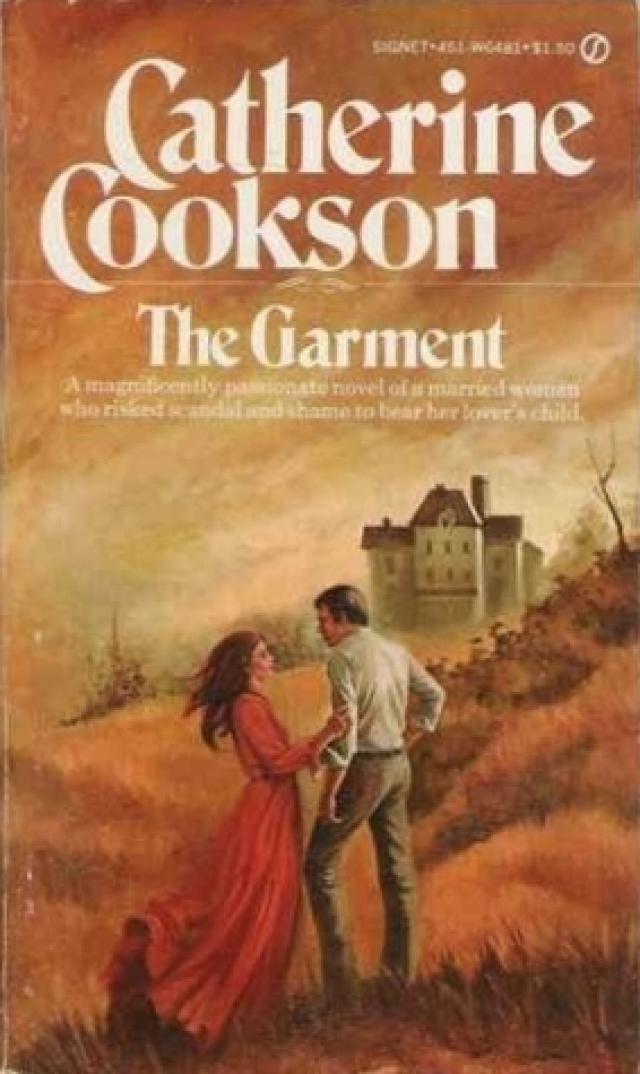
The Garment
Motherhood is every woman’s right and the natural outcome of a happy marriage. But what then when a normal and beautiful young woman is forced to recognise, after two years as the wife of a country parson in the north of England, that her marriage is a sham and will never bring her the fulfilment she desperately needs?
Grace Rouse is faced with this situation and, like many other women before her, she seeks to escape a mounting sense of frustration and despair by turning from the husband she has tried in vain to love to the comfort and release offered by another man.
The final outcome presents a huge dilemma as Grace is forced to wage a war between a man who can give her children and love and a man who passionately desires children but can only give them his name.
Copyright © The Catherine Cookson Charitable Trust 1967
The right of Catherine Cookson to be identified as the Author of the Work has been asserted by her in accordance with the Copyright, Designs and Patents Act 1998
This book is sold subject to the condition it shall not, by way of trade or otherwise, be lent, resold, hired out, or otherwise circulated without the publisher’s prior consent in any form.
ISBN 978-1-78036-058-4
Sketch by Harriet Anstruther
Except where actual historical events and characters are being described, all situations in this book are fictitious and any resemblance to living persons is purely coincidental.
Published by Peach Publishing
PART ONE
As she stared at the black, frost-patterned panes of glass, the voice that had been whispering at her became loud in her head. ‘Put it out,’ it demanded. ‘Go on, put it out.’ And her eyes flashed to the light above the dressing table to the left of her, then to the switch at the side of the window, and she imagined that her whole body, arms, legs, head, and even her bowels, rushed forward to the central point that was the little brass knob when all she did was lift her arm slowly and, after hesitating for a fraction of a second, switch out the light. As it snapped the clear outlines of the room from her gaze she closed her eyes, waiting for the panic to rise in her, but it only fluttered, a stationary flutter, for through her lids she could feel the soft-toned radiance of the four wall lights.
The fluttering took wings. ‘Now these,’ commanded the voice.
But that would mean walking the whole length of the room from the window to the door where the wall switches were. She couldn’t do it…it would be all right going, but it would be the coming back…in the dark.
Before the thought had dissolved in her mind she was walking towards the bedroom door, and as she put her finger on the first of the two switches she fixed her eyes on the floor. After the click her eyes did a swift hopping movement around the room, and then she felt slightly dizzy. All was merged now in a soft green glow. It was like looking through water. The white bedroom suite was no longer white but a delicate shade of blue; the bed, with its quilted coverlet, floated like a pale gold oblong box gently back and forth over a sea bottom, for the mustard carpet had taken on the appearance of moving sand; the rose curtains on the long window at the far side of the dressing table looked almost blue, even black where they touched the carpet. But those on the French window facing her seemed to retain their own hue and were the only things in the room recognisable in this unfamiliar light. Her body began to play tricks with her again. It was dry now and hard, knobbly hard and aggressive. Each particle of her was thrusting out, pushing, grabbing at the air to pull her towards the window. With a slight movement of her finger the last two wall lights disappeared and for a brain-screeching moment she stood in total darkness.
Although every artery in her body was clawing its way to deliverance and the window, she herself moved slowly, and when she reached it she put her two hands flat against the shivering glass, then, with only a slight intake of breath, she opened the glass doors and moved one step out on to the balcony.
She was out in the night: standing without light in the night. How long was it since she had looked at the night like this? She couldn’t remember, she didn’t want to remember. Her breathing became deeper, slower, steadier, it was as if she was emerging into the world, coming out of the womb, being born again, and all that had gone before was the experience of a past existence. As the air went deeper into her lungs she wanted to shout with the joy of relief, but she stifled it by clamping her lips with her fist. No more shouting of any kind, no more yells corkscrewing through her head, it was all over and done with. She had been born again. The only difference was, she would not have to wait for years before becoming aware of her surroundings, she already knew where she was. Of course she had always known where she was. No matter how bad she had been, she had always known where she was. At least in the daylight. But this was night, blackness around her, below and above her, but strangely no longer in her. She was facing the night and defying it.
There were no stars. It was a black night, she could not have picked a blacker with which to test her quivering courage, and she was suspended high up in the night and was no longer afraid…well, only a little.
Sit down and look around, she said to herself, then answered, It’s too cold. But again she was obeying her courage and her hand was already on the wrought-iron chair that took up a third of the balcony.
When she sat down she put her hands between her knees and pressed them close. It was a childish action and she couldn’t remember having done it for years, not since she was a girl and had first come to this house, as a bride …
The darkness of the sky seemed to thin itself out as she sat, and she saw against it a deeper darkness made by the pattern of the trees, some of which bordered the drive to the main road. The drive was to the left of her. Slightly to the right of her there was a break in the pattern, which had been made only recently when she had had the old beech cut down. There had been trouble about that. They couldn’t understand it. Nor could she have expected them to, only she knew why she had had the beech cut down. Yet she mustn’t be too sure of that. This thought brought a tinge of fear again.
In the daytime she could see, through the gap made by the beech, the fells, each rise, mould, hill and crag known to her so well that even now she could see their shapes through the darkness. Apart from the cottage that stood out there, in the far distance, to the right, there was nothing at all, nothing for miles but the fells.
But to the left of her, beyond the drive and down the hill, lay the village. Five minutes’ walk from the gate lay the village…lay the world. All the physical substance of the world was in the village. All the types in the world were in the village. There was James Buckmaster, butcher and greengrocer, small and thin, very thin for a butcher, not hearty and brawny. But why should butchers be hearty and brawny? They, like everyone else, lived double lives. Perhaps he felt hearty and brawny inside. Then Mr Brooke, who dealt in groceries and drapery and had part of his shop for chemist’s accessories and photography. Mr Brooke had a head for business. He delivered his groceries as far as ten miles away, and he was a sidesman of the church, and his wife didn’t speak to the women who went into the towns to supplement their larder, yet what was a wife for but to support her husband? Ironic laughter began to rise in her on this thought and she suppressed it hurriedly and turned her mind to the residents of the village again.
Although there were no street lamps in the village it would not be dark, for Mr Barker of the Stag always saw to it that there were two lights at least burning outside the bar. Mr Barker was a nice man, a kind man. They said he wouldn’t last very long, for he was drowning himself in his own beer. He had a very large stomach, but also he had a very large smile, so perhaps the smile would keep him afloat even when the beer threatened to drown him…Again there was laughter rising in her, but it had a touch of merriness about it this time.
Then Miss Shawcross, Kate Shawcross as she was called, the postmistress. Why was it that there was always a postmistress in a village, seldom a postmaster. She hadn’t thought of it before, but she didn’t want to think of Kate Shawcross, and her thoughts swung away to Peggy Mather, which wasn’t really very far, for Peggy lived with Miss Shawcross—she was her niece. She was also cook-general at Willow Lea, and at this moment was down below in the kitchen preparing dinner, a Christmas Eve dinner, a family dinner. She pushed her mind deliberately away from Peggy Mather, for there had returned to her body a slight trembling. She began comforting herself. This time tomorrow she would be able to think of Peggy Mather and lots of things that she hadn’t dared allow herself to dwell on, for this time tomorrow she would know whether she was to be free or not. Don’t look at it in that way. She chided herself for her thinking. And, now in spite of her efforts, her mind wandered back to Kate Shawcross and the post office and the matter of lighting. Kate Shawcross had never kept a light outside her shop to help the travellers through the village. Even the light inside the shop was a dim one and she put that out at closing time. Yet she was supposed to be a good woman. Going on the interpretation that she taught Sunday school and dressed the altar and had for years subscribed handsomely to this and that church fund, she was a good woman all right. Yet some people were not fooled by the interpretation, they knew why Kate Shawcross had been so liberal. Mr Blenkinsop, the verger, had put it very neatly one day when he said that her goodness wasn’t so much because she loved God as God made man. That had been very neatly put, very neat. After his wife died Mr Blenkinsop had wanted to marry Kate Shawcross; they said it was because she was a warm woman, having come into a considerable sum from an uncle in Canada, a man she had never clapped eyes on. They also said that Kate was indignant at the proposal. So Mr Blenkinsop had his reasons for being nasty and they were to do with…God made man.