

Irresistible desire, p.1
Bad Power, page 1


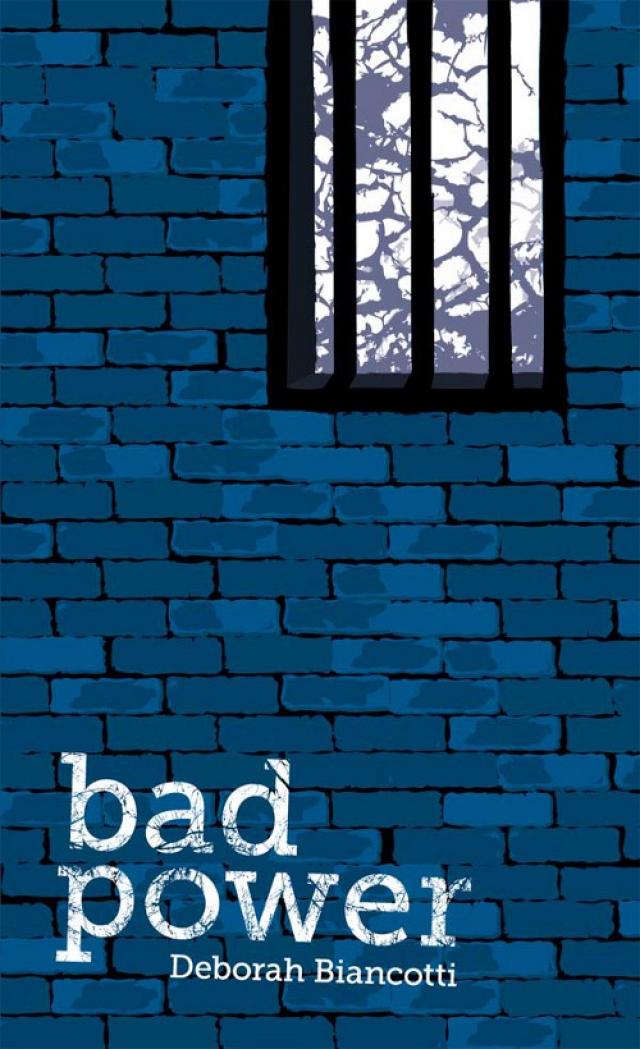
Bad Power
by Deborah Biancotti
First published in Australia in October 2011
by Twelfth Planet Press
www.twelfthplanetpress.com
All works © 2011 Deborah Biancotti
Design and layout by Amanda Rainey
Ebook layout by Charles A. Tan
All rights reserved. Without limiting the rights under copyright above, no part of this publication may be reproduced, stored in or introduced into a retrieval system, or transmitted in any form, or by any means (electronic, mechanical, photocopying, recording or otherwise), without the prior written permission of both the copyright owner and the above publisher of this book.
National Library of Australia Cataloguing-in-Publication entry
Author: Biancotti, Deborah.
Title: Bad power: a Twelve Planets collection / by Deborah Biancotti, edited by Alisa Krasnostein.
ISBN: 978-0-9808274-9-1 (ebook)
Other Authors/Contributors:
Krasnostein, Alisa.
Dewey Number: A823.4
For my family. All of you.
Contents
Introduction
Shades of Grey
Palming the Lady
Web of Lies
Bad Power
Cross That Bridge
About the Author
Praise for A Book of Endings
Also from Twelfth Planet Press
Introduction
I first met Deborah Biancotti on a trip to Australia several years ago. I fell in love with the country and have maintained close contact with many of the talented writers I met there. I am pleased and honoured to be writing this introduction to Biancotti’s Twelve Planets collection Bad Power.
In just five short stories Biancotti manages to create a new world that is strange and yet oh-so-familiar—her characters interact with each other across all these tales as they try to deal with the powers they’ve acquired and all I can say is I want to read more.
These appetisingly wicked stories give you the perfect taste of Biancotti’s talents. 'Shades of Grey' shows how the wrong power can be a bad thing as the wealthy Grey continues to seek ways to test his limits and punish himself for his ability to self-heal and possible immortality. We also meet the unusually gifted Detective Palmer—she seems to get all the interesting cases.
In 'Palming the Lady' a young medical student is stalked by an older homeless woman and continually berated by his famous doctor father. Detective Palmer takes up this case, too, and can’t seem to figure out what the homeless woman means about the 'bigger picture'. Not until later, anyway.
'Web of Lies' continues the story of Matthew Webb, that tortured medical student, and how he deals with his father’s death and his own growing powers. In 'Bad Power' Biancotti introduces us to a woman who holds a power she is not sure is a blessing or a curse. But she knows she wants to pass it on to her unborn son no matter what.
'Cross That Bridge' brings us back to Detective Enora Palmer as she pairs up with a reluctant Detective Ponti, who has an unusual gift for finding missing children (see, he was born with an extraordinary power after all). Max Ponti tries to help this little girl as she says, ‘Sometimes I just want to be someplace enough. Daddy says it’s bad to want something that much.’
These characters are not easily forgotten and their stories are compelling—they resonate and live on with you, leave you asking questions. What is the Grey Institute anyway, and what happens to the damaged people who go there? And why are there so many different kinds of powers? This collection is sure to provide a lot of pleasure to the reading public—I know I can’t wait to find out where Biancotti goes next.
Ann VanderMeer
Shades of Grey
Grey was a man who liked to plan. But right now his animal brain was taking over. His pulse raced. His stomach was twisted with adrenalin. He fancied he could feel each cell in every part of his body. He filled his lungs and sat and stared at the concrete barriers in front of him. Those foamy, rubbery things, duck-footed and already crumbling at the top edges. Five identical barriers in a row with the sky pressed flat above them and beyond an irresistible chance at personal oblivion.
He revved the engine. ‘I wanted to know...’
No one to hear him, but still he practised out loud an answer to a question which—should he live—would be inevitable.
Mr Grey, why would a man of your evident wealth and standing attempt suicide in such a strange and public way? Did you need an audience for your, shall we say, swan dive into oblivion?
‘No.’ That was beneath him. ‘Those barriers, you see? They looked just like stairs.’
It was only then, roleplaying the what-comes-after, that he realised he was serious. He drummed his thumbs on the steering wheel. A string of stunted teeth, that’s what the barriers looked like. And behind them, nothing, space, nothing. Sunlight and air, blue sky and the occasional suburban office or apartment building spread out and squatting no more than four storeys tall. He hadn’t, in fact, planned this. A fact that shocked and thrilled him. Hadn’t planned his visit to the building site, the slow spin of his car upwards to the top of the car park. He’d thought simply to check the progress of the work. A solid hanger of concrete and steel near a shopping mall. Solid, of course, except for the barriers. The proper girders were to come, he’d been told, the work was not yet done.
‘Not finished, Mr Grey, don’t want you t’get the wrong idea.’
‘Just a look,’ Grey had promised the site manager, and smiled and slipped a couple of fifties into the man’s hand.
There was really no doubt that Grey would drive his Audi R8 Quattro to the top of the construction if he chose. He owned it, after all. And most of the buildings around it. But there was something soothing about money to most people, and Grey liked to grease a few paths in his ascent heavenward. He handed the man another fifty ‘for the boys’.
Now, alone in his car, he gazed at the barriers. What was a man to do? Bold stripes of blue paint and even bolder smears of black rubber on their wide feet (testament, he assumed, to the attempts by others to push through those supposedly rigid boundaries, to spin off the edge and glide into Nietzsche’s promised void).
Mr Grey? … Why?
They’d obviously been used before on other building sites or other accidents, other attempts to seek annihilation in the face of those chunky city buoys.
‘I wanted to know what it would feel like. I wanted to see … to see how long I could keep going. If I could soar over the glass and stone suburb in a wingless machine.’ Here he gave the dashboard a smooth pat. ‘I wanted to make eye contact with the office workers trapped in their cubicles, faces slack with wonder…’
But here he ran out of analogy and stared, instead, at those insipid barriers. It wasn’t an answer he was forming, it was an excuse. He raised his chin, squared his shoulders to the windscreen. Esser Grey didn’t make excuses. He had one more go at the truth.
‘I wanted to die.’
And with the irresistible fact of his desire, something inside him was quelled. He pressed his foot to the accelerator and shot towards the edge of the car park, in a car that could accelerate from nought to eighty in forty-five seconds. In one minute, he estimated, he would be soaring grille-first into the sky or dragging those barriers over the edge in an inhospitable descent.
The Audi smoothly rushed forward with minimal pressure from Grey. It connected with the barriers and pushed them out into the air in an almost straight line for what felt like minutes. Like a cartoon character hanging out over a crevasse. Then they fell, the car following its concrete partners down and down and down.
He felt his thumbs break first under the weight of his torso as the seat shoved him forward. He felt his ribs impact spine, hips dislocate, legs crack in half high at his thigh. He felt his neck snap as his forehead slammed into glass, nose shattering, cheekbones snapping. He bit off his tongue and broke his jaw on the exploding dashboard. Then there was the squelch of his organs, muscles pierced and compressed, everything flattening and stopping cold, all of this in a roar like the world was erupting, noise everywhere.
And then, blessed darkness. An absolute nothing that was almost a return to the womb. He sensed it rather than felt it, became it for that brief moment of overwhelming relief.
The car rocked, upside-down, groaning like an injured thing. Grey reflected that surely in death, the mind must stop working. And yet, he could hear screams and voices, faint but certainly audible. He could feel the car rock like a cradle and become still. He could feel, after a moment, the healing, stinging march through his body as it rebuilt itself.
No.
Only one thing had ever denied itself to Grey and that was death. And now, turned to paste in his destroyed car, he began to realise that the absence of death may be a permanent thing. He was a man used to getting what he wanted and to have this one thing taken away from him, well. It was unbearable.
No.
He tried to scream but all that came out was a gurgle of bloody phlegm.
‘Jesus, mate, you okay?’ A stranger’s voice. The eternal question.
No.
From somewhere in the distance, someone was calling his name. Not the voice of God, he quickly surmised, but the near-hysterical shouts of his site manager. Should have slipped him another fifty to shut him up. Grey’s body knitted itself back into a loose semblance of its usual shape until he was able to take a lungful of air and release it in an agonising scream at once comforting and alien.
&nbs
His newly re-formed limbs trembled, his gut emptied air and muck onto the roof below him. To his embarrassment, people ran to his aid thinking him a victim of the strange and savage event.
‘Stay away from me!’
Hands reached for him. Strangers, trying to help. The very people who—until then—had probably run from the onslaught of his vehicle toppling from the sky. Once more returned to life, his hoped-for release from the press of humanity—even his own humanity—was cut off in its prime. Grey was ashamed. He wondered if this was how the gods felt, so removed from cause and effect they were, in essence, trapped. Forced to live alongside a population that drew further away the more their own godhead was revealed.
‘Mr Grey! Mr Grey, are you okay?’
‘No. I’m—’
But he didn’t know what he was.
‘There are two kinds of people with lawyers on tap, Mr Grey.’
‘There are?’
He was upright, clean, in bandages and borrowed clothes but to a large extent uninjured. It was, he was sorry to say, a kind of miracle. He leaned forward, steepling his fingers, ignoring the pure bland surrounds of Botany Bay police station. Nothing in this room, for instance, but a table and three chairs, a camera high on the wall. And the detective, easing into a chair opposite him and behind a low table.
‘The powerful,’ she said, ‘and the corrupt.’
Grey chuckled as if she’d made a joke. ‘Thank you.’
‘For implying you’re powerful?’
‘For imagining,’ he countered with a deferential nod, ‘that those are two different groups.’
She was young, dark-skinned, hair lacquered, hands laid now square and squarely in front of her so they formed a triangle with the base of her narrow neck. Her suit was so cheap the cloth shone at elbow and collar. Her notebook was in front of her but she hadn’t touched it.
‘What was your name again?’ Grey asked.
‘Detective Palmer,’ she said without missing a beat. ‘And you, Samuel Rainer Grey—’
‘Please, call me Esser.’
She reflected. ‘As in, your initials, Mr Grey?’
‘Please,’ he confirmed. ‘I prefer the name I chose myself.’
She turned back to her notes. ‘Let’s talk about what happened today. Mister Grey.’
Ah, here it was. She would be looking for the answer. He leaned back in his chair.
‘What made you do it?’
‘Made me?’ Grey echoed.
This wasn’t quite the question he’d planned for. He’d long forgotten to think of himself as someone made to do anything by either compulsion or constraint. But if she was asking what brought him here, what had built and fashioned him into the man he’d become—what had, in effect, made him—well, that was an epistemological question worth asking. The pioneering son of pioneering parents, he liked to think every pearl had its grit, every achievement its itch. For Grey, that itch was his own parents. Where they had built houses, he built hotels. Where they funded schools, he traded in hospitals. Their offices became his city complexes, their charity work, his all-encompassing full birth-to-death life subsidies.
His charities weren’t random. They were the end result of his research into the pitfalls of the human race. And his own yearning to be part of it. He groped for the answer that, hours before, had made so much sense. But something about her square gaze and the no-nonsense way she dressed made him doubt himself. Another new experience in an over-long day.
‘I built that car park. Well, paid for it to be built, at least,’ he stalled.
‘Yes?’
‘But … who designed it, I wonder? A car park over a busy shopping mall. Doesn’t that seem irresponsible?’
She didn’t blink. ‘You think that was irresponsible?’
‘It’s an invitation to crime, isn’t it?’ he gestured with a hand, trying to get the explanation out. ‘There we all are, pressed together into this city. And there’s a precipice over which one is practically obliged to drive one’s car—’
‘Precipice? You mean, the car park?’
‘I mean,’ he confirmed, ‘the car park.’
‘The car park, with the solid one-foot concrete barrier along its edges?’
‘I hate to disagree,’ he said, ‘since we’ve come so far. But the concrete isn’t that solid. It’s really the steel girders that hold the structure together. The concrete is more visual than actual deterrence, you understand. And concrete, of course, can rot. Whereas steel—’
‘Let me ask again. What made you,’ she stabbed the table with one long finger, ‘drive your car (stab) over the edge of an Eastgardens car park (stab) and straight down into a busy shopping mall, ultimately injuring—directly or indirectly—no less than seventeen people (stab)?’
‘I’m not sure I understand the question. Perhaps I’m reading too much into it.’
The detective regarded him with a steady gaze. Grey gave her a slow squint in return, gauging her. She was relaxed. Filling in time, waiting the few more minutes it would take his lawyer to arrive, knowing none of it was going to stick. Not to a man like Esser Grey.
She regrouped. ‘Let’s try something else. When they dragged you out of the car, you were covered in blood.’
‘Yes?’
‘Yet you were largely unhurt.’
‘Detective,’ he gave her a bruised look. ‘I assure you, I do hurt.’
Alas, was she moving away from epistemology so soon?
‘But how did you survive?’
‘A miracle.’
‘You could have killed someone.’
‘I didn’t.’
‘Another miracle?’ He could see her wondering whether to pursue his crime or his supernatural escape. ‘Does that make what you did any better?’
His lawyer burst through the door in a fit of authoritarian efficiency.
‘Bill,’ said Grey, raising a casual hand towards his opponent, ‘this is Detective … I’m so sorry?’
‘Palmer,’ she said, not reaching for Bill’s offered hand.
‘William Everton-Warburton.’ Bill thumped his briefcase on the table. ‘Mr Grey is a great humanitarian. He’s funded hospitals, for God’s sake. Charities for fertility, teen suicide, depression, child care, aged care—’
‘Bill, I’m pleading guilty.’
That sparked her up. Detective Palmer even went so far as to give him a sidelong stare.
Bill adjusted without pause. ‘That’s exactly what I’d expect someone to say who was temporarily insane owing to … for example, the stress of his illustrious position.’
He was an implacable player, Bill. With a thick veneer of implosive outrage covering a world-weary indifference. According to Bill, he’d lived in this city for fifty of his fifty-eight years. He’d seen everything, done very little of it himself, and was used to difficult clients making difficult demands. Already he’d be calculating the cost of Grey’s defence.
‘I’m not insane, or stressed,’ Grey said.
Bill looked pointedly at his client, then turned the same look to the detective. For a moment, nobody moved. There were just the three of them and the walls and the desk and the camera.
‘Give us a moment, would you, detective,’ Bill said.
Palmer moved to leave. When she walked, she held her shoulders back like a dancer, a thick plait of hair hanging halfway down her back, unswinging.
‘What’s this about, then, Sam?’ Bill took the detective’s seat. ‘They allowed you access to a doctor, right? We can sue if they didn’t.’
Grey almost chuckled. ‘They treated me fine. Even tried to put me in a hospital. I refused.’
‘Good. That sounds crazy,’ said Bill approvingly. ‘Those your clothes, dear boy?’
‘They were lent to me. My own were caked in blood.’
‘Whose? And remember, I’m your lawyer, bound by oath.’
Grey took a breath. ‘Bill, I have something important to say.’
‘I don’t doubt it, old friend.’
‘Look at this.’
Grey raised his arms to reveal minor scratches on his knuckles and arms which, even now, were developing a thin pink skein of healing. He unwound the bandage on his elbow like a serpent. The last few layers were hard with dried blood, but underneath was a narrow, uneven cut across his forearm, scabbed over and healing fast.





