

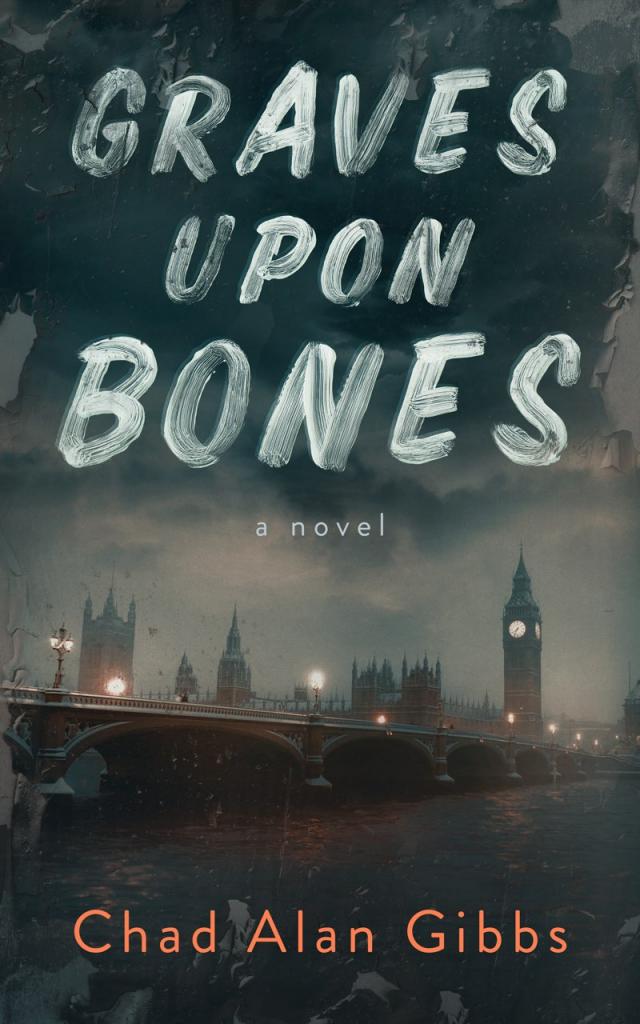
Graves upon bones, p.1
Graves upon Bones, page 1


CONTENTS
Graves upon Bones
1989
Chapter 1
Chapter 2
Chapter 3
Chapter 4
Davy Taylor
Chapter 5
Chapter 6
Chapter 7
Chapter 8
Davy Taylor
Chapter 9
Chapter 10
Chapter 11
Chapter 12
Davy Taylor
Chapter 13
Chapter 14
Chapter 15
Chapter 16
Davy Taylor
Chapter 17
Chapter 18
Chapter 19
Chapter 20
Davy Taylor
Chapter 21
Chapter 22
Chapter 23
Chapter 24
1989
Chapter 25
Chapter 26
Chapter 27
Chapter 28
1989
Chapter 29
Chapter 30
Chapter 31
Chapter 32
1989
Chapter 33
Chapter 34
Chapter 35
Chapter 36
1989
Chapter 37
Chapter 38
Chapter 39
Chapter 40
1989
Chapter 41
Chapter 42
Chapter 43
Chapter 44
Epilogue
Acknowledgments
A Note from the Author
Two Like Me and You (excerpt)
Chapter 1
Chapter 2
Chapter 3
Chapter 4
Chapter 5
Chapter 6
The Rome of Fall (excerpt)
Dear Brutus Wikipedia Entry
ACT I
The Austin Chronicle, April 1, 1994
1. 1994
2. 2017
SPIN, November 22, 1997
3. 1994
4. 2017
Also by Chad Alan Gibbs
GRAVES UPON BONES
For Tricia,
with love
“I long to go through the crowded streets of your mighty London, to be in the midst of the whirl and rush of humanity, to share its life, its change, its death, and all that makes it what it is.”
* * *
–Bram Stoker, Dracula
1989
Davy Taylor was exhausted.
He’d always thought the beauty of owning a pub was never seeing these ridiculous pre-dawn hours. Still, here he was, stomping through Graves at five in the bloody morning. Never mind he’d stayed up half the night having a row with his kids.
Ethan, his thirteen-year-old, wanted Davy to take him to some Marie Curie exhibit at the Science Museum across from Imperial College. “Sod off,” Davy told him. “Tomorrow is the playoff final. Your radioactive bint can wait.” Davy hoped knowing Madame Curie discovered radioactivity would earn him some points with the boy, but no such luck. Ethan burst into tears and ran to the basement, leaving his father to sigh and shake his head.
Ethan didn’t care for football or music.
Davy didn’t care for much else.
All they shared was blood and a name.
Sarah, Davy’s seventeen-year-old princess, cared entirely too much about football. Well, one footballer, that is. Harry Lane was a fixture at the Taylor house long before joining Graves United’s youth academy. Now he was under contract with the senior club and set to make a fortune if he could lead them to top-flight promotion in tomorrow’s playoff final against Crystal Palace. Thankfully, Sarah and Harry had broken up for the thirty-eighth time earlier in the week. Davy hoped this time it would stick.
“What’s wrong, love?” Davy asked, pointing to his daughter’s untouched bangers and mash. “Your palate too refined for pub food?”
Sarah smiled weakly. “It’s Harry.”
Davy groaned and let his forehead hit the dinner table.
“I love him,” Sarah said.
“Again? Two days ago, you called him a miserable prat.”
“It was just a stupid fight. I want to marry him.”
“Like hell you do,” Davy said, choking on his pint. “You’re seventeen bloody years old.”
“The same age Mum was when she married you,” Sarah replied.
Davy rolled his eyes because he couldn’t argue her point, and his daughter said, “I don’t know what you have against him. Harry has loads of money. Or at least he will.”
“It’s not about the money, love. You read the papers. Every one of them footballers has two birds on the side. He’ll break your heart, and I won’t allow it.”
“You don’t know anything about Harry.”
“I know you’ll marry him over my dead body.”
“Why couldn’t you have died instead of Mum?” Sarah screamed, then burst into tears and ran upstairs.
Davy sighed, toasted the photograph of his late wife on the wall, and finished his pint in one long chug. Harry Lane wasn’t a bad kid, but he’d never let Sarah marry him.
Sarah was a daddy’s girl.
Davy spoiled her to the moon.
But some bonds are thicker than blood.
The alarm jolted Davy awake at an ungodly hour the following morning. He showered and shaved, spent fifteen minutes searching for his keys, then made the half-mile walk to The Red Lion, his family’s pub that had served the Graves district since Queen Victoria’s ample bottom rested on the throne.
“Bloody hell, boys, what time did you wake up?” Davy asked the three Graves United supporters who were already queued outside when he arrived.
“We haven’t been to sleep yet,” one replied before they all burst into a song praising their teenage hero … “There’s only one Harry Lane!”
“Well, give me five minutes, and I’ll let you in,” Davy said, and the three substituted the pub owner’s name into their chorus … “There’s only one Davy Taylor!”
Davy walked inside and flipped on the lights. He’d planned to open at six, earlier now since customers were singing on the stoop, and he’d close at two and make his way over to Lenox Park for the match. Then, Davy and a legion of Graves United supporters would return two hours later and either celebrate or mourn late into the night. That his favorite club was on the precipice of England’s top division for the first time ever was beyond belief. Still, Davy needed a jolt from his morning tea before he could feel adequately excited.
The phone rang as he put a kettle on the boil.
“Red Lion, we open in five bloody minutes.”
“There’s a bomb,” a familiar voice said through the receiver.
Davy knew about these calls.
But he never thought he’d receive one.
Particularly not from …
Davy dropped the phone and took one step toward the door, but it was too late. The bomb planted downstairs in the men’s room exploded with enough force to blow out windows across the street. The three supporters waiting outside survived after choosing a most opportune time to piss in the alley, but Davy Taylor wasn’t so lucky. Investigators would continue to find pieces of him weeks after Graves United lost the most important match in club history.
But whoever planted the bomb proved much harder to find.
CHAPTER ONE
When I was in eighth grade at Dandridge Middle School, a meteorological miracle brought an ever-so-light dusting of snow to the Florida Panhandle. The night before, as local weathermen boldly predicted several dozen snowflakes, residents rushed the local Piggly Wiggly, hoarding milk and bread in anticipation of the apocalyptic blizzard. In the morning, when frozen precipitation did momentarily fall from the sky, schools and businesses closed en masse because how could anyone navigate such treacherous roads and live to tell? But by midmorning, the snow had predictably melted, and kids in my trailer park celebrated their day off from school by building snowmen out of the mud.
Elton had assured me while London was cold in the winter and snow would occasionally fall, schools and businesses would proceed as usual, citing expertise in winter weather the Sunshine State sorely lacked. So, it came as some shock on January 6, 2009, when cold weather forced the closure of St. Beckham’s School for Boys on our first day.
I’m a girl, by the way—Izzy Brown, sixteen, formerly of Dandridge, Florida. St. Beckham’s finally admitted female students back in the 1980s but never got around to changing its name because that required approval from the House of Lords or some nonsense.
“Okay, so why did they close our school yesterday and not today?” I asked Elton through chattering teeth on our frigid trek to school the following morning.
“Because yesterday the temperature reached minus eight degrees,” Elton said.
“What’s today?”
“Two degrees.”
“And that’s Fahrenheit, right?” I teased, because messing with Elton momentarily took my mind off how nervous I was for the first day of school.
“Negative, Izzy,” Elton said in his most exasperated tone before lecturing me for the thousandth time on how the Meteorological Office switched to degrees Celsius for weather reports and forecasts in 1962. Then he lost the thread and spent several minutes telling me about Anders Celsius (1701–1744), a noted Swedish astronomer and namesake of the Celsius scale.
Elton Jones-Davies was sixteen too, tall as LeBron James, and on the autism spectrum. He also read Wikipedia for fun, which m
My brother, Axl, was a hot-shot high school quarterback, and the previous year he received a football scholarship to the prestigious Bardo Academy in Bardo by the Sea, Florida. I received a scholarship too because the man doling them out eagerly wanted Axl to commit to his alma mater, Florida State University. Soon, my family, who’d previously called Pineview Villas trailer park home, found ourselves living in a multi-million-dollar beach house. Life was good for about a minute until Elton and I solved the twenty-five-year-old murder of Ricky Lee, a former Bardo Academy student, bringing down a respected Bardo family in the process, followed immediately by my arrest for opioid possession and my family’s Adam and Eve-esque expulsion from paradise.
Elton’s mother, Holly Jones-Davies, hated living in Bardo in the first place, and she cited the murders and drugs as reason enough to move back to her hometown of London. And since I was Elton’s best friend, she approached my mother about taking me with them in hopes I’d flourish away from all the trouble I’d found in Walton County.
My mother was furious at me for costing us our Bardo Academy scholarships and our fancy new life by the sea. Still, I don’t think she sent me to live with Elton and his mother out of anger. Our little family was always teetering on the edge of disaster, and it took all my mom’s energy to pay the rent and keep food on our table. She told me, only a few hours before I was arrested, coincidentally, how she’d never worried about me because I was her mature child. Her little grown-up in a kid’s body. I suspect adding me to her list of things to fret over pushed my mother to the breaking point, and she knew something had to change. I like to think my mother agonized over sending one of her children across the world to live with another family, but she said yes before Elton’s mother even finished asking, and though I wanted to go, I felt a little abandoned in the process. But in the end, it was an opportunity she couldn’t pass up, for either of us. So, two days into the new year, I was on an airplane flying across the Atlantic.
“Okay,” I said, skipping to keep up with Elton’s long strides, “but you’ve got to admit, England can’t handle the cold any better than Florida.”
“I will admit no such thing,” Elton boomed. “The London Underground was fully operational yesterday, despite temperatures that would bring Florida to a halt. In fact—”
Elton kept walking and talking, but I’d stopped to read the small blue plaque on the wall outside a pub on Graves High Street. I’d learn these plaques, installed by the English Heritage Trust, were everywhere, and they served as historical markers to commemorate a link between the location and a famous person or event on the site. You couldn’t walk down the street in London without passing a building where Agatha Christie, Freddie Mercury, or Winston Churchill had once used the toilet.
This particular blue plaque read, “Davy Taylor (1945–1989), lead singer of The Mongrels, died here in The Red Lion Bombing.” I peeked through a window into the pub, which was closed this early in the morning, before looking up to see an ornate sign featuring, you guessed it, a red lion, this one wearing an orange bowler hat.
“Furthermore,” Elton continued as I caught back up with him, “extreme temperatures like this would decimate Florida’s citrus crop, crippling the state economy. Wheat crops, on the other hand, are well suited for—”
“Who were the Mongrels?” I asked, interrupting his weather and crop diatribe because I didn’t care.
Elton squinted at me, confused by the sudden change in conversation, then said, “The Mongrels were a British pop quartet from London, formed in 1964 by brothers Davy and Brian Taylor. They had several popular songs, including the number one hit, “Show Me Baby,” but disbanded in 1966 after the brothers began fist-fighting mid-song during their performance at the Royal Variety Show, much to the delight of Princess Margaret and Lord Snowden.”
I looked to see if Elton was joking, which of course he wasn’t, then I started to ask him about The Red Lion Bombing, but a gust of wind caught his ridiculous straw boater hat, sending it high into the stratosphere. We chased it back down the street and watched as a man wearing an identical hat emerged from the Graves Park tube station and plucked it from the air before looking around in confusion. His face brightened when he saw us running toward him, and handing Elton’s hat back to him, he said, “Head down in the wind, lad, they’ve found Beckham hats as far away as Antwerp.”
“Thank you,” I said, because Elton was busy trying to calculate if a stiff breeze could blow his hat all the way to Belgium.
“All part of the job,” the man said, doffing his hat and inviting us to lead the way with a wave of his hand. “You must be our latest American transfers.”
“How’d you know?” I asked.
“A matter of accent,” he said with a wink. “I’m Mr. Taylor, your guide through the harrowing world of chemical equations and reactions.”
“I’m Izzy Brown,” I said.
“Elton Jones-Davies,” Elton said before launching into his customary surname explanation. “My mother is British, and the British are fond of double-barreled surnames.”
“Yes, I’m quite aware,” Mr. Taylor said, flashing me a conspiratorial smile. He appeared to be in his early thirties, with boyish good looks and shaggy blond hair. My crush on him was annoyingly instant.
“Any relation to the Davy Taylor who died in The Red Lion Bombing?” I joked as we passed the historical marker outside the pub a second time.
“Why, yes,” Mr. Taylor said, “he was my father.”
“Oh, shit, I’m sorry,” I said, then covered my mouth and apologized for saying shit.
“It’s quite all right,” Mr. Taylor said. “How could you have known? And so long as you don’t call me a shit, you have nothing to be sorry for.”
I blushed and smiled, and the three of us continued, crossing over into Chelsea and taking King’s Road toward St. Beckham’s. There’d been no time to explore London yet, and with the frigid temperatures, we’d hardly ventured outside our flat, so I took in the sights and sounds of our walk to school with wide-eyed wonder. The sky was a deep, dark blue, growing lighter around the edges as the lazy sun finally woke from its slumber, and the lights from the ground-floor shops and restaurants, and the flats and offices above, gave King’s Road a soft glow. People were everywhere—men and women in business suits, coffee in one hand, their BlackBerry in the other, rushing to work. Kids of all ages in school uniforms, heavy backpacks slung over their shoulders as they trudged to school. City workers bundled against the cold in bright, high-visibility coveralls, cleaning the streets and taking down Christmas lights. Two of London’s famous red double-decker buses passed by, and as I watched them with delight, it dawned on me more was happening right now on this street than had ever happened in the entire history of Dandridge, Florida. I found the whole scene intoxicating.
Mr. Taylor caught me smiling and said, “Excited for your first day at St. Beckham’s, I’m sure.”


