

In the beginning the sun, p.1
In the Beginning, the Sun, page 1


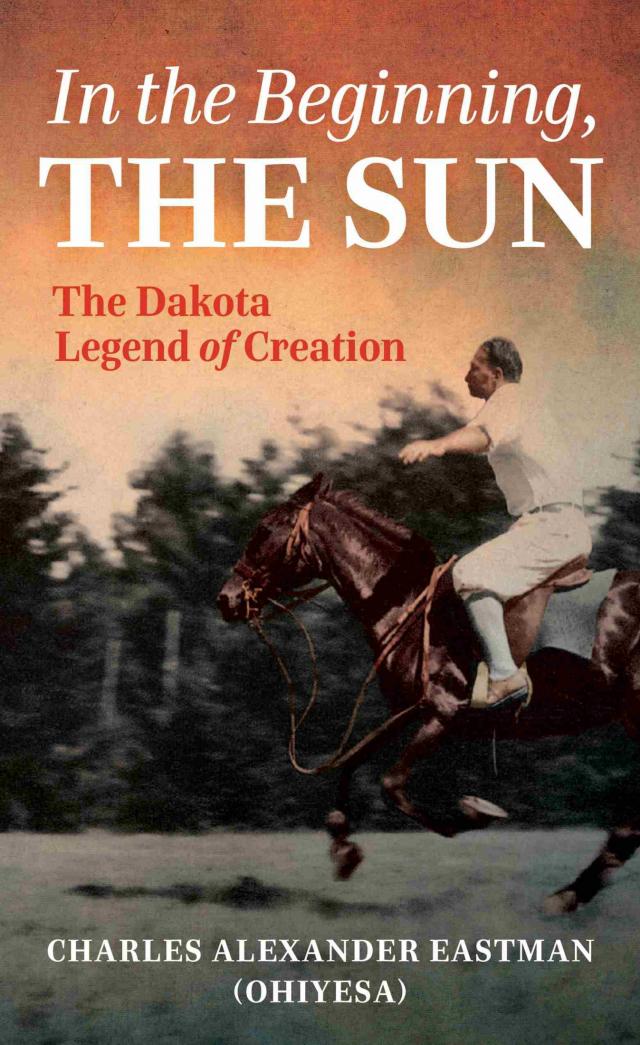
IN THE
BEGINNING,
THE SUN
The Dakota Legend
of Creation
CHARLES ALEXANDER EASTMAN
(OHIYESA)
Edited by Gail Johnsen
and Sydney D. Beane
Text copyright © 2023 by the respective authors; edits to the Legend copyright © 2023 by Gail Johnsen. Other materials copyright © 2023 by the Minnesota Historical Society. All rights reserved. No part of this book may be used or reproduced in any manner whatsoever without written permission except in the case of brief quotations embodied in critical articles and reviews. For information, write to the Minnesota Historical Society Press, 345 Kellogg Blvd. W.,
St. Paul, MN 55102-1906.
COVER
Charles Alexander Eastman, riding; digital color by Hinhan Loudhawk. The Dakota word for horse is sunka wakan, holy/mysterious dog. Members of the Horse Nation are spiritual beings and relatives to the Dakota people, teaching and helping through ceremonies, spiritual rides, and programs that carry traditional values to youth.
All photographs are from family collections.
Artwork on title and part title pages is by Yvonne Wynde.
mnhspress.org
The Minnesota Historical Society Press is a member of the Association of University Presses.
Manufactured in the United States of America
10 9 8 7 6 5 4 3 2 1
♾ The paper used in this publication meets the minimum requirements of the American National Standard for Information Sciences—Permanence for Printed Library Materials, ANSI Z39.48-1984.
International Standard Book Number
ISBN: 978-1-68134-233-7 (paperback)
ISBN: 978-1-68134-245-0 (e-book)
Library of Congress Control Number: 2022950119
This and other Minnesota Historical Society Press books are available from popular e-book vendors.
CONTENTS
PART 1 | FAMILY ORIGINS
A Journey through Time and Family
GAIL JOHNSEN
To Bend in the River and Beyond
SYDNEY D. BEANE
PART 2 | THE DAKOTA LEGEND OF CREATION
Introduction
CHARLES ALEXANDER EASTMAN (OHIYESA)
The Sun, the Earth, the Moon, and the Earth’s First Children
*
Unktomi and the Killing of Eayah, the Devourer
*
Unktomi’s Travels and the First Mourning
*
Unktomi’s Journey to the Bottom of the Sea and the Sacred Ritual
*
The Land Animals, the Sacred Ritual, and the World Contest for Speed
*
The Coming of Eshnaicage, the Spirit Messenger
*
The Creation and Nurture of Waceheska, the First Human Baby
*
Unktomi’s Trial
*
The Training and Rescue of Little Boy Man
*
The War of the Animals against Waceheska
*
The World Peace and Waceheska’s Marriages
*
The Great Snow and the Departure of Eshnaicage and Waceheska
PART 3 | DAKOTA LEGACY
Remembering Relatives
YVONNE WYNDE
Ohiyesa: From the Sacred Earth of the Oceti Sakowin, a Literary Tradition
GABRIELLE TATEYUSKANSKAN
This Is Our Truth
KATE BEANE
Contributors
A Note on Editing the Dakota Legend of Creation
Notes
Index
PART 1
FAMILY ORIGINS
Charles Alexander Eastman, his son Ohiyesa, and an unidentified friend (left to right).
A Journey through Time and Family
GAIL JOHNSEN
I OFTEN THINK OF THINGS I WISH I HAD ASKED MY MOTHER, my father, my grandparents. What were their early lives like? Why did they make the choices they did? What was most important to them? What made them who they were? Who were they, really? I will never know the answers to most of those questions, though there are hints in things they said or things they left.
That is probably why I accepted the papers and memorabilia left to my mother by her mother, Eleanor Mensel. These were things she had inherited in turn through her sister Dora, from their mother, Elaine Goodale Eastman, wife of Charles Alexander Eastman, whose Dakota name was Ohiyesa. I remember Elaine Eastman, and as I grew up, I knew three of Charles and Elaine’s children: my grandmother, Eleanor, and her sisters Dora and Virginia. Charles himself had died before I was born.
Elaine Goodale Eastman, born in 1863, was an author throughout her life and also became an educator and an advocate for Native people. In 1890, at the time of the Wounded Knee Massacre, she met Charles Eastman, a Dakota doctor working at the Pine Ridge Reservation in South Dakota, and she subsequently married him, to the consternation of some in her family. There was also a range of reactions in the press, with a number of articles romanticizing the union, some reporting it matter-of-factly, and a few decrying it.1
Charles Alexander Eastman was born in Minnesota in 1858; his mother did not survive his birth, and his grandmother raised him. It was a tumultuous time in Dakota history, the decade in which the bands were forced to move to a reservation as white settlers invaded their homelands. The government expected them to become farmers and to adopt the dress and customs of those who had taken their land; some people gave this a try, while others continued traditional lifeways. In 1862, when the US government failed to pay the promised annuities and Dakota children were starving, some of the Dakota attacked white settlements, beginning the US–Dakota War. Charles’s grandmother fled with him to Canada, where he was adopted by his uncle, as his father was believed to be dead. He grew up in the Dakota way of life, and he was taught to consider the whites of the United States his enemies—until he was fifteen, when his world changed forever.2
Imagine the double shock of learning that his father was alive and had come to take him to Flandreau, South Dakota, to set him on a path to education and acculturation in the American society of the time. Only respect for his father enabled him to accede to the plan. It would mean not only learning a new language and new skills, but learning about a new religion and a new way of being in the world.
Charles went on to become a physician, government investigator, prominent advocate for Native Americans, lecturer, and author. In some areas of his life, he confronted prejudice in its various forms. Yet in his writing career, this seems not to have been as much of a factor. Early in the twentieth century, the United States saw a surge in general interest in nature, outdoor activities, and conservation—and, now that the Indian wars were essentially over, a more romantic view of the hundreds of Indigenous nations. These factors awakened interest in Native lore and skills. Charles both benefited from this interest and contributed to it. He wrote numerous books about Dakota life and beliefs with the collaboration of his wife. Her letters confirm that she considered him truly the author of the books, with her contribution in most cases being editing while preserving his style and voice.3
One of Eastman’s goals in publishing books was to familiarize white America with a specific Native culture so that the dominant society might appreciate what the other had to offer. Indian Boyhood describes the childhood and training he had himself experienced. Wigwam Evenings sets out moral teachings in the context of traditional stories. Perhaps the most enduring of the books has been The Soul of the Indian, which outlines the values and spirituality of the society in which Charles Eastman had been raised as a child. In the foreword to From the Deep Woods to Civilization, Elaine Eastman stated that “in the end [he had] a partial reaction in favor of the earlier, the simpler, perhaps the more spiritual philosophy” of his Dakota upbringing.4 This philosophy sprang from the teachings he referred to as the Unwritten Scriptures, summarized in Chapter 5 of The Soul of the Indian.
What if there were some further indication of his philosophy, his thoughts, in the papers that had been saved and passed down? Charles Eastman died in 1939 and left his papers to his wife, and I now had them. To go through and organize everything seemed like a daunting task, one that would require a lot of time and thought. So they sat for a while. I remembered that my grandmother Eleanor had said that various people had visited her, wanting to know more about her parents and hoping to gain access to any papers she had. She had demurred, telling them—and me—that she hoped someone in the family could do something with them. She expressed this desire in a letter to one researcher as well.5
After a time, I began to investigate those cartons of history. There were letters, photographs, pamphlets, papers, manuscripts, and books. There was categorizing to do, decisions about what and how much to keep, and what to do with the things kept.
Though there are no original manuscript drafts of Eastman’s published works among the papers, the Eastmans kept manuscripts for some unpublished works. One thing that stood out was an old typed manuscript in a cover cut from cardboard, with a title page reading “Sioux Mythology / The Indians’ Bible / The Story of the Creation / by Charles Alexander Eastman (Ohiyesa).” Eastman signed the last page, and there are a few handwritten notations made by his eldest daughter, Dora. This could be a more complete explication of the themes found in The Soul of the Indian.
I had also inherited a manuscript my mother received from a researcher who speculated that Elaine had donate d Charles’s unfinished works to a museum in South Dakota that had then suffered a fire, perhaps destroying both the writings and the record of them.6 But my old typescript seemed to be that fuller exposition, and I searched for confirmation. In a 1935 letter to H. M. Hitchcock, a Minneapolis optometrist and amateur historian, Eastman claimed to have finished this work: “I have finally completed The Sioux Creation Legend. I called it [the] Sioux Bible. But I have to go over it again.”7
Why did he work on this particular material at that point in his life? One factor might be the circular the new US commissioner of Indian Affairs, John Collier, had put out in 1934. It stated, “No interference with Indian religious life or ceremonial expression will hereafter be tolerated. The cultural liberty of Indians is in all respects to be considered equal to that of any non-Indian group.” Until that time, the Code of Indian Offenses of 1883 had criminalized Native religious expression and much of the culture in general. Congress had also created Courts of Indian Offenses, which handed down harsh penalties for whatever actions they deemed to be infractions. The circular surely did not immediately wipe out all abuses—US laws made various Native religious practices illegal even after the passage of the American Indian Religious Freedom Act in 1978—but it was a significant change in policy and may have provided an impetus to Charles’s work.
Elaine herself wrote that in Charles’s later years, she and their son Ohiyesa felt that he had difficulty organizing his writing well.8 The typescript I found may or may not represent collaboration with someone else. It is extremely doubtful that it was Elaine or another editor, particularly given the minor punctuation problems, very occasional typographical errors, indefinite pronoun references, and other small problems that editors correct automatically. We have made these minor revisions in this book, knowing that as a seasoned author, Charles would have welcomed this kind of editing. (For more details, see “A Note on Editing the Dakota Legend of Creation,” page 193.) This is Charles Eastman’s work, based on his memory of his early learning and, as he related, confirmed by a tribal elder and teacher.
So why did Elaine not try to publish this manuscript after Charles’s death, especially considering that his other works had sold robustly, and she needed the income? She edited and published other pieces of his work, and she did not destroy or donate this manuscript. Looking at their later lives, it seems that both Charles and Elaine, with differing views, became more involved in advocating for the current status of Native Americans in American society, rather than in presenting a picture of a Dakota culture that could no longer be experienced. So it may be that since this manuscript represented what Elaine considered a reversion to a “simpler” philosophy, it went against her more assimilationist viewpoint. Also, the legends were of course stories, not a presentation of a more codified or even doctrinaire religion such as her own might seem. Further, as the manuscript expounded a philosophy of connectedness and community, it would not necessarily have resonated with a more individualistic and success-oriented cultural viewpoint. Finally, although she did publish “Peace Pipe and War Bonnet,” an edited series of newspaper articles based on some of Charles’s descriptions of the Dakota as they had been, she was unsuccessful in turning these into a published book and may have perceived that the timing for this sort of work was not right.
In his introduction to this manuscript, Eastman mentioned that he learned the legends as a child and first wrote them down in 1885, while he was a student at Dartmouth. He later consulted with his elder brother, John, to find out who still could repeat the entire cycle, in order to confirm his work. They went to an elder named Weyuha, who verified the main story and then repeated the twelve lessons of the legends that are given in this book. Echoing this process, as a descendant of Charles Eastman, I shared this manuscript with my cousin Syd Beane, a descendant of John Eastman, who consulted with tribal elders in an effort to verify the historicity of the teaching method. So this creation story, one story among many, traces back to an earlier time and culture, yet reverberates in the present day.
I began in hopes that the manuscript I found would tell me more about my great-grandfather, his values and their formation. In thinking about how we consider and frame his work and what we read into it, I realized we can also learn more about ourselves, our own prejudices or predispositions, our beliefs and values. And that’s a good thing too. Hecetu ye. It is so.
John Eastman.
To Bend in the River and Beyond
SYDNEY D. BEANE
MY BROTHER WILLIAM AND I ARE NOW THE OLDEST LIVING direct descendants of John Eastman. We were both born and raised within the Bend in the River Dakota community as enrolled members of the Flandreau Santee Sioux Tribe. This is the Dakota community where Charles Alexander Eastman was baptized as a Christian and learned how to speak, read, and write in English while attending a mission school. Grandma Grace Moore, a daughter of Rev. John Eastman and Mary Jane Faribault Eastman, was our instructor in the family history and the books of her uncle Charles Eastman. She encouraged us to continue learning our family stories and to share them with others, and we do that here.
Coming to Bend in the River
In February of 1869 twenty-five Dakota families, mostly Bdewakantunwan who were originally from Cloud Man Village in Minnesota, left the Santee Reservation in Nebraska, crossed the Missouri River into South Dakota, and settled along the Big Sioux River at a place they called Wakpaipaksan—a Dakota word meaning “bend in the river.” Their departure from Santee was a serious test of federal Indian policy. It was the Indian agent’s responsibility to keep them on the reservation, but an 1868 treaty gave male Indians the right to claim homesteads in the Great Sioux Reservation. Their departure could be described as either a heroic act or a foolish decision, depending on one’s point of view. Indians were still being killed outside their reservations.
The Big Sioux River Valley was a desirable area, and land development companies had competed for land claims and future townsites. One of them, the Dakota Land Company, was incorporated on May 21, 1857, during a session of the Minnesota territorial legislature. Legislation was further passed to create and name counties in what would become southwestern Minnesota and adjacent areas near the Big Sioux River. The Dakota Land Company claimed the site that would become the city of Flandreau, naming it in honor of Charles Flandrau, an associate supreme court justice for the Minnesota Territory and a Dakota Land Company shareholder. This townsite was abandoned within a year under pressure from the Yankton Sioux guardians of the nearby pipestone quarry. In 1862 Bdewakantunwan Dakota warriors led by Little Crow, furious and desperate over abuses of treaty provisions, went to war, and whites fled from the area. The city of Flandreau—spelled with the extra e—was officially established in 1879 after both white settlers and Dakota homesteaders occupied the valley.
The Flandreau area with its rolling hills and valleys along a major river became the place where Jacob Eastman (Many Lightnings, Wakandiota) established our family home following the Dakota–US War of 1862. Jacob’s family and kinship relations, although being on both sides of the war, experienced hanging, exile, imprisonment, Christian conversion, and reservation life away from our homeland in Minnesota.
Jacob had become separated from his son Charles Alexander Eastman (Ohiyesa) after they fled Minnesota into Canada during the war. After two years struggling to survive in Canada with other kinship followers of Little Crow, Jacob, his daughter Mary, and two of his sons, John and David, surrendered across the Canadian border at Pembina. They were taken from Pembina and placed in the stockade at Fort Snelling before being transported to the prison at Camp McClellan in Davenport, Iowa. They were released in 1866 and sent to the Santee Reservation in Nebraska.
Charles was raised in Canada until the age of fifteen by his grandmother and his uncle, Mysterious Medicine (Pejuta Wakan). Jacob found Charles in Canada in 1872 and reunited him and his grandmother with the other family members now living within the Christian Bend in the River Dakota community near Flandreau.


