

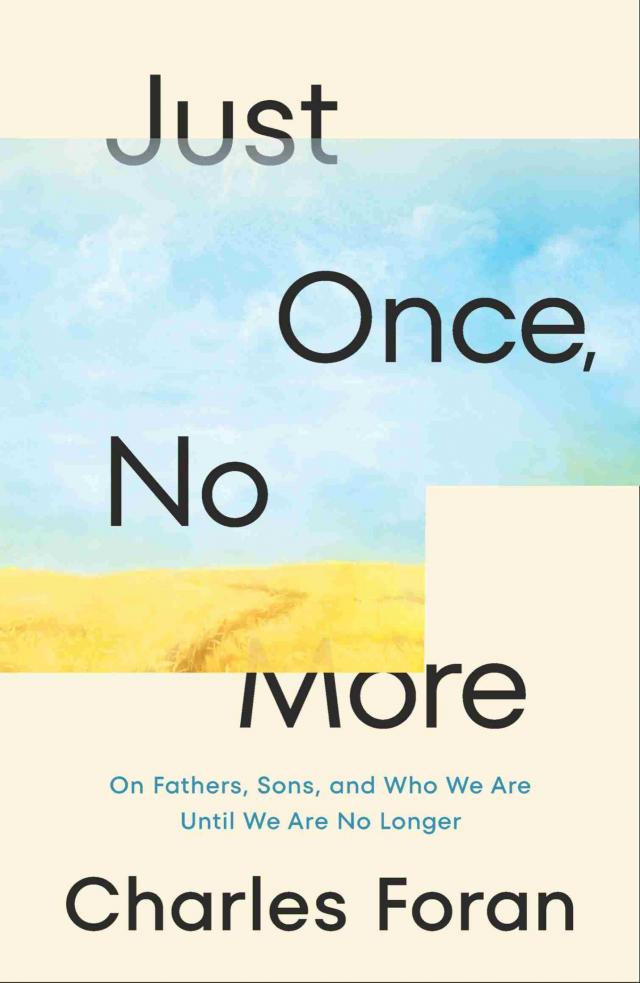
Just once no more, p.13
Just Once, No More, page 13


“I have to go,” she says, standing up. “Someone is waiting for me.”
With her eyes she indicates the staircase. A moment earlier you glimpsed another woman in a bay window on the second floor, watering plants on a sill. The glass refracts much of the light. But you did discern that this woman is aged, and tall, and has curly hair and the posture of a wilted flower. Her outline alone, the curls, make your heart—no other way to put it—burst. The math works; her mother lived to ninety-six. Also, she never smoked, exercised daily and looked after herself. Aged sixty, she could raise her legs over her head and count her toes.
Your own legs will not hold your weight. It is for the best; otherwise, you might try following her late-middle-aged daughter across the lawn. “Before you go,” you say. “Can I say one thing?”
Being kindly—she always was—she shrugs, lets the deranged person go on a little longer.
“My dad, your grandfather, gave me a look the final time I saw him alive. The expression tore me up with regret. And I don’t want that for you. I want you to see me now, and know I am happy and full of gratitude. All along I’ve felt loved and been able to give love in return. That’s it,” you add, dropping your gaze to the ground. “That’s pretty much the whole show.”
She pauses, then thinks better of engaging further. She speaks while walking. “Are you aware that you just used the word ‘regret’ twice in thirty seconds?”
At that, you smile, knowing that she gets it, or is starting to. “Keep walking,” you say. “Let Rilke explain.”
You quote from memory:
“Once for each thing. Just once; no more. And we too,
Just once. And never again. But to have been
This once, completely, even if only once;
To have been at one with the earth, seems beyond undoing.”
“That’s beautiful,” she says. Looping strands of graying hair around her ear, she climbs the stairs to rejoin her mother.
* * *
Here is another scene. You are paging through a family photo album that belonged to your grandfather’s second wife. You are doing so in a spacious room, formerly a stand-alone coach house, which you and your wife recently attached to the main house. The home, made of powdery red brick local to the area, dates from around 1870; the coach house might be older. Though you pretend otherwise, you are scouring the faded and dissolving photos in search of a family member who has your face. Once before, you came across a random daguerreotype from the 1860s that revealed a man who could have been you in the mirror, plus bushy mustache. But on this occasion, you are searching among actual ancestors, three generations’ worth. And you have reason to be optimistic; your crowd did not marry widely outside their kind—A to B to A again in race, geography, religion. You must lurk somewhere among the faded Forans and Mortons, McGradys and O’Neils. Where else would you dwell?
You subscribe to an ancestry search engine, and a few minutes of research rewinds your family into the nineteenth century. About your great-grandfather, William Foran, you already know a fair amount, thanks to those print obituaries taped inside the photo albums, although it is good to be reminded that “Billy” was married for forty years to Susan McGrady, also of Ottawa. You meet for the first time Thomas Foran—your great-grandfather’s dad—and your great-great-grandmother Alice Hickey. They were married in Ottawa in 1868, both aged twenty-three, but hailed, according to the certificate, from Quebec City. Alice’s parents are given as Michael Hickey and Mary Burke; Thomas’s are Michael Foran and Mary O’Neil. Previously you learned that your grandmother, Ruthie Foran, née Morton, had a mother who was likewise an O’Neil, Sarah Ann, better known as Daisy. She was from Dublin. Soon you are accustomed to a genealogy overrun by Annes and Margarets, Jameses and Johns. And there is certainly no escaping Marys.
But Michael Foran is the ancestor you wish to find. Your great-great-great-grandfather—also, it so happens, your actual brother, alive and well in northern Ontario in 2019—must have been the one who obtained passage on a ship. Likely he did so around 1840, and though he was probably driven out of Ireland by cholera, he had the good fortune to escape before hunger and disease took hold in 1845; the same year it seems, he and Mary O’Neil became parents in Ottawa. A million Irish died over the next sixty months, and a million more, mostly the poor, fled into exile. Michael may have emigrated with Mary or met her on the boat. Or perhaps they ran into each other during their early days here, at mass on Sunday or as domestics in a grand house.
You want to know more about his passage from Ireland to Canada. How Michael Foran managed those long weeks at sea. How he later understood the experience of migration. Learning about your ancestor’s Atlantic crossing suddenly feels urgent, and a photo of him would, you believe, reveal what is essential. From one shore to another, with so much water in between; from one identity to another, with so many points of connection. Three to four weeks at sea, if the winds are decent; fifty-nine years trapped in a chest cavity—if the heart keeps on thwomping.
A thought comes to you. Couldn’t Michael Foran have first entered Canada nearby Port Hope, the town near Toronto where you are examining those photo albums in your circa-1870 house? Many Irish did pass through this port before settling along the north shore of Lake Ontario. Suppose he took work on landing—he was likely penniless, and winter fast approaching—and wound up shoeing horses in an informal blacksmith’s shop partway up the hill from the harbor? A small shop, built out of the local brick, known for being powdery, which was later converted to a coach house, and later again attached to the main building?
The conversation happens late one night when the sky is blacked out, and the wind hurls leaves against the windows.
“It’s himself?” Michael Foran says.
“Is it?”
“Well, aren’t you?”
“Maybe,” you say.
“I think so.”
“Then you are…?”
Michael Foran smiles. A smile like your dad’s, or maybe his dad’s. Not like your own.
“Can I ask you about the journey?” you say.
“To get here?”
“Yes.”
“This fancy house?”
“Across the ocean.”
“You tell me.”
“Sorry?”
“You made it, as well. Everyone does.”
“Okay,” you say. “But what I want to know most about is…” You scroll through your mental list, settling on two items. There is the devastation that comes from leaving loved ones behind: the curl of her hair, the slope of her shoulders. As well, the fear of the unknown future, one most likely dark. A bottomless well, an ocean deep.
“The girl I left behind?” Michael Foran guesses.
“Then there was a girl?”
“There’s always a girl.”
“But who is Mary O’Neil?”
“Ah,” he says. “There’s always a Mary too.”
You wait.
“Met her on the boat. From another village, down in Cork. She’s grand. No complaints at all, except her accent. I understand barely the half of what she says. Might be for the best,” he adds with another grin.
“Okay.”
“But come here a minute,” Michael Foran says. “Let me tell you about the music that kept us from going mad those nights and days. It’s what you want to learn, is it not?”
Is that true? What you really want is the music?
“There was a lad with a concertina, an O’Sullivan from Mallow, and a piper from Glengarriff. Singers too, of course, plenty of them. We had great times, singing and dancing—at least, when we weren’t heaving our guts into slop pails or confined to bunks below.”
His phrasing reminds you of a song. “Do you know ‘Paddy’s Green Shamrock Shore’?”
“How does it go?”
You hum the melody.
“Sing it for me.”
You try:
“From Derry Quay, we sailed away
On the twenty-third of May.
We were boarded by a pleasant crew
Bound for Americay.”
Michael Foran winces. “Sounds familiar. A stronger singing voice might help.”
“The narrator leaves behind a girl named Liza. He vows to return and marry her once he’s made his fortune.”
“Does he promise that? Poor lad. Poor lass too—if she waited.”
“What did you sing on the ship?”
“Here’s one,” he says. He sings, his voice high and lonesome and pitch-perfect.
“Oh, the streams of Bunclody they flow down so free
By the streams of Bunclody I’m longing to be
A-drinking strong liquor in the height of my cheer
Here’s health to Bunclody and the lass I love dear.”
“I guess there is always a girl,” you say.
“This story takes a bad turn,” Michael Foran says. He sings another verse, and then explains. “The girl comes from money, you see, ‘a great store of riches and a large sum of gold.’ But the boy has nothing. He abandons family and friends and everything he knows and loves, boards a packet-boat to cross a raging ocean, all in the faint hope of finding wealth enough to be a worthy match.”
Closing his eyes to concentrate, your great-great-great-grandfather finishes the song:
“So fare you well father and my mother, adieu
My sister and brother farewell unto you
I am bound for America my fortune to try
When I think on Bunclody I’m ready to die.”
You reflect on the lyrics. “Maybe the tale doesn’t end so badly,” you say. “Maybe the immigrant lucks into a good deal shortly after he settles in New York or Chicago, Ottawa or Montreal. He earns a fortune, a small one, and writes home with a date of return. And then he shows up in Bunclody with his own riches and gold, marries the girl, and lives happily ever after?”
Michael Foran gives you a look, half pity, half disgust. “No chance of that happening,” he says.
“None?”
“Not in this life. Not unless you’re dreaming. It’s like I tell my bairns. ‘Wake up! Wake up! Don’t sleep so much!’ ”
“You say that?” you say. “ ‘Wake up! Wake up! Don’t sleep so much!’?”
“I do. To my children—Thomas, and the others.”
Your heart threatens to burst its cage, again. It was the music you wanted, after all. “It sure is a beautiful song,” you say.
* * *
One of these scenes happened. The other hasn’t—yet.
25
Dec 2019
Dear Dad,
I can’t seem to finish this book.
Thirty-six months ago, I began thinking and writing about you dying, and the onset of sadness within me. I could not identify the task then, but now I suspect I was hoping to reconcile your mortality with the unsettling of my being. I made a list titled “Why Older People Get Sad,” thinking I would be tracking these laments, one “why” at a time. Here is the original:
Death of loved ones
Loss of driving purpose: mating, children, career
Ebbing of once vital relationships
Overall feeling of diminishment—intellectual, creative, sexual
Health issues
Loneliness
Pattern recognition in nature—i.e., mortality
Tired of same old self
Less and less taste to food
Inability to find/feel/experience God
Now, much thinking and writing later, I have revised the list to make it truer to my real preoccupations and what I sensed coursing through these pages, half-formed and unresolved.
Deepening awareness of the suffering and anxiety experienced by all humans
Desire to help, see happy, those I care about
Metacognition
Superiority of music for expressing how it feels to be alive
Clumsiness of words—my own, at least
What Leonard Cohen said, words and music both perfect: “You lose your grip, and then you slip/into the masterpiece”
Will miss everyone! Will miss everything!
Our bodies
Who we are until we are no longer
The ultimate (nonhuman) nature of things
Perhaps the last three items require further explanation—all three because they are entwined. At first, I assumed it was your body, the obscure map outlined by the freckles along your arms, that I was exploring. But never has this book been only, or even principally, about you. Always the interrogation has been of my own body, the freckles that coat my arms too, from fingers to shoulders, and which are likewise an archipelago. And as for the notion that my inquiry was triggered by your slow decline, beginning three or four years ago? Living in Hong Kong during the tumult following 9/11, I wrote an essay about being far away from home at a moment when the planet started to spin faster. In the piece, I referenced the story of you shooting the bear, your father losing his nose in the Second World War, the tabernacle in our church with the mind shaft up to heaven, and Lao-Tzu wondering if he is a man dreaming that he is a butterfly, or the other way round. “To my father,” I wrote then, “I should have said this: I don’t miss the house I grew up in and I don’t miss the basement where I watched TV. But I miss him, and have been lonely for him, on some strange, subterranean level, a current I am only now registering in the soles of my feet, only now beginning to feel rise up into my body, an ache that might just be the ache of loss, all my life.”
We should have read that essay together when it was published in 2002, and we should have talked about it. Imagine: declaring in print that I was lonely for you and had been registering the loss of you all my life, while you were crafting birdcages and wandering hardware stores in happy retirement in Bobcaygeon. But I was on the far side of an ocean when the piece appeared and preoccupied with the death of a close friend. We Forans are timid people, passengers not only in our bodies but in the cargo vessel that conveys our emotions across those various seas, each container sealed, the contents frequently left to rot. Deflection, misdirection, sublimation: these are the tricks of the shy who are also the prideful, and the wounded who can’t get their words right—not even close.
There is also the problem, expressed in number Nine on the revised list above, of who I have “been” while working on this book. “All over the map” would be one answer. “In perpetual motion” might be another. Better this: “Stepping into the river every day and never finding it the same. Stepping into the river and not remembering—until I reread my notes—that I had been there just twenty-four hours earlier.” I dare an Atlantic crossing to reunite with my true love. I wait by the tree for Godot and do not move. I contain multitudes. I am a butterfly dreaming she is a woman. Which is true and which truth will more likely hold up? Which story is better told, which list most tightly crafted, to withstand the insecurities of self and the inexorable passage of time? Not me, not mine.
As for the final item—this declaration in black and white about the nature of the world—it, too, may be a thought I am only now beginning to engage. Early in the writing process I noticed that thinking about change and mutability was not compounding the midlife sadness I was feeling. Quite the opposite. Such moments of connection, however fleeting, and of apprehension, however imperfect, were offsetting those feelings—banishing them for a spell, reframing their underlying anxieties as silly and a waste. Such moments marked times when I voluntarily looked up, raised my line of sight. They were when I allowed the notion that human nature is not nature enough, not even close, to upend my too-conventional assumptions and preoccupations, free them for just long enough. Our lives play out adjacent to those rivers or nestled in those woods, the air either scorching or frigid, the light diffused by foliage or shade. However immersive, this topography and weather represent only the bottom tier of a canvas of clouds, skies and heavens. Above us lies fuller, deeper nature, most of which we can’t discern—too-thick clouds and skies too-hazy, cold on our skins and burning in our hearts. We do not often experience the empyrean. Instead, we tell ourselves that we dwell in an entirely separate space, and are special, exempt. That delusion may be our greatest sadness, not to mention a pending disaster for the planet. Like many forms of decentering, apprehensions and liftings may serve to make us feel not so separate from the rest of things, not so reckless and restless, solipsistic and lonely. They may offer a welcome break from being who we usually are.
The tenth preoccupation on the new list could also be why I’m unable to finish this book. Regardless of a tightening chest as I sit at my desk, I can’t yet absorb, never mind frame, this latest notion or get enough of my words to line up with sufficient elegance to cover the gaping holes, the embarrassing inadequacies, the not-even-understanding-what-I don’t-understand, of my careening thoughts. The only way to stop unraveling the text is to quit it.
Is it enough to understand now why I have written this, even if I do not know how to—or if I should—complete the work?
I hope so.
I think of two further details from the period after your death, one a confession, the other a proclamation. Using my iPhone, I snapped photos of your corpse in the hospital bed a half hour after your spirit departed. Five images in all, each one appalling: teeth out of your head and mouth gaping, no sheet to cover your naked torso. With the machines already gone—the security team, the hired muscle, had abandoned the fearless leader seconds after he breathed his last—I could take my morbid time. Your left arm lay exposed, and I studied it, as interested in the IV bruises at the inner elbow as the freckles running to the wrist. The freckles too were washing away, a child’s treasure map drawn on a sandy beach, the evening tide rolling in. I did not bother photographing them.


