

The trackers, p.1
The Trackers, page 1


Copyright
4th Estate
An imprint of HarperCollinsPublishers
1 London Bridge Street
London SE1 9GF
www.4thEstate.co.uk
HarperCollinsPublishers
Macken House
39/40 Mayor Street Upper
Dublin 1
D01 C9W8
Ireland
This eBook first published in Great Britain by 4th Estate in 2023
Copyright © 3 Crows Corporation 2023
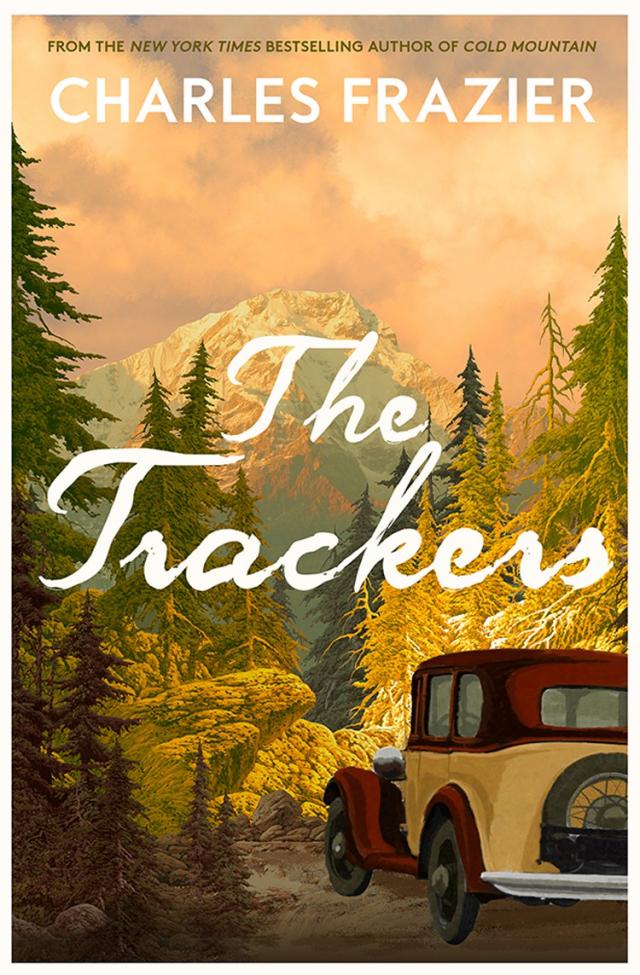
Cover design by Jo Thomson
Cover image © Getty Images / Designwest
Car based on a photo © Getty Images / Fox Photos / Stringer
Designed by Jennifer Chung
Interior art: Douglas fir and spruce trees © Max_Lockwood/shutterstock
Charles Frazier asserts the moral right to be identified as the author of this work
A catalogue record for this book is available from the British Library
This novel is entirely a work of fiction. The names, characters and incidents portrayed in it are the work of the author’s imagination. Any resemblance to actual persons, living or dead, events or localities is entirely coincidental.
Information on previously published material appears here.
All rights reserved under International and Pan-American Copyright Conventions. By payment of the required fees, you have been granted the non-exclusive, non-transferable right to access and read the text of this e-book on-screen. No part of this text may be reproduced, transmitted, down-loaded, decompiled, reverse engineered, or stored in or introduced into any information storage and retrieval system, in any form or by any means, whether electronic or mechanical, now known or hereinafter invented, without the express written permission of HarperCollins
Source ISBN: 9780008636593
Ebook Edition © April 2023 ISBN: 9780008636616
Version: 2023-03-15
Dedication
For David and Elizabeth
Epigraph
As soon as you embark, you’ll be free …
But don’t go astray.
—Sophocles, The Trackers
… hunger and cold and death ride the green light of every train the child tramp flips. Soon he knows them as old acquaintances.
—Thomas Minehan,
Boy and Girl Tramps of America, 1934
Contents
Cover
Title Page
Copyright
Dedication
Epigraph
Part I: Ten Thousand Foot Blue
Part II: Charcoal and Umber
Part III: Rust and Chartreuse
Part IV: Cinnabar and Azure
Part V: Indelible Black
Acknowledgments
Author’s Note
About the Author
Also by Charles Frazier
About the Publisher
A MUDDY BLACK-AND-WHITE NEWSPAPER PHOTOGRAPH. I’m standing on a scaffold made from two tall stepladders with boards running between them. I’ve barely begun the mural, haven’t even started putting color on the wall of the brand-new post office. In the photo, the wall looks almost blank, though if you know what you’re looking for, you can faintly see the penciled grid I’ve been laying out, where I’ll soon sketch the underlying form of my plan—curving lines moving across the space, swelling and rising and breaking like waves, the flow of energy moving left to right like a line of text. Up on the scaffold, my head nearly touches the ceiling. My tousle-top hair needs a trim. I’m wearing baggy khaki pants and a workingman’s T-shirt and an old pair of Converse All Stars. In the photograph, the paint stains barely show. I’m holding a brush in my hand, not because I’ve been using it but because the photographer asked me to hold it where the camera would see it. Long and Eve stand a few feet apart on the new black-and-white tile floor, their chins lifted, looking up at me. Eve is wearing a fancy show business cowgirl outfit. She looks a little silly, and at that moment somewhat ordinary. Long wears a dark business suit with subtle Western yokes on the chest. The photo highlights the gray at his temples and emphasizes the difference in their ages. They’re tired, having driven hours from Cheyenne after a few late nights of political business, lobbying and glad-handing. The flashbulb pops and records the moment we first met, and it was news. The caption on the front page of the Dawes Journal read, After Cheyenne trip, prominent rancher John Long and wife greet WPA painter.
MID-AFTERNOON, MAY, UNDER AN EMPTY HIGH-ALTITUDE sky, cool but the sun blazing like it yearned to cinder you, I took a right turn off pavement and passed under a massive H-shaped ponderosa-log entryway. A nearly discreet sign swinging on two chains from the crossmember read Long Shot. Down the dirt drive, two black arcs of telephone and electric lines drooped pole to pole for half a mile of tallgrass and sage.
At the end of the road, the ranch house sat long and dark brown. It wasn’t old—not much is out there except the land itself—but this was aggressively new. Its angular flattish rooflines looked like Frank Lloyd Wright had been hired to draw up an enormous log-and-stone cabin one morning and had tossed it off in time for lunch. The center of the house stood tall and angled, and the two wings stretched low and flat. My first thought was that it hunkered against the world, as if attacking bands might still roam the plains. As architecture, it made me wonder who it was afraid of or, conversely, who its anger was aimed at.
To the left of the house, the paved highway ran far enough away that vehicles passed miniaturized, barely visible and totally silent. To the right, open country stretched west across sage hills to distant blue-black pine mountains in front of ghostly snow peaks flat as drawing paper against the sky, the Wind River Range. Centered in my windshield, heavy double doors, tall and wide enough for a locomotive, or at least a Packard, to pass through, stood closed. Above the shoulders of the house, a herd of red cattle grazed a near hillside. They drifted all in the same direction, paired with their shadows, moving slow as a tide change. Sky stretched blank and blue to the horizon in every direction.
I stepped up on the porch and knocked three times. The knocker was a stylized bronze horseshoe big as the mouth to a five-gallon bucket. I waited and knocked again.
No response.
To the right of the house, a pole-fenced round pen with sandy footing sat next to a massive hip-roof horse barn. In the center of the circle, an elder slim cowboy in a frayed straw hat lunged a young quarter horse on a long line, the horse shorter both front to back and up and down than the thoroughbreds some of my father’s clients rode to kill foxes with packs of dogs. Handle and lash, the cowboy’s lunge whip was twice as long as he was tall. He swirled his right hand loose-wristed, making a figure eight with the whip, apparently just for the slow, rhythmic whooshing sound of it, the music. The tip never touched the horse. It trotted in circles, head and tail up and ears back.
I walked over to the corral and waited to be noticed. The cowboy didn’t even look my way. He seemed to be muttering low to the horse. Sometimes he let the whip end fall to the ground and barely tapped the horse with the long handle across its chest or upper legs. A reminder, like tapping someone on the shoulder. The horse would stop, change directions, change gait with tiny movements of the cowboy’s right hand or his muttered words. One time he let the horse slow to a stop, and then he slacked the line and let it fall to the ground. He lowered his head and looked at his boot tips and backed away a few slow steps like he had no expectations of the horse, required nothing from it, had in fact forgotten all about it. After only a few seconds, the horse stepped toward him, curious but wary, and then the cowboy pulled the line until it was off the ground but still loose. He made a slight mouth noise, and the horse trotted in a circle along the fence line. The succession of events was a communication, a language, and when the horse started circling with only a quick sound, it felt somehow like coming to the end of a stanza.
—Mr. Long? I said.
The cowboy kept his eyes on the horse, his beat-up, big-knuckled hands fully occupied with the lunge line and the whip. He tipped his head back and aimed his chin toward the front of the house. When the shade of his hat brim lifted, sunlight caught his face halfway and lit up white whiskers. First glance, he appeared to lack a mouth, since from nose down nothing revealed itself but bristles. He wore Levi’s worn pale at the rear end and a faded blue plaid Western shirt with the sleeves cut entirely off. Under the saddle-tanned skin, his forearms and upper arms and shoulders looked like an anatomy study. Muscle and tendon and veins squirmed and clenched in ropes and knots. His gray face looked grafted onto a younger body.
I stood there awhile by the fence wondering what to do until the cowboy, without breaking his concentration on the horse, finally said, G’on in.
And then to the horse he said, I’ve about got you to know the word whoa. So let’s us quit and head to the barn.
I CLIMBED THE STEPS BACK onto the porch, knocked again, and then opened the heavy doors and stuck my head in and said, Hello? Hey? Anybody home?
Apparently nope.
So I stepped into the entryway. As my eyes adjusted, the room swelled dark and wide, and taller than expected, shaped by massive timbers and log walls and Douglas fir plank ceilings. Daylight filtered down from narrow clerestory windows like slits in a fort wall for firing. A circular projection of amber light from a big mica-shaded lamp on a round oak table defined the center of the space. Shelves of books absorbed sound and light, but all around, rising high toward the ceiling, I could see paintings, layers of them rising high toward the ceiling. On pedesta
On a shelf higher than arm’s reach, a rifle with a long telescopic sight occupied a horizontal shelf that looked made for it, a space to display an art object. The rifle’s muzzle end was supported on a skinny metal bipod, and the belled rubber eyepiece of the scope flared like a coronet. Several little knurled knobs and wheels interrupted the long body of the scope and made me want to climb on a stepladder and twiddle with them to feel their precision. The forestock reached almost to the muzzle, and the whole thing, wood and metal and glass, shone like it had been polished yesterday.
At the end of the room, brighter hallways led off to left and right and straight ahead, but I hesitated to keep moving forward. I circled, looking at the art, mostly Western. I’d have needed a flashlight to see the signatures but guessed Russell for a lot of the bucking horses and Plains Indians hunting buffalo. A few Remingtons clustered together, including a very nice stark snow scene, almost black and white, of horsemen climbing through boulders up a rough mountain trail, very nearly abstract if you stood back and squinted. The sorts of paintings I studied photos of while I developed my mural proposal for Hutchinson to pitch to his committee.
Off to the side, I found a small and very handsome mountain landscape, surely a Moran. And then, surprisingly, at least at that first moment, two French paintings. One I guessed was probably a Matisse—a woman lounging on a chaise in a red room with a door opening to a blue sea. The other was, almost certainly, a tiny Renoir—a haze of landscape, bits of shiny water, a meadow with flowers, a female figure in the distance barely distinguishable from the vegetation. The painting itself couldn’t have been even five by seven. But it was framed deep, wide, and dark—almost more frame than image—to enhance its luminosity and its tiny preciousness. You looked into it, and it magically enlarged and expanded away from you.
I ventured farther into the house, calling out greetings now and then to avoid being taken for a burglar. Eventually, at the back of the house, I found a woman in a very large and bright modern kitchen. She chopped vegetables and tossed them into a huge pot of dark stock for stew.
The woman set down her knife and wiped her hands and said, You’d be the painter boy.
—I’m Val.
—Julia, she said. If you’re looking for Mr. Long, he’s gone. Be back in a few days, maybe. Or sometime after that. He goes to Cheyenne and you never know when you’ll see him again. Eve, she’s gone with him. You go out back to that first little cabin, blue door. That’s yours. The big one with the brown door is for the hands. Don’t ever go in there. It stinks something awful. And the one with the red door is Faro’s. You don’t want to go in there either, for different reasons.
—Blue door, I said.
—Round about six, come back in here and have a plate at the kitchen table or take it back to the cabin. In the morning, breakfast at six if you want meat and eggs and hash browns. The old man who cooks for the cowboys—he used to cook in chuck wagons on cattle drives—does breakfast and will bring it over if you’re up. After seven, nothing but coffee and toast and jelly and a glass of milk. Serve yourself.
I thanked Julia for her help and got my bag out of the car and walked around the house toward the blue-door cabin. Between the house and the barn, four cowboys stood in a gathering off to the side of another young cowboy who was clearly drunk. He was stocky and red-faced and wore his hat pushed back to his hairline so that the afternoon sun struck his face full on. It shone oily and golden. He wore a pistol in a low holster on his thigh like an old-time gunfighter in the movies. None of the other ranch hands carried guns.
One of them said, Come on, Wiltson, let’s go inside and settle you down before you make a fool of yourself.
Wiltson waved his fingers over the pistol butt like it was a magic wand. He claimed he was in no mood to be told what to do by anybody whatsoever.
The ranch hands conferred among themselves, and then one of them headed to the barn. In a minute, the old cowboy I’d mistaken for Long came out and walked toward the drunk cowboy. He still had on the sleeveless shirt, though the sun angled and the day had turned cool. He was not armed.
Wiltson said, Faro, you may be head man around here behind Long, but this ain’t the moment to dick around with me. Not a good time a’tall. Call it a bad mood, but you better step away and keep stepping.
Faro kept walking up. When he got close, Wiltson settled his hand near his right hip above the pistol butt. He locked his eyes on Faro and quivered the open hand like a threat to draw.
The skin of Faro’s face clinched tight against the bones. He swiped his left palm downward to smooth his face hair. He ran his tongue around in a circle inside his closed lips and rubbed his right thumb and forefinger together like he needed a toothpick.
He said, One chance, son. Shut up and go to bed and sleep it off.
Wiltson laughed and said, Old men supposed to be real wise and shit. But out here they don’t seem to make nothing but crazy fucking dumbass old men.
He got halfway into laughing at his own wit when Faro shuffled three steps very fast and grabbed Wiltson’s left wrist and yanked it sharp straight downward, and when the boy pitched forward from the waist, Faro met the face with a knee. Wiltson’s nose burst with blood, and he bawled like a branded calf and staggered half a step. His knees buckled, and as he began to fall, Faro reached for Wiltson’s pistol and pulled it from the holster and whipped the barrel of it against the back of his head as he fell. It happened almost too fast to follow.
Wiltson’s hat landed a few feet away, right side up, and Wiltson came to earth facedown with arms and legs splayed. He didn’t move except for struggling to breathe around the blood from his broken face. Faro stuck the pistol under his belt and walked back toward the barn.
One of the hands said, What are we supposed to do with him?
Another one said, He didn’t mean nothing.
Over his shoulder, Faro said, Neither did I. Wipe his face and put him to bed. Quit acting like somebody died. It might look bad right now, but this is not beyond the ability of the human body to heal. Tomorrow morning, if he’s sobered up and can walk and still wants a job, tell him to come see me by noon at the latest. Otherwise, hit the road with all the other railroad bums and hobos.
THE GUEST CABIN WAS LOG outside and inside, one large brown room with a gigantic bed at one end and a smooth riverstone fireplace at the other. Two fat stuffed leather chairs angled in front of the fireplace. A cozy two-chair breakfast table sat by the window, and that, together with the great bed, were as sad as checking in to the bridal suite when you’re traveling alone. If you were looking for something to criticize, the bathroom was maybe a little dim and narrow. You had to watch banging your elbows on the wall while brushing your teeth. Otherwise, the cabin was luxurious. Without Long’s offer to Hutch, I’d have been spending a slice of my earnings on a dingy room over a store in town, a filthy shared bathroom down the hall.
I bedded down early, right after dinner, anxious to get an early start on my mural. But I couldn’t sleep due to anticipation and altitude. I looked through some of my folders of information and found that the county was over six thousand feet high.
I went out and sat on the little porch. Laughter came from the bunkhouse until an hour after dark, and then silence. The big house showed light in only a couple of windows. Half an hour later, Faro walked by from the red-door cabin toward the barn. As he passed, he glanced at me and said, Can’t always count on those turd cowboys to do night check right. Too bad you had to witness that little transaction. These days, some of the young ones especially, you have to remind them they’re not the boss.
I HAD NEVER TRAVELED FARTHER west than Louisville, so the rail portion of my journey to Wyoming felt epic and magnificent. All the different trains and stations, the elements of landscape but not full landscapes, only linear swipes of color flying past through the windows, flowing in muted horizontal bands. Beige, blue, gray, green, white. And the smell of coal smoke and the acidic odor of cinders. Names of insignificant towns along the rail lines became briefly important waymarkers. Same with redcap porters, their names passed along among fellow travelers. Oh, look for Johnny on the Kansas City to Denver run and mention my name, he’ll take care of you.


