

Extratime goal, p.1
Extratime Goal, page 1


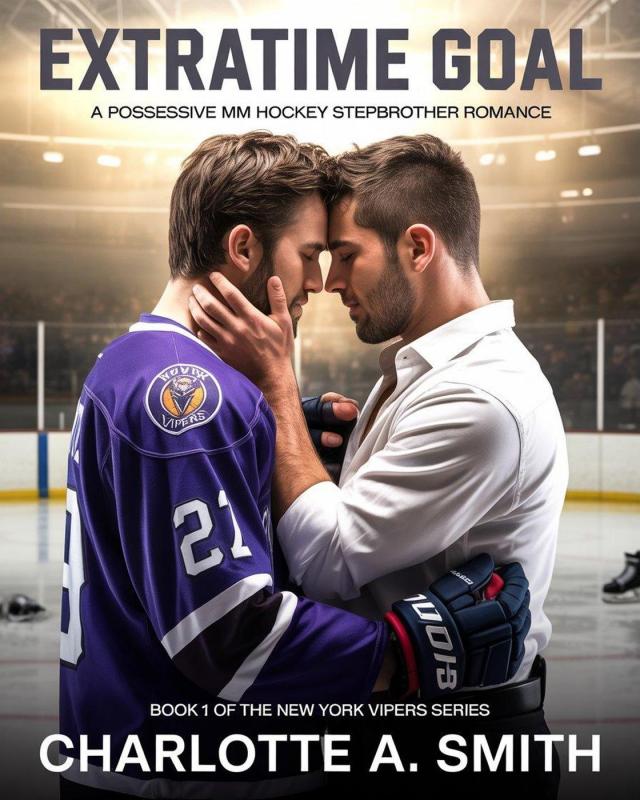
Extratime Goal
Book 1 of the New York Vipers series, Volume 1
Charlotte A. Smith
Published by DETROY EMANUEL ROBINSON, 2025.
This is a work of fiction. Similarities to real people, places, or events are entirely coincidental.
EXTRATIME GOAL
First edition. December 16, 2025.
Copyright © 2025 Charlotte A. Smith.
Written by Charlotte A. Smith.
Also by Charlotte A. Smith
Book 1 of the New York Vipers series
Extratime Goal
Buch 2 der Seattle-Storm-Serie
Five-Hole Heart
Seattle Storm Series
Five Hole Heart
Standalone
Das Rematch
La repetición
The Replay
Death by the Christmas Cookie
Table of Contents
1. Chapter 1
2. Chapter 2
3. Chapter 3
4. Chapter 4
5. Chapter 5
6. Chapter 6
7. Chapter 7
8. Chapter 8
9. Chapter 9
10. Chapter 10
11. Chapter 11
12. Chapter 12
13. Chapter 13
14. Chapter 14
15. Chapter 15
16. Chapter 16
17. Chapter 17
18. Chapter 18
19. Chapter 19
20. Chapter 20
21. Chapter 21
22. Chapter 22
23. Chapter 23
24. Chapter 24
25. Chapter 25
Charlotte A. Smith
Extratime Goal
Copyright © 2025 by Charlotte A. Smith
All rights reserved. No part of this publication may be reproduced, stored or transmitted in any form or by any means, electronic, mechanical, photocopying, recording, scanning, or otherwise without written permission from the publisher. It is illegal to copy this book, post it to a website, or distribute it by any other means without permission.
This novel is entirely a work of fiction. The names, characters and incidents portrayed in it are the work of the author's imagination. Any resemblance to actual persons, living or dead, events or localities is entirely coincidental.
Charlotte A. Smith asserts the moral right to be identified as the author of this work.
First edition
This book was professionally typeset on Reedsy
Find out more at reedsy.com
Contents
1. Chapter 1
2. Chapter 2
3. Chapter 3
4. Chapter 4
5. Chapter 5
6. Chapter 6
7. Chapter 7
8. Chapter 8
9. Chapter 9
10. Chapter 10
11. Chapter 11
12. Chapter 12
13. Chapter 13
14. Chapter 14
15. Chapter 15
16. Chapter 16
17. Chapter 17
18. Chapter 18
19. Chapter 19
20. Chapter 20
21. Chapter 21
22. Chapter 22
23. Chapter 23
24. Chapter 24
25. Chapter 25
One
Chapter 1
K
AI
The buzzer sounds and twenty thousand people lose their minds.
I don’t hear them. My focus is locked on Petrov, the Rangers’ left wing, who’s been running his mouth all night. He slams into the boards three feet from where I’m standing, and I feel the vibration through the glass. Good. The Vipers are up 3-1 with forty seconds left in the third. This series is ours.
“Vance! Box three!”
I glance up at the sound of my name, squinting past the ice glare and arena lights. Our media liaison, Jenny, is gesturing frantically from the tunnel. Box three. That’s Dad’s box—when he bothers to show up, which isn’t often. He’s been in Singapore for the last month closing some tech merger. The fact that he’s here, now, during the playoffs, means something’s wrong or he wants something.
Neither option appeals to me.
The final seconds drain away. Our goalie, Reeves, catches the puck and drops to his knees in that theatrical way he has. The team swarms him, gloves and sticks flying. I stay on the bench, watching. Let them have their moment. This is game three. We still have work to do.
“Yo, Warden!” Marcus, our center, skates over and slaps my shoulder hard enough to rattle my teeth. “Smile, man. We’re going to the second round.”
“We’re going when we win game four,” I say, but I tap his helmet anyway.
The nickname—The Warden—started my rookie year when a reporter said I “policed the ice like a corrections officer.” It stuck. I don’t mind. On the ice, I am the warden. I control the blue line, I shut down their best players, and I make grown men think twice before entering my zone. Everything is discipline, structure, control.
Off the ice? Same thing.
I navigate the post-game chaos—the handshake line, the media scrums, the obligatory locker room celebration—on autopilot. My body aches in that good, used way. I took a hit from Petrov in the second period that’s going to leave a spectacular bruise across my ribs. Doesn’t matter. I’ve played through worse.
Thirty minutes later, I’m showered and dressed in my standard post-game uniform: dark jeans, plain black henley, leather jacket. My hair’s still damp. I run a hand through it and head toward the boxes.
Jenny intercepts me in the corridor. “Your dad’s got guests. He wanted me to make sure you came up.”
“Guests?”
“A woman and a younger guy. Twenty-ish, maybe?” She shrugs. “He seemed... happy?”
That stops me cold. Happy. My father doesn’t do happy. He does satisfied, accomplished, victorious. But happy? The last time I saw him genuinely happy was before my mom died, and I was twelve.
“Fine. I’ll go up.”
Box three is one of the luxury suites overlooking center ice. The door is open. I hear my father’s laugh before I see him—a sound so foreign it takes me a second to place it. Then I round the corner and stop.
He’s standing with his arm around a woman. She’s maybe forty-five, pretty in an understated way, with warm brown skin and dark hair pulled into a twist. She’s wearing a cream sweater and jeans, smiling at something Dad said. And next to her—
My brain short-circuits.
Next to her is a guy my age, maybe a year or two younger. He’s leaning against the bar with a camera hanging from a strap around his neck, and he’s... beautiful. That’s the word that slams into my consciousness, unwanted and undeniable. Not handsome in the conventional hockey-bro way. Beautiful. Delicate bone structure, expressive dark eyes behind black-framed glasses, a mouth that’s too full for his narrow face. His hair is a mess of black curls, like he’s been running his hands through it. He’s lean, built like a runner, wearing a faded NYU hoodie and ripped jeans that fit him in a way that makes me look away and then immediately look back.
He’s watching me. Those dark eyes are assessing, cataloging, seeing me in a way that makes my skin feel too tight.
“Kai!” Dad crosses the space in three strides and pulls me into a hug. Also weird. We’re not huggers. “Hell of a game. That hit you laid on Petrov in the first? Textbook.”
“Thanks.” I extricate myself, hyperaware of the two strangers watching. “You said you were in Singapore until next week.”
“Plans changed.” He turns, his smile going soft in a way I’ve never seen. “I wanted you to meet someone. This is Sarah Reed. Sarah, my son, Kai.”
Sarah steps forward, extending her hand. Her grip is firm, her smile genuine. “It’s wonderful to finally meet you. Your father talks about you constantly.”
“Does he?” I shake her hand, my mind racing. Finally meet me? How long has this been going on?
“And this,” Dad continues, gesturing to the beautiful disaster by the bar, “is Sarah’s son, Levi.”
Levi pushes off the bar and approaches. Up close, he’s even more devastating. He’s shorter than me by a few inches—I’m six-three, he’s maybe six feet—but there’s a quiet confidence in the way he moves. His scent hits me as he extends his hand: something clean and sharp, like cedar and darkroom chemicals.
“Nice to meet you,” Levi says. His voice is lower than I expected, with a slight rasp that does something unfortunate to my nervous system.
I take his hand. His fingers are long, ink-stained, and they curl around mine with surprising strength. The contact sends a jolt up my arm, electrical and wrong and right in a way that makes me want to pull away and never let go simultaneously.
I hold on a second too long. So does he.
When we break apart, there’s a flush creeping up his neck. He shoves his hands into his hoodie pocket and looks away, jaw tight.
“Levi’s a photographer,” Sarah says, oblivious to the tension crackling between us. “He’s finishing his MFA at NYU. Sports photography, actually. That’s how we ended up with credentials tonight.”
“Sports photography,” I repeat, my voice coming out rougher than intended. I clear my throat. “That’s... cool.”
Smooth, Vance. Real smooth.
“Yeah, well.” Levi’s eyes flick back to me, guarded now. “Hockey’s a good subject. Lots of movement, drama. Photogenic violence.”<
There’s a challenge in his tone that makes my teeth set on edge. Photogenic violence. Like I’m some performing animal in a cage.
“It’s not violence,” I say, probably too sharply. “It’s strategy.”
“Strategy that involves slamming people into walls at twenty miles an hour,” Levi counters, one dark eyebrow arching. “But sure. Strategy.”
Dad laughs. “Levi’s not a hockey fan, I take it.”
“I appreciate the artistry,” Levi says, still looking at me. “I’m just not convinced grown men need to give each other concussions for entertainment.”
The artistry. Something about the way he says it—not mocking, but genuinely analytical—makes me reassess him. Most people who don’t like hockey just dismiss it. He’s actually thinking about it.
“The concussions are a feature, not a bug,” I say dryly.
His mouth twitches. Almost a smile. “Good to know you’re self-aware.”
“Boys,” Sarah interjects gently, “maybe we could sit? I’m sure Kai’s exhausted.”
I’m not, but I nod. We settle into the plush seats overlooking the ice, which is currently being resurfaced by the Zamboni. Dad and Sarah take the loveseat. That leaves me and Levi in the individual chairs, angled toward each other.
This is a disaster.
“So,” I say, because someone has to fill the silence, “how long have you two been together?”
I’m looking at Dad, but I feel Levi’s gaze on me.
“Six months,” Dad says, and there’s that soft expression again. “We met at a gallery opening. Sarah’s a curator for the Museum of Modern Art.”
Six months. Six months and he never mentioned her. Not once.
“And you decided to spring this on me post-playoff game because...?”
“Kai.” Dad’s tone sharpens slightly. Warning.
“It’s okay, Richard,” Sarah says, touching his arm. “It’s a fair question. We wanted to tell you in person, and with your schedule and your father’s travel...” She smiles. “Timing has been complicated.”
“Timing,” I echo. I’m being an asshole. I know I’m being an asshole. But I’ve spent twenty-four years as an only child, and now my father’s dating a woman with a son who looks like temptation wrapped in flannel and denim, and I’m supposed to just smile and play happy family?
Levi shifts in his seat, and I catch the movement in my peripheral vision. He’s bouncing his leg—a nervous habit. His camera is in his lap now, fingers drumming against the lens cap.
“The thing is,” Dad continues, his hand covering Sarah’s, “we wanted to tell you together because... well, we’re engaged.”
The words land like a hit I didn’t see coming.
“Engaged,” I repeat slowly.
“We know it’s fast,” Sarah says quickly, “but when you know, you know. Right?”
I force my expression neutral. “Right. Congratulations.”
Levi makes a sound—not quite a laugh, not quite a cough. When I look at him, his jaw is clenched, eyes fixed on the ice below.
So he’s not thrilled either. Interesting.
“We’re thinking a summer wedding,” Dad says, and he’s talking faster now, the way he does when he’s trying to sell a deal he knows is shaky. “Small, intimate. And we’d love for you two to get to know each other. You’re going to be family.”
Family. The word tastes bitter.
I look at Levi. He’s looking back, and for just a second, I see my own panic reflected in those dark eyes. Then he schools his expression into something polite and distant.
“That’s great,” Levi says flatly. “Family.”
The next twenty minutes are excruciating. Dad and Sarah talk about wedding plans, the summer house they’re buying upstate, how excited they are to “blend their lives.” I nod in the right places, say the appropriate things, and try not to stare at Levi.
I fail.
He’s doing that leg-bounce thing again, and I notice he chews his bottom lip when he’s thinking. He barely speaks, just takes small sips from a bottle of water and occasionally adjusts his camera. But when Sarah mentions something about Levi moving his darkroom equipment, he comes alive, talking about chemical processes and film grain with genuine passion.
I shouldn’t find it attractive. I definitely shouldn’t be imagining what he’d look like in a darkroom, all that focus and intensity directed at me instead of negatives.
Jesus Christ, Vance. Get it together.
Finally—finally—Sarah glances at her watch. “We should let you go. You must be exhausted, and we have an early flight tomorrow.”
“Flight?” I stand, grateful for the excuse to move.
“Back to Chicago,” Sarah explains. “I’m overseeing an exhibition opening there this week. But we’ll be back next weekend for game five, if there is one.”
“There won’t be,” I say automatically. “We’re closing this series in four.”
Levi snorts softly. I shoot him a look. He shrugs, not quite hiding his smirk.
We do the awkward goodbye shuffle. Dad hugs me again, Sarah kisses my cheek, and then it’s just Levi, standing there with his hands in his pockets and that guarded expression back in place.
“Good game,” he offers.
“Thanks.”
We stare at each other. The silence stretches, taut and uncomfortable.
“Well,” Levi says finally, “I’ll see you around. Brother.”
The way he says it—slightly mocking, with an edge that could be anger or something else—makes my hands curl into fists.
“Yeah,” I manage. “See you.”
He turns to follow our parents, but as he does, his camera bag slips off his shoulder. He fumbles for it, and something falls, skittering across the polished floor.
I bend down automatically, scooping it up. It’s a press pass, the kind that gets photographers field access. But there’s a photo clipped to it—a small print, maybe four by six.
It’s me.
The shot was taken from ice level, probably during the second period. I’m mid-play, stick raised, mouth open—probably yelling at someone. But it’s the composition that stops me cold. Everyone else is blurred motion. I’m in sharp focus, isolated in the frame. The lighting catches the sweat on my face, the intensity in my eyes. I don’t look like a hero. I look... alone. Fierce and alone and almost vulnerable.
It’s the most honest photo anyone’s ever taken of me.
“That’s—” Levi’s voice, close now. He’s right next to me, reaching for the pass. “Sorry, I was just—I shouldn’t have—”
I look up. He’s flushed, that same color creeping up his neck from before, but darker now. His eyes are wide behind his glasses, and there’s something in them—guilt, maybe, or fear of being caught.
Caught doing what? Taking a photo at a hockey game?
Or caught looking at me the way I’ve been looking at him?
“You took this tonight?” My voice comes out low, almost rough.
He swallows. I watch his throat work. “Yeah. During the game. It was just—the light was right, and you were—” He stops, then reaches out and plucks the pass from my hand, careful not to touch me. “It’s nothing. Just practice.”
“It’s not nothing.”
We’re standing too close. I can smell that cedar-and-chemicals scent again, see the faint freckles across his nose, count the shades of brown in his eyes.
“Levi!” Sarah’s voice, from the hallway. “Ready?”
“Coming!” He steps back quickly, shoving the pass into his bag. But he looks at me one more time, and the expression on his face is complicated—want and guilt and something like desperation all tangled together.
Then he’s gone, jogging after our parents, and I’m standing alone in an empty luxury box, my heart pounding like I just played overtime.
I pull out my phone and text Marcus: Need to hit the gym tomorrow. Early.
He responds immediately: Bro we just won. Take a day off.
I don’t answer. I can’t take a day off. Because if I do, I’ll think about Levi Reed and his dark eyes and the way he looked at me like he was seeing something nobody else does.
I’ll think about the fact that my father just got engaged to his mother.
I’ll think about how Levi’s going to be my stepbrother, which makes whatever I’m feeling—this heat, this fascination, this want—completely off-limits.


