

Intervals of hope, p.1
Intervals of Hope, page 1


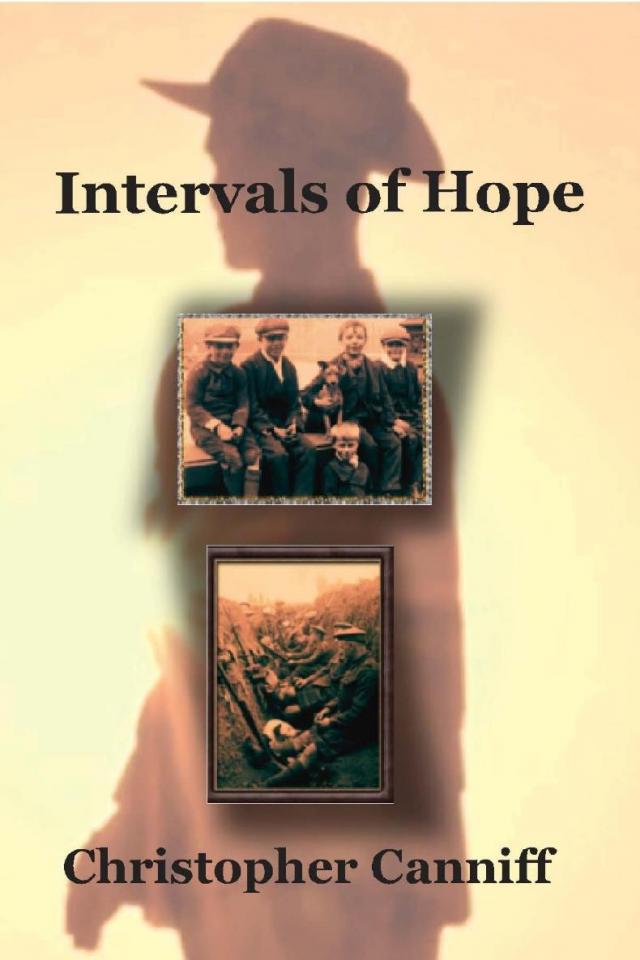
Intervals of Hope
Christopher Canniff
Intervals of Hope
Copyright © 2021 Christopher Canniff
All rights reserved
Published by Blue Denim Press Inc.
First Edition
ISBN 978-1-927882-69-6
No part of this book may be used or reproduced in any manner whatsoever without written permission, except in the case of brief quotations embodied in critical articles or reviews. This is a work of fiction. Resemblances to persons living or dead are unintended and purely co-incidental.
Cover & Interior Design—Shane Joseph
Typeset in Cambria and Georgia
Library and Archives Canada Cataloguing in Publication
Title: Intervals of hope / Christopher Canniff.
Names: Canniff, Christopher, author.
Identifiers: Canadiana (print) 20210269553 | Canadiana (ebook) 20210269561 | ISBN 9781927882672
(softcover) | ISBN 9781927882689 (Kindle) | ISBN 9781927882696 (EPUB)
Classification: LCC PS8605.A574 I58 2021 | DDC C813/.6—dc23
“In the chaos of sentiments and passions which defend a barricade, there is something of everything; there is bravery, youth, honor, enthusiasm, the ideal, conviction, the eager fury of the gamester, and above all, intervals of hope.”
-Victor Hugo
“And the word ‘Family’ implies much more than a collection of people tied by relationship. Differences of character and opinion, the stress of poverty, bits of success, days of fun, accidents and illness, long and heart-rending separations, even death itself—all serve to bind its members closer, and charge the word with lovelier meaning as life grows sterner.”
-From A London Family Between the Wars, M. Vivian Hughes, 1940
Other Works by Christopher Canniff
Novels
Poor Man’s Galapagos (Blue Denim Press, 2015)
Abundance of the Infinite (Quattro Books, 2012)
Short Stories
The Russian Soldier (Descant Magazine)
Solitude (Tightrope Books)
Clean Conscience (LWOT, Montreal)
Soli Deo Gloria
For Gordon Schottlander, whose bravery, courage and service to his country is an inspiration to us all
and
For my great–grandfather Wilfred Littlejohn who fought with the First Battalion, First Canadian Regiment in the trenches of the Great War.
Table of Contents
1
2
3
4
5
6
7
8
9
10
11
12
13
14
15
16
17
18
19
20
21
22
23
24
25
26
27
28
29
30
31
32
Acknowledgements
Author Bio
End Notes
1
September 18, 1934
London, England
Crouching behind my bedroom door and peering downstairs past the painted wisteria paper lining the walls, I was a jungle cat ready to pounce. My pa, Wilfrid Lionel Dixon, was not supposed to be here; yet there he was, leaning on the kitchen door frame with a newspaper under his arm. His hat was askew, casting an outline along his grey, grubby face. A scarecrow among the shadows, that’s what he was. The only sounds came from the sputtering kitchen stove and the infuriating navy blue cuckoo clock in the upstairs hallway. Maybe Pa was coming home to London to live, to get a job here, and this was not simply another visit. My mum, Doreen, would have a husband, and we would finally have a father again.
Or, more likely, this was only another sham.
Dressed in her old white housecoat and stumbling upon Pa’s sinewy figure outlined beneath an iron cross, Mum suddenly stopped. She shuffled beneath his arm, I’m sure, wincing at the stench as she moved toward a kettle heating between a pile of glowing bricks and a copper hood, waiting in silence now for the water to boil, her hands uselessly clenched together.
Verbalizing my thoughts, with each word more emphatic than the last, she started their chewing match:
“Ya here to stay?”
When he didn’t respond, she moved beneath his arm again into the darkened drawing room, sitting on the lilac-flowered couch that looked like a girl giant’s deformed shoulders. Opening my bedroom door wider to hear his answer, as though I didn’t already know, I repositioned myself in the dark beside hinges I had cleverly lubricated with bicycle grease to avoid detection in an instance such as this. There was a clattering of knitting needles as Mum nestled into the comfort of the girl’s hulking arms.
“No,” Pa replied softly.
“I could have told you this, Mum,” I said. “And you wouldn’t have had to bother asking.”
A shrieking noise caused my heart to flip. The kettle was boiling.
Relieved, perhaps, to hear the vessel calling out to her, Mum walked back into the kitchen and set to work. They moved together, out of sight, and I shifted to listen. I needed to move downstairs, to know why this scarecrow had left his fields unprotected to come here, what had changed, what other deceptions he had planned. There were no simple visits. He was after something.
A kitchen chair grazed across the linoleum floor; a single cup and saucer were removed from the cupboard and clanked onto the table.
“What’re you here for, then?” she asked, moving out of view.
“Right,” I said aloud. “I was wondering that, too. And ask him if he’s afraid of catching fire with the heat under the kettle.”
The clock snapped rhythmically. Pondering now if they had heard me, they began speaking again a moment later. The echo of their voices was subdued.
Descending the creaking stairs, with the subterfuge of a spy, was the only way.
As I began, Ian began snoring behind me and I rolled one of my socks, tossing the ball his way. The mass bounced neatly off his face, hushing him. Recalling my mental map, bypassing the creaky parts of the top stairs, I carried on with my descent. Five steps later, the infernal cuckoo clock chimed and then erupted into its odious song before returning to unremitting ticks. I continued down, my drop easier now.
At the bottom of the stairs, separated from Wilfrid and Doreen only by a thin wall, there was no escape. In the glass of the window, Mum’s reflection flashed by. Pa was seated, so I could only see the image of his emaciated back.
I was certain Pa said the word “luggage.” Glancing around, there were no bags that I could see; but maybe he was planning to take the bulky green suitcase, our only piece of luggage, to return here with all his stuff.
The last I had seen that suitcase, years before, was after we had relocated to the Middleton Colliery in South Leeds. We had been in the mining town for only a short time when Mum suddenly announced that she had been swindled and that we were not, in fact, losing our London home to the bank as Pa had led her to believe. She strained to carry her suitcase as we made our way down the dusty road, her two young boys on either side holding her arms as we gazed back at our father. I had wanted him to take us by the hand and lead us back to our row house, demonstrating what a man should do when confronted with the impending loss of his children. And each morning after such a dream, one that I’m sure we shared, I envisioned him awakening to begin the day and mourning his inaction so many years before over a slice of oily bacon, an egg, dry bread and black tea hastily prepared by his elderly landlady. A pitiful consolation.
Mum, her reflection clutching on to the kettle’s wooden handle, turned back toward her husband.
“Your sons,” she said. “Why, they need a father.”
“Right, Mum, stick it to him,” I said quietly. “Fathers are supposed to show sons what they’re to become. If fathers are nowhere to be found, well then—”
But there was no response from him.
“Nicholas is fourteen years old,” she continued. “Almost a man.”
“I am a man now,” I clarified. “The man of this house, anyway.”
Confusion flashed in her sea-green eyes and from the intensity of previous fights, and the rarer tender moments, I wondered whether she might suddenly hurl scalding water, or simply set the pressure vessel aside and embrace him.
“I miss the lads,” he said.
“I haven’t heard you utter that one before, Pa,” I said quietly. “Good line for whatever you’re up to.”
“The boys are upstairs, asleep,” she said. “They’re always after me, asking when you’ll be home next. Good heavens, I’d like to give them some idea.”
Retrieving another cup and saucer, she set them on the table. Moving to sit down, she stopped and gazed upward. For a moment, I thought she might have caught a glimpse of me. But then, she glanced away as I put my back to the wall to reveal nothing of this clandestine spy but a covert shadow.
Pouring herself a cup of tea from a blue and white flowered teapot, she invited her husband to do the same. His voice, garbled with an echo resonating on the walls, muttered something about a job. She did not reply, perhaps surmising the details he had not yet divulged.
This could be the start of a new era for all of us.
“Your new job, it’s at the colliery then?” she asked.
“A promotion, and a new house,” he said before elaborating further, now presenting his plan for all of us to move to the mining town where Pa’s chum Edward had died of the “lung” and another chap Reginald was almost buried alive in a cavern, the doctors and the miners considering it a miracle that Reginald had even survived.
“You must’ve questioned your decision till now,” Pa continued, “which is good for not one of us, staying here in London with the boys. It’s against our upbringing, our morality, and even against God’s will that a married couple with children should be living apart.”
“Who fed you that line?” she asked. “I passed a gift onto the boys, being here. They’ll not be trained by their father to work in the mines.”
She had said before that without her resolution to stay in London, Ian and I would, one after the other from the age of fifteen, slowly become this man before her now: a man hardened and beaten by the underground and by drink, with thick, calloused hands ingrained with the soot of the earth that would not fully wash away and that kept him securely within its confines. Still, she had the power to impart another gift, that of a father for Ian and me, and a husband for herself.
“Albert sent me letters,” she said. “Doings in the mines and such. I don’t want him writing about an accident involving you, or some illness you have from always inhaling dust. We want you here.”
“Dreadful,” I said. “I told you before, Mum, that he won’t move here unless some place like Beckton Gas Works is hiring.”
Evidently, they were not, as Pa said nothing in reply.
I could not recall the last time I had seen her smile, but there must have been a period when she smiled often, a time when that was all my father thought about. After meeting her and her father, a retired Lieutenant, at the bar of the Cecil Hotel during the war, Pa must have fought with her image in his mind. Her visage had surely changed little since, her waved auburn hair cropped short, and her lips curling toward the dimples drawn on her cheeks when she smiled. In his idle moments in the trenches, Pa must have deliberated about his homecoming and their life together after the war, having some conception of a life he was fighting for, his image of their future nothing like this.
The legs of his chair dragged across the floor, and he raised his voice.
“I don’t know what is the problem with you,” he said.
His voice trailed off, and she did not reply. She must have known that what he had said about morality and God’s will was true. The reflection of Pa simply stared across the table, his image cloudy with the steam rising above the pot.
“You’re keeping the family apart,” she said, “not me.”
“You’re both to blame,” I said, far too loud. “No giving in. More his fault than hers, though.”
The jig was up.
Pa walked into the next room. Finding me leaning against the wall, he jumped.
“Go upstairs,” he said.
I stood there as Mum lit some lamps to illuminate the white and gold drawing room. She sat down in her rocker and began knitting a blue sweater. The fireplace glowed with blue and white decorative tiles and an iron hood, the wavering illumination adding to the light from a tasseled table lamp. Black fur shone from the cat Minnaloushe, now sleeping on the floor beside her.
“I’m not so tired,” I said, casually moving away from the wall, peering into his eyes. “But maybe, based on the look of you, I should be. Why’re you home?”
“Brasher than ever, I see,” he replied. “What did you overhear?”
“You said you’re not here to stay, and then you said something about luggage I guess, which is confusing if you’re not moving back here. Then you said you missed us. You have a promotion and you’re looking for a new row house in South Leeds, where we can live together as a family.”
“So, after all that, I’m to blame for keeping the family apart?”
“Mum doesn’t want to be in South Leeds, and you don’t want to be here… so, when you were in the war, what were you fighting for?”
He paused before answering, squinting at me and shaking his head: “What claptrap are you on about?”
“I mean… why aren’t you living here? Don’t you want us?”
There was no response until, clenching his right fist in his left hand, he raised his arms and shoved me back. Losing my grip on the floor, my contorted body spilled down, and he slinked through the front door without a word. Minnaloushe darted after him. Mum threw her knitting needles to the side, the drumsticks clattering to rest. She embraced me there on the wooden floor, squeezing out tears.
He would not be back for months this time, maybe longer.
I wanted to run after him. But I had not challenged his departures before. And I certainly wasn’t going to oppose him further, a soldier who, without contemplating desertion had risked his life so often over a four-year duration of service to his country. Yet running away seemed easy to him now.
In bed, I tried to calm myself by reading Pa’s war journal that I had recently found, while listening to the sputtering and crackling of coal in the drawing room fireplace. I lay awake for a long time before I was able to fall asleep.
I crawled on my hands and knees, first though pouring rain, then up to a German front line trench and over the edge, the blade of my bayonet plunging into the blackness. Pa led the way through underground tunnels and I had the notion that my father, the war hero, had never been so pleased with me. A smile creased my lips.
My subconscious led me to dodge the crags and low ceilings of the tunnels, peeking up to see a sea of rocks suddenly pouring down from above. I was not hurt, but my father was no longer there. My initial shock was accompanied by a sort of panged relief; as though acknowledging that Mum’s troubles, all of which seemed to stem from the man now buried beneath blackness and ash, were over.
My father had faced the German Army for nearly four years in the trenches of France. And ever since examining his wartime journal, a longing for his approval and stress in defying him had become more poignant, more palpable. I knew of his being gassed and awarded medals during the war, tangible yet reticent depictions of courage and valour.
“We’re not going anywhere,” Mum yelled, which shocked me into consciousness and awareness of an ignominious shame. The darkness of my dreams had transformed into an ethereal bedroom, Ian snoring beside me.
After rubbing my eyes, I sat up, climbed out of bed, opened the door slightly and crouched down at the top of the stairs, waiting. Mum was in the next room, yapping in her sleep again.
Maybe my lack of action was keeping the family apart. My parents may have been responsible, but perhaps I was also somehow to blame.
I lay back down in my bed with thoughts of my recent fights in the schoolyard where I had not been hurt, except for bruises easily concealed beneath my clothes; my gambling at Pitch and Toss; and my recent discovery that I could talk back to teachers and even my own mother without reprisal. Yet Wilfrid was previously impervious to such vehemence from either of his two sons.
He was not used to any nonsense from me, and maybe now he would only stay away longer as a result.
My stomach ached, my head sweated, and this kept me awake for seemingly interminable hours as I stared first at the candy-striped wallpaper of my bedroom, the uninspired paintings of a windblown meadow and another of a pond replete with lily pads, and then up to the wavering shadows on the ceiling. Mum mumbled until she had nothing more to say. The cracks on the ceiling oscillated like moving rivers from the moonlight reflecting off the trees outside, and my eyes wound down the length of the rivers carefully before I was finally able to sleep once more.
The next morning, I resolved to bring the family together. Since no one else would do so, I would have to invent a scheme.
I soon learned, over a breakfast of black bread and marmalade, that what I had suspected was true: my father had left for South Leeds as unexpectedly as he had arrived.


