The siege of arista, p.1
The Siege of Arista, page 1


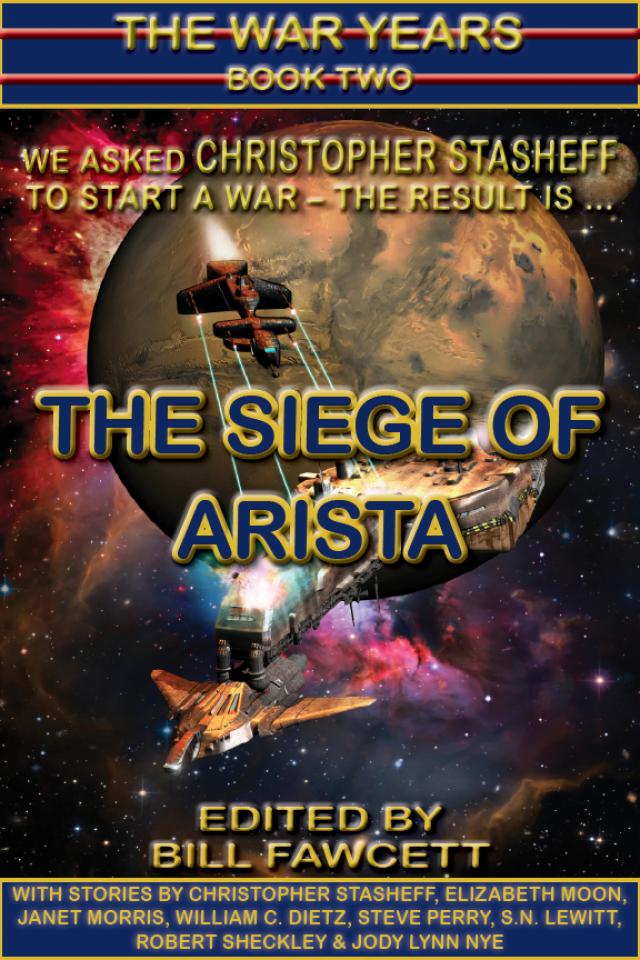
MAN DID NOT expand into the galaxy. He exploded into it with an optimism and level of energy that hadn’t been seen in several millennium. There was no plan to this explosion, no form or purpose. Individuals, governments, traders, and criminals generally followed the paths of least resistance across the hundreds of worlds capable of supporting Terran life.
One of the more unusual results of this erratic expansion was that man settled a long string of stars stretching outward along the upper edge of the spiral arm in which Earth was situated. Several hundred light years out they discovered the Far Stars Cluster, containing six thousand stars and over a hundred eminently habitable’ planets in a relatively small volume of space. Man encountered often fierce resistance from the races already living in the cluster, but within three centuries was entrenched in the cluster. Even a major war against the powerful and militaristic Gerin only served to strengthen and unite all the worlds under the banner of the xenophobic League of Man.
Fifty years after the Gerin War, the Far Stars were crowded, civilized, and safe. They were too powerful to attack and too prosperous to allow change. Those with too much ambition, or too little sense, once again began traveling beyond the known worlds. As always, those who led this lurch outward were the desperate and those who had to be the first on new worlds. With no FTL radio, each of the newly settled planets was still basically on its own. The men who first explored—and often were the first to die on—the new planets often gave their names to worlds they found. Worlds such as Shelling, Silvercase, and Douglas. Arista itself was named after the wife of its discoverer, Christopher Blancmont. After the loners, came the exploiters, those who were attracted by the easy wealth the first men found. Finally, there came those who were to stay, to settle, and those who carne to live off of them, the bureaucrats and the merchants.
Arista was settled early in this new wave of human expansion. It was a rich world, full of fertile soils and easily mined minerals. It was ideally located to serve as a connection to the distant League and dozens of developing new planets. The population grew quickly as did the world’s wealth. The Aristans parlayed this advantage into a growing mercantile empire. The total population of Arista when the war started was five million.
Soon the small but aggressive Aristan navy directly controlled a massive volume of space and a half-dozen worlds. Many other planet’s settlers and nonhuman races now found they now had no choice but to deal through Arista. On Arista, a generation grew to assume prosperity was their right, no matter what the cost to others. Others, equally rapacious, became wealthy almost overnight. Arista had the feel of a boom town, and its leaders soon became interested only in keeping the boom going with little regard for the consequences.
“DID SOMEBODY FART?” Michaels said, too loudly, hitching up his weapons belt as he stood over the aliens’ table. The nonregulation buckle on the Aristan SOG major’s belt said, “I’m the Guy Your Mother Warned You About,” in raised titanium letters; the belt was cutting into the major’s gut because the flamethrower slung on it was so heavy.
The giant ants seated at the table bent their noseless heads together and made whistling noises at each other. Then one of them twitched in Michaels’ direction, as if to rise to its full seven-foot height.
Michaels’ flamethrower came out of its quick-release scabbard already flaring, leaving a track of smoldering, scorched wood that actually ignited in places as the major brought his weapon to bear on the enemy.
The giant ant was breathing a methane-based atmosphere which he’d brought with him in a feeder tank. Which was too bad for the ant. The tank, the hoses to it, whatever the ant used for a nose, and every breathing passage inside of the ant exploded as soon as the flamethrower whooshed up his tall, slender black body.
McMurtry could see the whole thing in the mirror behind the bar where he waited for his drink. At the table, the other two giant ants, called Hothri, started unfolding themselves into erect positions—maybe to go for weapons, or perhaps just instinctively to help their fellow.
The first Hothri was already down on the wood floor, looking a whole lot worse than the family cat had, the night McMurtry’s brother had lit it back on Arista.
The other two, who either had hive minds and couldn’t help themselves, or just had an inordinate amount of respect for the about-to-be-dead, were down on the floor trying to extinguish their flaming fellow when Michaels depressed his trigger a second time and fried the other two ants, stepping back as he did so because they popped some when their tanks and lungs went.
In the mirror, it looked like a fireworks display gone to shit, rather than alien beings gone to glory in the first salvo of a trade war.
All around the bar, the rest of Michaels’ Special Forces team were keeping order. All but McMurtry. McMurtry didn’t think this was any kind of good idea, and Michaels knew it. So McMurtry’s job was to keep an eye on the bartender and everything else, using the bar’s mirror to make a covert record of the encounter through a minicam he wore pinned to his collar.
Since McMurtry was the COA (Cover Our Asses) officer on this little foray, he picked up his black beer and sipped it calmly, keeping one eye on the bartender, and the other on the mirror in case something went wrong.
Nothing was going to go wrong that the bartender had anything to do with. McMurtry had put his Aristan Military Industries machine pistol on the bar when Michaels approached the ants, just to make sure.
The bartender was watching the pistol, and McMurtry was watching the bartender—when he wasn’t watching the spitting multilegged bonfire and the frightened locals who were trying to get out the door any way they could.
Of course, you couldn’t get out the door—Sonny and Raven had the door covered. Sonny might have figured that the civilian Portu women, at least, ought to be let outside where the smell wasn’t so bad, but Raven was a hard case. Michaels had told Raven, their S-3, that nobody left.
Therefore, nobody left.
You couldn’t do Special Operations Group missions any way but by following orders. Even when the orders were dumber than Portu locals. McMurtry knew that. So he’d kept quiet when Michaels told everybody what the objective was: “Take out the local ant trading mission—all of ‘em. Arista doesn’t want Portu aiding and abetting these Hothri scum. We’re harrying and destroying Hothri wherever we find them, until the Portu humans get the message that harboring aliens isn’t a good idea.”
So it was economics at the heart of this: Arista didn’t like Hothri competition. To McMurtry’s way of thinking, that wasn’t a reason to field SOG personnel. But nobody was asking McMurtry what he thought.
Except, before they’d deployed here, Michaels had pulled him aside: “Something you don’t like about this mission, Sergeant?”
“No, sir,” McMurtry had said, looking straight into Michaels’ blue eyes. “You’ve got real survivability here, sir. However . . . “
“However?” Michaels had said.
“If we’re goin’ out purposely to get Hothri shit all over our shoes, shouldn’t we be sure we’ve got some way to wipe it off later—sir?”
“That’s a command decision, McMurtry. Not mine. You know that.”
“Yes, sir,” said McMurtry, and was willing to leave it at that. Fry the aliens the way Michaels had originally ordered, let the brass worry about repercussions.
But Michaels knew McMurtry better than to leave it at that. A Special Forces sergeant can usually run a good team without the team leader or the operations officer, and McMurtry had outlived two previous holders of Michaels’ slot, and Raven’s slot.
Michaels said, “Tell you what, McMurtry. You go in wired and I’ll do the shooting, this time.”
It wasn’t a consultation. It was an order. It was also close to a goddam slap across the face.
But it was Michaels’ team while he was ambulatory.
So McMurtry played eye-games with the bartender and watched the mirror to make sure his lapel-pin videocam was recording the proceedings.
Damn, if it hadn’t smelled real bad in here before, it sure did now. McMurtry had an almost unbearable urge to go to the bathroom: he wasn’t really a part of this action, and yet the “pucker factor”—the adrenalin rush that pulled his guts in tight—was real high in here.
McMurtry couldn’t sit out any more of this. He picked up the machine pistol, ported it, and turned—slowly, for the camera’s sake.
What patrons weren’t cued up trying to make Raven let them out, were trying to get away from the stinking, black smoke.
Lucky the whole place hadn’t blown. Nobody knew what would happen when you set fire to an ant that big, wearing methane-atmosphere augmentation.
But you couldn’t tell anybody back on Arista anything. Back on Arista, it was Arista forever; Arista, right or wrong; everything for the greater glory of the newest trading power in this sector of the universe.
Aristan trade usually meant exclusivity, high prices, and “protection.” Most of the time, the army was engaged in “protection.“
Right now, McMurtry would have given anything to be protecting a caravan, a trading mission to Hui Whey, a boat or a hypersonic. There was something about this mission that felt purely wrong.
He wasn’t in the pest extermination business.
And neither was his team. They didn’t know enough about what they were dealing with to come in this heavy
But here they were.
And so far, so good.
The ants hadn’t gotten back up out of the flames. There was an occasional crackle from the pile that used to be the Hothri traders. As McMurtry watched, a leg or an arm bone broke in a cascade of sparks, falling on the pile, making the burning heap shift a bit.
But that wasn’t serious.
The serious stuff was all happening over at the doorway where Michaels was putting the appropriate face on the mission, telling the locals what they’d just seen—winning hearts and minds, as the saying went, before he let them out to spread the word.
From over McMurtry’s shoulder, the bartender said, “Want another beer, soldier? On the house? This one’s got black scum on the top.”
“Yeah, okay,” McMurtry said, still watching Michaels and Raven.
Raven, their S-3, was this amazing female with a tiny waist and a real knack for logistics, strategy and tactics. If she’d been a woman of the sort McMurtry understood, he’d have been crazy in love with her. But she scared him, even after half a tour, so he kept his distance. When she was up and running, Raven was something to see. All grace and speed and lethality, with none of the split-second hesitations even the best of men displayed.
Raven, comforting a blond woman a full head shorter than she, was doing a passable imitation of a feeling being.
Only McMurtry knew better. The single one who might give him an argument about Raven’s purely murderous nature was Sonny, who (rumor had it) was sleeping with her.
But you didn’t ask if rumors were true. And you didn’t think about stuff like that. Raven was as good an S-3 as you could have for the low-intensity-conflict sort of mission that McMurtry’s Team 12 specialized in: she’d lasted twice as long as her direct predecessor.
If she weren’t so damned beautiful, with that wavy mane of dark hair and those big velvet eyes that looked at you over a pair of upward-tilting breasts, then maybe having her directly above him in the command chain wouldn’t make McMurtry so uncomfortable. But there she was. And he had to look at those breasts when they weren’t safe inside hardsuit armor, like—
Raven’s breasts blew apart. Her trunk spewed blue-purple-white-brown organs and pureed flesh mixed with spine.
The concussion of the blast that took out the door came slightly afterwards.
The bartender was just saying, “Here’s your beer—“
But all McMurtry could see was Raven with no chest and the surprised look in her big velvet eyes as her body was thrust forward by the force of whatever had holed her.
Then she fell, slowly—much slower, seemingly, than McMurtry as he dived for the wood floor boards, his machine pistol looking for a target.
There wasn’t a target.
There was almost nothing to shoot at, according to the feed he was getting from his sight control electronics. The rest of the twelve-man team had hit the deck, and taken the civilians with them. Everybody was down and covered.
The little shocks the pistol was feeding to his right wrist told him that it was still set for an ant target.
He reached out to set it to nondifferential, so that he could shoot at anything he wanted to, when the whole wall before him, front facade included, disappeared, taking with it what was left of Raven’s corpse in a bellow of physics and a pulverizing explosion.
Part of McMurtry‘s job was to know where all his people were, every minute.
He knew where everybody else had been, and one blink into the billow of explosion in front of him told McMurtry that there was no use waiting around to see if he had wounded or dead he could carry back.
Anyhow, there was only one priority at a time like this: get the intelligence back.
He scrambled backward, trying to get behind the bar, kicking over something as he did. He blinked repeatedly, trying to see something more than the mass of black/red/gold smoke and the silhouetted casualties in its midst.
He couldn’t. And he couldn’t hear anything either except the buzzing tones and electrical whine that was the blood in his ears.
When he made it behind the bar, he was panting and didn’t realize he was climbing over the bartender, until the man shoved at him.
The bartender’s face was bloody from a heavy scalp wound, so that his eye-whites looked yellow and his teeth were pink.
McMurtry yelled: “Another way out?”
The bartender gestured.
McMurtry ran without a backward look.
He could still see Raven’s chest exploding. Damn, why couldn’t it be the vision of silhouettes flung before the explosion that he was left with?
But it wasn’t. It never was, he thought as he stumbled through a back room full of kegs and dove through a door into loamy dirt. It never was the easy stuff you remembered.
He’d had a bad feeling about this mission all along, he told himself as,.against his better judgment, he crawled around the side of the building to get a peek at what had totaled its facade.
And then he saw ants. They’d never really seen ants before, he realized. They’d seen . . . a couple ants. Nothing like this.
Must be the hive mind thing. Lots of ants . . . kill one, the rest react.
The whole goddam main street of Portu Prince was covered with ants. The sky above was dark with ant aircraft—big stuff, not just little flyers—that must have been deployed from low orbit.
Shit. Now, McMurtry had to get out of here. The ants were methodically hosing down everything standing in Portu Prince.
The sound of the whistling ant language, coming through amplification devices, mixed with the rumble of ground vehicles and the whine of air cover, nearly masked the steady stream of curses coming from McMurtry’s own throat.
Damn Michaels. Damn SOG Command. Damn the whole Aristan Senate, and its Aristan Military Industries constituency, who hadn’t bothered to research the ants.
Hadn’t anybody wondered how they’d react? he asked himself as he sprinted along the alley, throat raw, machine pistol slippery in his grip?
Didn’t anybody remember the difference between trade war and real war? Business enemy and mortal enemy?
These ants were on the town of Portu Prince too fast, too hard, and too heavy for McMurtry to mistake what he was seeing back there.
And intel had to know. He had to get back with his record of the proceedings. Otherwije, Arista wasn’t going to know what kind of war it had just started, until the Hothri fell on the next unsuspecting human settlement—or the next. Because no Portu humans were going to be doing any talking about what had happened here—or what was happening here.
The gouts of flame, from area denial munitions pounding the main street behind him, attested to that.
McMurtry tried to leap over a barrel that had overturned and was rolling into his path. He miscalculated, and fell on it—with it, rolling.
Damn, too much noise.
The next thing he knew, he was crawling inside the barrel. He could hear that whistling, coming closer. Something overhead was screeching in a language he didn’t understand.
He huddled in the barrel, his machine pistol cradled against his chest as if he were some frightened little boy with a teddy bear, until the whistling receded and the thud of chopped air lessened as the air cover went on its way.
If he ever found out whose idea this was, he was going to kill the son of a bitch. He kept seeing Raven’s chest, exploding, all that pureed lung and heart, sprinkled with shards of bone.
Well, he thought, if it was any consolation, he’d been right about there being something wrong about this mission.
The damned ants were telepathic, or empathic, or group-minded, or somesuch. You’d think somebody would have thought of that.
But you’d think the brass would think, just once in a while, about something besides the bottom line.
Of course, people never set out to screw up. They just set out to win in their terms. The problem came when those terms weren’t terms on which everyone involved could win.
Right now, winning in McMurtry’s terms meant calling for pickup somewhere that didn’t get himself and his automated dust-off craft hosed down along with the rest of Portu Prince.