

Normal family, p.24
Normal Family, page 24
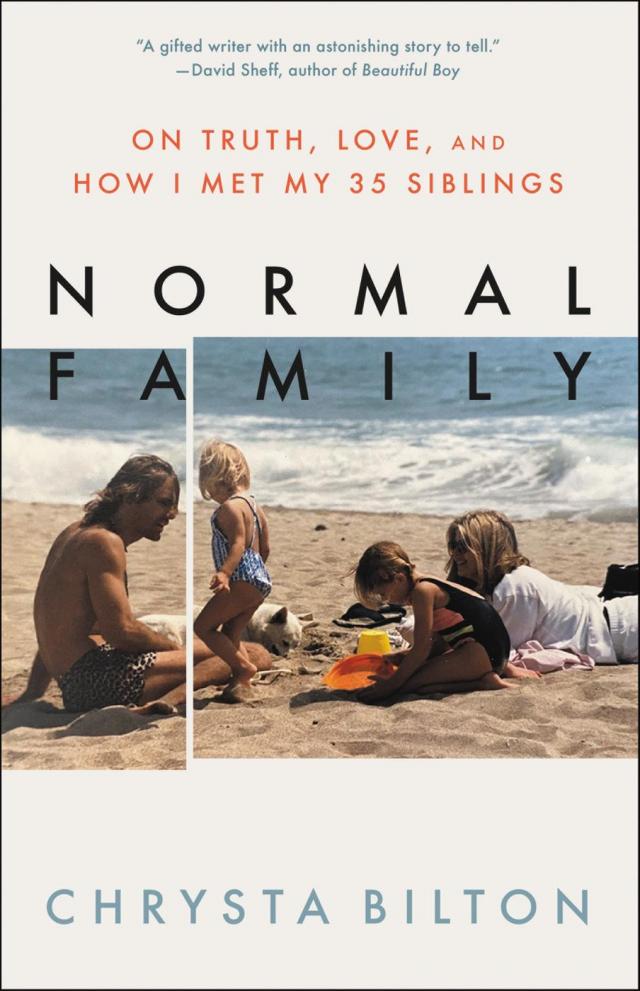


Nick stood and grabbed his niece’s hand.
“C’mon, Willow,” he declared, in defiance of his sister. “We are taking you to get you your hamster!”
We all piled into our respective cars and drove to the nearby Petco. As we were waiting in line to pay, Willow holding a baby hamster in a little plastic tub, Nick looked down and noticed that a man’s dog was about to urinate on his leg. He quickly stepped back as the dog relieved himself on the Petco floor.
“Excuse me, sir, but I think your dog just peed,” Nick said after the owner, lost in thought, hadn’t appeared to notice.
It was enough of a statement that we all turned to see who Nick was talking to. There stood my father, in an old white shirt and jeans—the same jeans Mom had given him all those years ago—still with only his front teeth, his little scraggly dog Trixie by his side. It had been almost a decade since I’d seen him. In a city of four million people, made up of five hundred square miles, I had somehow managed to wind up in the exact same place as my dad at the exact moment in my life when I myself was about to become a parent. What were the odds of this chance encounter?
“Dad,” I said, shaking, as our eyes caught each other’s, Nick registering that this was my father.
I froze as I noticed my father’s eyes move down to my very pregnant belly.
I stood in the middle of the Petco line, unable to move as I turned and looked at Nick’s sister, her husband, and their daughter and son staring awkwardly, and then back at the pee spreading toward my foot.
“This is Nick,” I said as casually as I could, trying to act normal. “Nick, this is my dad.”
Nick, too, tried to act as if everything was perfectly normal. He shook my father’s hand, then introduced him to the rest of the family.
Willow, who was holding her little hamster, looked up and glanced sideways, curious.
“Are we family?” she asked my father.
I could see that he didn’t know how to answer.
“Yes, this is my dad,” I told Willow.
I looked at my father, but I had no idea how to access what he was thinking.
“Do you want to see a dog trick?” he asked Willow, holding out a treat as he tried unsuccessfully to get Trixie to jump up and catch it. Willow bent down to pet Trixie, a ragged and fearful mutt, who quickly nipped at her.
We got to the front of the line as my father fumbled to pay for a few dog treats for Trixie, using one-dollar bills and spare change. I awkwardly tried to think through whether I should offer to pay, but wondered if that might insult him.
I gave my dad a hug goodbye and told him I would call him soon. Nick and I walked back to the car in silence.
The second I saw that my father was gone from sight, I burst into tears. I didn’t even know my father anymore, nor did he know me. He had emailed and texted me throughout the years, to say things like “Happy birthday, Chrysta,” and “Merry Christmas,” often including a photo of him smiling with one of his dogs, which I’d warmly responded to. But he had not been at Nick’s and my tiny wedding at the Beverly Hills Courthouse because I hadn’t invited him. He was not a part of my life anymore, and he’d just seen firsthand so many people who were. “Together” people. “Normal.” I wondered if he’d noticed the difference.
I sat in the passenger seat of our car in the Petco parking lot, hyperventilating because I was crying so intensely, while Nick rubbed my back and tried to be supportive. I realized I hadn’t spent a lot of time thinking about my father over the past several years. It had been easier to just pretend he didn’t exist, to compartmentalize my feelings for him and believe in some imaginary world wherein he was, indeed, just a sperm donor, rather than to face the truth of his being my real dad.
“I’m a terrible human being, aren’t I?” I said to Nick through tears.
“No, Chrysta,” he said, reaching over to hold my hand. “He chose this life. You are not responsible for where he ended up.”
Nick had a smile on his face that I found quite odd, even annoying. He was happy we had just bumped into my father, that it had led to my brief outburst of tears. He had a long-expressed theory that my father represented some big Pandora’s box of emotion I had never dealt with.
Nick looked over skeptically while I wiped away my tears and resumed my position of being completely fine. “I am a thousand percent sure this is just hormones from being pregnant.”
“That must be it,” he said, again with that annoying smirk. He seemed to feel it wasn’t a good long-term strategy to deal with my feelings about my father by suppressing them, and the run-in was the universe’s way of opening Pandora’s box so I could sort through it.
We pulled up to our home in the hills of Los Feliz, which I’d spent months decorating with the zeal of an eight-year-old who decides to rearrange the furniture in her bedroom every evening. It drove Nick crazy the way I moved objects around. He’d walk into a room to sit down with a coffee and a book, only to discover that a chair that had been there hours earlier had since vanished. He was more of a put-things-in-one-place-and-leave-them-there kind of person. But he also understood that having a home of my own, one not at risk of being taken away at any second, meant more to me than it did to most people.
When we walked inside, I couldn’t help but compare my life now to the life my father lived. I looked around at the living room, at several overpriced linen pillows I had just purchased, then thought about my father living in a broken-down motor home. I felt ashamed. I tried to mentally grasp how I might set aside enough money to help him financially. Nick and I were already stretched thin, supporting my mother and with a new mortgage and a baby on the way.
I decided that for now, I would start slow and attempt to rebuild a relationship with him as an adult, without having my mother involved. It occurred to me that she had always been there when I was with him, hovering over us, controlling him and the conversation, and I really didn’t know my father.
It was difficult talking to Dad on the phone, and for our first two telephone conversations after the pet store, I just let him rant for almost an hour about wild conspiracy theories.
“The new world order is marching toward total enslavement,” he’d say. “We have two years max before they drop neutron bombs!”
I realized the only way to have a productive conversation with him was to loudly interrupt and steer the conversation toward concrete topics of real life.
“Dad, can I ask you a question that’s been on my mind?” I said one day.
“Sure.”
“When you used to come visit me and Kaitlyn, as kids, what was that like for you?”
I was fishing. I wanted to learn the answer to the question I had been trying to get answered my whole life: if my father loved me.
“You know, your mother used to pay me to come over to visit you and Kaitlyn,” he said casually.
I sat up in shock as I cradled my now giant belly and felt a painful kick.
“What do you mean she paid you?”
“Oh, you know. I’d come over, maybe massage her feet for a bit, then play with you and Kaitlyn, and she’d give me a little donation. Maybe twenty or a hundred dollars, depending on how she was doing.”
My father kept talking, with no idea that what he’d just said was hurtful. I felt angry and confused, but I didn’t know who to be angry with: my mother for coming up with this plan, or my father for going along with it and then telling me about it. Did all those birthday parties mean anything to him, or had they just been a job to him?
Mom came over later that afternoon, and we talked in my bedroom. She was incensed by the suggestion that she’d paid Jeffrey to pretend to be my father.
“I didn’t pay him!” she insisted. Then she paused, perhaps wanting to cover her tracks. “Well, not for every visit. Sometimes he came without being paid!”
“That’s great, Mom. Just great.”
There seemed to be no end to the lies.
“Chrysta, your father did love you, as much as he was able to love.”
I sat there, quiet, trying not to tear up as I thought again about him picking through loose change to pay for dog food.
“How does he get by, Mom?” I asked. “How does he even feed himself?”
“Your father is very complicated, Chrysta.” She came and put her arm around me on the bed, her face concerned.
She told me about a time, years earlier, when she’d gone alone to Venice to see how he was doing. He’d walked out of his car covered in open blisters. He had MRSA, he’d explained nonchalantly, as he pulled up his pants to show her that both of his legs were covered in scabs. Then he casually asked if she could drive him to the health food store to get some tea tree oil.
“Tea tree oil! Jeffrey, get in the car right now!” she’d demanded, and then rushed him to the hospital. She knew how dangerous MRSA was, that it could be fatal. As she later stared at him in the hospital bed being shot up with antibiotics, she wondered if he could have died. She had gently suggested he apply for government aid. She’d read that he could get an SSI benefit check every month, for $730, if they deemed him mentally ill, which would at least be enough money to buy food.
“They are not going to give me money,” he’d said to her. “I don’t have a mental illness. What will I even say when I go in there?”
“Just go in exactly as you are now,” she’d said, staring at his bloody legs, and the rat’s nest in his hair, and the dirt on his hands and face. “Tell them that story you just told me about the arsonist on the hunt for you, and that you are the coming of Christ. They will give you a check—trust me.”
My mother laughed now, shaking her head at the memory, then turning back to me and growing visibly sad. I could see she didn’t enjoy sharing these kinds of reflections about my father. “Soon after, he started to get the checks,” she said. “In his mind, he thinks he conned the government into thinking he was mentally ill.”
“What was he diagnosed with?” I asked. This was somehow my first time registering that my father might struggle with mental illness—that perhaps drugs and meditation had simply been his attempt to self-medicate a suffering he could not otherwise break free from.
“I don’t know,” my mother told me. “He always grew very vague whenever I asked him about it. Honestly, I was just amazed he even figured out how to get through the paperwork.”
“What if we get him a proper psychologist?” I asked.
“Chrysta,” Mom said, now stern. “I have spent thirty years trying to help Jeffrey. Trust me when I tell you there is nothing you can do. You’re having a baby any minute. Do not take this on right now.”
A few days later, my father began sending me angry messages in the middle of the night. He said my mother had always promised him that in return for acting as our father, his children would take care of him when he was older. This really hurt me because it once again brought into question his motivations for being in my life. And the irony was that if I trusted that his motivations were honorable, I would likely have done everything I could to help him.
I was so overwhelmed by the barrage of messages that I could focus on little else. I couldn’t answer work emails or pack for the hospital. I was comatose. I realized the problem with opening this Pandora’s box was that I was incapable of not crawling inside it.
My mother was right. I was not in the appropriate place, at this moment, to take this on. I gave her some money to purchase a new motor home for him to live in, mostly to ease my guilt, and then I stopped responding to his messages—even to a very sweet note he sent me after I gave birth to my son Somerset.
A Tube of Saliva
It was 9 a.m. on a beautiful March morning in 2017. I was sitting in a rocking chair with Emerson, my and Nick’s second child, who was less than one month old. As I held Emerson’s tiny toes in my hands, I felt both profoundly in love and also grateful he was passed out so I could have a moment’s rest.
I heard my mother arrive downstairs, then listened with a combination of amusement and irritation as she attempted to tiptoe her way upstairs to Emerson’s bedroom, dropping her purse loudly on the way up, then realizing she had left her dog outside. She called out “Gracie!” at the top of her lungs, proceeding to swear at herself loudly for having also forgotten her phone.
“Be quiet!” I hissed as Emerson began to stir.
My mother entered the room with a sneaky look on her face as she fumbled through her purse, furiously looking for something.
“What are you up to?” I whispered, suspicious.
“I need you to spit into this tube,” she said. She pulled out a plastic vial and held it to my face.
“Why?”
“I’m convinced your great-grandmother was Jewish, and I want to verify it with your DNA.”
I raised an eyebrow and made the face I usually made when she assumed I would just pay for some little whim of hers.
“How much does it cost?”
“Just spit!” she demanded, holding the tube up to my lips. “It costs nothing. Consider it an early birthday present.”
Running on very few hours of sleep and wanting her to leave me alone so I could nod off, I spit.
Ever since I’d married Nick, who happened to be of Jewish descent but barely celebrated Hanukkah, my mother had become obsessed with the idea that we also had Jewish roots. She explained that she had always felt “a deep connection to the Jews” and “to their plight.” She now pressured us to celebrate every Jewish holiday and arrived at the house almost daily with new Jewish-themed children’s books for the kids.
My mother used that vial of clear liquid and signed me up for Ancestry.com, hoping to find out more about her maternal line, and perhaps a bit more about Jeffrey’s, too. What she did not realize, in all her adorable technical incompetence, was that by creating this account, she was consenting to share my results with a vast social network of people who had my same hereditary material.
To my mother’s great dismay, Ancestry.com notified her that we were not even .001 percent Jewish. But she was quickly distracted from that disappointment by another Ancestry.com feature, which allowed her to fill in our family tree. In between visits to our house to fawn over her grandchildren, she now spent her days happily immersed in research, looking up names and dates and photographs of parents and great-grandparents and uncles and great-uncles on both sides, with no idea that all this information was being made public.
I was feeling more lighthearted toward Mom these days, perhaps because becoming a parent had given me more empathy for her. As much as I loved being a mother, I now lived with a constant, intense pressure to do everything “right” that was sometimes overwhelming. I could not imagine how my mother had done it alone—how any single parent raises a child by themselves—nor could I fathom how scary it must have been to do it so differently than everyone around her.
A few weeks later, the universe came knocking as my mother sat in the living room of her quaint “Tibetan Orange” apartment in West Hollywood. She had just gotten off the phone with a distant cousin of Jeffrey’s who she’d bonded with in recent months because the woman was as interested in ancestry as she was, and was now helping my mother fill in holes in Jeffrey’s family tree on my Ancestry.com account.
Mom logged in, excited to add a new great-uncle to the tree, still believing that everything she was doing was private. Then she noticed a little bubble at the top of her screen notifying her that she had several new messages in her inbox—or shall I say my inbox, which she was in control of.
She clicked on the first message.
“Hi, how are we related?” the most recent note read. It was from a woman named Jennifer.
My mother sat up in her chair, stunned, unsure what to do. She picked up her phone and dialed me.
“Chrysta, I think you might have a new sister,” she said.
“Have what?” I asked.
“She just reached out to me on my Ancestry.com account. I don’t think she has figured it out yet.”
“Mom, that is my account,” I said, flabbergasted at the boundary I only just realized even existed and that had long since been crossed. “That is not your account!”
I demanded the login and password, hoping to unravel what she had done, at which point I saw that a new message from Jennifer had just landed in the inbox.
“I feel terrible sharing this with you,” it read, “but I think my uncle Bob had an affair with your mother and whoever your dad is isn’t actually your biological father.”
I couldn’t help but laugh. Clearly this poor girl had no idea it was the other way around: she was the one who had her father wrong. I wondered how long it would take her to figure this out, if she’d already realized it as I read this.
It had been almost ten years since I’d learned about the siblings, and I had not given them a great deal of thought since. At some point, my mother had shared that a documentary had been released about my father meeting the first few biological children he had discovered, but I’d never watched the film, not even the trailer. Nor had I ever read any of the dozens of articles about him. None of the siblings had reached out since that first interaction with Rachelle on Facebook. I had been so clear in my communications with her that I did not want anything to do with the siblings that apparently she had passed along the message, and everyone had respected my wishes and left me alone.
But Jennifer had found me before she found the Facebook group.
I pulled up Instagram and stared at pictures of a blue-eyed woman in her mid-twenties who looked exactly like Kaitlyn. She had the same dimple over her left cheek, the same full lower lip, and the exact same shade of thick brown hair. I had always looked more like my mother, but Kaitlyn took after our father, and she and Jennifer were identical. The algorithms on my iPhone would have had a difficult time recognizing them as two separate people.
I scrolled through Jennifer’s photos and saw pictures of the exact same gardening books I had literally just purchased—not only popular gardening titles, but obscure ones. Some of the same esoteric philosophy and art books that sat piled on her nightstand sat on mine. She also dressed exactly like me: in loose-fitting muted earth tones, usually with a scarf around her neck.


