

Camp damascus, p.7
Camp Damascus, page 7
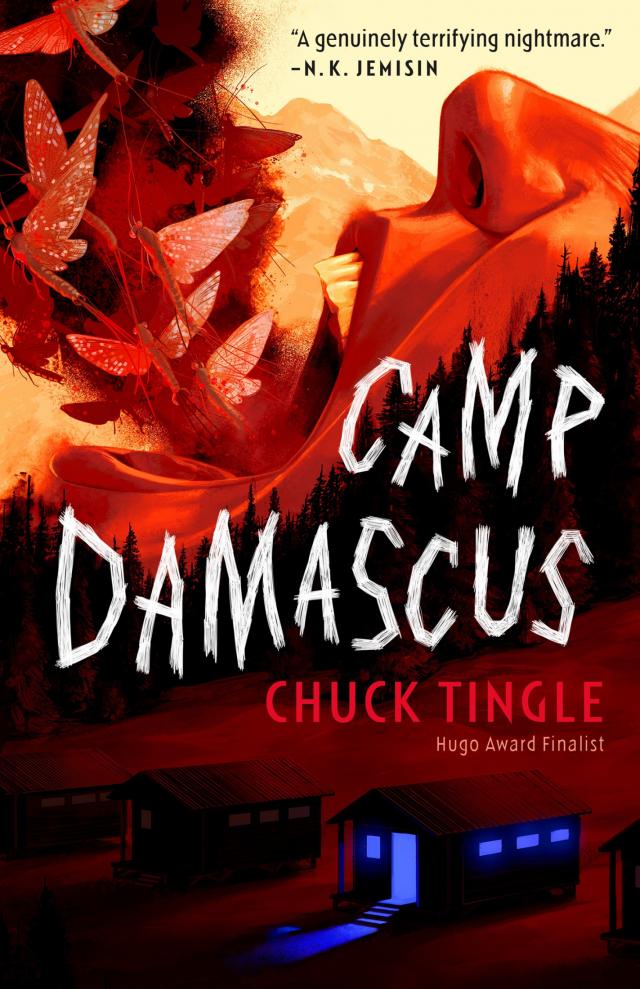


The final spark in Martina’s awareness was her friends screaming in panic and horror, blubbering over a body that couldn’t feel and eyes that couldn’t see.
I’m supposed to be fine with this because she’s in a better place now. She wasn’t a member of the congregation, but she loved Jesus above all others.
That counts. At least, that’s my take.
Other things I’ve learned:
Around 150,000 people die every day across the globe, Martina being one of them.
Cotard’s syndrome is a rare mental disorder that makes people believe they’re dead.
The Turritopsis dohrnii jellyfish lives forever. As far as science can tell, it’s the only immortal species on record.
I’ve buried myself in death facts, devouring everything I can find on the subject. My behavior is obsessive, and I know it, but it’s better than staring at the wall for hours on end, watching shadows gradually creep across my bedroom as a thousand intrusive questions dance through my mind.
What kind of god would let this happen?
Is Martina really happy now?
Because she certainly didn’t look happy with her head cracked around backward, her spinal column shredded, and her shattered bones rending her flesh like hundreds of tiny knives.
A shudder rolls across my frame as I revisit this terrible image, tears forming at the corners of my eyes that I swiftly wipe away. I dive back into the massive blocks of text on my phone, returning to an article about the burial customs of ancient Greece.
“You okay?” my mother’s voice sounds from the doorway behind me.
I scramble to tuck away my device, which they’ve made clear is for emergencies only. In any other circumstance I’d be receiving a hearty taste of parental discipline, but it appears Lisa has momentarily holstered the whip.
Mom steps onto the wooden porch and stands behind me, gazing across the backyard. There’s not much of a view here, just a huge patch of grass and an abrupt line of trees at the far end, but it’s quiet.
“Wanna go on a walk?” my mother asks.
I don’t, but after sitting inside for two weeks this idea might be the lesser evil.
I glance back at her, struggling to plaster on the most natural expression I can manage. Typically, I’m great at masking, but right now the cracks are simply too profound to maintain.
“Sure,” I offer, my voice wavering slightly.
Right-handed people live an average of three years longer than left-handed people.
I stand up and move past her, making my way into the house as I gather my things. I grab a jacket and pull on my shoes, ready for a temperature drop as the evening settles in around us.
Soon, we’re heading down the front steps and taking our usual right turn up the quiet suburban street.
This walk is a ritual for Mom and me, a little moment for us to connect in ways directly spoken and otherwise. The modest neighborhood loop has gotten me through a lot, but nothing quite like this.
We remain silent at first, the soft pulse of our middle-class hamlet filling in the spaces between words. Sprinklers shuffle and churn as dogs bark in the distance. I pick up on children laughing behind the fence next door, and the faintest chime of a bicycle bell rings out just a few blocks onward. It’s not as crowded as other neighborhoods, with plenty of distance and swaths of forest between the houses, but this time of the evening it seems like everyone’s up to something.
After we pass by a handful of familiar abodes, my mother points over at a home on the corner.
“Adultery,” she offers. “Husband is cheating on his wife with…”
Mom drifts off for a moment, considering her options.
“The maid,” she finally concludes.
I remain silent, unable to play along. I refuse to turn and assess the target.
“Come on, Rose,” my mother continues.
All I can do is shake my head, then abruptly stop in my tracks as tears begin to well.
Mom sees it coming, but she doesn’t demand I pull myself together. That’s what my dad would do.
To be fair, though, he’s absolutely right.
Tobias Herrod Cobel wouldn’t have accomplished a damn thing without perseverance and sacrifice, and that spirt runs deep through the congregation. The Industrial Revolution wasn’t a great time for a workplace accident, especially one that took his hand and stole two months of his life in a coma, but without that horrible moment the Prophet would never have received his vision, and without his vision we wouldn’t have Kingdom of the Pine.
Prophet Cobel managed to pull himself up by his bootstraps, and he had it much worse than this.
My mother doesn’t recite any of the tenets, however. She doesn’t remind me of Tobias’s story or tell me to have faith. Instead, she opens her arms wide and wraps me in a tight hug.
We stay like this for a long while, until I finally pull back and instinctively reach up to brush the tears from my eyes. There’s nothing to wipe away, however. I’m all cried out.
My mother starts walking again and I follow her lead.
“Husband cheating with the maid,” she reminds me.
I glance over at the light blue structure, warm light emanating from the kitchen where a family loudly clinks their dishes and laughs with their whole bellies. It’s hard to picture the story Mom’s created, especially given that the Kimberlys live here and we know them very well, but I go with it.
“Send the couple to church counseling,” I offer. “Fire the maid. Remind them of John 3:18, Ephesians 5:33 … Exodus 20:14, obviously.”
Mom nods along, my skills of biblical recollection so precise that it actually prompts her to chuckle in amazement. “That’s great,” she offers. “Consider them saved.”
We continue onward, strolling up the next lane as it curves and sweeps around a large hill. This section of the route is a little more forested than the rest, trees stretching out over the road and a modest creek trickling parallel to cracked pavement.
A car passes, slowing to a crawl as the driver offers a friendly wave. I have no doubt our neighbors would take this care either way, but by now the news of Martina’s death has permeated our community and soaked into everything like spilled ink. Everyone knows I was there when it happened.
Deep in the forest, another home can be seen perched atop its own modest hill.
“I love this place,” my mother announces. “So quiet.”
She says this every time we pass, and although this little comment has been deeply ingrained in my mind, I never understand it.
Lisa is a warm, beaming member of the community, a blond-haired, blue-eyed beacon of light at every church function and a consistent host of book clubs and women’s prayer groups. Almost everything I’ve learned about navigating social cues I picked up from her, a brilliant teacher whether she knows it or not.
This house on the left, however, is the last place I’d ever picture Lisa Darling yearning for. It’s the smallest home in the neighborhood, much older than the rest and featuring a single chimney that’s likely the only source of heat. It’s a one- or two-room cabin, barely visible through the woods: a place of solitude.
“Secular influence,” my mother begins, nodding toward the cabin as we pass. “The daughter brought home terror fiction from her school library; public school, of course. She’s starting to act out.”
This one is easy.
“Remove the secular influence. Schedule a youth pastor one-on-one,” I suggest. “Assign a meditation on 1 Corinthians 10:31 and a reading of Romans 1, top to bottom.”
“The whole thing, huh?” Mom questions.
“Sure,” I reply.
My mother is impressed.
As our walk enters its second half, I find a strange, creeping dread beginning to simmer deep within. The overwhelming sadness I’ve been feeling has been momentarily sidelined, and for that I’m thankful, but this method of ignoring the problem can only hold for so long.
We can’t keep walking forever, and as vast as the subject of death remains, I’ll eventually run out of facts to fill my skull like dry bandages.
The spiritual bleeding hasn’t stopped. In fact, it’s gushing more than ever.
Once I’ve finished tackling death and trauma, there’s only one topic left to shift over to. It’s a question that hangs like a specter in the back of my mind, haunting me.
What does it mean to see things that aren’t really there?
Even more frightening: What if they really are?
Kingdom of the Pine is strict in its teachings about demonic forces, taking a firm but realistic approach over the last decade. We live in the modern age now, and we’re fortunate enough to understand these creatures as a metaphor for the dark cravings within ourselves.
But when’s the last time you saw an abstract metaphor shatter anyone’s spine?
“Rose!” my mother snaps angrily, her sharp tone breaking through my haze of concentration. “Fingers!”
I glance down to realize I’ve been doing my counts, a massive transgression in the Darling household. My hands immediately stiffen, then relax.
Lisa’s face remains stern over the remaining block, finally relaxing by the time we’ve reached our next sharp turn. This area transitions back into newer suburban houses, a cozy lane featuring some of my favorites. Other Kingdom of the Pine families are clustered here.
Mom gestures to another house as we pass, the porchlight on and a lazy orange cat sitting confidently on the front stoop. Inside, the television chatters, a prayer service drifting out through the cool evening air.
“Suicide,” my mother suggests. “The father took his own life.”
I’m always trying to impress her with my responses, answering these hypothetical queries of spiritual warfare with a quick and firm solution. This time, however, I falter.
I know exactly what she wants me to say, but as I open my mouth the words refuse to emerge. Something doesn’t quite fit.
“For the family?” I finally manage to question.
“For the sinner,” my mother clarifies.
Martina didn’t take her own life, but the weight of her death is undeniably tethered to this topic all the same. I can’t help wondering if my mother is doing this on purpose, but the innocent look on her face says otherwise.
A far more heartbreaking realization washes over me, one that doesn’t require any ulterior motives or discreet social manipulation from my mother.
The truth is, even I wouldn’t have found this question sickening until recently. On any other day I would’ve jumped right in with a pitch-perfect prescription, a way for that poor soul to repent even after they’ve left this earth.
Maybe I’d even reply it was impossible; what’s done is done.
Now, however, the simmering dread has reached a boil. Everything feels wrong. It’s not just this particular question that has grown distasteful, it’s the whole exercise. Judgment as sport, whether fictional or not, has taken an undeniable toll on me, a weight that’s likely even more caustic than any encounter with some hallucinated demon.
Or a real demon.
“What do you think?” Mom prods, waiting for my response. “Can he be saved?”
I feel nauseated, the world swaying awkwardly below me as I struggle to maintain my composure. There’s a tear in my soul, a rip that started with Martina’s death and continues unraveling with every passing day.
The Four Tenets were built for moments like this, reminders of my higher purpose in the face of doubt and despair, but the stitches this mantra provides can’t hold back what’s coming.
Respect—I will honor when I do not understand,
Integrity—I will believe when I do not witness,
Service—I will strive when my sin is heavy,
Excellence—I will persevere when my body does not.
I’ve followed this path since I was a little girl, and with a community of cheerful faces at my back and a loving family by my side, it always felt righteous and good.
It doesn’t feel righteous anymore, and with that feeling gone, something even more potent has continued to blossom within me: curiosity.
I suddenly realize how long I’ve been silent, scrambling for an answer that doesn’t exist. “Hey, you wanna grab ice cream after dinner?” I finally blurt.
My mother raises her eyebrow ever so slightly, hesitating. She’s considering whether or not to let me move on.
Eventually, Lisa erupts in a sharp cackle of laughter. “Sure, honey,” she replies, clearly thrilled by our breakthrough.
Her horrible question drifts away into the ether, unanswered.
* * *
I’ve been a patient of Dr. Smith’s for years now, the therapist carrying me diligently through good times and bad, and while the circumstances of my life have changed plenty, the feeling of his office has not. This has always been a place of safety and warmth, a port in the storm of young adult angst that swirls around any girl my age.
In the past, I’ve actually felt guilty over the security I find here. The only one I should feel this welcome around is Jesus, I’d worry.
Back then, I’d been so solid in my convictions, my faith the steady foundation from which everything else was constructed. Sure, I was much keener to explore science and nature than my parents would’ve liked, but that was only because I appreciated these subjects as an extension of God’s love.
And I still do. At least, I think I still do.
But the fact remains, something in this bedrock is cracked and wobbling, a key bracer that was mentioned in the blueprints but was never really there. The more I look around, the more these bracers come up missing.
It’s a little frightening, but after that night at Isaiah’s birthday party, what isn’t a little frightening?
“Where are those plaques from?” I blurt.
Dr. Smith follows my gaze, turning in his striped chair and gazing up at the sweeping assortment of metallic rectangles marking the wall behind him. “All over the place,” he says. “Would you like to take a look?”
I stand up and cross the office, passing Dr. Smith and arriving next to his desk where these awards and accolades hang proudly. I begin to look them over, moving slowly from piece to piece as I silently take them in.
2018 Montana Christian Fellowship Mark of Excellence
2009 Church of the Crossroads Honorable Service Award
2021 Ignite Ministries Youth Outreach Medal of Appreciation
As I move from one side of this display to the other, I discover a whole section of the wall is dedicated to certificates from Camp Damascus, ranging from 2014 to now.
“Almost a decade at Damascus,” I observe.
Dr. Smith watches me closely. He nods as I say this, but doesn’t speak in return.
Eventually, I reach the end of the plaques and turn around. “Why are these all from Christian organizations?” I ask flatly.
My therapist laughs. “What else would they be? Buddhist?”
“But you’re a doctor,” I continue. “Why don’t you have your doctorate hanging up?”
“I learned much more from the Bible than I did in any schoolbook,” Dr. Smith retorts. “I choose to display the things that matter to me.”
I stand in awkward silence, two distinct halves of my brain tugging in opposite directions. While I usually have a simple enough time finding a middle ground between my faith and my curiosity, it’s a dichotomy growing more and more difficult to synthesize. Dr. Smith’s reasoning is both perfectly understandable and overwhelmingly frustrating.
He motions back toward my chair and I follow his lead, returning to this familiar seat.
“You don’t seem like yourself,” he observes.
“Well, yeah,” I reply. “I saw my friend die two weeks ago.”
“You seem angry,” Dr. Smith clarifies.
“I am fricking angry!” I snap, then gasp at my own rage. “Forgive me.”
The two of us sit awkwardly for a moment, my unexpected outburst hanging in the air as I struggle to understand what just happened. I’m ashamed, but the shame feels confusing and unjustified and ultimately just makes me even more frustrated.
“Who are you angry with?” Dr. Smith asks.
I let out a long sigh. “I don’t know.”
“Me?” he asks, taking a direct approach. “Your parents?”
I ignore the second part of this question, a bridge I’m not quite ready to cross, but the first half is intriguing.
“You lied to me,” I declare.
Dr. Smith raises his white eyebrows, nodding along from behind circular glasses. “Care to elaborate?”
“You told me demons weren’t real,” I continue, barreling onward in a way that admittedly feels cathartic.
Dr. Smith and I have been meeting every other evening since Martina’s death, but most of that time has been spent in quiet introspection.
These feelings—these questions—have been bubbling up inside me for a very long time, and finally purging them from my body feels incredible. It doesn’t matter how Dr. Smith responds, only that I’m allowing myself to speak freely.
“I never said that,” my therapist immediately clarifies. “In fact, I told you point blank that demons are real, just not in the way you think.”
“You said they were abstractions,” I push. “What I saw wasn’t an abstraction.”
It’s taken a while for this conviction in my demonic visions to form, but now that it’s here the results are powerful. It feels amazing to say these things without qualification or doubt.
My therapist sighs, shifting his weight for a moment.
“People who witness the things you’ve described rarely know they’re illusory,” Dr. Smith counters. “Subjects think they’re real, because that’s what their senses tell them. They trust their eyes and ears and heart, but these are all easily corruptible things. You are trusting your flesh over God. And for what? For a murderer?”
“Parker Torrance didn’t murder anyone,” I retort.
“Kingdom of the Pine is paying the legal fees for Martina’s family,” Dr. Smith informs me. “I’ve seen the case against him and … it’s not great.”





