

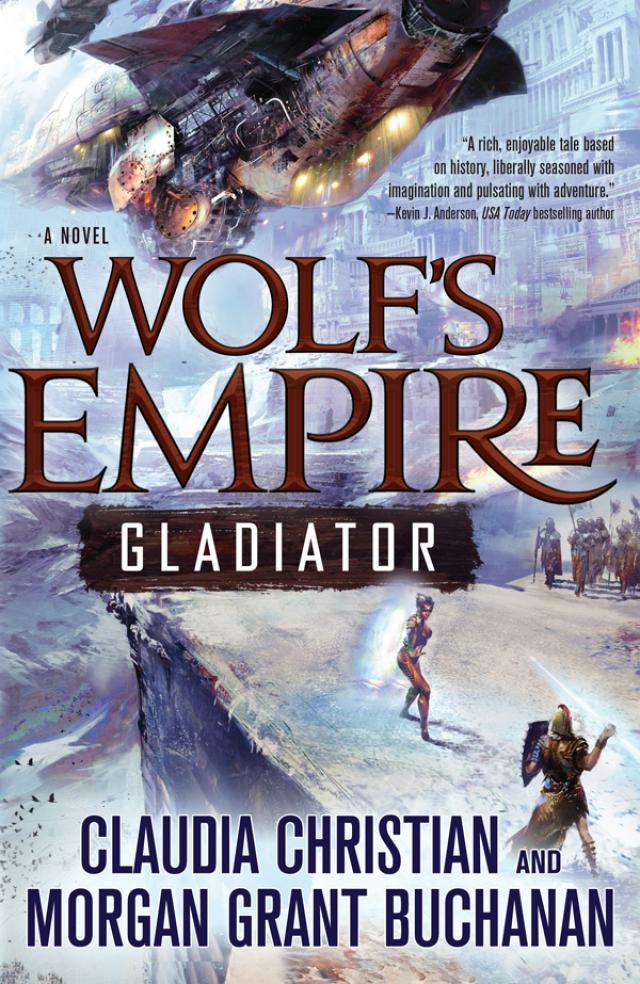
Wolfs empire gladiator, p.1
Wolf’s Empire: Gladiator, page 1


Begin Reading
Table of Contents
About the Authors
Copyright Page
Thank you for buying this
Tom Doherty Associates ebook.
To receive special offers, bonus content,
and info on new releases and other great reads,
sign up for our newsletters.
Or visit us online at
us.macmillan.com/newslettersignup
For email updates on Claudia Christian, click here.
For email updates on Morgan Grant Buchanan, click here.
The authors and publisher have provided this e-book to you without Digital Rights Management software (DRM) applied so that you can enjoy reading it on your personal devices. This e-book is for your personal use only. You may not print or post this e-book, or make this e-book publicly available in any way. You may not copy, reproduce, or upload this e-book, other than to read it on one of your personal devices.
Copyright infringement is against the law. If you believe the copy of this e-book you are reading infringes on the authors’ copyright, please notify the publisher at: us.macmillanusa.com/piracy.
To the legions of science fiction fans around the world who have brought me so much love and support through the years.
—CLAUDIA CHRISTIAN
To Catherine, my bright swan.
—MORGAN GRANT BUCHANAN
DRAMATIS PERSONAE
ROMANS
Accala Viridius Camilla—the heroine
SERTORIAN TEAM
Licinus Sertorius Malleolus—tribune, the team leader and war chain fighter
Gaius Sertorius Crassus—the team trainer, gentleman, and javelin fighter
Gaia Sertorius Barbata—a trident-wielding gladiator
Servius Tullius Lurco—a hammer-wielding beast fighter
Castor Sertorius Corvinus—a one-armed charioteer
Pollux Sertorius Corvinus—a one-armed charioteer
Mania Sertorius Curia—a trapper of beasts and dreams
VIRIDIAN TEAM
Vibius Viridius Carbo—tribune and team leader
Gnaeus Viridius Metellus—the team trainer
Darius Viridius Strabo—Accala’s cousin, an archer and a gladiator
Titus Viridius Nervo—a charioteer
Trio Viridius Mercurius—a charioteer
Scipio Viridius Caninus—a dart-throwing beast hunter
Capitulus Viridius Pavo—a crossbow-wielding beast fighter
Taticulus Viridius Leticus—a club-wielding gladiator
OTHER ROMANS
Julia Silana—a Vulcaneum immune
Marcus Calpurnius Regulus—Accala’s lanista
Caesar Numerius Valentinius—imperator, emperor of the Galactic Roman Empire
Quintus Viridius Severus—Accala’s uncle, the Viridian proconsul
Aquilinus Sertorius Macula—the Sertorian proconsul
Lucius Viridius Camillus—Accala’s father, a war hero and senator
Alexandria Viridius Camilla—Accala’s mother, a philosopher and scientist
Aulus Viridius Camillus—Accala’s younger brother
BARBARIANS (ALIENS)
Lumen—a Hyperborean child
Concretus—a Hyperborean warrior, Lumen’s guardian
Alba—an Iceni body slave
Bulla—Accala’s Taurii body slave
TRIA NOMINA
Typical Roman names of the Galactic Empire have three parts (the “tria nomina”). For example, for Accala Viridius Camilla:
• Accala is the given name.
• Viridius is the gens, or house name (House Viridian).
• Camilla is the family name.
PROLOGUE
THE VIRIDIAD, PART I
The History of Accala, the Noble-born Gladiatrix, from the Chronicle of the Seventh Empire, 7753–7901 A.U.C.
Justice—Goddess, sing of the retribution of Lucius’ daughter, Accala. Driven by a thirst for vengeance, she cost House Sertorian countless lives. Like raindrops striking the ground, they died, black-hearted warriors, their souls cast down to Hades’ boundless halls. What terrible price did she pay to see justice carried out? Tell us what Fate drove her to brave such hardship. To endure so many trials?
But wait. First, O Muse, sing of Galactic Rome, master of ten thousand worlds, the stage upon which her story is set.
Rome! It was the twins, Romulus and Remus, who laid her foundations eight thousand years ago. Abandoned at birth, they were found and suckled by a she-wolf until they grew in strength and power. From her they inherited resilience, loyalty, and ferocity—qualities they bestowed upon their city. Unconquerable Rome! The city that grew to rule over Mother Earth, crushing all efforts to bring about her fall. Eternal Rome! That expanded into space over five thousand years to become the heart of a galactic empire.
In Accala’s time, seven noble houses ruled the empire’s galactic provinces, each vying for the imperial throne, held by the eighth, the emperor’s own house. Fighting between two houses—the virtuous and brave House Viridian and the corrupt and heartless House Sertorian—had driven the empire to the brink of a civil war.
The shining Viridians! Accala’s own family, bearing the standard of the golden wolf. Steeped in military honors, placing service and duty above ambition. For two thousand years, they embodied and upheld the best of Roman virtues.
The black-hearted Sertorians! They bore the standard of the ruby hawk—a hawk with outstretched talons, seizing wealth and power at any price.
Begin, Muse, when the two first clashed, the boldest of each house—Crassus Sertorius, lord of corruption, and the brilliant Lady Accala Viridius. Both young and reckless, both gifted in the gladiatorial arts and filled with the spirit of ambition, desperate to triumph at any cost.
PART I
BURNT OFFERINGS
Let justice be done though the heavens fall.
—Lucius Calpurnius Piso Caesoninus
I intend to speak of forms changed into new entities.
—Ovid, Metamorphoses
Who has not seen the dummies of wood they slash at and batter
Whether with swords or with spears, going through all the maneuvers?
… Or, it may be, they have deeper designs, and are really preparing
For the arena itself. How can a woman be decent
Sticking her head in a helmet, denying the sex she was born with?…
What a great honor it is for a husband to see, at an auction,
Where his wife’s effects are up for sale, belts, shinguards,
Arm-protectors and plumes!
… Hear her grunt and groan as she works at it, parrying and thrusting;
See her neck bent down under the weight of her helmet;
Look at the rolls of bandage and tape, so her legs look like tree trunks,
Ah, degenerate girls from the line of our praetors and consuls,
Tell us, whom have you seen got up in any such a fashion,
Panting and sweating like this? No gladiator’s wench,
No tough strip-tease broad would ever so much as attempt it.
—Juvenal, Satires
ACT I
SHE-WOLF
Gods of my country, heroes of the soil,
And Romulus, and Mother Vesta …
Preservest, this new champion at the least
Our fallen generation to repair …
Here where the wrong is right, the right is wrong,
Where wars abound so many, and myriad-faced
… new strife
Is stirring; neighbouring cities are in arms,
The laws that bound them snapped; and godless war
Rages through all the universe.
—Virgil, Georgics
I
Rome, Mother Earth, 7798 A.U.C
EVERY NIGHT THE SAME dream—a blast wave of atomic fire raced across the surface of a distant ice world, an inferno that would envelop the planet’s capital in a matter of minutes, transmuting sturdy buildings to slag, consuming three and a half million lives with the same dispassion as it liquidized steel and stone. But before that could happen, I had to bear witness.
Mother ran toward me as the bright firewall rose up behind her, rapidly gaining ground. Ever Stoic, her face registered no fear, only a dread urgency—there was something important she had to tell me before the fire claimed her—but I was trapped behind a wall of thick, dirty ice, entombed alive in it. In place of words, all that reached my ears was a dull, brassy drone.
Mother tore out her hairpin and used it to scratch two words into the ice, but they appeared back to front, and I couldn’t read them in time because my little brother suddenly entered the scene. Aulus’ small body was trapped in the press of stampeding citizens as they fled the city, his eyes wide with panic. Mother turned from me and rushed to aid my brother, hair flailing behind her, the tips of the tresses catching fire as the burning wind rushed over her. Arms outstretched like a dragnet, she made an instinctive but futile effort to catch Aulus and wrap him up before the thermal currents scorched them both to ash. The ice was the only thing protecting me from the unstoppable fire, yet I battered it with my fists, clawed at it until my fingernails splintered and snapped. I fought to stay, prayed to Minerva that I be consumed with Mother and Aulus, disintegrated by heat and light.
* * *
I WOKE IN A fevered state, burning up, heart racing, breathing rapid and shallow. The silk sheet was d
A clear golden light bathed the high ceiling of my bedchamber, the kind that follows a summer dawn. The gilded cornices that skirted the ceiling’s edges bore seventy-one cracks of varying lengths, and I slowly counted each one in turn until I could breathe normally and all that remained was a residual choleric anger—the outrage that any human being must experience at witnessing the murder of loved ones. The sharpest sword dulls with repeated use, but the dream never lost its cruel edge. My ears still rang with the sound of Mother’s voice trying to penetrate the wall of ice between us. No instrument could replicate the unsettling drone that poured from her mouth. The closest analogy I could come up with (and in the aftermath of the dream each morning, I had plenty of time to turn things like this around in my mind) was the sound of a living beehive submerged in water.
I sat up on the hard edge of my bed, ignoring aching muscles and the patchwork of bruises that peppered my body, still tender from my last match. My cameo lay on the bedside table, projecting a holographic scene into the air on endless loop—the sky was blue, a field of golden wheat blew back and forth in the wind behind them. Mother was playing with Aulus out front of our country villa on the Amalfi Coast, throwing a ball for him to catch. Her hair was tossed gently this way and that by the summer wind. It was the same as mine, that hair. Jet-black and dead straight with one curvy bone-white shock that originated in the roots above the right forehead and ran all the way down like a skinny waterfall tumbling over a shiny onyx pillar. My brother was laughing. Some of his teeth were missing. He was nine years old. I’d taken the video myself the day before they left on what was supposed to be just another one of my mother’s research trips. Aulus was on holidays and had bothered Mother for weeks to take him with her to Olympus Decimus until she finally caved in and agreed. I was seventeen years old, busy with my final year of studies at the Academy, and had no intention of tagging along as a glorified babysitter. So I was sleeping soundly in my apartment in Rome when, fifty thousand light-years away, the talon fighters of House Sertorian’s attack fleet peppered the ice world with their bombs.
Seven hundred and fourteen days had passed since. For almost two years their deaths had gone unavenged, their spirits tossing and turning in Hades’ dark caverns.
Slowly rising from the bed, I allowed gravity to ground me, feeling my weight sink to my feet, finding each sore muscle on its journey, letting the pain signals pass over me. On day seven hundred and fifteen, when dawn stretched out her rose-red fingers, I would journey down Via Appia with my team, cheered on by the city before boarding a carrier that would transport me to Olympus Decimus to join in the Ludi Romani, the emperor’s great gladiatorial games. There, on the ice world where Mother and Aulus had been killed, I’d either suffer their fate and be killed or survive and triumph, with the men responsible for the bombing dead and bloody at my feet. Then Mother and Aulus would be at rest and the dream of fire would depart, leaving me to the embrace of a cool and silent sleep.
Peeling off my nightdress, I hurriedly threw on a loose-fitting training outfit and snapped my armilla over my forearm. My armilla—a long utility bracelet bordered with gold piping and inset with a small monitor, input pad, shield, and holographic projector eye—was thin and comfortable, like a second skin.
I strode from my bedchamber, down the hall toward the center of my apartment, past the shrine surrounded with holographic busts of my ancestors, until I reached the atrium, where the open-roofed courtyard provided the most available vertical space. Tapping the panel on my armilla, I projected research nodes into the air about me. A dozen screens presented notes and files, media streams from all corners of the empire, studies in history, tactics, law, ancient and modern arms and armor—my research. A sharp turn of the wrist unhitched the screens from the device, leaving them hanging in space. My hands swung through the air, managing my information like a conductor leading an orchestra. First I scanned the morning news on the vox populi forum. I had keyword alerts set up, but you couldn’t anticipate every eventuality. My mother had taught me self-reliance and critical thinking—“Never trust technology to cover every base, Accala. Always make the extra effort to bring your brain into the equation.”
I brought the day’s arena schedule to the fore and read it again. The final trial rounds were being fought in the morning. There were two places out of fifty-six still undecided. Vacancies in the teams of House Calpurnian and Flavian. It would all be decided before noon, after which the final team complements would be announced in full. In the afternoon there’d be speeches (the galactic audience would be watching eagerly via the vox populi forum from the most distant corners of the empire) followed by the contestants’ private dinner. The speeches would be the most unbearable part of the day. The game editor would release some clues about the obstacles and challenges in the coming events, then senators and committee officials would follow with dreary speeches designed to remind the empire of their value and importance. Finally, each gladiator would occupy the podium for a few seconds and state his or her hopes and reason for fighting. I loathed public speaking, but there was no way out of it; the audience demanded a predeparture speech from the gladiators. It added spice to the games, gave the audience a chance to decide whom to back, and aided a vast network of bookmakers in the sharpening of their odds. So I’d be brief. I’d speak of Viridian honor, of avenging the souls of our fighters and colonists who died at Sertorian hands. I’d thank Marcus for training me, be conciliatory to my fellow Golden Wolves who’d missed out on a place, and I’d bite my tongue no matter how much the Sertorian contestants or the withered chauvinists of the Galactic Committee for Combative Sports riled me. I wouldn’t mention my personal goals and grievances, no ammunition to give anyone cause to disqualify me.
Switching back to the vox populi forum, I scrolled the latest news items. Locally the Festivities of Minerva on Mother Earth were already coming to a close in the southern hemisphere. There was coverage of our own dawn service at Nemorensis. A special report detailed a new Sauromatae revolt on their worlds near the galactic rim—rioting on the streets, a magistrate from House Arrian killed in an explosion, but the local legion already in the process of restoring order. Five thousand and one already dead. One Roman magistrate and five thousand blue-scaled Sauromatae, most of them extended family members of the rebels who were executed as both punishment and deterrent. No surprise. That was how barbarian uprisings usually played out.
The main news, as expected, was about the coming Festival of Jupiter, the most important and extravagant holiday of the year, and its games, the Ludi Romani, which were always the most eagerly awaited and most hotly contested. Long ago we’d learned that the key to sustaining a galactic empire lay in delivering a never-ending serving of bread and circuses. Emperors and politicians talked about honor and tradition, but all the masses wanted was to be fed, employed, and entertained in peace. Then the whole system ticked over. As one holiday festival ended, you had to wait only a week or two before the next one started up.
Scanning through the multiple streams of media coverage, I listened to brief snatches of discussion on strengths and weaknesses of the gladiators, the rules, and various contests that might be brought into play, but it was all speculation until the emperor’s officials announced the nature of the course. And the prize. They couldn’t stop talking about it, the greatest prize ever offered in the empire’s long history.
Satisfied, I tapped the panel on my armilla to shut down the information nodes. Once the sun set, I’d be home free, on track to depart the galactic capital with nothing but the tournament to focus on. Until then though, my father still had the time and the means to try and derail me. He’d been suspiciously silent on the topic of the coming tournament, refusing to discuss the matter or acknowledge my part in it, and so I’d set aside the whole day to manage any potential disaster that might rear its head. I’d sacrificed everything to secure my place in the coming games, overcome every hurdle put in my path. Nothing was going to stop me from fighting in the Ludi Romani. That was my fate. It was set in stone.





