

The einstein effect, p.1
The Einstein Effect, page 1


Also by Benyamin Cohen
My Jesus Year: A Rabbi’s Son Wanders the Bible Belt in Search of His Own Faith
Thank you for downloading this Sourcebooks eBook!
You are just one click away from…
Being the first to hear about author happenings
VIP deals and steals
Exclusive giveaways
Free bonus content
Early access to interactive activities
Sneak peeks at our newest titles
Happy reading!
CLICK HERE TO SIGN UP
Books. Change. Lives.
Copyright © 2023 by Benyamin Cohen
Cover and internal design © 2023 by Sourcebooks
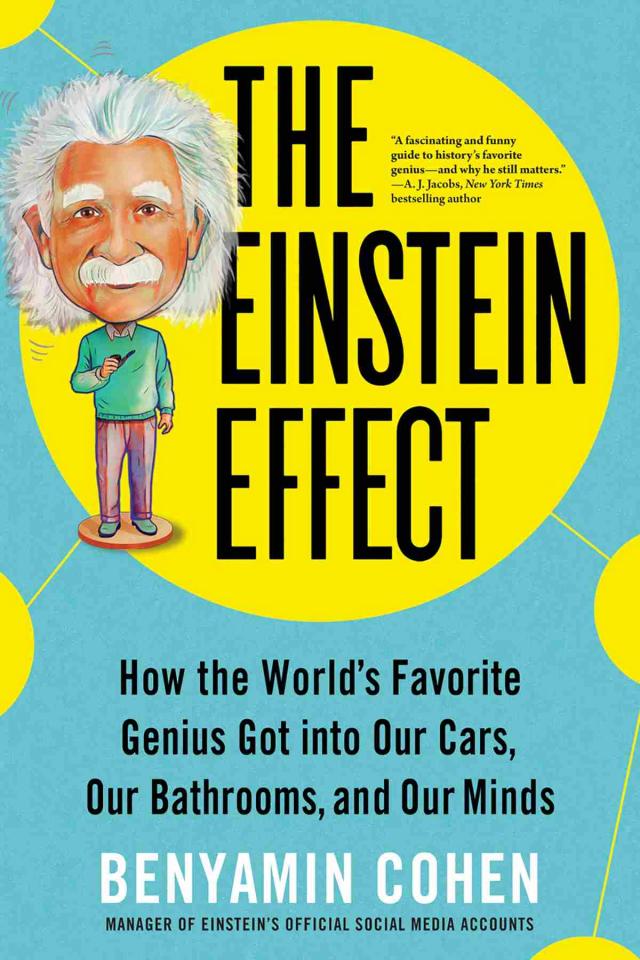
Cover design and illustration by Philip Pascuzzo
Internal design by Laura Boren/Sourcebooks
Sourcebooks and the colophon are registered trademarks of Sourcebooks.
All rights reserved. No part of this book may be reproduced in any form or by any electronic or mechanical means including information storage and retrieval systems—except in the case of brief quotations embodied in critical articles or reviews—without permission in writing from its publisher, Sourcebooks.
This publication is designed to provide accurate and authoritative information in regard to the subject matter covered. It is sold with the understanding that the publisher is not engaged in rendering legal, accounting, or other professional service. If legal advice or other expert assistance is required, the services of a competent professional person should be sought.—From a Declaration of Principles Jointly Adopted by a Committee of the American Bar Association and a Committee of Publishers and Associations
Published by Sourcebooks
P.O. Box 4410, Naperville, Illinois 60567–4410
(630) 961-3900
sourcebooks.com
Cataloging-in-Publication Data is on file with the Library of Congress.
CONTENTS
Introduction: Einstein Tweets
Stealing Einstein’s Brain
Flying, Driving, and Surfing with Einstein
Einstein and E.T.
War and Peace…and Einstein
Einstein’s Miracle Year
Brand Einstein
Einstein and Time Travel
Einstein Life Hacks
With a Name Like Einstein
Einstein and Pop Culture
Einstein in the Age of Fake News
Preserving Einstein
Einstein and the Next Generation
Acknowledgments
Bibliography
Notes
Index
About the Author
To Albert Einstein and all of those who he described as “passionately curious”
INTRODUCTION
EINSTEIN TWEETS
“If the facts don’t fit the theory, change the facts. —Albert Einstein.”
—IVANKA TRUMP
When Ivanka Trump shared this famous Einstein quote with her six million Twitter followers after lunch on a sunny summer afternoon, she wasn’t hoping to make news. It was—like so much of the ones and zeros that zoom across the digital ether—just something to share on a Wednesday. It was an innocent post, but there was just one problem…
Albert Einstein never actually said that.
And the irony wasn’t to be missed. She was tweeting something that was factually inaccurate in a tweet about changing the facts. Fortunately for Ivanka, the internet is flooded with incorrect Einstein memes, so she could be forgiven for finding one of the many misquotes that reside across the web. Indeed, nobody even noticed the tweet, let alone the mistake.
That is until Albert Einstein himself rose from the dead to correct her.
At 8:15 a.m. on July 24, 2017, the verified Albert Einstein Twitter account sent out a message to Ivanka. He confirmed that he never said that and then, for good measure, included a link to a book of official Einstein quotes. It was the mic drop heard round the world. It made international news. The Huffington Post’s headline: “Ivanka Trump’s attempt to quote Albert Einstein backfires spectacularly.” Newsweek declared: “Ivanka Trump misquoted Einstein and the Internet loves it.”
In an age of “fake news,” this was seen as a triumph.
I know this story firsthand because from my home nestled in the forests of the Appalachian Mountains, I log onto the internet each morning and manage the official social media accounts of our planet’s favorite genius. After collecting eggs from my chickens and helping my neighbor milk her cows, I boot up my computer and pretend to be a Nobel laureate. To millions of people around the world, I am the digital avatar of Einstein (my short and kempt hair not withstanding). Teenagers in India message me for help with their science homework, physicists in Florida email me the findings of their latest research, producers at PBS call and ask if I’ll promote a new Einstein documentary. It’s an awesome responsibility, one which I don’t take lightly, because I know that Einstein’s contributions to our understanding of science are at least matched, if not surpassed, by his importance as a symbol.
That’s because Albert Einstein is widely considered to be the first modern-day celebrity. Before Jennifer Lopez and Ben Affleck, paparazzi were chasing around the world’s favorite scientist. They wanted to know the most mundane details about his life: How many hours did he sleep each night? What did he eat for breakfast? “Pressmen roared up the plank whenever his ship docked in America,” wrote Carolyn Abraham, who published a history of Einstein. “A couple of them once fell into the harbor trying to scramble on board.” That iconic photo of Einstein sticking out his tongue? That was his way of acknowledging the ludicrousness of his situation: He was a German Jewish refugee seeking asylum from Hitler’s wrath. He was famous for his high IQ, for physics and math and quantum mechanics—and yet, here he was in Los Angeles visiting movie studios and tossing bon mots at a red-carpet Hollywood premiere with his friend Charlie Chaplin.
Nearly seven decades after Einstein’s death, he is still a celebrity. Nowhere is this more evident than on social media, where he has verified blue-checked accounts, with nearly twenty million followers on Facebook (more than Tom Hanks!), another million on Instagram, and more than half a million on Twitter. And I get to talk to all those people each day as the wizard behind the curtain:
I am Albert Einstein.
Dead celebrities are surprisingly popular on social media. On Facebook, you can be friends with Elvis Presley or John Lennon—both of whom each have about thirteen million fans. Follow Marilyn Monroe on Instagram (1.8 million followers) for fashion inspiration. John Wayne is on Twitter, but he doesn’t have much to say. That may explain why he has fewer than forty thousand followers. Yet Einstein dwarves them all in both size (did I mention the more than twenty million fans?) and content: I share roughly ten posts a day. There’s Throwback Thursday photos of a young Einstein posing with his sister and the famous quotes I post for Wednesday Wisdom. There’s also the video I made of an Einstein bobblehead sledding down a hill in a snowstorm and the countless contemporary science news headlines that are surprisingly related to Einstein’s research.
Most of these accounts are run by the estates of the dead celebrities, and my case is no different. I work for the Albert Einstein Archives. When Einstein died, he bequeathed his estate to the Hebrew University in Jerusalem (more about that in a later chapter). The archivists and curators who work there are all academics; they mostly help find material for other academics doing research about Einstein. Tweeting is not really their expertise. So that’s where I come into the picture. I’m the hired hand who can, on a good day, come up with a clever retort to Ivanka Trump.
Keep in mind, I’m not a scientist. At best, I’m a likable idiot. The Einstein family maid once dubbed Albert “the dope,” so maybe there’s hope for me. But I think there’s a benefit to not knowing the difference between a quantum mechanic and an auto mechanic. The majority of people who are following Einstein online likely couldn’t explain the theory of relativity any better than I could, yet they still feel a connection to this genius. This is nothing new: When Einstein gave a speech to a packed audience at the Kroll Opera House in Berlin in 1930, the headline in the newspaper the next day was “4,000 Bewildered as Einstein Speaks.” Sure, he represented the romance of the cosmos, but he transcended science.
Wharton Professor Jonah Berger, author of Contagious: Why Things Catch On, spent years researching the most shared stories on the New York Times website. He found that articles about science and innovation tend to go viral because they evoke a sense of awe. And our brains are wired—and we’re inherently inclined—to want to share stories of discovery. Awe-inspiring articles were 30 percent more likely to make the Times’ “Most E-mailed” list. As Albert Einstein himself noted, “The most beautiful emotion we can experience is the mysterious. It is the power of all true art and science. He to whom this emotion is a stranger, who can no longer pause to wonder and stand rapt in awe, is as good as dead.” It’s this aspirational “aha” attitude that helps make Einstein—more than, say, John Wayne—so popular online.
In my role as Einstein, I don’t don a wig and glasses, but rather a digital skin, an embodiment of genius to the masses. When the guy in Great Britain tweets at Albert, little does he know that a short, bespectacled Jewish guy in rural West Virginia is pretending to be perhaps the greatest, and definitely the most famous, scientist who ever lived.
Managing Einstein’s social media accounts is more than just posting inspirational quotes and archival pho
What I’ve found along the way is that Albert is more than just a chapter in history. His work lives on in so many facets of our everyday lives—in science, technology, entertainment, and so much more. I merely serve as the tour guide to a planet full of people who look to Einstein as their muse.
When I first took the job of becoming Albert, I thought I knew enough about the man to skate by. I could write a list of the ten most iconic mustaches of the twentieth century. (Here’s looking at you, Mark Twain.) What’s more, since I had listened to the entire twenty-one-hour audiobook of Walter Isaacson’s seminal Einstein biography, I was surely qualified to shoot off some tweets. But what I soon discovered was that Einstein is not someone who merely exists in the past. Unlike other great scientists of old—like Isaac Newton and Thomas Edison—whom we revere but whose discoveries we have largely moved on from and improved upon, Einstein’s theories and equations are still as alive and essential as they ever were.
Decades after his death, Einstein is still making the mundane magical. So much of the technology we touch on a daily basis—and that shapes how humans see the universe is a direct result of Einstein’s genius. This technology may be invisible to the naked eye, but take a closer look: His work lives on in the form of iPhone cameras and burglar alarms, remote controls, supermarket scanners, laser eye surgery, and in the space program. Driverless cars, DVD players, weather forecasting, and even the search for aliens—it’s all thanks to theories hatched by Einstein. His formula to measure the size of molecules dissolved in liquids made it possible to create or improve thousands of consumer products—including better shaving creams and toothpastes. Not to mention the more than fifty inventions he had patented while he was still alive—including an eco-friendly refrigerator that required no electricity. His work on relativity, gravity, and curved space-time enabled the invention of GPS devices, which were first created to guide satellites in outer space—and are now used to tell you when your pizza delivery will arrive. (What has Galileo done for you lately?)
But it’s not just his scientific discoveries that continue to shape our world. In 2023, more people know Einstein as an icon than as a theorist. Googling “Einstein icon” nets you millions of results—including actual emoji of Einstein’s iconic face. He’s the one scientist that everyone knows on sight. Walk up to any elementary school student and ask them to name a genius: it’ll likely be Einstein.
“Do not believe everything you read on the Internet, especially quotes from famous people.”
—ABRAHAM LINCOLN
Becoming Albert Einstein has led me to ask some larger questions: Is there a place to celebrate genius in a post-literate world filled with scrolling news feeds of cat videos and Instagram posts of influencers on vacation (and photos of Lincoln taking a selfie)? In an age when ignorance is often celebrated, what do Einstein and his “big brain” stand for? His accessibility as a genius—not to mention his own popularity on social media—gives Einstein entrée and relevance to an entirely new generation. That’s the point of giving him an online presence long after his death: to keep his spirit of discovery and drive for knowledge alive. As the voice of one of the planet’s most respected minds, I sit at the crossroads of “Einstein the celebrity” and “Einstein the scientist.” My job is to continue to build Einstein’s popularity, but not just for celebrity’s sake; the articles I share with millions each day cover cutting-edge science and new discoveries, many of which are directly related to Einstein’s own work. But there is so much more of the story to tell.
In his 2018 book The Death of Expertise, Professor Tom Nichols wrote how in our age of unlimited knowledge—where answers are just a Google search away—the internet is actually making all of us a lot dumber. Sure, we no longer need to memorize the numerical value of pi or the capital of North Dakota; Google’s vast servers can store that information for us. (It’s 3.14 and Bismarck…in case you were wondering.) But that shift in our cultural mindset has produced a downside as well—many, in fact. That glut of readily available information has created the feeling that we have less of a need for actual experts, not to mention an increase in those who like to call themselves experts. For example, asked during the run-up to the 2016 presidential election whom he turns to for advice on foreign affairs, Donald Trump famously cited himself.
The internet has given us all free Gmail accounts, but it has also birthed the likes of 4Chan and Reddit, online message boards that are littered with the detritus of misinformation, conspiracy theories, and bogus science. Anti-vaxxers and flat-earthers can now easily find comrades in their own self-created filter bubbles, magnifying and emboldening their views. At the same time, we’ve seen an alarming increased notion of anti-elitism and anti-intellectualism. Career State Department officials, who have spent decades in the trenches, are now no smarter than a troll with a Twitter account. Pulitzer Prize–winning journalists are being accused of writing fake news.
Coalesce all of these disparate threads and we can ask ourselves a proverbial question. I call it WWED: What Would Einstein Do? What would Einstein think of all this, especially when it comes to the universal search for knowledge? How would he react to a 2020 law passed in Ohio called the Student Religious Liberties Act that allows students to give incorrect answers on a test if giving the correct answer is against their religion? (Put simply, a student could write a wrong answer about evolution or climate change and still ace the test.)
Einstein was deeply philosophical and famously open to questioning our assumed presumptions about the world. But when it came to facts, he spent a lifetime trying to prove his work. He would likely not take too kindly to those sowing doubt and spewing misinformation. He was not one to stay silent and keep his thoughts to himself. He would be the first to mock the anti-vaxxers with a pithy tweet. Indeed, he reportedly once told a friend, “If you think intelligence is dangerous, try ignorance.”
That’s why I’ve decided to go on this immersive quest to find the modern-day relevance of Einstein, my own “unified field theory” of Albert. This journey will take me across continents: from the United States to Israel and Japan. I’ll stand atop the world’s largest telescope, become an Uber driver, and meet a man who built a time machine—all to show how Einstein’s theories are weaving their way into our daily lives. I will interview dozens of Einsteins (including not one, but two Rabbi Einsteins) and spend months tracking down the last remaining physical vestige of Einstein—his brain, stolen from his body by the pathologist performing Albert’s autopsy. (Spoiler alert: it’s kind of squishy.)
In an era when we are flooded with information (and misinformation) and we don’t know whom to believe, the celebrated mind of Einstein is needed more than ever. He is someone we can all believe in. But, even beyond the man himself, our landscape is replete with modern incarnations of Einstein—scientists, artists, and those in a whole host of other fields who are inspired by the greatest mind of the twentieth century. In their own ways, they are each continuing Einstein’s legacy—not just with their work, but also by becoming new sources of inspiration for the rest of us. Like Einstein, they look at the world with a sense of curiosity and a desire to ask questions. Those key ingredients are often what’s missing in our national dialogue.
Einstein is not lost to the annals of history, only to be read about in dusty classroom books, or plastered with a quote on coffee mugs. His theories and his worldview are as alive today as they ever were. And his quest for deeper understanding should be a call to arms in our age of short TikTok videos.


