

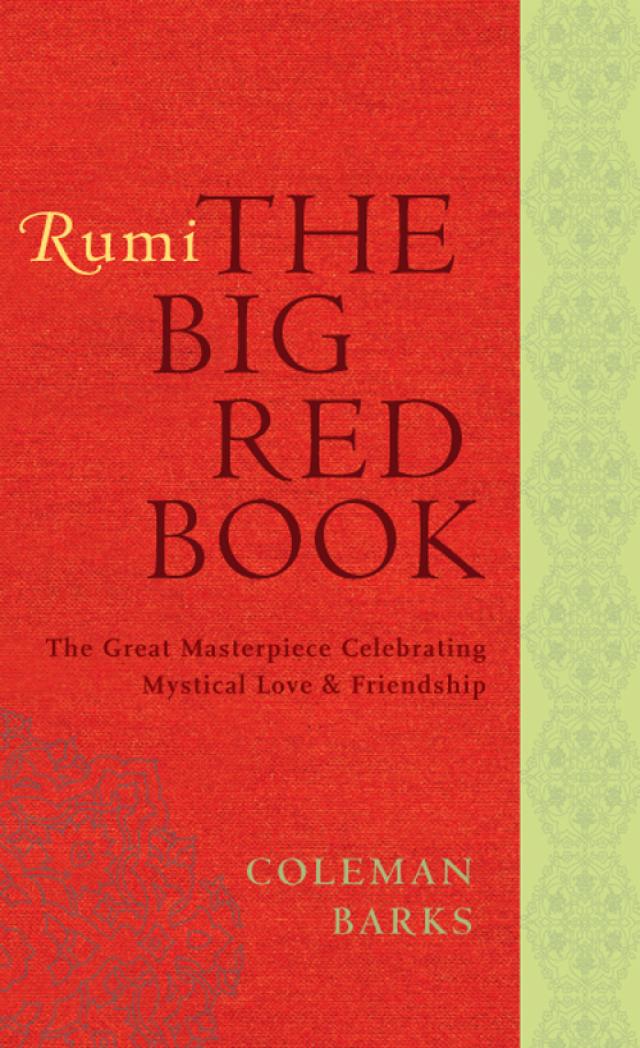
Rumi the big red book, p.43
Rumi, The Big Red Book, page 43


Chapter 26
1. “Hallaj”: See note on “Green from Inside” (chap. 3) above.
2. “Mashallah”: Ma sha Allah, “What God wills,” implying something ongoing, not completed. Inshallah refers to something that has not happened yet. Alhamdulillah gives praise for what God has already done.
3. “YHU”: Hu is the out-breathing of the divine presence in the zikr (see chap. 23 note above). I have had a dream in which that was combining with the pronoun You, in big glowing letters, to make this elision of human and divine.
Chapter 27
Introductory Note: Bawa Muhaiyaddeen, Questions of Life, Answers of Wisdom, vol. 1 (Philadelphia: Fellowhip Press, 1991).
1. “Pearl”: Nizami (1141–1209) is a Persian poet best known for his long narrative poems, especially for his version of the Layla and Majnun love story.
2. “Zero Circle”: This poem is actually not from The Shams. It is a small segment of the Masnavi, Book IV, ll. 3748–3754, but it feels like a ghazal.
Part II: Quatrains
Introduction to the Quatrains
1. Robert Bly, Silence in the Snowy Fields (Middletown, CT: Wesleyan University Press, 1962); James Wright, The Branch Will Not Break (Middletown, CT: Wesleyan University Press, 1963).
Chapter 38
1. “A voice inside both of us sings out . . . ”: This probably means, “A line from one lover, then a line from another. ”
Chapter 54
1. “As long as my soul is in this body . . .”: I do not hear this quatrain as a claim that Islam has an exclusive truth. Rumi is honoring the presence of Muhammad and the truth of the Qur’an. Others have heard this poem as proof that Rumi should be considered an Islamic poet, and that only. I would claim that there are many other passages that show how he and Shams honor the living, gnostic, experiential truth of every unique life, and that core of longing that is beyond doctrine and religion. I hear him as a planetary poet, and would point to the following passages: See “Inside the Friend . . . ,” “I Am Not,” “Almost in Sight,” “A Question,” “A Holiday Without Limits,” “The Self We Share,” “There You Are,” “Waking Up, Dawn-Music,” “Two Hands,” and “Say I Am You.”
I would align myself with Dag Hammarskjöld (1905–1961), U.N. Secretary-General and Nobel Prize winner, who quoted Rumi in Markings (“The lovers of God have no religion but God alone.” [Dag Hammarskjöld, Markings. New York: Random House, 1964]) as representing the world-embracing tolerance we need, and with the many others over the last one hundred years, who hear in Rumi a universalist way beyond churches and religions, including Gurdjieff, Joseph Campbell, Erich Fromm, Meher Baba, Hasan Shushud, Sam Lewis, Pir Vilayat Khan, Reshad Feild, Idries Shah, Hamid Karzai, and wonderfully, Barack Obama.
I should explain the Obama reference. In the fall of 2009 Richard Holbrooke, Special Envoy to Pakistan and Afghanistan, asked his assistant in the State Department, Frank Archibald, who knows a friend of mine, Angela Elam, to contact me and ask if I would sign a book for President Obama. A Year With Rumi was the one requested. The request from Holbrooke as it moved along to me was accompanied by the sentence, “Rumi is Obama’s favorite poet.” I signed the book, “For President Obama. Barack, your presence is fresh air for this country to breathe. Much love to you and your beautiful family, Coleman Barks.” I found out his birthday, Michelle’s, and the two girls, Malia’s and Sasha’s, and put birthday messages on the appropriate pages of A Year With Rumi.
I am not at all sure that I am saying these things with proper respect, awe, for the grandeur of Rumi’s surrender, and for that of Shams Tabriz. There is a story that Shams tells in his Maqalat.
One day the companions of the Prophet came to see him. There is a man here who is neither with the deniers, nor the Muslims. We see him pray, and we do not see him occupied in gaming or other such things. We do not see the attributes of the mad in him, nor the seeking of livelihood of the sensible. A feeling of compassion arose within the Master. He said, “Now go, and when you see him, convey my greeting to him, and say, ‘Our Master wants very much to see you.’ Do not command him to come here; do your best not to injure his feelings!” They came near the man, and at first, they were not able to greet him. After some time passed, the opportunity opened and they conveyed the greeting of the Prophet to him, and his love and his strong wish to see him. All the while, he kept silent. They obeyed the command of the Prophet about not creating trouble for him and did not speak further. After a while, they saw that the man had come to visit Muhammad. For some time, he sat silently in the gathering. The Prophet sat silently, and he was silent too. At last, Muhammad stood up from his place. Both when the man arrived and when he was leaving, the Prophet behaved with great humility towards him. He said, “Abundant light has poured upon you—Great grace has poured down upon you. Our medrasah is this—these four walls made of flesh. The instructor is very great. I cannot say who He is. And His tutor is the heart; just as some people of God have said, ‘My heart has informed me about my Lord.’” (Rumi’s Sun: The Teachings of Shams of Tabriz, trans. by Reflik Algan and Camille Adams Helminski [Sandpoint, ID: Morning Light Press, 2008] p. 387).
I love the feeling of Muhammad’s presence in this story, and the silence that seems to be the gist of his conversation with the visitor. I once visited Omani Chisti in Herat, Afghanistan. He has studied and taught the Masnavi for eighty years. We were sitting side by side. I leaned against him and asked, “Who is Shams?” He answered quickly. Shams is the doctor who comes when you hurt enough. In the thirteenth century the intensity of longing was strong enough so that he came. Now it is not so strong. May our longing increase to what is needed to bring such a doctor again. I am told that some Sufis have a custom of meeting secretly with mystics from various traditions. The designated meeting place is the one with a single rose above the door. These meetings need no longer be secret.
2. “Come, come, whoever you are . . .”: This is one of the most frequently quoted quatrains. It has long been associated with the Mevlevi Order in Konya. A Turkish version with English translation is in a glass case in the Rumi Museum in Konya with a copy of the quatrains, but it may well not have been written by Rumi. A similar quatrain is attributed to Abil Khayr (d.1049). The invitation itself remains open.
Note on These Translations
Since New Year’s Day 1977 until the mid-1990s, the Persian scholar John Moyne sent me literal translations of Rumi’s poems from The Shams. These have been used to produce many of these versions, as have A. J. Arberry’s scholarly translations: Mystical Poems of Rumi (Chicago: The University of Chicago Press, 1968), Mystical Poems of Rumi, vol. 2 (Boulder, CO: Westview Press, 1972), and The Rubaiyat of Jalal al-din Rumi, Select Translations into English Verse (London: Emery Walker, 1949). Reynold Nicholson’s Divani Shamsi Tabriz (Bethesda, MD: Ibex Publishers, 2001) and Nevit Ergin’s twenty-two-volume translation of The Shams (San Mateo, CA: Echo Publications and the Turkish Ministry of Culture, 1995–2003) have also been used.
Index of Familiar First Lines
The pagination of this electronic edition does not match the edition from which it was created. To locate a specific passage, please use the search feature of your e-book reader.
A lover is not a Muslim or a Christian, 476
A night full of talking that hurts, 390
A nightingale flies nearer the roses. A girl blushes, 239
A road may end at a single house, 448
A secret turning in us, 395
A shout comes out of my room, 142
Advice does not help lovers, 295
Ah true believers, what can I say, 352
All day and night, music, 381
All day I think about it, then at night I say it, 352
An eye is meant to see things, 305
Are you jealous of the ocean’s generosity, 459
As elephants remember India perfectly, 267
As long as my soul is in this body, 476
As you start out on the way, 409
Be helpless and dumbfounded, 357
Birdsong, wind, 420
Birdsong brings relief to my longing, 434
Candle, wine, and friends, 283
Christ is the population of the world, 416
Come, come, whoever you are, 476
Death comes, 350
Did you hear that winter is over, 82
Dissolver of sugar, dissolve me, 270
Do not expect to be always happy on this way, 252
Do not go anywhere without me, 23
Do not worry about saving these songs, 76
Do you think I know what I am doing, 378
Fire is whispering a secret in smoke’s ear, 58
Flowers open every night across the sky, 447
Forget your life. Say God is great. Get up, 182
Gamble everything for love, 457
Going into battle, we carry no shield, 177
Hallaj said what he said and went to the origin, 326
Has anyone seen the boy who used to come here, 110
Held like this to draw in milk, 420
Here is evidence of presence, 115
How does a part of the world leave the world, 119
How will you know the difficulties of being human, 452
Humble living does not diminish. It fills, 425
I, you, he, she, we, 465
I am dust particles in sunlight, 280
I am so small I can barely be seen, 403
I am the tent you set up, then strike, 190
I have heard that a certain man lost his camel, 155
I have lived on the lip of insanity, 428
I hear nothing in my ear, 454
I honor those, 406
I reach for a piece of wood. It turns into a lute, 406
I saw grief drinking a cup of sorrow, 439
I see my beauty in you, 113
I used to be shy, 473
I want to say words that flame as I say them, 193
I was happy enough to stay still, 436
I would love to kiss you, 367
If a tree could fly off, it would not suffer the saw, 129
If anyone asks you, 322
If you do not have a woman who lives with you, 156
If you want what visible reality can give, 457
Imagine the time the particle you are, 65
Imagining is like feeling around, 452
In every gathering, in any chance meeting on the street, 231
In the evening between sleep and awakening, 189
In the slaughterhouse of love they kill only the best, 398
In your light I learn how to love, 453
Inside this new love, die, 108
Inside water, a waterwheel turns, 399
Is there a human mouth that does not give out soul sound, 16
It is the old rule that drunks have to argue, 336
Jars of springwater are not enough anymore, 16
Joseph has come, the handsome one of this age, 179
Keep walking, though there is no place to get to, 391
Last night my teacher taught me the lesson of poverty, 168
Last year, I admired wines, 180
Learn the alchemy true human beings know, 16
Let your throat-song be clear, 436
Lightning, your presence, 419
Listen to the presences inside poems, 402
Longing is the core of the mystery, 403
Look how desire has changed in you, 226
Love comes with a knife, not some shy question, 20
Love has taken away my practices, 271
Love is alive, and someone borne along by it, 79
Love is the way messengers, 458
Lovers in their brief delight, 453
Lovers think they are looking for each other, 335
My worst habit is I get so tired of winter, 99
No one knows what makes the soul wake up so happy, 20
Now I lay me down to stay awake, 470
On the day I die, 89
On the night when you cross the street, 307
Out beyond ideas of wrongdoing and rightdoing, 367
Outside, the freezing desert night, 51
Pale sunlight, 453
Praise to the emptiness that blanks out existence, 206
Say the moth is building a house of candlelight, 65
Some nights, stay up till dawn, 386
Someone says, Sanai is dead, 109
Something opens our wings, 416
Sometimes you hear a voice through the door calling you, 162
Soul, if you want to learn secrets, 275
Spring overall, 444
Stay together, friends, 39
Sugar merchants, I have news, 278
That camel there with its calf running behind it, 215
The breeze at dawn has secrets to tell you, 367
The clear bead at the center, 469
The first stork has come, 25
The friend comes into my body, 388
The hurt you embrace becomes joy, 161
The lord of beauty enters the soul, 259
The minute I heard my first love story, 377
The morning wind spreads its fresh smell, 402
The most alive moment comes when those who love each other, 84
The soul: a wide listening sky, 331
The sound of hoofbeats leaving a monastery where all, 343
The way of love, 435
The work is always inside you, 474
There are no words to explain, no tongue, 214
There is a being who is drunk without wine, 225
There is a channel between voice and presence, 394
There is a community of the spirit, 40
There is a hidden sweetness in the stomach’s emptiness, 22
There is a light seed grain inside, 371
There is a passion in me, 235
There is a path from me to you, 400
There is a shimmering excitement in being sentient and shaped, 333
There is a way of breathing, 468
There is some kiss we want with our whole lives, 131
Think that you are gliding out from the face of a cliff like an eagle, 374
This is how I would die, 445
This is how it is with love. You take a bite, 460
This marriage be wine with halvah, 266
This moment this love comes to rest in me, 397
This piece of food cannot be eaten, 385
Those who do not feel this love pulling them like a river, 209
Time’s knife slides from the sheath, 199
Today like every other day, we wake up empty, 366
Totally conscious, and apropos of nothing, you come to me, 193
Walk to the well, 391
We are here like profligates, 17
We are the mirror, as well as the face in it, 380
We have come to that knee of seacoast, 195
We search the world for the great untying, 437
We sit in this courtyard, 232
What I want is to see your face, 170
What is the deep listening, 289
What is the heart, 310
What shall we call the presence that arrives, 357
What was in that candle’s light, 195
When I am with you, we stay up all night, 366
When I see you and how you are, 121
When I see your face, the stones start spinning, 185
When it’s cold and raining, 283
When love itself comes to kiss you, 278
When school and mosque and minaret, 455
When the soul first put on the body’s shirt, 437
When you are with everyone but me, 413
When you feel your lips becoming infinite and sweet, 405
Which is worth more, a crowd of thousands, 438
Who gets up early to discover the moment light begins, 66
Whose idea was this, 354
Without a net, I catch a falcon and release it to the sky, 226
Would you like to have revealed to you, 443
Acknowledgments
We are so grateful to be able to reproduce Mohamed Zakariya’s calligraphy in the Odes section of this book, with his kind permission. To read about his amazing life and to see more of his transformative work, Google “Zakariya Calligraphy.”
The illustrations in the Quatrains section of the book are reproductions of ink drawings from al-Sufi’s Book of Fixed Stars by arrangement with the Library of Congress. And thanks to Muhannad Salhi in the Near East Section of the Library of Congress for his gracious help with finding these images.
Galway Kinnell’s poem, “Prayer,” is from A New Selected Poems, Houghton Mifflin (New York: 2001). Reprinted by arrangement with Houghton Mifflin.
I would like to acknowledge the help with many things, the quatrain references in particular, of Sergey Sechiv of Southfield, Michigan. Sergey has translated The Essential Rumi into Russian.
Alan Godlas, Professor of Religion at the University of Georgia, has been a great resource for the Notes. His award-winning Web site is an important scholarly tool: Islam and Islamic Study Resources.com
Kenneth Honerkamp, Professor of Religion at the University of Georgia, translated the Arabic around the constellation images. http://hnrkmp.myweb.uga.edu
Nicholas O. Splendorr’s superb computer skills and careful attention to detail have been a continuous support. http://simolinic.com
Some of these poems appeared first in the following Maypop books (Athens, GA): We Are Three (1987), Delicious Laughter (1989), Like This (1990), Birdsong (1993), and Say I Am You (1994). Reprinted by arrangement with Maypop.
Some of these poems appeared first in the following Threshold Books (and later with Shambhala) volumes: Open Secret (1984), Unseen Rain (1986), and This Longing (1988). Reprinted by arrangement with Threshold/Shambhala.
Some of these poems first appeared in These Branching Moments, Copper Beech, 1988. Reprinted by arrangement with Copper Beech.
Some of these poems first appeared in The Glance, Viking, 1999. Reprinted by arrangement with Viking.
I should also acknowledge that, as I put this collection together, I felt drawn to relineate and revise, slightly, almost every poem. So with any future reprintings of these translations, I would prefer that these refreshed, 2010 versions be used.


