The retreat 4 alamo, p.1
The Retreat #4: Alamo, page 1


THE RETREAT
Episode Four: Alamo
By Craig DiLouie
With Stephen Knight and Joe McKinney
THE RETREAT, Episode #4: ALAMO
©2016 The Retreat Series, LLC
This is a work of fiction. All characters, organizations, and events portrayed in the novel are either fictitious or used fictitiously.
Lyrics to the children’s song “Baby Bunting” used in this novel are in the public domain.
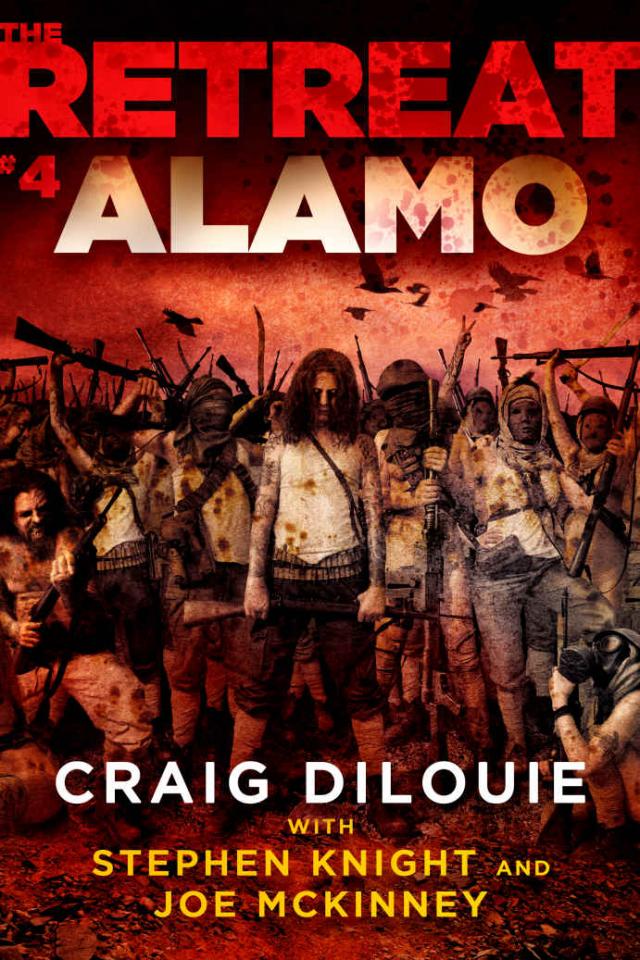
Cover art by Joachim Luetke, originally created for Kreator’s “Hordes of Chaos” album. Used with permission.
Cover design by Jeroen ten Berge.
Editing by Timothy Johnson. Military/Technical advice by Scott Wolf.
Published by The Retreat Series, LLC.
www.TheRetreatSeries.com
Sign up for Craig DiLouie’s mailing list here to be the first to hear about new releases of The Retreat.
ONE.
Tittering, chortling, cackling.
So many ways to laugh.
Chuckling, guffawing, snickering.
Like a baby’s cries, each had a different meaning.
Shades of pleasure. Chords of pain.
Across America, the slaughter continued with a discordant laugh track.
The end was coming soon.
TWO.
The lost battalion ground through dead towns, raising a colossal dust cloud.
Burned houses. Graffiti-covered buildings. Omnipresent trash.
Intricate dioramas of pain and torture, gore and death. Body parts arranged in a massive spiral on a grassy field. A trio of impaled policemen staring at the sky, hands bound behind their backs, mouths frozen in the aftermath of a final scream. A child nailed to a door.
Totems marking territory. This land was their land.
The battalion hardly resembled a military unit anymore. The giant caravan of vehicles and people on foot all moved at a crawl. Civilians outnumbered soldiers. The battalion was a rabble that clawed its way along back roads in the final heat of summer. Only by the grace of God were they still alive.
They’d broken out of Philadelphia and entered Maryland, following Route 1 before striking west to give Wilmington and Baltimore a wide berth. The goal was Florida, though after all this time, they wondered if it was still there.
At night, the eastern horizon glowed red. Low-hanging clouds burned like hot coals. Muted booms disturbed the quiet. Tanks. The 1st Marine Division still held Washington. They’d have to destroy it to save it, but they weren’t giving up. They’d hold the capital until they ran out of ammo, and then they’d fix bayonets.
In three days, the battalion would reach the High Point Special Facility at Mount Weather. The emergency operations center had supplies, defenses. The government was there, running things in their deep underground bunker. The battalion could regroup and rest. Keep their families safe. Rejoin the remnants of the U.S. Army. So close now.
High Point. The Alamo of the U.S. government.
THREE.
A forest of crosses.
At first, it was only the utility poles. Southern yellow pine poles soaring thirty-five feet above the ground, one planted every three hundred feet. On each, a dead man, woman, or child hung from their wrists or feet, some gutted, others blinded.
Bad enough, except some still lived, infected and gasping laughter. As the battalion moved on, the ground next to the roadway became crowded with elaborate constructions made from planks and household furniture, onto which crucified remains hung lashed with barbed wire.
Black swarms of angry flies filled the air.
Lt. Colonel Harry Lee gazed upon these fresh horrors from his Humvee and said, “Colonel Bell said they’re the next stage of evolution.”
“Yeah, well, he was nuts, sir,” said Sergeant Mike Murphy, who was driving.
“Even a busted clock is right twice a day.”
An entire town had been crucified along this lonely stretch of road leading to Bluemont. The amount of effort that had gone into it boggled Lee’s mind.
He didn’t feel disgust anymore. No matter what the crazies showed him. He felt nothing. That scared him more than anything.
Right now, suicide claimed more lives than the Klowns. Suicide and desertion. The battalion needed a rest. A moment of sanity.
Murphy: “You think he was right? About them being the next stage?”
“Evolution is survival of the fittest, isn’t it?”
The NCO said nothing. Lee pictured the world after they were gone. A cannibal world. Laughing maniacs capering in the ruins of a civilization they’d destroyed and forgotten. A tribal society based on sadism.
Ritualized warfare. Worshipping their god of pain. The concept of family gone, children born of rape, few children born at all. Humanity, slowly dying.
“We’re still fit, sir,” Murphy said after a while. But he didn’t sound too sure.
The radio chattered, an endless series of routine observations and questions. The Humvee ahead of them growled exhaust into the hot air. A tall soldier stood ramrod straight in the turret, manning his fifty-cal machine-gun.
Lee said, “I suppose we are. We’ll reorganize at Mount Weather.”
They had many more mouths to feed now. They needed to inventory their supplies and figure out a new rationing system for food and water. If half of war was firepower, the other half was logistics. They had to get more vehicles and fuel, or they’d be stuck moving four miles an hour for the duration. The remnants of the 56th Stryker Brigade, which had come out of Philadelphia with them, had to be organized. A colossal task.
Lee sighed, exhausted. He hadn’t slept in twenty-six hours. His headache, which had started in Boston and had since become a constant searing pain behind his eyes, wouldn’t let up. All the Advil in the world couldn’t dull its edge.
Lee was tired. Murphy was tired. They were all tired. Defeated and driven into retreat by massive cannibal armies who months ago had been average American citizens. Bearded and gaunt from rationing. Lee wondered why they kept going. The whole idea of their retreat was to get to Florida and rejoin the Army. A tectonic shift had occurred, and Major Walker had seen it coming. They’d gotten out of Boston just in time. Pounded their way to Fort Drum only to narrowly avoid a massacre. Drove on to Philadelphia, which was under siege, only to watch commercial jumbo jets obliterate it.
While they endured all this, another tectonic shift occurred. The net fell silent. One unit after another dropped off the map. The Marines in Washington broadcasted a steady stream of Scripture. Sometimes, the radio/telephone operator, or RTO, heard shrieking laughter and screams from locations where days earlier there’d been a functioning military unit.
America as they knew it was dying.
Even the government’s emergency bunkers had begun going dark. The battalion had already passed one of them, Site R, the Raven Rock Mountain Complex in Pennsylvania. The underground Pentagon, they called it. While High Point was the federal government’s Alamo, Site R was the military’s.
Lee had dispatched a recon group to check it out while the convoy rolled through Gettysburg. Lieutenant Ellis had found the entire mountain blazing in a massive forest fire. Meanwhile, they’d lost contact with High Point Special Facility. It was still their goal. They had no choice but to hope. But Lee had no idea what they’d find there.
Sometimes, he thought they should have died in Boston. They were still alive, but one could hardly call this living.
Rifle slung across his chest, a soldier walked past Lee’s crawling vehicle with a sleeping little girl on his back. The battalion’s lightfighters had shot their way across five hundred kilometers to recover their families. Many of Lee’s men didn’t make it to Philadelphia. Many among their families didn’t make it out. But many were reunited. They’d done that at least, and it had felt like victory.
It had felt like maybe there was a future after all.
The America Lee knew may have been dying, but these people were still alive, and that was everything. His world had gotten a lot smaller in the last months. The mission was no longer to take back the country, but to simply survive.
“We won’t give up,” Lee said.
Somebody had to survive.
FOUR.
Maryland State Route 180 cut through trees and farmland. As it crested a rise, Corporal Sandra Rawlings saw the convoy strung out ahead through a brown haze. Dozens of vehicles and trailers, hundreds of soldiers, thousands of civilians. From here, the retreat looked more like a rout.
Overloaded with wounded, children, and gear, the Humvees and trucks crawled along the road. The Trailblazers scout platoon and Alpha Company, Captain Hayes’s hard chargers, formed the vanguard. Then Headquarters under Jane, with Echo, the logistics company, under Johnston, and the mortar and medic platoons. Charlie under Sommers. Delta under Perez.
Decimated by kamikaze attacks in Philadelphia, Marsh’s Bravo Company brought up the rear with the remnants of the Pennsylvania Guard’s 56th. Later, they’d be integrated. If there was a later.
Everywhere, people coughed on the dust in the afternoon heat of this, the last dregs of summer. Babies cried. Gear clattered. Vehicles snarled and spewed exhaust. The retreat had taken them nearly two hundred kilometers out of Philly, through Gettysburg. They felt sickened and numb, even hard cases like the big hairy Sergeant Muldoon, who seemed born for a war like this.
Rawlings remembered first meeting her squad, these lightfighte rs of Company B. Before that, at Harvard Stadium, she’d been a leader; the boys there had been so shell shocked, they’d all but given up, but rallied to her mothering. These 10th Mountain guys, however, had seen her as a leaf eater. She’d proven herself—not by any single heroic act, but simply by covering her sector and shooting straight—and when they looked at her now, they often forgot she was NG, a Nasty Girl.
They’d changed since that first time she’d met them and they’d tried to intimidate and impress her with their barracks routine. The grab-ass, the macho posturing, the dumb jokes, and the bitching had vanished. They’d started to resemble the lost boys of Harvard Stadium, which worried her. They didn’t talk about how they missed KFC and beer and PS3 and football games, the comforts of home. They were home, what they called the “Home Front,” and it was filled with blood. They missed everything. They missed their loved ones. The world didn’t make sense. They were supposed to do the fighting and dying while their loved ones stayed safe. Now here they were, safe for the moment, while so many people they knew were probably dead or cowering in some government stronghold.
Rawlings felt the same guilt. She remembered getting called up in Beantown and reporting to the Muleskinners, a logistics unit with the 164th Transportation Battalion, Massachusetts National Guard. The epidemic was tearing Boston apart. Everybody thought, once the civilian governments had pulled their heads from their collective ass and unleashed the military, things would get back under control. The Army held the line for a while, but only a while. Every day, the gunfire got a little louder, a little closer. Every day, things got worse.
The Army had closed Boston’s major arteries to civilian traffic and used them as super lanes for troop movements and logistics. Day and night, the Muleskinners hauled supplies all over the crumbling city. Then one day, a five-ton broke down on the Massachusetts Turnpike near the Big Dig. The convoy stopped. Lieutenant Spaulding set up a security perimeter while the gearheads got to work. The Muleskinners shared cigarettes and sweated in their combat uniforms. Rawlings popped a fresh stick of gum in her mouth and chewed like she wanted to kill it.
A group of police officers appeared at a chain-link fence on a nearby hill and looked down at her. Some wore riot gear. About thirty in all. They’d come out of the Mass Pike Towers, a low-income housing project. One cop raised his hands and waved frantically over his head, which made Rawlings stiffen. Something was wrong. While she stared back at them, they climbed the chain-link fence and loped down onto the highway. They glanced over their shoulders.
“Sergeant,” Rawlings said. “We got company. Some kind of trouble.”
Lieutenant Spaulding was already jogging toward them. Sergeant Nance sighed. “Look at her go. Wonder Woman to the rescue. Like we need this shit. We’re already behind schedule.”
Rawlings heard Spaulding ask, “What do you guys need?”
“Christmas,” a cop said and cut her in half with his shotgun.
Rawlings swallowed her gum. “They’re crazies!”
“Shit!” Nance said. “LT! Shit! Loonies!”
The cops tore into their outfit with a joyous cheer. The policeman who’d killed the Lieutenant grinned at Rawlings and swept his finger across his throat. She raised her M16 and fired a three-round burst, missed, and fired again. The man fell to his knees laughing, smoking pouring from his chest.
They’re cops, she’d thought. This wasn’t supposed to happen. It couldn’t be happening. But it was.
Nance dropped without a sound, half her face gone. One moment, she was a human being shouting orders, the next a falling sack of lifeless meat. Everywhere, people screamed. Others laughed. Rifles popped. Rawlings fired at a charging figure. Something blurred in the corner of her eye; her mouth exploded in pain. She reeled, spitting blood and splinters of teeth, as a gorilla in a bulletproof vest swung his baton again with savage glee, ringing her helmet like a gong.
She fired on reflex. The bullet entered his right eye, bounced around, and shot the mess out the back of his skull. Then she blacked out.
She’d awoken at Harvard Stadium, her friends dead, her unit destroyed. Two weeks later, she’d been forced to kill another friend, Private Scott Wade. Six weeks after that, she watched another good man, Jeff Carter, die.
So much horror and death, yet she lived.
Rawlings often wondered why.
On Maryland State Route 180, bodies dangled from a dead power line.
The battalion hadn’t seen a Klown—short for Killer Clown, the nickname the lightfighters had given the laughing infected—in days. She wondered where they all went. The fields here had been trampled flat. A massive army had passed through this place.
Marching next to her, Muldoon nudged her shoulder. “You okay?”
Rawlings glared at him. Was anybody okay?
“You’re okay,” he told her.
Unlike the other Bushmasters marching with their heads down and their shoulders clenched, the big NCO walked easily. He’d shrugged off the horrors of Philly days ago and was back to his old insufferable self. He was doing just fine. The sergeant seemed at home with all this. A true survivor.
Despite the affection Rawlings felt for the man, she hated him right then.
“Our earnest and intrepid Colonel Lee has gotten us this far,” Muldoon said loud enough for the whole squad to hear. “We’ll reach Mount Weather soon. Corporal Nutter will grab his balls and tell the President he didn’t vote for her.”
Nutter said, “Is that an order, Duke?”
“Ramirez will drink his Mexican ass stupid. Donegal will bitch about something. Make that everything. Garza will somehow get the clap.”
Garza: “Hooah, Sergeant.”
“And Cline will look for the nearest gay bar.”
The squad burst into laughter, earning them worried glares from the people around them.
“Crusher 3-1, this is Crusher 3-6, over,” Muldoon’s radio buzzed.
“Go for 3-1, over.”
“Knock off the laughing. Now. Over.”
Now Rawlings joined in. Laughing felt dangerous but good.
Muldoon said, “Just boosting morale, Lieutenant.”
“You’re killing everybody else’s. Gonna give somebody a heart…”
“Negative contact, Six. Say again, over.”
“What the—? Wait one.”
“Train!” somebody cried.
Rawlings stiffened as a flurry of panicked screams rippled through the civilians. She looked across Bravo’s helmeted heads and spotted a civilian with a scoped hunting rifle standing on an RV.
“Train,” the man repeated. “There’s a train coming!”
FIVE.
Lieutenant Chris Ellis commanded the Trailblazers, the battalion’s scout platoon. Six armored Humvees equipped with advanced surveillance systems plus two cavalry fighting vehicles salvaged from Fort Drum.
The vehicles drove in a column formation to screen the convoy’s advance. Ellis’s platoon served as the battalion’s eyes. The ongoing mission involved scouting terrain, detecting threats such as enemy forces and improvised explosive devices, mapping bypass routes, and contacting any friendlies still alive in the area. It was a recon in force; whenever it encountered a significant number of Klowns, however, Alpha’s hunter-killer teams bounded forward to destroy them.
As leader of the recon element, Ellis had been almost continuously engaged with the enemy since Boston. His battered Humvee bore the scars of axes, bullets, Molotovs, chainsaws. He’d come close to dying countless times. He attributed his survival to luck. That, or maybe he had friends in high places. He wanted to think it was God, but it was hard to believe. God had punished so many, so cruelly, while saving him. What was so special about him?
After the last radio message, he wondered if his luck had run out.
Platoon Sergeant Mike Simpson glanced at the radio. “Did he just say he spotted a train coming right at us?”
Ellis picked up the handset. “Eyes 4, Eyes 6. Say again, over.”
“Six, we’ve got a commuter train inbound from the east, over.”
The vanguard had crossed railroad tracks a klick back. The convoy now straddled it. The train rocketed on a collision course with their formation.