

House of skin, p.1
House of Skin, page 1


WWW.COMETPRESS.US
A Comet Press Book
First Comet Press Electronic Edition November 2013
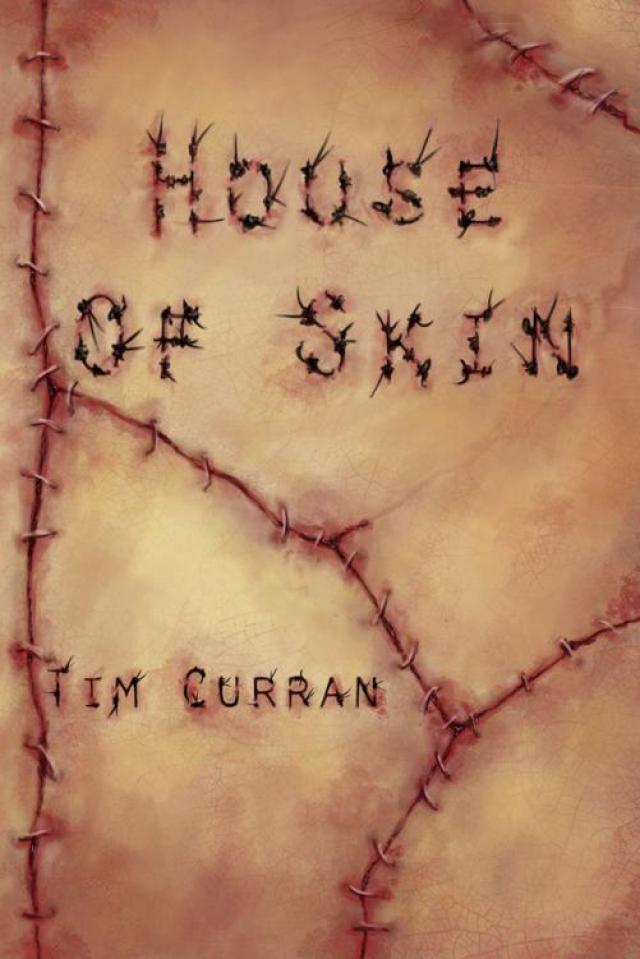
House of Skin copyright © 2013 by Tim Curran
All Rights Reserved.
Cover illustration by Amy Wilkins
This book is a work of fiction. People, places, events, and situations are the product of the author’s imagination. Any resemblance to actual persons, living or dead, is purely coincidental.
No part of this book may be reproduced or transmitted in any form or by any electronic or mechanical means, including photocopying, recording or by any information storage and retrieval system, without the written permission of the publisher, except in the case of brief quotations embodied in critical articles and reviews.
Also available in print: Trade paperback ISBN 13: 978-1-936964-39-0
Visit Comet Press on the web at: www.cometpress.us
Follow us on Twitter and Facebook
Tim Curran hails from Michigan’s Upper Peninsula. He is the author of the novels Skin Medicine, Hive, Dead Sea, Resurrection, Hag Night, The Devil Next Door, Long Black Coffin, Graveworm, and Biohazard. His short stories have been collected in Bone Marrow Stew and Zombie Pulp. His novellas include Fear Me, The Underdwelling, The Corpse King, Puppet Graveyard, Sow, and Worm. His short stories have appeared in such magazines as City Slab, Flesh&Blood, Book of Dark Wisdom, and Inhuman, as well as anthologies such as Flesh Feast, Shivers IV, High Seas Cthulhu, and Vile Things. Find him on the web at: www.corpseking.com
BLOOD RED CHERRY
* * *
Although there were any number of beginnings to what came to pass, Lisa would later be certain that it began the night she left Chowchilla and picked up a rider.
It was one of those nights cribbed from a Gothic novel: a whipping, wind-driven rain was falling from the black, lonesome sky and lightning flashed on the horizon, limning the prison buildings in ghostly, strobing phosphorescence. Thunder roared and the wind screamed. She had felt the storm coming all day as she could feel her period sneaking up on her late in the month sometimes. This was Mother Nature’s menstrual cycle; this was how she cleansed herself. Not with a flow of blood but with an acrid fall of rain, an ozone stink of lightning, and a roar of thunder. Out with the bad and in with the good.
“Christ in Heaven,” Lisa said under her breath.
It was a bad one.
That was just great.
She had a big day ahead of her tomorrow and if the storm raged through the night, she’d get no sleep. It was an affliction she’d suffered with since childhood: a mortal fear of storms. Rain and wind filled her with a creeping sense of foreboding that was completely inexplicable. When a storm raged, she’d cower on the sofa, stare blindly at the Weather Channel, hoping for a sign of relief, an indication that the tempest would pass quickly. When it didn’t, she would start drinking cognac, the only liquor she could stomach for some reason. At first just in a glass with ice. Then, as her nerves frayed with every boom and flash and her reserve went to pieces with them, straight from the bottle.
Storms.
Thunder. Wind.
She thought: I can’t take another night of it. I’ll lose my mind this time.
She climbed behind the wheel of her SUV and drove to the gates. The guard waved her through. The storm was gathering quickly, intent on destroying her peace of mind. She had to get home as quickly as possible.
The traffic was heavy, of course. Every idiot with a set of wheels was out on the streets tonight. It would take a good thirty minutes, if not more, to get home to the relative safety that awaited her there. Her knuckles were white as she gripped the wheel for dear life. Perspiration was running down her temples. A stink of fear came off her skin—salty and hot.
It took her no less than three-quarters of an hour to make it to her lonely little house outside Modesto. By that time the rain was cascading down in sheets, the night world shuddering with the rumble of thunder. Lightning flashed at regular intervals, the countryside exploding with blinding light. The wind lashed at the car, trying to force it into the ditch.
Not far now, she told herself, just hang on.
Finally, her driveway. She pulled in and killed the engine. Her fingers trembled so badly, she dropped her keys. It took two hands to pick them up: one to steady the other.
The wind slammed into the car.
She reached for the door handle and something shifted behind her.
Someone’s in the back seat—
But she never finished that thought. There was a blur of motion and then a loop of wire encircled her throat. Tightly, but not tight enough to kill. Not yet. Her heart thudded in her chest, her breath rasping in her lungs.
So dark, so terribly dark. She could see nothing in the rearview mirror, just a black shape. Her hands were clutched on those that held the wire. They felt cool, damp even, but feminine.
“Who are you?” she managed.
There was a smacking sound. Someone licking their lips.
“Please. Who are you? What do you want?” she gasped. “I … I have money.”
“It’s not enough, Dr. Lisa,” the voice answered.
Lightning flashed and the car was flooded with light. She saw her attacker. It was one of the patients from the prison hospital. Cherry Hill. Cherry, of all possible inmates. There were a lot of bad ones at Chowchilla, but Cherry was somehow worse. During one of their sessions, Cherry had told her that she could smell death on herself, that it clung to her like a sewer stink clings to a buried pipe. It could not be sanitized or washed away, she claimed, because it oozed from her pores like sweat. It was on her skin, it was in her hair, she could smell it on her fingers and taste it on her tongue. Every morning in Ad-Seg, solitary, she tried to cleanse herself of it: she stood in the hot shower soaping herself with foam and gel and body wash, she scrubbed and scrubbed until her skin was red and hurting. She washed her hair again and again until it smelled like green apples and it was so clean it squeaked.
It was a psychosis, of course. Cherry had murdered many people, even members of her own family, so it wasn’t that surprising.
As difficult as it was, Lisa tried to keep her composure. “Cherry. Listen to me. Can you do that? Will you listen to my words?”
“No.” Flat denial. When she was in that mood, there was no talking to her. It was best to keep quiet and let her begin, if she would begin at all.
Cherry had many obsessions as most killers did, but her favorite was evil. The nature of it, the politics of it, the way it contaminated minds like some toxic contagion. She considered it a natural force like wind or rain. Evil (she had said) not only turned minds black with hate and turned cities into graveyards, but it spread like a virus, jumping body to body in a ceaseless, remorseless circle of infection. Evil existed to destroy the human race. Its goal was to strip you bare at your most primal level. It did this by invading your body until your body was no longer your own, but a vessel for itself. Once it had you, it would kill and maim everything you loved, it would rape your soul and enslave your mind and force you into the most diabolic acts, shitting on your morals and ethics and pissing all over your belief system until you could only believe in evil itself and nothing more.
“Death is leaking from me, Dr. Lisa. Can you smell it?” she said.
The insane thing was for just a moment, Lisa almost could.
“Cherry?”
“Cherry’s dead.” The voice was flat, emotionless.
“Please, Cherry … please …”
“That’s what they always say, isn’t it?” the voice said. “Please.”
“What do you want?”
But she wouldn’t say.
Cherry believed not only that evil was a force of nature, an elemental, but that death itself was a parasite. It entered you in the larval stage when you were weakened from abuse and despair. Then it crawled up your spine and attached itself to your brain stem where it grew, lengthening and thickening, filling itself with eggs until it was ready to burst with spawn.
“That’s when you kill,” she had said during one of the sessions. “It controls your mind and makes you. Do you know why?”
“Why, Cherry?”
“Because … that is its life cycle. When you kill, it plants its eggs in your victim and infests other hosts.”
Lisa gasped as the wire cut a bit deeper.
She knew Cherry was expert with it. The garrote. She’d killed several people with it out in society and murdered an inmate at Chowchilla, nearly taking her head off. Lisa could not have been in a more dangerous situation. Cherry was deluded, paranoid, schizophrenic, and psychotic. She was housed in the criminally insane wing of the hospital. How she had gotten out was open to conjecture. The fact remained: she was out.
The wire constricted and Lisa’s eyes bulged like egg yolks. Her fingers fought and tore at the wire, but it was hopeless. The wire had severed her skin now, cutting into meat, going deeper where no fingers could find it. Her head pounded and her lungs ached, but it was her throat that knew the real pain. She started to wish she’d left the hospital at a normal time, came home and stretched out the sofa. A glass of wine, a little TV …
The thoughts in her mind were spiraling now from lack of oxygen. They were spinning around and around, faster and faster. There was no focus or cohesion. She trembled on the edge of consciousness.
She opened her eyes. She had blacked out, but just for a moment or two. The wire was still around her throat. Cherry had her face very close. Lisa could feel her hot breath in her ear. “I lo
The wire had loosened. “What do you want, Cherry?” Lisa said, her voice dry and gritty. “Tell me.”
The wire tightened and tightened.
A thousand thoughts and memories converged on her drifting, oxygen-starved mind as she saw static, gray glittering specks, and everything was washed away and she fell into darkness.
And a coo of a voice said, “Not yet, Doctor. It won’t be that easy for you …”
THE CONFESSIONS OF DR. BLOOD-AND-BONES (1)
* * *
There are places death goes.
A multitude of dead-ends and vacant quarters that it inhabits and calls its own. Abandoned cemeteries and forgotten crossroads where the night winds play and whisper in the tongues of lost souls. Dusty crematoria and dank crypt, prison, madhouse, and morgue. Cancer wards and slaughterhouses where the reek and scream of tortured life cling like grave mold or a child’s echoing cry. Death lives on the razored edges of knives and surgical equipment. On the tips of fingers and tongues, in concentration camps and marriage beds, in cribs and mausoleums alike. Death is everywhere, sewn into the tattered, unwoven fabric of reality.
There is nowhere Death doesn’t go, no hole too deep or altar too sanctified. And it is most at home in the twisted dreams and anguished thoughts of men and women.
It has a special place here.
It moves without check, in places where the living and dead mingle. Where the insane and the sane wear the same brooding faces. It lives in the dreamscapes where men deflower a thousand lovers, their children, and ultimately themselves. Where women mate and kill and destroy everything but their own vanity.
And sometimes death visits the same houses and buildings and thoroughfares that these same men and women call their own. This time it chose an old and crumbling house of filthy brick and here it looked for answers.
The aura of decay and depravity and human suffering was nearly overwhelming. Droplets of rain entered through the sagging, patched roof and fell into the attic. The air was pungent with the stink of rotting plaster and mice-gnawed wallpaper, the windows grimy, the floors uneven, and the walls bowed.
Death had heard things about this place, tales of madness and horror. Stories of unspeakable atrocities and blatant perversities committed behind these graying, powdery walls. So it came, hungry to learn more, looking for something, anything to call its own in this lifeless place that was untenanted by even rats or spiders or termites or silverfish.
Within the walls, reality and unreality were evenly balanced, like light and shadow at twilight or madness and sanity in the mind of a desperate man.
There are places death goes.
I know these places, for they are mine.
BLOOD BATH
* * *
The house stood high above the others on the street, set on a lurching hill covered with stunted grasses and denuded trees. Its neighbors crowded in to either side, dwarfed by the rambling, gothic monolith. It was desolate and weathered a uniform gray. Black turrets and crooked spires jutted from its sagging roof into a sky of rolling, moon-washed clouds.
Eddy stood before it, head bowed.
If houses had voices, then this one was calling to him. It went far beyond what he’d heard of the place—those were tales, true maybe, but just tales and this was reality. He didn’t go in alone. He took Cassandra along. She had a hunger for heroin and sexual excess. She was a whore and a junkie and that’s why he loved her. Like him, she was not whole. She was damaged and he understood damaged.
Holding hands, Cassandra and Eddy went in.
He wasn’t sure what he expected. Perhaps a rush of demon wind; a rattling chandelier; clanking chains or ghostly laughter. None of these things were in evidence. Instead, there was singular neutrality suspended in the air like a flat and distant memory. To some, it would have been nothing— merely a feeling of desolation and destitution common to all old and empty houses; but to the truly sensitive, it was a huge and morose sound, a scream of nothingness, a chorus from the void.
Eddy heard it and stopped dead in his tracks, a feeling of elation and rumbling confusion in his head.
“Why so many mirrors?” Cassandra said.
Eddy shrugged. He wondered this himself. There were mirrors of every size and shape crowding the walls. Many were broken, many were not. All were covered in grime and dust.
He cocked his head as if he were listening.
“What is it?” Cassandra asked. She was used to his sensing things that she could not.
“Did you hear it?”
She shook her head.
He thought as much. Sometimes he wondered if he wasn’t as disturbed as all those doctors said, hearing the things he did. But no, there was a rhyme and reason for everything and the sounds and voices he heard also fit into that pattern. All he had to do was make sense of it all, fit together the puzzle.
He and Cassandra had been together for six weeks now and he supposed it was the longest he’d ever spent with one woman. But she wasn’t like the others. She understood why he had to find his father even if, at times, he didn’t.
She gladly, willingly traveled from city to city with him, through ghetto and slum and desperation, as he searched, listened for the faint psychic echo that would lead him to the man who’d fathered him. Their travels had brought them here, to a desolate and shunned section at the edge of the Excelsior District. To this house in particular. A house his father had once called his own.
They moved quietly from room to room as Eddy smoked and listened to the wall of indecipherable noise he encountered everywhere. Close, so very close. They went upstairs and the noise thinned.
Cassandra was nervous. Was she, too, beginning to feel something? Or was it just her imagination toying with her? She decided it was probably neither and nothing that a syringe couldn’t fix up.
* * *
“Anything?” she said after a time. She was beginning to sweat.
“He’s been here,” Eddy said in a breathless voice.
“Recently?”
“Yes.”
Her eyes were bright and expectant. She was shaking and wiping her nose almost continually.
Eddy turned to her, stroking her cheek. “You don’t look well. Do you need a little something?”
Cassandra nodded. “Yes, just a little.”
He slipped a plastic bag into her hand. “Take as much as you like. Only go downstairs and do it. I need to be alone.”
She thanked him and left.
Eddy listened to the thud of her feet on the stairs until she was gone.
Then he fell to his knees. He was alone in this crowded room. He had to think, to make sense of it all, to keep in mind that he was the catalyst here and without him, nothing would or could happen. He stared off through the dust and grime and tried to empty his mind, tried to let the quiet noise of the voices fill his head.
Just let it happen, he told himself.
But it wasn’t that easy.
He kept seeing his father in his mind. The man he remembered from boyhood, a gaunt, hollow-eyed man who rarely spoke. A man who spent his days locked in a room full of books, his nights out on the streets practicing his art. William Zero considered himself an artist, they said, and his canvas was the human body. His admirers were few. It took a special mind to appreciate what he did to human flesh with his knives. Yet, an artist he was. And his son, Eddy, never saw him as anything else.
He’d been gone twenty years now. Twenty years in which his son’s only contact with him was through yellowing articles his mother had clipped methodically from newspapers. Articles she had clipped and pasted into a scrap book. It was her hope, Eddy supposed, that by rubbing his face in his father’s crimes he would be saved from the same life of derangement and violent delusion. But it hadn’t worked. He never saw his father as the bogeyman she’d hoped, but as a complex individual he could never hope to understand, but wanted to.
A man he spent his teens and twenties fantasizing about.
A man he wanted to meet.


