Headlong, p.25
Headlong, page 25


He said his name again and introduced Swilley. She did not react. Her eyes had that thousand-yard stare. He tried to engage it. ‘You knew I would come,’ he said.
‘I suppose so,’ she said at last. Her voice sounded rusty with disuse. She turned and walked away from him, into the flat, and he followed, Swilley closing the door behind them.
And this was not the same flat. The neatness, the almost obsessive tidiness, was blurred, things had not been put away, mugs not washed up, items of clothing had been discarded at random. The cat came straight towards Slider, but with what sounded like an anxious mew. He wondered if she had remembered to feed it.
She sat heavily on the sofa, hands clenched in her lap, a defeated slump to her shoulders. Slider pulled the armchair round and sat facing her. Swilley, in whom she had evinced no curiosity, stood behind the sofa, where she could see her in profile.
Slider leaned forward, elbows on his knees, hands dangling loosely between them, making himself unthreatening, someone to talk to. ‘You knew I would come,’ he said again, gently. ‘You knew I’d find out. Do you want to tell me about it, or shall I talk?’
She barely shrugged. ‘I don’t know what you want from me.’
The cat jumped up onto the sofa as if heading for her lap, but stopped as if prevented by an invisible barrier. Probably the smell of her distress. It mewed, and jumped down again, and walked away. Its unsatisfied prowlings made the background to Slider’s interview with Amy Hollinshead that afterwards he always remembered.
‘Let’s talk about that Monday,’ he said, to get her started. ‘When Ed came back from lunching with Cathy Beccles. Were you jealous of her?’
That got through. She looked surprised. ‘Cathy? No.’
‘They slept together, didn’t they?’
‘A long time ago. Not for years.’
‘You’re sure of that?’ She shrugged indifferently. ‘There is a certain kind of man,’ Slider went on, ‘who gets amorous when he’s had a bit to drink. I’m guessing Ed was that sort of man. He arrived back from lunch a bit lit up, and wanted you to go upstairs with him.’
Amazingly, tears stood in her eyes. He’d have thought she’d be cried out by now. ‘You don’t understand,’ she said. ‘I loved him.’
‘I know that.’
‘And he loved me,’ she added fiercely. ‘We were lovers.’
‘I know. So you went upstairs. Had a glass of wine together. Talked a little, perhaps.’
‘A lot. Ed loved to talk.’
‘And made love.’ She assented with a slight nod. ‘In his bed, in his bedroom.’ She squeezed her eyes shut. ‘After that – perhaps you lay in his arms for a while, talking. Or did he fall asleep? He’d had rather a lot of wine.’
She nodded, staring at the blank air. ‘I went downstairs and got on with some work. He never slept for long – just a short nap. Always, after sex. Always a nap. He was very energetic. It took a lot out of him.’
Sometimes Slider regretted his vivid imagination. He saw this picture all too clearly. He even saw her fond glance at the sprawled and sleeping Wiseman as she dressed and padded out – the faint smile of the work-wife who, for the moment, had everything she wanted. Asleep, after sex with her, he was hers entirely.
He had felt it himself, God help him, with Joanna sometimes, when she slept after love-making: Joanna the sleek and beautiful and independent, the musician with the incomprehensible talent, the never entirely possessable.
He went on. ‘So he woke up after a bit, dressed again, and came downstairs and carried on with his own work. Everything was just as normal?’
‘Normal,’ she consented, but as though it was a word in a foreign language, whose nuances she might not understand.
‘Then it was time for you to go home. You’d tidied up, ready to go,’ he said, remembering her neatness, imagining her putting papers away, slipping the dust covers over the screen and keyboard. ‘But just after six, the phone rang.’ She closed her eyes and nodded. ‘Why did you listen in?’
‘I always did, when it was the landline,’ she said automatically. ‘In case it was something he’d want me to deal with.’
‘But when you heard it was Virginia Foulkes …?’
‘When she called it was always a long one. I wanted to go up and say goodbye to him before I left. I didn’t listen to all of it. I just went in on the line after a few minutes to see if it sounded as though it was near the end.’
He suspected this was not the truth. He suspected she listened to it all – perhaps not with any sense of urgency, but just waiting impatiently for it to be over so she could go up to him again. He saw her seated, leaning her elbows on her desk, the receiver to her ear, half bored with the old-friends chat, only half attending – until something made her sit up sharply.
‘And then you heard Ed say that he was going to marry Calliope Hunt.’
He saw enlightenment flicker across Swilley’s face. She was quick on the uptake when it came to human relationships. She would not need to have it stressed how important that was.
‘He said …’ Amy began miserably. She hardly wanted to say the words aloud, but they forced their way out. ‘He said she was everything to him.’
‘But you’d known about her for a long time.’
‘I knew he had a crush on her. But it’d happened before. He got these silly … enthusiasms. They never lasted. They burnt out, like paper. That’s all she was, a paper cut-out, no substance.’
‘But this time it was serious. He really was going to marry her.’ She said nothing. ‘The call ended at last, and you were going to go upstairs, but it rang again immediately.’
‘I thought it was Virginia again,’ she said. ‘So I listened.’ He waited, to make her say it. ‘It was Duncan. The solicitor.’
He saw the deep-down flicker of anger that had not been entirely burnt away. That was good. He fanned it. ‘Was that the first time you’d heard that he was selling the business?’
‘Yes,’ she said. ‘He hadn’t said a word.’
‘It must have been a shock.’
‘Not – a – word,’ she repeated. ‘I didn’t see how I could not have known about it. When the call ended, I rushed upstairs, but he wasn’t a bit remorseful. He was happy. He laughed, as if he’d been very clever, keeping it from me. He said he’d had the due diligence done when I was out of the office. I remembered he’d given me the day off one day, saying he didn’t feel like working, and he was going to visit some friends in the country. I didn’t think anything of it, because he’d done that sort of thing before. Due diligence doesn’t take long with a small outfit like ours – they could do it in one day.’
Slider noticed, with an inward wince, that she had said, ‘ours’.
‘But to trick me like that – to keep me in ignorance, after all I’d done for him!’ The words poured out now, on a flood of indignation, hurt and anger. ‘I asked him why. Why? He said he was selling up and marrying Calliope Hunt, and investing the money in her career. He’d get her stupid book published even if he had to pay for it. He’d spend on publicity for her. He’d be her agent as well as her husband. They were going to start a whole new life together. He looked – lit up! And it was all about her. All those years I’d helped him build up the business, but I didn’t count a bit!’ She clenched her hands together. ‘I said, what about me? What about my job? And he said I’d soon get another one. He said … he said he’d give me a good reference.’
It was hard for her to say the last bit. It was the final insult, Slider saw: a reference was what you gave to a mere employee. She had been so much more than that. ‘That was cruel,’ he murmured.
He didn’t know if she heard him. She cried out in pain, ‘Thirteen years! For thirteen years I was like a wife to him, more than a wife! I did everything for him. We were so close. He told me everything – he never made a move without me. He loved me – I know he loved me. And then … this!’
‘It was more than you could bear,’ Slider suggested.
‘I screamed at him. How could he do this to me? How could he? And with her – that – that trollop! That painted airhead! She couldn’t even write! I practically re-wrote that book for her, when Ed got bored with it. He was throwing me out like a stray dog, for her?’
They had come to the delicate bit. No wrong moves now. ‘He was sitting down at his desk,’ he suggested quietly.
But she was on a roll, her eyes fixed on the replay of the scene, her jaw clenched with the remembered fury. ‘Swivelling back and forth in his chair, the way he did, looking self-conscious, like a kid who knows he’s done wrong but won’t own up. And then he put his glasses on and pulled a manuscript towards him as if he was going to work on it, and he said, “Get used to it, Amy. It’s happening.” He was dismissing me! And he said, “You’d better look for another job.” Without even looking at me, he said that. “Look for another job”.’
‘So you grabbed the cricket bat off the wall.’
‘That stupid bat! I hated it!’
‘And you hit him.’
Now she looked at him. ‘I didn’t mean to hurt him. Not really hurt him. I was just so mad at him, and he was pretending to ignore me. I had to make him notice me, pay attention to me. So I just – sort of – lashed out at him.’
‘You play tennis,’ Slider said sadly. ‘You have a good, strong swing.’
‘It felt good,’ she whispered, as if to herself. ‘It felt good when I did it. He looked so surprised for a second: oh, stupid Amy, the dogsbody, the nobody, she’d actually stood up for herself! So I hit him again.’ She closed her eyes for a second, and Slider heard with her the crunch of the connect. She opened them and went on. ‘He fell out of the chair onto the floor. I wanted to laugh, he looked so … undignified. Not like Ed at all. Ed was always so together. You could never imagine him tripping or falling over or anything like that. And there he was looking ridiculous, lying on the floor like a bundle of clothing.’ She swallowed. ‘But he didn’t get up, he didn’t move, and I realised – I realised I must have hurt him after all.’
‘The side of the skull is quite fragile, where you hit him. If you’d hit the back of the head, he probably would have had a nasty bump, but maybe nothing more.’
‘I’d killed him,’ she said, staring at nothing again, speaking to herself. ‘I’d really killed him. It was …’ She didn’t seem to know what it was. Terrible? Slider wondered. Wonderful? At last she said, on a breath of a voice, ‘Unreal. It still seems unreal.’
Swilley made tea, and put a mug into Amy’s hands, which were trembling now. And at a gesture from Slider, she put some food down for the cat, which ate as though its life depended on it. Perhaps it did.
Bit by bit, Slider got the rest of the story.
She had sat, frozen in shock and horror for a long time – an hour, maybe more.
‘You didn’t think of ringing for help – police, ambulance?’
‘I didn’t think of anything. I couldn’t think. I was numb. I couldn’t move or think or anything.’
It was the front doorbell ringing that jerked her out of her trance. It rang long and loud and angrily. She jumped almost out of her skin, her heart pounding with fear, realising the full horror of her situation. Here she was in the room with the body of the man she had killed. Slider, unwillingly, could imagine her agonised fear. Suppose the bell-ringer didn’t go away? Suppose they had a key and came in? Or knew someone else who had one? Suppose they guessed something was wrong and called the police? She listened, attention straining, frozen in panic. She was just beginning to think the danger had passed when the bell rang again.
Slider glanced at Swilley, who nodded slightly. These must have been the attempts, first by Langley and then Burke, to visit their tormentor. It was good corroboration – it would help their case when they came to present it.
She waited a long time, but there was no more sound from downstairs, and now she had to move. She knew the trouble she was in, and looked round for inspiration, her trapped mind running back and forth, searching for a way out. The darkness outside made her think of the workings next door. Ed had been looking out of that window one day and had made a joke about making sure not to fall out because there would be no soft landing. It gave her the idea. With scaffolding and heaps of bricks and concrete mixers and all the rest of it, there was plenty down there to account for a head wound if someone did fall. Slider imagined the flood of adrenaline as she thought she might somehow get out of this horrible mire.
She had switched off the light, pushed the window up, and heaved the body up by the armpits until it was hanging out from the waist up over the sill. Ed, though tall, was lean, and she was tall for a woman, and strong – and was made stronger by sheer necessity. Finally, having got the body into position, she lifted the legs, changing the balance, and pushed it out, head first.
She closed her eyes at the memory. ‘I heard the thud,’ she said.
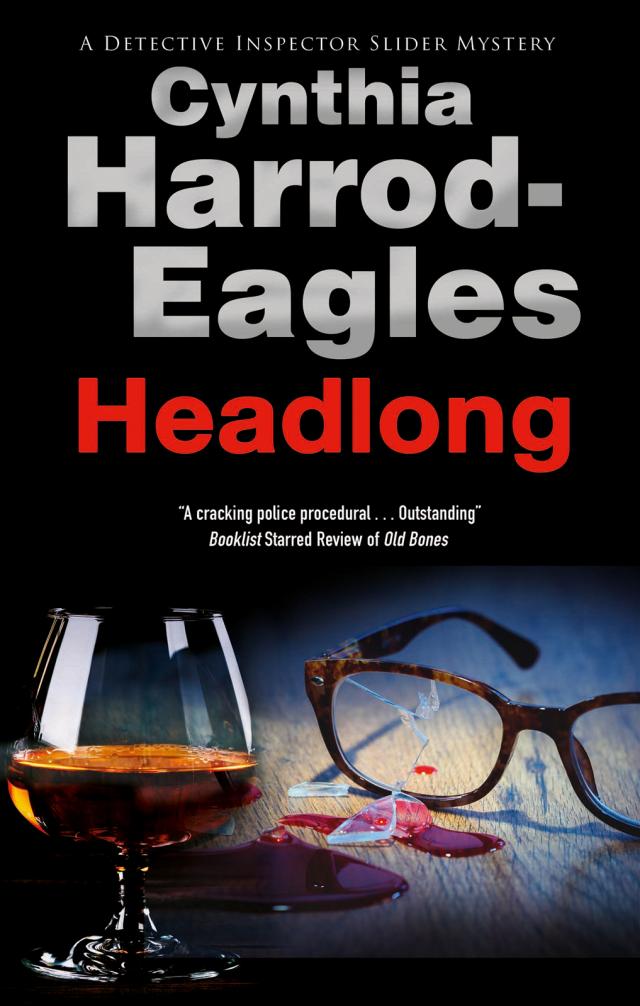
Then it had all been about covering her tracks. She switched the light back on; had enough wit about her not to close the window again. Arranged the scene, with the desk lamp on, and his papers placed so it would seem as though he’d been sitting there working. Poured a brandy and set the glass on the desk. He had got up for some reason, to look out of the window, overbalanced and fell.
‘What did I forget?’ she said to herself; and then she looked at Slider, and said it again. ‘It looked good. What did I forget?’
‘His glasses,’ said Slider. ‘You had to throw them out with him because they were broken. But if he’d been working, and got up to look out, he’d have taken them off and left them on the desk.’
‘Oh,’ she said. And then: ‘Yes. I see that.’
‘And being so very, very tidy in everything, you pushed his chair in under the desk.’
She frowned, remembering. ‘Did I? I suppose I did. But what was wrong with that?’
‘If someone gets up for a break from work, they shove the chair backwards to get up, but they’re coming back again, so they don’t usually push the chair in.’
‘I would,’ she said blankly.
‘I know. But would Ed?’
She mulled this over, and then, looking at him properly, seeing him perhaps for the first time as a real, present person, she asked, ‘Is that it? Is that what gave it away?’
‘Partly. The first thing was that when I talked about his bedroom on the top floor, you started. You’d already told me you never went up there.’
‘I didn’t want you to—’
‘To think that you would know anything about his bedroom, I know. You were just the secretary, nothing more. But you’d just remembered you’d left the wine glass up there, the one you’d been drinking out of.’
She bit her lip. ‘How could you know that?’
He didn’t answer that. ‘The final thing, that clinched it, was the cricket bat.’ She winced at the word. ‘I could see there was a space on the wall, that something was missing, but I didn’t know what. I found out later. But when I spoke to you about the cricket memorabilia on his study wall, you talked about the cricket balls, but you didn’t mention the bat. An innocent person would probably have mentioned the bat before the balls: with the signatures, it was the more interesting object. And the more important to him. But you didn’t dare draw attention to it. Or perhaps you just couldn’t bear to speak about it.’
‘You’re clever,’ she said dully.
‘You didn’t dare leave it in Ed’s study. You couldn’t put it back on the wall. The murder weapon.’
‘Don’t,’ she winced.
‘You’d heard of all the wonderful forensic tests we have now. You had to take it away and get rid of it. So you hid it under your coat and took it home. But then you couldn’t think of what to do with it. If you tried to dispose of it, someone might see, you might be caught on camera, it might somehow be traced back to you. You just had to keep it.’ He met her eyes. ‘Hateful, horrible thing, reminding you every minute of what you’ve done. It’s somewhere in the flat now, isn’t it?’
‘In my wardrobe,’ she acknowledged on an outward sigh.
Slider nodded at Swilley, and she loped quietly out. With the bat, and the lip print, and the CCTV evidence, he had enough now to back up her confession. Hollinshead remained staring at nothing, in a daze, until Swilley came back in and nodded to Slider, it’s there all right. Now they could get SOC in to officially find and secure it, and her clothes as well, because there might be blood or matter on some of them.
He stood up. ‘Well, that’s it,’ he said. She looked up at him. ‘You had better come with me now to the station, and make your statement.’ For a moment she didn’t move. He encouraged her like a child. ‘Come on now. Up you get. The worst is over. DC Swilley will look after you. She’ll help you get it all written down.’
Hollinshead stood up, but didn’t seem to know how to move. She looked around her, and Slider almost saw her waking up, saw her face sag with realisation. Now, at this moment, she understood the ruin of her life, of her entire being. It was finished. It was over. This was the end of everything.
‘What will happen to me?’ she asked Slider, her voice seeming far away. He imagined her receding, blown helplessly backwards away from the warm precincts of the cheerful day, and into the blank chill of process: trial, imprisonment, oblivion.
‘You must expect a custodial sentence,’ he said. ‘But there are discounts for pleading guilty and possibly because you are not likely to kill anyone else. With good behaviour you will get parole. But you should expect to serve at least eight years.’
She said, ‘Eight,’ but not with any emphasis. The length of time was secondary to the understanding that she would actually go to prison. He had seen it before – that to the respectable middle classes, prison itself was a thing of utter terror, a deterrent as it could never be to the criminal classes.
Although, in the moment of red-hot passion, nothing really deterred, did it? And Ed Wiseman was dead. He must never allow his empathy with the cornered fox to seduce him into forgetting that.