

Five to five, p.1
Five to Five, page 1


This edition published in 2021 by Moonstone Press
www.moonstonepress.co.uk
Introduction © 2021 Curtis Evans
Originally published in 1934 by Methuen & Co. Ltd, London
Five to Five © 1934 The Estate of D. Erskine Muir
The right of Dorothy Erskine Muir to be identified as author of this work has been asserted in accordance with the Copyright, Designs and Patents Act 1988
ISBN 978-1-899000-42-5
eISBN 978-1-899000-43-2
A CIP catalogue record for this book is available from the British Library
Text design, typesetting and eBook by Tetragon, London
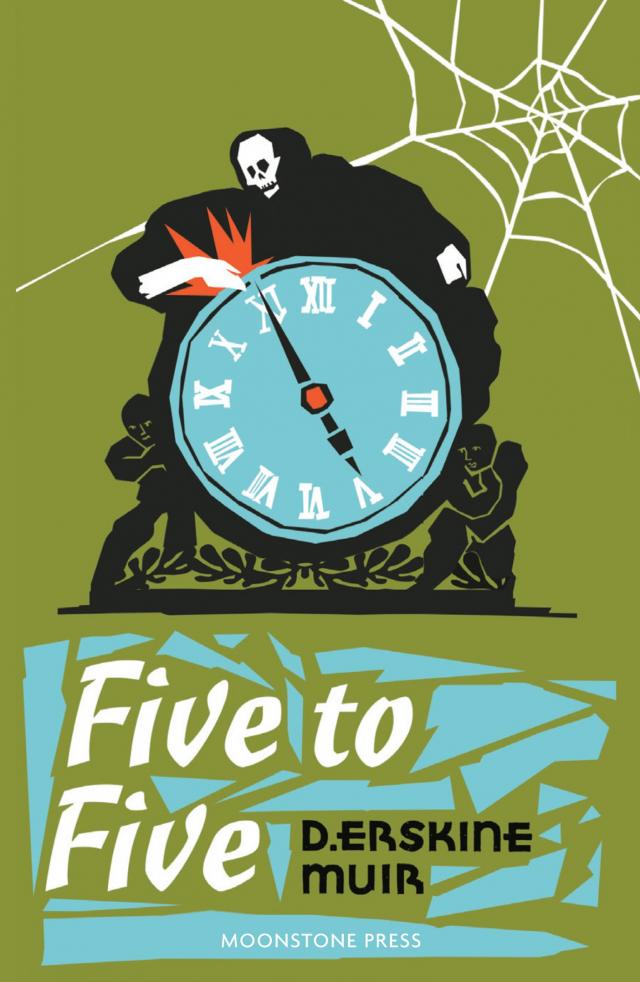
Cover illustration by Jason Anscomb
Contents
Introduction by Curtis Evans
Characters
I. The Watcher
II. The Prey
III. The Tea-Party
IV. The Return
V. The Dead
VI. The Detective
VII. The Dealer
VIII. The Heir
IX. The Hypothesis
X. The Suspects
XI. The Doctor
XII. The Wife
XIII. The Artist
XIV. The End
XV. The First Solution
XVI. The Complete Case
Introduction
At seven o’clock on the evening of Monday, 21 December, an old lady, living alone with one servant in a comfortable flat in a well-to-do Glasgow street, was brutally butchered on her dining-room hearthrug, during the temporary absence of the maid to buy an evening paper. The victim was Miss Marion Gilchrist, eighty-three years of age, a person of reserved and solitary habits, only remarkable in that she possessed some £3,000 of jewels, which she kept hidden among her dresses in her wardrobe.
—“The Slater Case”, in Knave’s Looking Glass (1935) by William Roughead
The murder in Glasgow of octogenarian jewel-fancier Miss Marion Gilchrist remains unsolved today, likely largely because the original investigation by Scottish police into the crime and its circumstances was either astonishingly inept or criminally complicit in the dread deed. The great Scottish criminologist William Roughead—he will be familiar to those of you who have already read Dorothy Erskine Muir’s first true-crime-inspired detective novel, In Muffled Night (1933), which draws on another of Glasgow’s notorious unsolved murders, the 1862 Jessie McLachlan case—was associated with the Gilchrist murder case for years, having:
(1) attended the original trial of Oscar Slater, the man accused of the crime, in 1909;
(2) authored Trial of Oscar Slater for the Notable British Trials Series, which highlighted the gaping flaws in the state’s case, in 1910;
(3) published a revised edition of the book, with even more damning detail, in 1925;
(4) served as a witness at the hearing of Oscar Slater’s successful appeal against his now nineteen-year-old prison sentence in 1928;
(5) published a final revised edition of Oscar Slater in 1929;
(6) produced a concise account of “The Slater Case” in his collection of criminological essays Knave’s Looking Glass, in 1935.
“The Slater Case” was reprinted in 1951, a year before Roughead’s death at the age of eighty-two, in his penultimate book, Classic Crimes, a brilliantly cut jewel of true-crime writing that was reprinted in 2000 by New York Review Books in a fine edition that happily remains in print and available throughout the world today. The essay makes compelling if infuriating reading, as Roughead methodically demolishes the state’s absurd case against the man whom it successfully prosecuted for Marion Gilchrist’s bloody murder.
The police errors (?) in the Slater case were both manifold and grievous. As Roughead notes, with a fortune in jewels (worth some £315,000/$450,000 today) at her elbow, “Miss Gilchrist was morbidly afraid of robbers,” and had made unsanctioned ingress into her domain a daunting procedure indeed; so it seems highly unlikely that the murderer—who had managed to gain entrance to the flat, presumably, during the perilously brief absence of the live-in maid, Helen Lambie—would have been unknown to the victim. When Lambie returned and entered her mistress’s flat in the company of a neighbour, Arthur Adams, who resided downstairs with his two sisters (a few minutes earlier all three of them had heard loud noises emanating from the flat above), they encountered a gentleman, purportedly unrecognized by them, departing the premises. Yet another witness—a fourteen-year-old message girl named Mary Barrowman, who claimed to be in the street at the time (although this claim was challenged)—stated as well that she saw a man running down the steps of the building. Although the police inferred from the disparate descriptions given by the three eyewitnesses that the man leaving the flat and the man running down the stairs were not actually one and the same person, they later altered this view, after they had alighted on a suspect, a thirty-six-year-old native German Jew of rather dubious background named Oscar Slater, upon whom they proceeded crudely to pin the crime.
According to Helen Lambie, out of the hoard of jewellery in her mistress’s flat only a diamond brooch was actually missing. (Miss Gilchrist’s papers had been disturbed as well.) When the police discovered that Oscar Slater had recently pawned a diamond brooch before departing for the United States (a trip planned before the murder took place), this set them on his trail. Even after it was learned that Slater’s brooch was actually a different article from Miss Gilchrist’s missing one (thus rendering the “brooch clue” entirely worthless) and the police failed to establish that their suspect even knew the victim, they clung tenaciously, like a pug on a trouser leg, to the belief that Slater was their man. After a farcical identity parade and constant honing of the eyewitnesses’ recollections, he was brought to trial, convicted on a 9–6 verdict (this being Scotland, unanimity was not required) and sentenced to death by a piously overbearing judge who set a new standard in prejudicial judicial sanctimony.
It is no wonder that the Slater case, like the McLachlan case before it, provoked outrage and protest among thousands of individuals, including, famously, Edinburgh native Sir Arthur Conan Doyle, creator of Sherlock Holmes, who damned the entire official proceeding as a “lamentable story of official blundering from start to finish”. As in the case of Jessie McLachlan nearly half a century earlier, Oscar Slater’s death sentence was commuted to a term of life imprisonment, of which, as mentioned above, he served nineteen years. All in all, it was surely one of the clearest cases of judicial injustice in Scottish legal history.
For many decades accounts of the Slater case were less concerned with the question of whodunit than with what in hell was done to him? In other words, writers about the affair mostly devoted themselves to pointing out the manifold structural weaknesses in the shaky scaffolding which the state had erected in support of Slater’s shameful conviction. However, in Five to Five, D. Erskine Muir’s second detective novel, the author went looking for another killer. In her review of the novel in the Sunday Times, Dorothy L. Sayers noted that the Gilchrist enigma was one of the most “mysterious of all recent murder cases”, with the quashing of Slater’s sentence having been unsatisfactorily “based on technical grounds which shed no further light upon the central problem of who really did the murder”. “Mr. [sic] Muir” had, Sayers added, “used the opening situation [in the Slater case] as the thesis for an exciting and well-constructed murder story… with a dramatic and soundly argued conclusion”.
Admittedly lacking in the story is the real-life high drama of a monstrously stigmatized man unjustly tried and convicted for a crime he did not commit, but in its place readers will find an engaging murder problem constructed with all the sober rigour of Freeman Wills Crofts and enriched with Muir’s superior descriptive power and skill at the drawing of character. Additionally, we also are treated to a return engagement, after his winning appearance in In Muffled Night, with the upright and tenacious Detective Inspector Woods of the CID, with whom Crofts’ own Inspector French doubtlessly would have been honoured to serve. Readers who peruse further in the stacks of Slateriana that have accumulated over the decades—Roughead’s “The Slater Case” certainly would be a good place to start—will find additional instances, like those concerning the murder weapon and the mysterious “watcher” from across the way, where Muir has drawn on the real-life-crime problem in constructing her fictional one. Surely to the mystery of the cruel slaying of Mr. Simon Ewing, that disagreeable, elderly and infirm collector of jade and jewels, the author has come up with a far more credible solution than the Scottish authorities ever managed to do during their infamous investigation into the murder of Miss Marion Gilchrist.
Curtis Evans
Germantown, TN
28 June 2021
Characters
Simon Ewing
Penelope Fordham
Henry Godfrey
Anne Godfrey
Doreen Godfrey
Mrs. Dutton
Nurse Edwards
Mr. Hetherington
Detective-Inspector Woods
Detective-Sergeant Riley
George Fordham
Dr. Ainslie
NOTE
All the above characters are fictitious and have no reference to any living person or persons.
Chapter I
The Watcher
There was the warmth and light—
The sense of life so just an inch inside—
Half-Rome, R. Browning.
The rain slanted down, quietly and steadily. It was cold, and the man standing in the street shifted uneasily from one foot to the other. He had been standing there for some little time, his back pressed against the railings of the area of the empty house. Now he moved slowly along the dripping pavement, glancing up and down as he slouched along, collar turned up, hands in pockets.
The rain-soaked street was silent and deserted. Only a subdued roar of traffic from the great main road, some little distance away, echoed through the air. No traffic passed along this quiet backwater. Situated in Kensington, not far from the chief shopping area, it was yet extraordinarily isolated. The houses were of the familiar London brick, once pale yellow, now dark. Originally built as large family houses, they were now mostly split up into flats or maisonettes. The road was a short one, curving away from the spot where the watcher stood. He had been loitering between two houses, one empty, the other with a brass plate which bore the name “Dr. Ainslie”. Opposite to him a street lamp shone across the wet road. Its light fell upon the entrances to the flats behind it, forming part of a block of converted houses. Actually the three or four at that end of the street belonged to the “Residential Hotel” at the corner. The proprietress there, who had made a success of her business, had bought up the adjoining houses and turned them into good flats, which were served from her hotel, and had a passage built on at the back communicating with her restaurant.
The man in the raincoat turned at the sound of a motor coming round the corner behind him. It was Dr. Ainslie’s car, and, as if anxious to avoid being seen, the watcher went hurriedly up the steps of an entrance beyond and vanished under the portico. This belonged to a set of self-contained flats, and in consequence the main door into the hall was open. Standing within and glancing back, the man saw that the doctor, instead of stopping in front of his own house, was drawing up at the one where he himself was sheltering, and was evidently intending to pay a visit within.
After a moment’s hesitation, the man, clearly wishing to avoid a meeting with the doctor, began to ascend the staircase. He paused on the first landing, but hearing the doctor’s quick footsteps beginning to mount behind him, went on up the next flight. The doctor halted on the first floor; a pause, and then came the faint sound of a bell trilling in one of the flats. The man above stood still, listening and waiting. From his position now it chanced that he could see out of the window, which, facing towards the street, lit up the staircase at the turn. He stared out. Across the dusk a light shone brightly. It came from one of the flats on the opposite side of the road. A room on the first floor had been left with blinds undrawn. The interior showed as a lit-up stage shines across the dark auditorium. From the street level no view into this room had been possible, but from his present position the watcher could look down and across and see everything within. Stepping to the window, he leant his arms on the sill and gazed eagerly out.
Three long windows faced him. They gave a clear view into a very beautiful room, contrasting rather sharply with the drab exterior of the buildings. Tall glass-fronted cabinets were ranged against soft green walls; a few large pieces of oriental china were placed here and there. A great copper bowl filled with pink and white lilies took up the whole of a table near the windows. Mirrors in lacquer frames gleamed on the few spaces left on the walls between the cabinets, and a big lacquer screen apparently stood before the door. On the hearth a fire of sea-logs sent off those bright blue flames which are advertised as a special attraction by firms of ship-breakers. The light sparkled into the room and was reflected back by the shining objects with which the cabinets were filled.
In a big arm-chair with an invalid’s foot-extension, drawn up close to the hearth, sat a man. He had white hair and, as far as could be seen, a pale, thin, waxen face. He had a special sort of baize-covered board in front of him, resting on the arms of the chair. This was evidently used as a writing-table, for some sheets of paper were scattered on it, and he held something in his hand which appeared to be a pen, for as the watcher looked on he began to write. A tall standard lamp in a beautiful oriental design was placed close to the arm-chair. The light, falling softly downwards, showed quite clearly the glint of his white head bending forward over his papers. The fireplace was in the middle of the wall to the left of the watcher. Between it and the window stood a bureau, with a tall open top, consisting of two doors, folded back now and showing an elaborate arrangement of small drawers and pigeonholes. On the rug before the hearth knelt a girl, whose fair hair caught the gleam of the flickering flames. She was busily picking up something from the floor. Her hands moved backwards and forwards, seeming to tidy with swift movements. Presently she rose, and pressed whatever she had collected in her hands down into a waste-paper basket standing by the corner of the hearth. She walked across the room and disappeared behind the screen. Presently she reappeared, now wearing a waterproof, and pausing in front of one of the mirrors began to adjust her beret. The elderly man laid down his pen and turned towards her. From the depths of his arm-chair he fished up some small packet which he held out towards the girl. She took it, but with a curious stiff little gesture, and with a perceptible pause of hesitation. The man then pulled from his breast-pocket a wallet and handed the girl what was clearly money in the shape of bank-notes. The girl put this and the little packet into her hand-bag, and then, turning away, began to pick up a number of parcels from a chair which was out of the range of sight from the window. Both girl and man glanced towards the mantelpiece. Following an imperious gesture from the old man, the girl, awkwardly balancing the pile of parcels on one arm, stepped towards the tall windows, and with her free hand began to pull the cords which worked the curtains. Slowly as she tugged, the heavy folds began to slip across the lighted spaces. She went from one window to the other, until finally, again with that faint reminiscence of the theatre, the last fold swung into place, and the bright interior was shut away.
The watcher opposite still did not stir, but stood motionless and intent. Presently the front door across the street opened. The girl came out and stood to open her umbrella beneath the big portico. Then, running down the steps, she turned to her right and went swiftly down the street.
At this very moment the watcher was startled by a sudden outburst of voices coming from below.
“Very well, I’ll run up, doctor, and see if Miss Stack would let me use her telephone,” and hasty steps could be heard mounting the stone staircase towards the landing. Instantly the man turned, and began with great speed to go up still higher. On the floor above two doors faced him, one on either hand, giving access to the small two-roomed apartments at this, the top of the house. The farther one had a card pinned on it: “Mr. Hetherington”, Hastily crossing to it and keeping his back towards the person coming up behind him, the man pressed the bell, and while the woman was knocking and ringing with agitation at the nearer door he found himself confronted by a tall, burly figure wearing an artist’s overall.
“Mr. Finlay?” he inquired in a rather low, husky voice.
“Certainly not,” retorted the artist. “Can’t you read?” pointing to the card fixed to the centre of the door by a drawing-pin.
“Sorry, I was told Mr. Finlay lived here,” mumbled the watcher.
“Well, he doesn’t; and the man who was here before wasn’t called Finlay either. I’ve only moved in a couple of weeks, but the fellow before me was MacNaughton. You’ve come to the wrong block,” and with these words, snapped over his shoulder, the peppery occupier of Flat 5 bounced back into his passage-hall, slamming the door in the inquirer’s face.
By now, however, the agitated lady had been admitted to the opposite flat and the coast was clear. The watcher began to make his way down the staircase. He had hardly passed the lower landing, when he heard the door of the flat open, and the doctor’s voice was audible, in the preliminaries of departure.
“Well, I must be off now, I’m afraid. I’ve an urgent case waiting. But the nurse will do all that’s needed, and I’ll look in again on my way home to dinner.”
Hastening ahead, the man in the raincoat reached the front door. Slipping out, he glanced cautiously round, and as he did so a big clock in some nearby tower began to boom out its deep chimes. It was five o’clock, and as the heavy notes died away trembling through the damp air the man ran very hurriedly down the staircase and vanished into the rain.


