

Colossus the boxset, p.1
Colossus The Boxset, page 1


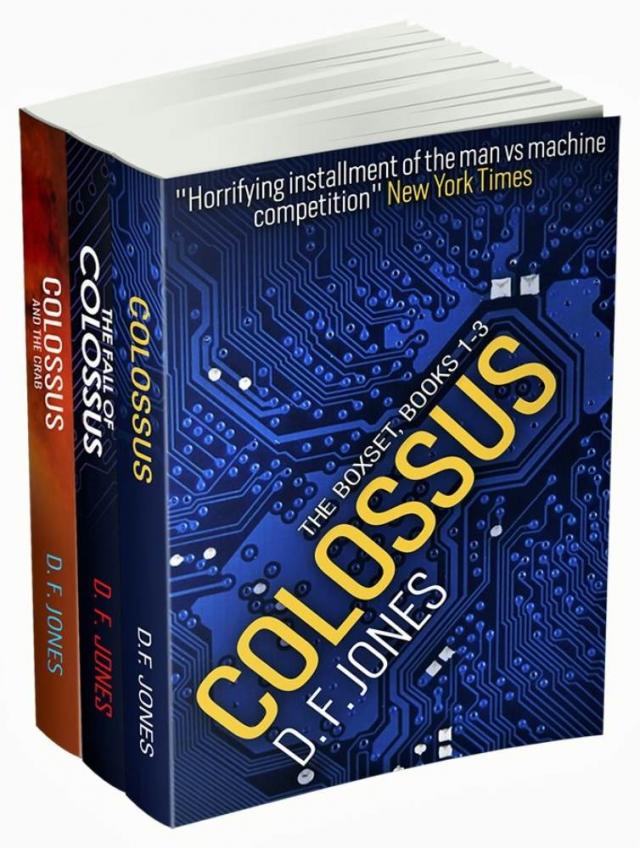
Colossus The Boxset
Books 1-3
D. F. Jones
© D. F. Jones 1966, 1974 and 1977
D. F. Jones has asserted his rights under the Copyright, Design and Patents Act, 1988, to be identified as the author of this work.
COLOSSUS first published in 1966 by Rupert Hart-Davis Ltd.
THE FALL OF COLOSSUS first published in 1974 by G. P. Putman’s Sons.
COLOSSUS AND THE CRAB first published in 1977 by Berkley Publishing Corporation.
This edition published in 2016 by Venture Press, an imprint of Endeavour Press Ltd.
To Neville Randall
Table of Contents
COLOSSUS
Chapter 1
Chapter 2
Chapter 3
Chapter 4
Chapter 5
Chapter 6
Chapter 7
Chapter 8
Chapter 9
Chapter 10
Chapter 11
Chapter 12
Chapter 13
Chapter 14
Chapter 15
Chapter 16
Chapter 17
Chapter 18
Chapter 19
Chapter 20
Chapter 21
Chapter 22
THE FALL OF COLOSSUS
I
II
IV
V
VI
VII
VIII
IX
X
XI
XII
XIII
XIV
XVIII
COLOSSUS AND THE CRAB
Chapter I
Chapter II
Chapter III
Chapter IV
Chapter V
Chapter VI
Chapter VII
Chapter VIII
Chapter IX
Chapter X
Chapter XI
Chapter XII
Chapter XIII
Chapter XIV
Chapter XV
Chapter XVI
Chapter XVII
Chapter XVIII
Chapter XIX
Chapter XX
Chapter XXI
Chapter XXII
Chapter XXIII
Chapter XXIV
Chapter XXV
Chapter XXVI
Chapter XXVII
Chapter XXVIII
Chapter XXIX
COLOSSUS
Chapter 1
Forbin leaned back in the plastic-smelling opulence of the armour-plated car of the Presidential fleet, gazing at the dartboard neck of the Marine driver. The great moment was a bare five minutes away — the moment he had worked unremittingly towards for twelve hard years. Forbin knew it was not his work alone; nothing of this magnitude could be the achievement of one man, or even a hundred. It had been the collective effort of two or three thousand minds, backed by thousands of technicians. But — and it was a very large but — his had been the guiding brain, the one with the big overall concept, the vision. And that was the one that counted. Now the job was done and his moment of triumph was at hand, the moment beyond which he had never had the inclination — or time — to look. And all he felt was a sense of flatness and overwhelming tiredness.
Briefly he considered his future, but the idea of life without the Project lacked reality. He mused on reality; he had lived so long with his work that the outside world had grown unreal. What was real — all that back there, a thousand miles away, or all this, this man, the President? Was he reality, or just a simple dummy?
Forbin half-smiled to himself. If the Secret Service man beside the driver could guess what his passenger was thinking, he would rate Forbin a bad security risk — and that could be a very unhealthy state of affairs if you happened to be scheduled to meet the President of the United States of North America in the near future. Since the Kennedy tragedy all those years ago, the protection of the President had been, for his bodyguard, not so much a job as a religion. Forbin knew the life of a bodyguard; psychoanalysis and medical checks every three months, a closely observed private life, special schools, housing precincts, vacation centres — even separate chapels — and the whole set-up guarded almost as closely as the President himself. No Presidential guard must have anything on his mind except the security of the President; if he had a problem he could not solve, whatever it was, it was his duty to report it to the Help agency, and they would deal with it. A guy prone to difficulties had no place beside the President.
Forbin knew that sort of life; his had not been so very different for the past ten years. But now — all this would be swept away as a side effect of his work. He wondered, not for the first time, if even the President appreciated the difference the completed Project would make to his personal power and the stature of his office …
The car slowed down, making its final careful approach to the White House entrance. The Secret Service man reached forward, switching on the radar responder, coded to give the correct signal for that particular time when they were invisibly challenged by the radar interrogator beamed down the drive. Given the right response the interrogator would automatically open the massive gates and allow the car through the first barrier that stood between the President and the man in the street. Forbin experienced a slight moment of anxiety before the gates swung swiftly open. From previous visits he knew that as soon as the car reached the gates, another pair had closed equally swiftly behind it. While he did not know what would happen if the wrong response was given, to be trapped between two gates with high stone walls on either side was like being in a giant bird-cage, and potentially unpleasant.
The car silently rolled up the drive to a side entrance. Before the car stopped, the Secret Service man, with the ease born of long practice, was out, his door shut and his dog tag pass flashed before the suspicious gaze of a colleague with whom he probably played pinochle every evening.
Forbin made no move to get out. He knew that until the guard established his identity the car door was locked. The spokesman of the two external guards grudgingly admitted it was OK to open up, and the car guard did so. Forbin got out, zipping his jacket under the hard suspicious eyes of the guards. Inside, in the inspection room, Forbin was briskly searched by an impersonal, impassive guard with fingers like a concert pianist. His briefcase, quickly X-rayed, was passed to his internal escort for safekeeping. Forbin’s own dog tag was carefully checked, as if it might be a clever forgery, by a guard whom Forbin recognized from at least a dozen earlier meetings — not that that made the slightest difference.
Free at last, Forbin and escort set off down a corridor, to reach at last a pair of swinging doors marked ‘Presidential Precinct.’ These doors were controlled by another guard sitting in a gas-tight, bulletproof cubicle. Again passes were shown, pressed against the plate glass window. Forbin stated the time of his appointment to the microphone; the guard consulted his checklist.
‘OK, Mr Forbin — you’re in.’
Inside the Precinct precautions appeared to be relaxed. But only superficially. In fact more guards, the cream of the cream, continually patrolled. They were not there to demand passes or search for weapons, but to be ever watchful, ready to deal at a split second’s notice with anything they might regard as suspicious. They alone could enter the President’s private sanctum without knocking, and would silently disappear at a nod from him. Without the nod, they stayed. Forbin wondered how a man could stand it for four years, let alone a second term. Worst of all, there were the staring eyes of the TV cameras, watching all public rooms and corridors. Forbin would not be surprised to find that there was an electronic eye behind the toilet paper holder in the Presidential can.
And practically all this would be unnecessary from now on.
Ushered into the outer office of the sanctum, Forbin was met by the PPA — Principal Private Aide — who came forward, hand outstretched.
‘My dear Forbin, glad to see you.’ The PPA glanced at the wall clock. ‘As always, right on the button.’
They shook hands warmly. Forbin muttered something, but to save his life he could not remember the aide’s name, although they had met often enough. To Forbin he was part of the unreal world, a shadowy figure, something on the fringe of the real thing that lay a thousand miles away.
The aide pressed a button on his desk and spoke in no particular direction, looking at Forbin as he did so, smiling.
‘Mr President, Professor Forbin is here.’
The President’s voice replied almost at once, floating out in hi-fi from a concealed speaker beside the double doors.
‘Have him come in.’
The aide did not reply, but inclined his head doorwards, at the same time moving forward to open one. Both doors were opened only for ceremonial visits. Forbin nodded his thanks and entered the holy of holies, the Presidential sanctum. The door shut softly behind him.
Visitors to the President usually found him seated behind his king-sized red leather-topped desk, flanked by his personal standard and ‘Old Glory’ — an almost posed position, as if waiting for the official photographer. Forbin had seen him many times like that, but today was different, very different.
The President had clearly been pacing the carpet when Forbin was announced. He turned to greet his visitor, hand outstretched.
‘Mr President,’ said Forbin, trying to sound respectful, aware of the warm, firm, professional handclasp. They stood for a long moment shaking hands: the short corpulent President, red-faced, dynamic and extrovert, the epito me of the man who knew what he wanted and saw that he got it, and the scientist Forbin, taller and thinner, and, in these surroundings, showing no signs of the mental power and drive he had needed to get to the top of his profession. They were both roughly the same age, in their very early fifties, though a hundred years earlier they would have appeared much younger.
The President switched his welcoming gaze from Forbin to the closed doors.
‘Prytzkammer!’ he said.
Yes, thought Forbin, that’s the name.
The President went on, ‘See I’m not disturbed — and switch this damned thing off.’
‘Yes, Mr President.’
At once the red light on the panel over the double doors went out. The President had real privacy, a commodity hard to come by in the White House. He released Forbin’s hand; almost reluctantly, his manner implying that it had been a good interlude, but now to business. The smile was switched off as he looked hard into Forbin’s face.
‘Well, Forbin?’
Forbin in turn looked calmly back and allowed his half smile to show. This was it.
‘Sir. Project Colossus is completed, and can be activated upon your command.’
For what seemed a long time the President stared at Forbin, his green-brown eyes shrewdly probing the face before him, sensing that there was something unsaid, aware also that this was an historic moment, and that for the benefit of posterity, he must say the right thing. He was a professional politician to his fingertips.
‘Professor,’ he spoke solemnly, formally, ‘I must ask you if you are quite satisfied that the requirements and directives for Project Colossus have, in all respects, been achieved?’
Forbin matched the President’s formality. ‘Mr President, I testify that all the requirements, directives, specifications and parameters ordered are so met, and that Project Colossus is in all respects ready. Only your order is necessary to activate the whole system.’
The pleasure this formal statement gave to the President was clear. Forbin repressed a slight feeling of contempt for the man. For his own part, he too was pleased that the Project was completed, although ‘pleased’ was far too slight a word. He was overawed, indeed humbled by what he and his kind had achieved. The President was only interested in the power it gave him, and to be fair, his country. There lay the difference between the two men.
Once more the President offered his hand.
‘Forbin, this is a great moment. You and I, and thousands more of course, have been living with this concept for nearly ten years’ — Forbin could have added he had spent twelve years on the job, but the President would have brushed that two years aside; he was that sort of man —’and I find it hard to believe that it is now a fact. As President and Commander in Chief of the Armed Forces of the United States of North America, let me be the first to congratulate you on an achievement unparalleled in history.’
They shook hands once more, the posterity side of the President’s mind uppermost. Forbin’s mind was in quite a different channel. He had a very clear idea of how unparalleled the achievement was. But had the President?
The President, posterity dealt with for the moment, laughed shortly. ‘You don’t seem very excited, Forbin. Is there something wrong — something you want?’
‘I’d like to smoke, if you’ve no objection.’
Again the President laughed, this time with more sincerity. He turned to his desk and sat down, swinging gently from side to side in his swivel chair.
‘You’re a strange guy, Forbin. You lift the biggest burden a man was ever called upon to carry, and ask if you can smoke! You can burn the White House down, if you wish, and I’ll personally lend you my lighter.’
Forbin fished out his pipe and began to fill it.
‘Sit down, man — but first fix us a drink.’ The President waved Forbin towards a cabinet that once had graced the residence of the Soleil Royale in Versailles. ‘I’ll have a Scotch on the rocks, since we’re alone. I can’t drink it in public, I’d have our distillers round my neck in no time.’
Forbin poured two large Scotches on ice into heavy cut-glass Jacobean tumblers, placed one carefully beside the President, then sat down in a low armchair — the only available seat. Being short, the President liked to get his visitors where he could do the looking down.
Forbin lit his pipe and sat still, looking at his drink. The President sipped his, then placed the glass precisely in the middle of his blotter, adjusting its position with one eye shut.
‘You’ve only answered half my question. Is there something wrong? Something’s biting you.’ He spoke casually, intent on moving his glass to a new position.
Forbin sat silent, rubbing his nose with the stem of his pipe. Finally he took a deep breath and spoke, all traces of formal deference gone from his voice.
‘I don’t know quite how to say this. You may have it all figured out — but I haven’t had much time to study all the broad issues while the work was going on, and maybe you haven’t either.’ He stopped, drank a good half of his Scotch and relit his pipe. The President tried a new position for his glass on the northeast corner of his pad. Forbin went on.
‘Lately, as we got the bugs out, I’ve felt, more by instinct than anything I can prove, that Colossus has some mighty big side effects built in. I think there are going to be a lot of changes. It’s like the old race to the moon — we were all in such a hurry to get there first, there was no real consideration of what it was really for. Or take the uncontrolled use of those broadband insecticides that wrecked ecology over vast areas. Remember the red mite invasion in the mid-West? All the bugs that eat the red mite were killed, but the mites thrived on the insecticide. One or two small townships had to be abandoned — thousands of acres were turned over to the Army to work over with flame-throwers — just to keep the mites down until we bred enough bugs to restore the balance. Even now, twenty years later, there are patches where you can’t keep chickens for fear of the red mite. I can remember us buying eggs from China — us!’
He finished his drink. ‘I haven’t said my piece the way I meant to, but I hope you get the idea.’
The President pushed his glass to one side. His smile lacked conviction.
‘You had me worried. I thought maybe there was a hole in Colossus’ head. Believe me, I’ve given them some thought — the side effects — not as much as they probably deserve, but enough to satisfy me for now. The main object is of overriding importance, and if that’s OK, we can tackle lesser problems as they crop up.’ He banged his desk with sudden vehemence. ‘You’ve no idea what it’s like behind this desk. When you were in diapers, there was a President — Truman — who had a sign on his desk that said, “The buck stops here.” He was dead right.’
The President collected his glass from the deep field of his desk and drank, looking hard at Forbin over the rim.
‘Colossus will take that buck, the big buck of a mega-million lives that all Presidents have had to carry since Roosevelt. Don’t you worry, Forbin, I can ride out any bad breaks the new setup may bring.’
He hasn’t got the message, thought Forbin. But he could see the President’s viewpoint — the intense desire for relief from the staggering weight of responsibility, a desire that blinded him to any objections. Maybe he’ll make out. Forbin stood up, placed his glass on the desk.
‘I guess you’re right. I just get the feeling sometimes that this thing is one hell of a lot bigger than we know. Still, that’s one buck that I have now passed to you.’ His tone was calm, bordering on the formal once more. ‘What are your orders for activation?’
The President, swinging gently in his chair, looked curiously at Forbin.
‘You’re an odd one, Forbin. You spend your life working like a beaver leading the biggest brain-bank in the world. You spend so much money you damn near bust the US Treasury, and now you’ve done what you set out to do, you sit back and gripe. Hell — aren’t you even excited?’
‘Yes,’ Forbin said thoughtfully, ‘I suppose I am, in a way. But I read about the synthesis of the first broad band insecticides, before they got to the field trial stage, and it struck me then that the idea was potentially dangerous. And we ended up with the biggest plague since Ancient Egypt.’
‘Sure, but we licked it.’
‘Yes, we did — and the bug killer was withdrawn,’ Forbin replied. ‘But this time there is no way of walking back. The whole point is the Project’s unstoppability.’


