

The pale princess, p.1
The Pale Princess, page 1
part #1 of Storyweaver Series
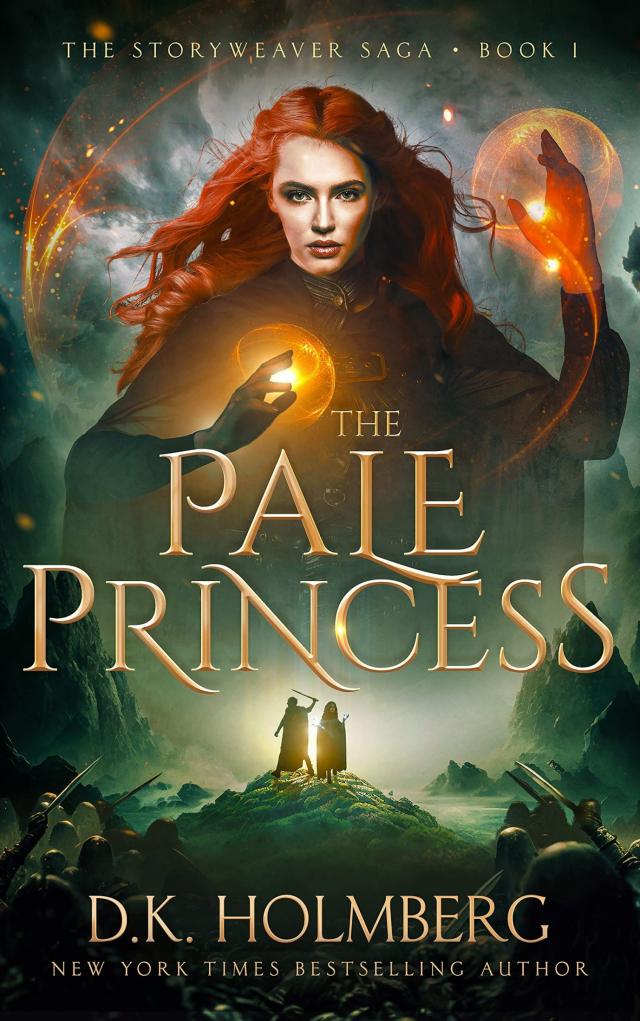


The Pale Princess
THE STORYWEAVER SAGA: BOOK 1
D.K. HOLMBERG
Contents
Chapter 1
Chapter 2
Chapter 3
Chapter 4
Chapter 5
Chapter 6
Chapter 7
Chapter 8
Chapter 9
Chapter 10
Chapter 11
Chapter 12
Chapter 13
Chapter 14
Chapter 15
Chapter 16
Chapter 17
Chapter 18
Chapter 19
Chapter 20
Chapter 21
Chapter 22
Chapter 23
Chapter 24
Chapter 25
Chapter 26
Chapter 27
Chapter 28
Chapter 29
Chapter 30
Chapter 31
Chapter 32
Chapter 33
Chapter 34
Chapter 35
Chapter 36
Chapter 37
Chapter 38
Chapter 39
Chapter 40
Chapter 41
Chapter 42
Chapter 43
Chapter 44
Chapter 45
Chapter 46
Chapter 47
Chapter 48
Chapter 49
Chapter 50
Chapter 51
Chapter 52
Chapter 53
Chapter 54
Chapter 55
Chapter 56
Author’s Note
Series by D.K. Holmberg
Chapter 1
LAN
Thunder rumbled through a cloudless sky. Lan Varison glanced up, expecting to see storm clouds rolling in, as they often did at this time of year, but only the bright sun sat overhead.
“That’s not thunder, you dolt.” Sophie elbowed him in the side, drawing his attention back to her.
Though she was younger, her elbow found its way to his ribs, and her deep blue eyes met his almost level. Then she swiveled back to the road, sending her brown hair swinging. A hint of a smile was on her lips.
“What is it, then?”
She elbowed him again. “It’s like you’ve never heard horses before.”
Lan stared along the road, looking for signs of horses, but saw nothing. Is she teasing me again? Sophie loved to joke, but he often didn’t understand her jokes. The way her cheek pulled back, twisting the small scar at the corner of her mouth, made it seem unlikely.
“What horses sound like that?” Lan asked.
She twisted her bright orange belt and lifted the end of the fabric to her mouth to chew on it. “Those do,” she whispered.
He squinted. A trail of dust rose along the road, rising into the sky like a cloud. It was faint, barely more than a haze, but she had still seen it.
“That’s from horses?” he asked.
“And a lot of them, from the sound.”
The thundering grew louder, to where Lan could feel it within him. It stirred the dust around him, turning it into something almost alive. Another moment passed, and he noted light glinting off metal.
Lan’s breath caught. Armor.
Something caught his eye even more. A trail of black ran through the armor of the nearest rider. Even without seeing the pattern, he recognized it. This close to the border, everyone in Narith would recognize it by reputation, almost as much as Lan and Sophie would recognize it from the stories Nana told them.
“That would be the Taihg. What are they doing here?” Lan had never seen the elite soldiers of Reyash, and he had never expected to see them this close to their village.
Sophie shot him an annoyed look. “The Taihg wouldn’t have any reason to come through here. The border is leagues away.”
The soldiers approached quickly, so Lan grabbed Sophie and pulled her away from the road. She resisted—she always resisted when he tried to tell her what she should do—but he maintained a firm grip.
They stood off to the side as the soldiers passed. Each soldier sat stiffly in his saddle, sunlight gleaming off the metal. Dark etchings along their chest plates created a familiar pattern that drew his eye, and it was even clearer that they were the Taihg. One of the soldiers glanced over as he passed, but he quickly dismissed them and turned his attention back to the road, heading toward the village.
“Why would they be riding toward Halith?” Sophie whispered.
“They probably aren’t.” Lan watched the riders. They shouldn’t even be here, but then, Narith was a small country with little for defense other than the natural protection formed by the difficult terrain of its borders.
There was something impressive about the way they rode—a ferocity. Some claimed they were gifted with magic, while others claimed the swords they used were enchanted. All recognized the Taihg were practically unstoppable.
Sophie rounded on Lan, placing her hands on her hips in a mimicry of their grandmother. Lan didn’t fear Sophie nearly as much as he did his grandmother. She was almost as intimidating as the Taihg.
“There’s only our village along the road, Lannerdon. Where else would they be traveling?”
He glared at her. “The village is along the road, but there are many other places beyond it that the Taihg would more likely visit.”
“I bet they’re going to Halith.” She started back along the road, forcing Lan to hurry after her to keep up. With her long strides, she made quick progress.
“You bet?” He arched a brow. “It sounds like you’ve been spending too much time with Lucan. I’m sure Nana would be thrilled to hear about—” He broke off as she elbowed him again, somehow managing to find a soft spot between his ribs.
“If you tell her anything, I might just have to talk to her about the way you sneak off into the forest and maim that poor tree.”
“You wouldn’t!”
She shrugged. “Don’t think you can keep your secrets hidden, Lannerdon,” she said, making a point of emphasizing his name even more this time. “I know where you keep that sword hidden, sneaking off with it each night. Where would you get a sword, anyway?”
Lan flushed. “I found it buried in Papa’s shed.”
She snorted. “Papa wouldn’t have a sword. He’s a farmer. Can you imagine Papa attempting to wield a sword?”
Lan shrugged. “There was a time early in the war when everyone had to fight, even farmers. They were called up to protect Narith on the chance that war spilled over its border.” Thankfully, it hadn’t. “Maybe it is from then. That was—”
“A while ago. I know the stories as well as you.” She looked toward the village in the distance.
From where they stood on the edge of the road, Lan could make out the tops of the nearest buildings, and he saw the trails of smoke rising from chimneys.
“That wasn’t what I was going to say,” Lan said. “That was back when our parents were still alive.”
Sophie’s face clouded. “They weren’t lost in the war.”
“They were. I know you don’t want to believe it, but they died—”
“Trying to get us to safety.”
“Because of the war.”
“You say it like they were fighting. They were running, like so many others. They weren’t like the Taihg. Had they been there…” She sniffed and fell silent, moisture gathering in her eyes.
Lan slipped his arm around her shoulders. “I’m sorry. I shouldn’t bring them up.”
She shrugged his arm off. “You always bring them up.”
“Trying to pretend they’re not gone doesn’t bring them back,” he said.
She glared at him again. “You don’t think I know that?”
Lan didn’t press. Sophie had always had a harder time dealing with the loss of their parents.
She walked along the road, and Lan followed her, staying quiet.
When they reached Halith, any hope that he might discover what had brought the Taihg through the village faded. There was no sign of the soldiers.
Lan stopped at the edge of the village, staring. Halith was large for a village, having grown over the last decade because of people moving away from the border, wanting to avoid the war, and away from the larger cities—those felt to be targets—for a quieter life. A safer life. It was what their parents had intended by bringing them back to their home village.
Halith was known for its weaving, though most of the village consisted of local craftsmen and farmers. Lan and Sophie’s grandmother led the weavers and had been attempting to teach Sophie, but when weaves didn’t go well, she would easily get frustrated and give up. Not Nana. She had incredible patience—at least with weaving. She would stick with the most complicated pattern, working through it until satisfied she had it exactly right. Lan was more like Nana, with her patience, than Papa and his tremendous strength.
“See?” Lan said. “They didn’t come to Halith.” Scanning through the village, he didn’t see any sign of the Taihg—no trail of dust and no reflection off metal. It was as if the soldiers had vanished. He tried to hide the disappointment on his face.
Sophie shifted her feet as she glanced at him, the small scar on her cheek twitching. “Lan… I’m sorry.”
He shrugged. The soldiers shouldn’t have been here, anyway. That they were suggested a kind of danger the village didn’t want. It meant the safety of Narith had changed. It meant the war was starting up again.
“I’m goin g to see where they might have gone,” Lan said.
As he turned, Sophie reached for his arm, and he pulled away quickly, not giving her a chance to stop him. He hurried through the village and didn’t turn to see if she followed. Lan doubted she would. When they argued—even over things as minor as this—she rarely bothered to stop him.
The village itself was quiet. It was midday, and the rush of the early morning had passed. The farmers would be working in their fields, trying to complete the harvest and prepare the land for the coming winter. Weavers, like his grandmother, would still be working through the day’s project. Others would nearly be through with activities for the day and be readying for the next.
Lan ignored the few familiar faces he encountered, avoiding the annoyed glares he received, typically from those who were close to his age. He and Sophie were given more freedom than most their age. Lan worked with his grandfather often enough, but he only needed so much help. Even though Lan would one day be expected to take over the farm, that wasn’t something Lan wanted for himself.
Even with its growth over the years, Halith only had one street running through it, the forest bordering one end and the open plains the other. As he got closer to the forest, the scent of sawdust overpowered the lingering smell of the sweet breads from the bakery and smoked meats at the butcher’s shop.
“Lannerdon? Is that you?”
He turned and smiled at Tenar Marlon, who’d been making his way along the road. The owner of the sawmill was an older man. His hands were twisted with age, and he had a milky sheen to his eyes, but he still had a sharp mind and ensured the trade for the lumber went in his favor.
“It’s Lan, Master Marlon.”
“Ah, you don’t need to call me Master anything. That is, unless you plan to take up my offer.”
Lan smiled at him. “I think Papa would be disappointed if I didn’t take over the farm.”
Marlon clapped him on the shoulder, squeezing him briefly. “A shame. You’ve got the size to do well for me. I think in time I could train you to run it.”
“Not Jarmas?” he asked with a smile. The sawmiller’s grandson was about the same age as Lan, though Lan and Jarmas hadn’t always gotten along, and he wasn’t all that reliable.
“Jarmas could work for you one day. You know how important the sawmill is to Halith.”
Lan had no idea what Halith would be without the sawmill. There were other industries, but none quite as valuable. “I know, Master Marlon.”
“Maybe Jarmas could take over Ilian’s farm.”
The idea of Jarmas working with Papa was too much for Lan to consider. “Papa wants the farm to stay in the family.”
Marlon waved his hand. “I think I might have to have a few words with him the next time we dice.”
“Is that all you do?” Lan asked, smiling.
“Maybe there’s ale to be drunk, but I would never share that with Persepha.”
Lan hid a grin. Nana knew quite well that Papa enjoyed sitting at the tavern and sharing ale with his friends, and she turned a blind eye to it. It was how he heard the gossip, the same as she did with the weavers.
“What are you doing in the village today?” What Lan really wanted was to know if Marlon had seen—or at least heard—anything about the Taihg.
“A meeting,” Marlon said, waving his hand again.
“What kind of meeting?” Lan could imagine him meeting with someone from the Taihg, but then why would they have met with the owner of the sawmill?
“Nothing very exciting, I’m afraid.”
“Have you seen—” He caught himself. Marlon was nearly blind, so he had probably not seen anything.
“You know I haven’t seen well for nearly ten years, Lan. I could use an escort back to the sawmill, if you don’t mind.”
Lan looked all around him before turning back to Marlon, nodding, and holding out his arm to the man. “Of course.” Papa would be disappointed if he didn’t.
“Good. Maybe by the time we get there, I’ll have you convinced to come work with me.”
Lan smiled, and they made pleasant conversation as they strolled through Halith. Every so often, Marlon would pause and speak to people they passed while Lan remained silent. Usually Marlon would recognize people long before they saw him, letting Lan know the man wasn’t nearly as blind as he made himself out to be. By the time they reached the sawmill, Lan had heard enough about the operation of the business that he thought he could step in and do it—which was likely what Marlon had wanted.
The sawmill was an enormous wooden building standing beside the Ulsa River, which flowed around the edge of Halith. The sawdust was thick enough that Lan coughed as they approached, and sounds of activity came from inside. For all the pressuring Marlon did, Lan had never been inside the sawmill.
“Well, I will be sure to let Ilian and Persepha know how you assisted me today. We’ll talk again soon, I’m sure.”
Lan nodded, and when Marlon disappeared into the side entrance of the sawmill, Lan continued toward the edge of the village, relieved to leave Marlon behind.
When he reached the edge of the forest, he heard rumbling coming from within. Lan peered through the shadows but couldn’t make anything out within them. The sound wasn’t like anything he’d ever heard before. Was it the Taihg returning? The rumble could be from their horses. Likely Sophie would know.
The sound came again.
The deep, heavy rumbling sounded something like an animal, but what kind of animal would make a sound like that?
“What are you doing?”
Lan jumped and saw Sophie watching him. “How long have you been there?”
She sniffed. “Long enough to see you staring into the forest. What are you doing?”
He turned his attention away from her and stared into the trees again. At the edge of the forest, they didn’t rise nearly as high as they did deeper in, but they were dense enough to make it difficult to see far in.
“I heard something,” Lan said.
“Why are you here?”
“I walked Master Marlon to the sawmill.”
“I bet he tried to get you to work for him again.”
Lan didn’t answer. Sophie loved to harass him, but he wouldn’t give her the pleasure of a response.
“What’d you hear?” she asked.
He shook his head. “I don’t know. It sounded something like an animal.”
Sophie pushed a strand of her brown hair back from her forehead and grinned at him. A dimple formed in the corner of one cheek when she did, a feature Nana often claimed was one of their mother’s. Lan had memories of their mother, but a dimple wasn’t part of them.
“You sound like an animal.” She pushed past him and headed into the forest.
“I don’t think that’s safe. If you’d heard what I did, you wouldn’t be going in there.”
She cast a glance over her shoulder, her mouth puckered in a smirk. “I know you wouldn’t. I would.”
“Darish take you, Sophie!” he swore, only earning another edge to her smirk. “What if there’s—”
“A boar. That’s likely all you heard. We’ve hunted them enough to know how to bring them down. Besides, Papa would love the meat. Are you afraid of a boar?”
Lan’s brow furrowed. “No.” The word came out sounding petulant. As the older brother, he wasn’t supposed to sound like that.
“Then come on. Let’s see what you heard. It’s probably nothing—”
The rumbling came again, this time much closer than before.
Sophie stiffened. “What was that?”
He grunted. “That was what I was telling you about. I don’t know what it is. I only know that it’s not a boar.”


