

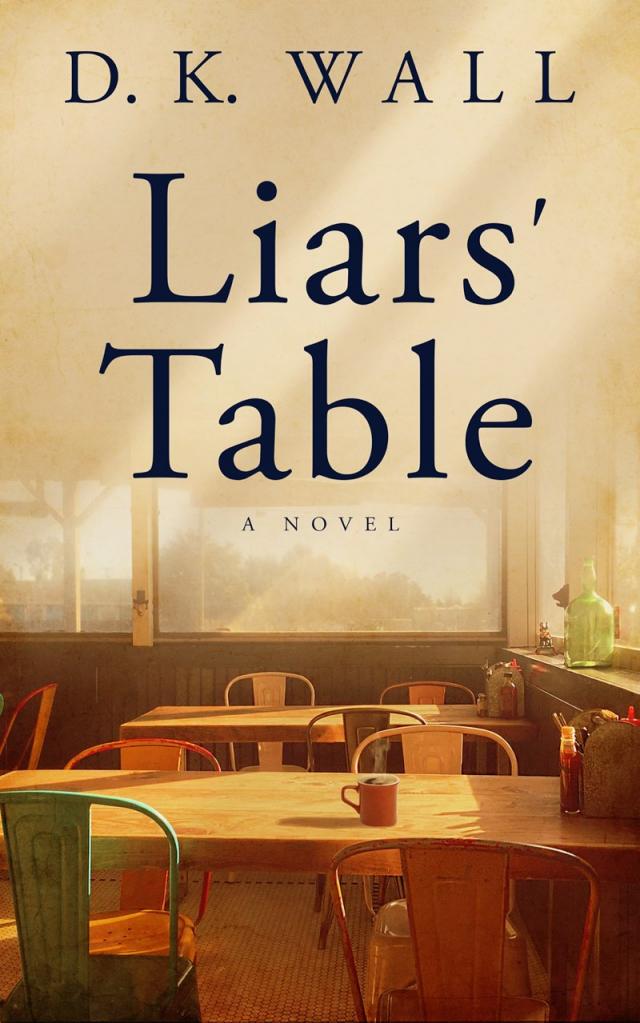
Liars table, p.3
Liars' Table, page 3


“I’m just asking, not accusing. You went to bed after me. Maybe you heard something. Saw something.”
“I don’t know a thing.”
Ever the peacemaker, Belle jogged over and nuzzled his leg. He squatted to scratch her neck. She flopped over on her back in her not-so-subtle hint for a belly rub. He obliged.
“You think it’s stolen?”
I looked at the bottom of my empty coffee cup. I really needed more caffeine. “What else could it be?”
“You going to call the sheriff?”
He no more wanted me to call the law than I did. I may have never felt the cold steel of handcuffs on my wrists like he had, but I still had my own disdain for cops. My experiences through Jessica and Wyatt told me all I needed to know.
Besides, I didn’t want a patrol car coming down our road, raising a cloud of dust and announcing its presence. We didn’t have many neighbors, but they would sure be entertained by a lawman’s visit. The rumor mill would fly, probably with speculation that Wyatt had gotten into trouble again.
“It’ll take them an hour to get a deputy out here. He’ll look around, type up a report on his computer, and leave. Not like he can dust the gravel for fingerprints. I’ll call them from Abe’s.”
“You don’t have to do that on my account. I’ll head into work before he gets here.”
“It’s not about that. I want to get into town.”
Wyatt stood, much to Belle’s disappointment. She pawed at his bare ankle to get his attention, but he ignored her.
“You could skip your breakfast club once. The world wouldn’t end.”
Rather than trying to defend my routine, I decided to use Wyatt’s challenging adjustment to our rural lifestyle. Being stuck at the house was his biggest nightmare, so I knew exactly what would get his agreement. “I don’t have a car. Too late for me to call C.J. for a ride, so if you don’t take me to town, I’m here all day.”
Belle, deducing no more attention was forthcoming, trotted up the steps to the porch. She waited by the screen door, casting an accusatory look in my direction to remind me it was breakfast time. I dutifully followed, calling over my shoulder, “Get dressed.”
“No one’s going to see me.”
“I see you, and that’s more than enough.” I let the screen door slam shut behind me.
5
Wyatt dropped me off at the faded Abe’s Market sign and raced off to work, late as usual. I walked past the old gas pumps—the kind without those fancy credit card readers that had to be turned on from inside with a wave if they knew you or a deposit if they didn’t—toward the low, white-framed building. From outside, the unassuming building didn’t look like much, but the bevy of vehicles parked out front hinted at its popularity.
Abe’s father had started the business as a full-service gas station before any of us were born. During his high school years, Abe worked part-time changing oil, pumping gas, and repairing cars. People who couldn’t afford the bills offered goods for barter—fresh produce from their gardens, canned goods of excess crops, butchered meats, and even moonshine brewed in illicit stills. The enterprising Morgans built display shelves and sold the goods—except the moonshine, which might have brought too much attention to their business—to the workers getting off shift from the factories at the industrial zone next door.
As the grocery business became more valuable than car repairs, the building was expanded. Coolers were added for milk, juice, soft drinks, and eventually beer—once legalized, alcohol replaced the old moonshine business. Metal shelving replaced the creaky wooden displays for the groceries, now brand-name products from big distributors alongside produce from local farmers.
A new garage was built behind the business. The old bays were converted to a simple butcher counter. Later, that morphed into the deli that now served breakfast and lunch six days a week. The retired old men who used to hang around the garage took over a table each morning, drinking coffee and telling stories. Abe, in his late sixties like me and the rest of the gang, pretended to still run the store, but the third generation of Morgans did the heavy lifting. Abe did little more than watch over his empire as we friends gathered for breakfast, news, and tall tales.
I pushed through the front door, sending the little bell jangling its alarm. With a quick wave to Colette—Abe’s daughter—behind the register, I stomped through the produce aisles to the deli in the back—run by Danny, Abe’s son—without even a good morning to anyone else. A dozen of us gathered for breakfast, and I was the last through the door. The others glanced up as I approached, but Abe was in the midst of his latest tale. They returned their attention to him.
“I fought him with everything I had, but nothing worked. He was the strongest one I’ve ever tangled with. An absolute beast. I know you don’t believe me, but he looked me right in the eyes and smiled. He wanted me to know he was winning.
“The longer the fight went, the more I struggled to stay upright. My arms burned. My hands tingled. My back screamed in agony. I was exhausted from the battle, and he seemed to gain more energy minute by minute. I was fading while he was growing stronger.
“I braced myself on the slippery rocks as best I could, but he had the advantage in the river. He reared back with a mighty yank, using every ounce of his massive size, and pulled me with the strength of a thousand mules. Go ahead and laugh if you want, but it’s true. My boots skidded on the wet boulders. Rather than find solid bottom, my right foot sank deep into a hole. Icy water flowed over the top of my hip waders and filled my boot. My foot grew numb, making it that much harder to keep standing. I lost my balance and found myself flailing about, fighting to keep my head above the surface.
“No ounce of mercy was coming from him. He took advantage of my weakness and pulled again, dragging me deeper into the river. My wedged leg twisted. The pain shot up my spine. If the bone snapped, the battle would be over. I’d pass out from the pain, and he’d pull me under that raging water. Drown me right there. My life flashed before my eyes, just like they say it will. I thought of my poor Martha over there as a widow. My kids orphaned and trying to run this store without me. All of you, my precious friends, sitting around this very table with tears in your eyes. Go ahead and scoff, but you guys would miss me something terrible. I realized I had only one choice if I wanted to get out of there alive. I had to let go.
“If I didn’t, I was going to meet my Maker. I wasn’t ready to leave this world. I begged the beast to give me a chance, just the slightest opportunity, and I would leave him be.
“He answered me. Don’t laugh, but I’m telling you he did. The most amazing thing I’ve seen in my sixty-eight years. That monster leapt out of the water. I don’t mean he broke the surface. He came way up high, his entire body above the rapids. A beautiful sight to behold.
“He was the biggest one I’ve ever seen. I swear he was this long…”
Abe’s hands hung frozen in midair, marking the length of the lucky fish that had escaped, much bigger than any fish the men around the table had ever caught. If I was a betting man—not that I was—I would say bigger than any fish Abe had ever brought home for Martha to clean and fry.
That was the point of a good story, wasn’t it? The fish that got away was always the biggest because no one could prove it wasn’t. We were entertaining each other, not trying to win any accuracy award. Every man at the table knew better than to let facts impede a good tale.
Abe was one of our best storytellers, if I was honest, which was a funny thing to try to be at the Liars’ Table. He was almost as good as C.J., not that we said that aloud since it was Abe’s place where we gathered.
Interrupting one of his better tales made my rude entrance even worse.
Abe fixed his glare on me. “Would you sit your butt down until I finish?”
On any normal day, I would’ve slunk over to my empty chair and waited quietly, but it had been anything but normal so far. I broke protocol and interrupted with my announcement. “Someone stole my car.”
The Liars’ Table had rules—not written or formalized by committee, but everyone seated knew them. Order breakfast, or at least coffee, from Danny behind the counter before settling into your seat. Throw money into the pile on the table at the end of the meal to cover your bill. If you’re short cash one day, make up for it when you can. Never sit in someone else’s chair. Don’t talk ill about another member at the table or their families, but anyone else in town was fair game. Banter was acceptable if you didn’t take it too far.
But changing the subject when someone commanded the attention of the group? That simply wasn’t allowed. I had violated the sacrament.
“What the hell are you talking about, Purvis?”
A sharp voice rang across the store. “Abe! Language.”
Most of our rules were self-inflicted and self-enforced, but Martha did not tolerate foul language inside the store. She stood in front of her display of flowers, which were picked fresh each morning from her garden at their house behind the garage and arranged neatly into bouquets. She proudly called it the “just because” section of the store, reminding all of us we should buy flowers for the women in our lives “just because,” not only on special occasions. We secretly referred to it as the “I screwed up” section, though none of us was brave enough to say it so she could hear.
Martha planted her fists on her hips and tipped her head toward their teenaged grandson stocking shelves. Luke’s face reddened at the attention as he tried to hide behind a tall shelf of canned goods. We knew he heard much worse at his middle school—probably said worse too—but we were smart enough not to contradict Martha. After decades of marriage, so was Abe. He turned his scowl back toward me, lowered his voice, and repeated his question sans profanity. “What are you talking about?”
Some men enjoyed being in the spotlight, regaling others with a fable. I’ve never been one of them. Most mornings, I sat quietly in my chair, bantering and laughing but rarely venturing onto center stage. As everyone’s eyes turned toward me, I dropped my gaze to my mud-caked, scuffed work boots. My red flannel shirt hung askew, misbuttoned and half-tucked in a pair of dirty Wrangler blue jeans. In my rush to come tell them what had happened, I hadn’t changed my clothes.
Sweat rolled down the side of my head and slipped under my gray-speckled beard. I ran my hands through my thinning hair, a nervous tic I tried to avoid since it left my hair standing in scattered directions, unruly and unbrushed, leaving me looking like some lunatic. I took a deep breath to calm my nerves. I wanted to explain, but all that came out under the pressure of their gazes was a repeat of my words. “Someone stole my car.”
A hush settled over the table as they absorbed the news of such a crime in our small town. A murmured debate broke out. Was this more proof the world was going to hell in a handbasket? Or maybe the opening gambit to another fantastic and entertaining tale? The consensus settled on the latter, signaled by Levi’s opening suggestion, his green eyes twinkling with mischief. “Maybe it was one of those Russian spies getting revenge for your CIA spy days.”
I’d never told them I’d been a spook back in my military days. Once the stories started, though, I’d never denied it either. That tidbit had developed over the years, and I didn’t object since it sounded more glamorous than the reality of a menial desk job. Now I was stuck with the lie even though I had never said it.
Tommy’s booming voice, shaped by years of coaching football at the local high school, carried from the end of the table. “Always thought it was quite clever for the agency to have one of its secret agents masquerade as a lowly airman in the air force. Who would ever suspect an enlisted man lived a life of intrigue?”
“I don’t think it was CIA.” Harlow pulled on his handlebar mustache, a trademark habit when he was deep in thought. “Since he was air force, maybe he really worked in Area 54 and the aliens got their revenge by beaming up his old car.”
Levi raised an eyebrow. “You mean Area 51, dingbat.”
Harlow crinkled his face in confusion. “I thought it was 54. You’re sure the aliens are at 51?”
“It was Studio 54 and Area 51.”
“There were aliens at Studio 54?”
Tommy rolled his eyes. “Have you seen photos of that place? They were definitely alien. Disco aliens.”
Abe grimaced. “Nitwits. It wasn’t aliens.” He paused until everyone looked at him. “It was Bigfoot that stole that car. After all, it wasn’t his first visit to Purvis’s house.”
They laughed at my expense until Levi quieted them with a vigorous head shake. “Be serious, guys. That bear could never have reached the pedals with his paws.”
I didn’t normally mind the joshing, though the Bigfoot / black bear thing was annoying. No man who lived his whole life in these mountains could admit to being scared by a simple black bear, but I had to let them believe that story. I’d never told them what had really transpired when I saw the mythical beast staring at me through my bedroom window. Sometimes letting something be, even if it was embarrassing, was easier than telling the truth.
Picking on each other was part of the camaraderie, and everyone spent time as a target, even if we had heard the jokes a hundred times before. Right now, though, I needed their attention. I locked eyes with my best friend, Cody Joe Duncan, who sat with his arms crossed at the far end of the table, and hoped he’d come to my rescue.
Everyone respected C.J. Not only did he tell the most riveting tales that could keep us in stitches, but he was also the biggest man in the group by far. His muscles may have sagged over the years, and his overalls might strain to contain his girth, but he could still menace with his bulk. He nodded at me, placed his hands on the table, and waited for quiet to descend. Once he had everyone’s attention, he turned back toward me and asked, “This isn’t some setup for a yarn, is it?”
The tension flowed out of my body for the first time since I’d discovered my missing car. In response to my nod, C.J. patted the empty chair beside him. “Sit. Let’s figure it out.”
With C.J.’s intervention, the tone at the table shifted. The jokes faded into mutterings.
“What’s this world coming to?”
“Kids today.”
“Millerton ain’t what it used to be.”
Every morning, we agreed civilization was crumbling, though the debate raged whether Russia, China or the Middle East, music or video games, or Republicans or Democrats were more to blame.
“Did you hear anything? Your dog bark?”
“That poor ol’ dog is deaf as a doornail. She snored through the night.”
In truth, I only heard her rattling when I got up in the middle of the night to pee, but I didn’t want to point that out. Someone might mention my car had been stolen from just outside my window, and I hadn’t heard anything either.
Levi picked at the biscuit crumbs on the paper wrapper in front of him. “Maybe your grandson borrowed it?”
My jaw clenched. I resented the question, partially because the same thought had flashed through my mind. I did my best to protect him from others, though, which was why I let a black bear take the blame for his Bigfoot stunt.
During Wyatt’s first fifteen years of life—time when neither of us had known the other existed—the boy gained many unsavory skills. He’d once picked the lock to my house when I’d left my keys inside and made it look so simple, I wondered why I bothered to lock it again. He’d hot-wired a tractor we needed to start and joked it was easier than doing it on a car, which implied he had personal experience with a car. So, yes, he had the talent to take my car, but in the five years since he’d moved to Millerton and lived under my roof, he’d lived a far more conventional life. After that first tumultuous year, at least.
“He has nothing to do with it.”
Levi sipped his coffee and settled the cup down on the Formica top. “Maybe one of his buddies. He hangs with a rough crowd.”
“Not anymore. After Jessica died…” I swallowed. Shelby had been better at talking about mother-daughter troubles and how she didn’t know about her grandson’s existence until he was fifteen. I didn’t like to share, even among friends. Those were private family matters, but sometimes I couldn’t avoid mentioning how Wyatt had been orphaned. “The people surrounding him before his mother died weren’t good, but his friends now aren’t like that.”
Levi held up his hands in surrender.
Abe poked at his scrambled eggs with his fork. “Don’t take this wrong, but why would someone steal your car? I mean, it’s kind of old and leaks oil and…”
Ronnie settled his coffee cup on the table. Tall and lean, he wore blue work pants and Red Wing boots. As the plant manager at one of the few remaining factories operating in town, he was the only person sitting around the table with a full-time job. Tommy still coached football at the high school, but we kidded him that the way the team played, he might as well be retired like the rest of us.
Once Ronnie had our attention, he said, “Maybe kids stole it just for the fun of it. Some young buck teenagers probably took that treasured car out for a joyride.”
A little hope rose in me as I traced a coffee ring on the table with my finger. “Yeah, maybe it’s just some kids funning around.”
“There’s some good news in that.”
“How so?”
Ronnie paused as all eyes turned toward him. A grin spread across his face. “Too embarrassing for their friends to see them in that old trap. They ditched the thing in the woods or some cornfield before sunup. Have to maintain their reps, after all.”
The men roared with laughter as my face burned. “Hardy har har. Y’all are too funny for words. That car is a classic.”
“A classic piece of…” Abe hesitated and glanced at Martha. She fired back a warning stare. Luke shook his head at the huddle of old men and pretended not to listen. Chastened, Abe lowered his voice. “Crap.”


