Agent josephine, p.1
Agent Josephine, page 1


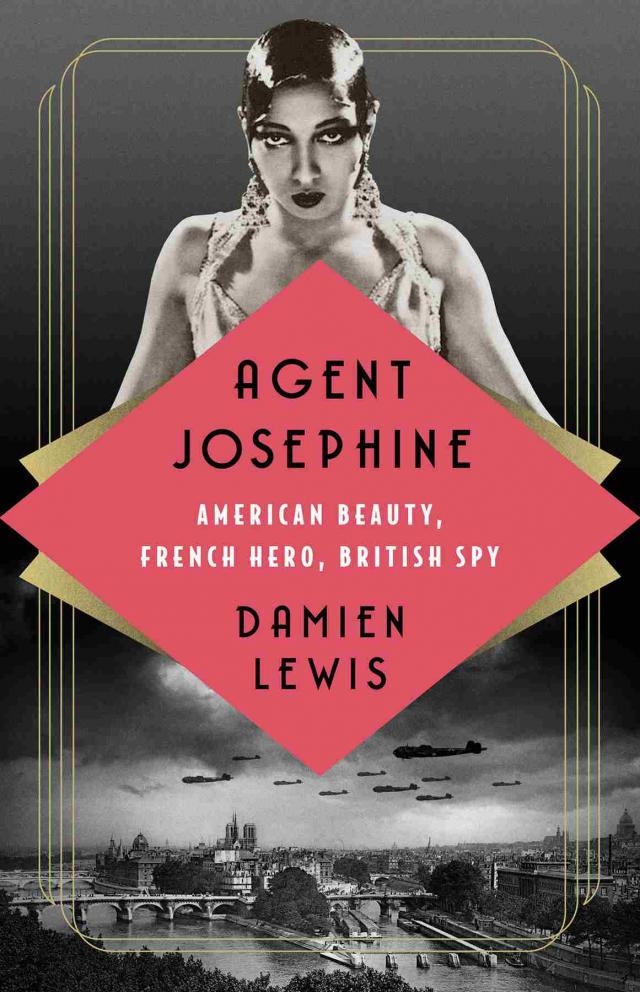
Copyright © 2022 by Damien Lewis
Cover design by Pete Garceau
Cover photographs: Josephine Backer © Cineclassico/Alamy Stock Photo, German bombers © Interfoto/Alamy Stock Photo, Paris © Historia/Shutterstock
Cover copyright © 2022 by Hachette Book Group, Inc.
Hachette Book Group supports the right to free expression and the value of copyright. The purpose of copyright is to encourage writers and artists to produce the creative works that enrich our culture.
The scanning, uploading, and distribution of this book without permission is a theft of the author’s intellectual property. If you would like permission to use material from the book (other than for review purposes), please contact permissions@hbgusa.com. Thank you for your support of the author’s rights.
PublicAffairs
Hachette Book Group
1290 Avenue of the Americas, New York, NY 10104
www.publicaffairsbooks.com
@Public_Affairs
Originally published in hardcover in Great Britain in 2022 by Quercus Editions Ltd
First US Edition: July 2022
Published by PublicAffairs, an imprint of Perseus Books, LLC, a subsidiary of Hachette Book Group, Inc. The PublicAffairs name and logo is a trademark of the Hachette Book Group.
The Hachette Speakers Bureau provides a wide range of authors for speaking events. To find out more, go to www.hachettespeakersbureau.com or call (866) 376-6591.
The publisher is not responsible for websites (or their content) that are not owned by the publisher.
Typeset by CC Book Production Ltd.
Picture credits in order of appearance:
1 – Studio Harcourt; 2, 18, 27, 28, 29 – Le Service Historique de la Défense; 3 – Paillole family; 4 – Bertrand-Hugues and Bernadette Abtey; 5, 26 – Brian Hammond; 6, 13, – Unknown, courtesy of J.P. Reggiori; 7 – Paris Match; 8 – Bundesarchiv; 9, 14, 22, 23, 24 – Public domain; 10 – Imperial War Museum; 11, 12 – Paul Biddle; 15 – Hulton Archive/Getty Images; 16 – Roger-Viollet; 17, 20, 36, 38 – Author’s collection; 19 – Philippe Verrier; 21 – Tango Images / Alamy Stock Photo; 25 – Renault Family Estate; 30 – Yorkshire Air Museum; 31 – Ullstein/Getty; 32 – Robert A. Schmuhl/United States Holocaust Memorial Museum; 33 – J.P. Reggiori; 34 – Prosthetic Head; 35 – Tim Spicer; 37 - Science History Images/Alamy Stock Photo
Library of Congress Control Number: 2022934998
ISBNs: 9781541700666 (hardcover), 9781541700680 (e-book)
E3-20220511-JV-NF-ORI
Contents
Cover
Title Page
Copyright
Dedication
Epigraph
Author’s Note
Preface
Chapter One: A Traitor Unmasked
Chapter Two: An Honourable Spy
Chapter Three: From Paris With Love
Chapter Four: A Most Sensational Woman
Chapter Five: The Darkness Descends
Chapter Six: It Can’t Always Be Caviar
Chapter Seven: The Enemy At The Gates
Chapter Eight: The Iron Resistance
Chapter Nine: Stardom, Her Cloak And Her Dagger
Chapter Ten: The Black Angel
Chapter Eleven: Invisible Ink And Secret Steamships
Chapter Twelve: On The Gestapo Hitlist
Chapter Thirteen: Abandon All Hope
Chapter Fourteen: Unbreakable
Chapter Fifteen: The Twelve Apostles
Chapter Sixteen: Dances With Death
Chapter Seventeen: Operation Josephine B
Chapter Eighteen: Operation Underworld
Chapter Nineteen: Captured, Imprisoned
Chapter Twenty: The Grim Reaper Calls
Chapter Twenty-one: Lighting The Torch
Chapter Twenty-two: Die Another Day
Chapter Twenty-three: Into The Heat And Dust
Chapter Twenty-four: Liberation Day
Chapter Twenty-five: A Song For Buchenwald
Epilogue
Photos
Acknowledgements
Discover More
About the Author
Also by Damien Lewis
A Note on Sources
Selected Bibliography
Sources
Notes
Association for the Defence and the Memory of Colonel Rémy
For my father, and for Lesley, for first taking me to the heart of the Josephine Baker story.
And for Peter Watson – gone but not forgotten.
Explore book giveaways, sneak peeks, deals, and more.
Tap here to learn more.
‘What is the use of living, if it be not to strive for noble causes and to make this muddled world a better place for those who live it after we are gone?’
Winston Churchill
‘More is achieved by love than hate.
Hate is the downfall of any race or nation.’
Josephine Baker
Author’s Note
The writing of this book has presented an unusual set of challenges, and mostly due to the secrecy that surrounded, and still surrounds, operations of the security services. In 1949, the main protagonist of this book, Josephine Baker, who was a special agent serving on espionage duties for the Allies during the Second World War, told her biographer, Marcel Sauvage, precious little about her wartime activities on behalf of the Allies, and very deliberately so. She rarely if ever spoke or wrote in detail about any of her wartime work, and went to her grave in 1975 taking many of those secrets with her.1
In 1975, the year of Josephine Baker’s death, Colonel Paul Paillole, her immediate chief at the Deuxième Bureau – basically, the French equivalent of the British Secret Intelligence Service (SIS) or the American CIA – published his own account of his war years, entitled Services Spéciaux 1935–1945. In The Author’s Introduction, Paillole explained why he came to take the decision to break the rigid code of secrecy, by which he still felt bound some three decades after the end of the Second World War, and which is defined by the saying that ‘What is secret should remain secret.’ He had chosen to do so to counter falsehoods that had arisen in the interim, while still acknowledging that much could not be written, and that the code of silence was one in which he still ardently believed and by which he was bound. As Paillole made clear, even after the thirty-year-rule had elapsed, any such public release of material still needed to be processed through the relevant French authorities.2
A few years earlier, the acclaimed French Resistance hero, Colonel Rémy – real name Gilbert Renault – who became a prominent author after the war, wrote his own account of Josephine Baker’s war and that of her Deuxième Bureau partner, Captain Jacques Abtey. It is entitled J.A.: Épisodes de la vie d’un agent du S.R. et du contre-espionnage français. In the introduction to that book, which is based upon extensive interviews with the key protagonists, Rémy explained how the aim of writing it was chiefly to honour Josephine Baker and her colleagues’ war effort. It was a homage chiefly to her – and Captain Abtey’s – wartime service. That a man of Colonel Rémy’s stature felt compelled to tell their wartime story reflects the importance and status it held, at least in Colonel Rémy’s eyes.3
However, Rémy also outlined how the constraints of secrecy binding French security service agents were far more stringent than what was expected of those who served in the French Resistance. In short, those waging the espionage war were privy to secrets of far greater sensitivity and longevity than those who had waged a guerrilla war to drive out the enemy. As Rémy explained, the war of the shadows – the espionage war – never ended, whereas the role of the Resistance was over once peace was declared. The sensitivities and the need for secrecy regarding the former endures. As a result, even in Rémy’s account some names, places, dates, and even the events portrayed had been suitably disguised. Much had been left out, due to issues of ongoing sensitivity and secrecy.4
In 1949, and again in 1967, Captain Abtey wrote accounts of his wartime service, the first book entitled La Guerre Secrète de Joséphine Baker, and the second, 2ème Bureau Contre Abwehr (which is co-authored with an Abwehr – German military intelligence – veteran of the Second World War). In the latter volume, Abtey writes of how the rules concerning French intelligence work require that any files concerning those operations are closed to the public for several decades at the very least. Indeed, some of the most important Second World War-era files concerning Captain Abtey and Josephine Baker’s wartime service were only released to the public in 2020, more than seventy-five years after the events they pertain to. As a point of note, the French government and the French security services should be applauded in deciding that files concerning the activities of their intelligence agencies can be released after appropriate time has elapsed. As far as I am aware, there are no such laws or practices concerning the equivalent British agencies, and few if any files, no matter their vintage, are ever released to the public.5
I also believe that the concept of ‘plausible deniability’ has been applied to some, if not all of the above accounts, as any number of the activities described therein – or indeed deliberately left out of some of the accounts – were on the very cusp of what was legal and sanctioned and acceptable, at least outside times of war. Needless to say, the war and the long and savage occupation of France pitted French men and French women against each other, and loyalties were often conflicted and opaque. The history of much of this remains sensitive, and often accounts were written with a view to not upsetting the status quo
Then there are the intricacies and layers of secrecy which attach to the wartime operations of special agents themselves. Rarely in reports submitted to military and political leaders are the sources of the intelligence made clear, only the reliability of those sources (I elaborate upon this further in the main body of this book). Moreover, during the Second World War agents of different Allied nations had a vested interest in claiming ownership of key war-winning intelligence as delivered to their taskmasters, regardless of its true genesis. As just one example, the 12 Apostles – the American Vice Consuls who were dispatched to French North Africa to spy on behalf of US President Roosevelt – hoovered up intelligence from a vast array of largely non-American sources, and took the lion’s share of the credit for having secured it. Josephine Baker was by then a French national, as were many of her special agent colleagues; the Polish spymaster codenamed Rygor was another key source for the Apostles.
As one final layer of intrigue, there is also a supposedly fictional account that deals in some depth with Josephine Baker and Jacques Abtey’s wartime service, but which is, by the author’s own admission, actually a true story in which he has had to disguise some names, dates and minor details. That extraordinary tale, written by Austrian author Johannes Mario Simmel, and called in English It Can’t Always Be Caviar, tells the wartime story of Hans Müssig, a German national, although Simmel uses the pseudonym ‘Thomas Lieven’ for Müssig in the book. Müssig, a fervent anti-Nazi, was a most unusual character. He was also something of a French intelligence agent and he proved a very useful and dynamic colleague for Jacques Abtey and Josephine Baker, one who refused to be hamstrung by tradition or convention.
Unpicking and sifting the fact from the fiction and identifying the deliberate obfuscations in the above accounts, and cross-referencing that with the wartime and post-war files and the plethora of other documents that have survived, has been a challenge. Very likely, I have not always reached the right conclusion, although I have endeavoured strenuously to do so. Nevertheless, I believe that the story as told in the following pages is as close to the truth as can ever be reached from the vast amount of often-contradictory material that is available. It remains the most credible, plausible and convincing account, one backed up by the most numerous and reliable sources.
There are sadly few survivors from the Second World War activities described in these pages. Throughout the decade spent researching and writing this book I have sought to be in contact with as many as possible, plus surviving family members of those who have passed away. If there are further witnesses to the stories told who are inclined to come forward, please do get in touch, as I will endeavour to include further recollections, where relevant, in future editions.
The time spent by Allied special agents operating far from friendly territory tended to be stressful and traumatic and wreathed in layers of secrecy, and many chose to take their stories to their graves. Memories tend to differ and apparently none more so than those concerning such work. The written accounts that do exist tend to differ, and locations and chronologies are sometimes contradictory. Nevertheless, I have endeavoured to provide an accurate sense of place and time. Where various accounts of a mission or an event appear to be particularly confused, the methodology I have used to determine where, when and how events took place is the ‘most likely’ scenario. If two or more testimonies or sources point to a particular time or place or sequence of events, I have opted to use that account. The dialogue used in the pages that follow is in all cases taken from either contemporaneous accounts, or from accounts written after the war by the individuals portrayed.
The above notwithstanding, any mistakes herein are entirely of my own making, and I would be happy to correct any in future editions. Likewise, while I have attempted to locate the copyright holders of the photos, sketches and other images, and of the written material quoted in this book, that has not always been straightforward or easy. Again, I would be happy to correct any errors or omissions in future editions.
Note: ‘Black girl.’ ‘Coloured.’ ‘Negro.’ ‘Wench.’ These and other terms in Agent Josephine may be found by readers today to be offensive, but they were the language used at the time. As this was the language used then, I have included such phraseology when quoting from the actual words used by the characters portrayed, or their writing, in an effort to relate this story as authentically as possible, remaining true to the time in which it took place. In doing so, I seek to reflect the realities of the age depicted and so as to avoid censoring history. We need to learn the vital lessons from the past. That being said, I have rendered the N-word as ‘n*****’, as readers may find it particularly troubling.
Preface
I like to think every book begins with a journey; a first step. This one has involved an exceptionally long and tortuous and at times challenging road. There are several reasons for this, and I go on to enumerate them in the section that follows, but much of it has to do with the fact that Josephine Baker and her fellow special agents operated wholly in the shadows during the Second World War, and in many ways they wished their wartime exploits to remain obfuscated thereafter. But for now, to start with, I’d like to tell the story of what first opened my eyes to Josephine Baker’s secret war – what set my feet firmly on the path.
My father and my stepmother, Lesley, live in France, in a beautiful medieval-era château that they purchased as a near-ruin with cattle still living in some of the buildings. Over the next several decades they renovated and restored it painstakingly – stone by stone, tile-by-tile and ornate carving by ornate carving. A labour of love. So ancient are the roots of the place, that some of the building-blocks have been reused from castles of an even greater vintage, from which medieval knights set forth to prosecute the Crusades. In some places, the huge stones boasting carvings of crucifixes or coats of arms or other heraldry have been reused in a somewhat haphazard fashion, for the building of this new – fifteenth-century! – château, such that they appear upside-down or skew-whiff, the writing or iconography seeming at first glance to be scrambled. A few of the carved building blocks even originate from the ruins of a Roman villa, and a bronze statue discovered in the grounds is now housed in the Louvre museum, in Paris.
Unsurprisingly, a love of châteaux – and of ancient history and of buildings of all types – runs deep in their blood. So it was that several years back they took a trip to the Dordogne and, among a number of visits to other historic sites, they decided to take a look around the Château des Milandes. Milandes – both the amazing, turreted château itself and the splendid gardens – is open to the public, and they went there expecting to enjoy a day immersed in the centuries-old history of the place, as expressed in the magic and majesty of limestone, slate, iron, oak and stained glass. They did indeed experience a day of magic and wonder, but not quite as they had anticipated.
Château des Milandes happened to be the wartime and post-war home of one of the most famous and highly paid female entertainers of the 1920s and ’30s, Josephine Baker. As a black American singer and dancer she had emigrated to France in the early 1920s, when still only nineteen years old, seeking fame and fortune. She would find it chiefly in Paris, from where she would become a global star of stage, screen and song. At first, in the early 1920s, she set Paris alight with her sexually charged, ‘exotic’, semi-naked dance routines, which both scandalised, provoked and captivated her audiences. But as the years progressed and her fame mushroomed – she was reputedly the most photographed woman in the world by the late 1920s – she matured into a singer, dancer and movie star with real gravitas. She gained superstar status and fabulous riches, and she was admired and courted by the wealthy, the famous and royalty alike. Just prior to the war she had made Château des Milandes her home, after Paris, and it has been preserved to this day as a fabulous memorial to her life and works.