Verbalize, p.1
Verbalize, page 1


Fascinating fiction starts with characters who make readers care. This Live Wire Writer Guide presents a simple, effective technique to sharpen your hook, charge your scenes, and amplify your voice whether you’re a beginner or an expert.
Most writing manuals skirt craft questions with gimmicks and quick fixes rather than plugging directly into your story’s power source. Energize your fiction and boost your career with
• a new characterization method that jumpstarts drafting, crafting, revising, and pitching.
• skill-builders to intensify language, stakes, and emotion for your readers.
• battle-tested solutions for common traps, crutches, and habits.
• a dynamic story-planning strategy effective for plotters and pantsers.
• ample examples and exercises to help you upgrade fiction in any genre.
Blast past overused tics and types with storycraft that busts your ruts and awes your audience. Whether you like to wing it or bring it, Verbalize offers a fresh set of user-friendly, language-based tools to populate your pages and lay the foundations of unforgettable genre fiction.
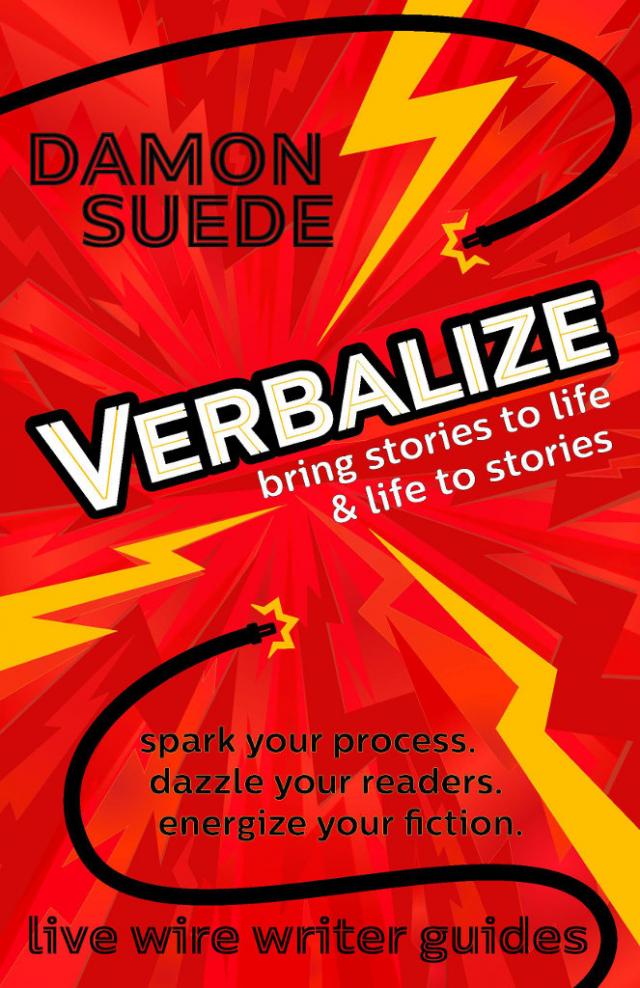
VERBALIZE
bring stories to life & life to stories
by Damon Suede
Verbalize: bring stories to life & life to stories (live wire writer guides) by Damon Suede.
Copyright © 2017 Evil Mastermind, LLC. Manufactured in the United States of America. All rights reserved. No part of this publication may be reproduced, distributed or transmitted in any form or by any electronic or mechanical means including information storage and retrieval systems without permission in writing from the publisher, except by a reviewer, who may quote brief passages in a review.
Published by Evil Mastermind, LLC
New York, NY
EvilMastermind.com
First Publication: 12 March 2018
Edited by Lynn West
Illustrations by Evil Mastermind, LLC
Book formatting by BB eBooks
ISBN 978-1-945043-02-4 (Ebook)
ISBN 978-1-945043-03-1 (Print)
Website: DamonSuede.com/livewire
Note: Chapters 7 and 8 include some material that first appeared in rough form as blog posts (“Add Verbs” and “Moving Target”) at Romance University.
Copyright © 2017 by Evil Mastermind, LLC, All Rights Reserved.
Contents
Cover
About the Book
Title Page
Copyright Page
Exercises
Introduction
Live Wire
Magpies
Part I: Wire
Chapter 1: SHOWBIZ
Practice
Impersonals
Significance
Chapter 2: DEVICES
Psych
Ride
Process
Chapter 3: ORDER
Alignment
Parts
Control
Part II: Fire
Chapter 4: VISION
Pattern
Leaps
Possibility
Chapter 5: MOJO
Contrast
Collision
Spark
Chapter 6: MAGIC
Predicament
Problem
Want
Part III: Action
Chapter 7: VERBS
Life
Source
Force
Chapter 8: OBJECTIVE
Transitivity
MacGuffins
Achievement
Chapter 9: MOTION
Range
Chain
Links
Part IV: Tactics
Chapter 10: FLOW
Shifts
Steps
Shelves
Chapter 11: OBJECTS
Target
Nature
Challenge
Chapter 12: BEATS
Trajectory
Direction
Transformation
Finale
About the Author
Appendix: Genre Examples
Pride and Prejudice Actions
The Lord of the Rings Actions
Notes
Bibliography
Character
Genre craft
Grammar & Language
Criticism
Acting & Performance
Neurology, Psychology, and Philosophy
Acknowledgments
Index
Exercises
Verbalization boosts every facet of the writing process. If you have a pressing issue in a certain craft area you want to tackle right away, use these drills and workouts to develop your skills. These exercises appear sequentially in the book and build on each other. They assume you have a basic handle on verbalization and can offer a quick fix for specific creative challenges if you’re stuck.
Character
• If your character details feel scattered, disconnected, or forgettable, get a handle on effective alignment via the Story Line exercise.
• If you cannot pinpoint any character’s essential action, check out the Dark Matters exercise.
• If you need to create an unforgettable character who writes their own story, amp your process with the Add Verbs exercise.
• If your character’s impact on their world or other characters feels disjointed, brew up some mojo with the Big Ripples exercise.
Depth
• If you struggle to access the kind of character complexity that supports intense emotions, dig into the Inner Space exercise.
• If you’re interested in unpacking more of a character’s power, potential, and paradoxes, investigate the Deep Dive exercise.
• If you have a scene that’s not popping for the characters participating in it, play around with the Monkey Wrench exercise.
• If you want to drill into your character’s layers in the most memorable, believable way, map out a strategy in the Book Self exercise.
Genre
• If you can’t meet and exceed genre expectations as a matter of course, take a look at the Trouble Maker exercise.
• If you’re curious about classic genre construction and want to push the envelope, splash around in the Fan Fave exercise.
• If you want to understand genre characters in any media, spend some quality time on the Couch Potato exercise.
• If you need a firmer handle on genre mechanics and distinctions, spend a little time with the Genre-flecting exercise.
Emotion
• If you struggle to access maximum drama and tension in every story moment, there’s real mojo in the Best Enemies exercise.
• If your story sometimes feels passive, aimless, or trapped inside your character’s head, check out the Trans Mission exercise.
• If the relationships between characters need a boost, build that chemistry with the Counter Action exercise.
• If you want to elicit more emotion in your readers, have a go at the Loaded Dice exercise.
Arc
• If you want a better handle on your character’s evolution over the course of the book via Goal/Motivation/Conflict, tackle the Hard Time exercise.
• If your character’s overarching story goal isn’t clear or camera-ready, find your focus with the Big Picture exercise.
• If you have an info-dump addiction or tend to deliver backstory in big slices of expo cake, charge your scenes with the Direct Object exercise.
• If you struggle to depict meaningful transformation and clear emotional growth, spend some time on the Arc Aid exercise.
Plot
• If your project lacks the kinds of memorable moments that dazzle genre fans, check out the Event Planning exercise.
• If coherent, compelling story structure eludes you, take a whack at the Prize Fight exercise.
• If your scenes ever get stuck in a narrative rut or predictable plateau, challenge your habits with the Page Directions exercise.
• If you want to structure your entire story in a robust format that’s useable for plotters and pantsers, invest time in the Grand Plan exercise.
Words
• If you tend to recycle character types and tropes from book to book, shake things up with the Strong Language exercise.
• If you struggle with low stakes or character inaction, you’ll probably benefit from the Amp Site exercise.
• If your story verbalization ever feels banal, flaccid, or clichéd, stretch beyond your comfort zone with the Booster Shot exercise.
• If you want to amp suspense, emotion, or surprise, bust the rut via the Turn Signal exercise.
Introduction
There is no one way to write a book.
In the pages that follow, I present an approach to genre writing that has paid my bills and won me acclaim for the better part of twenty-five years.
Why do some imaginary people move us, inspire us, and change the world? Why do audiences spend time with your book instead of any other kind of entertainment? Why do you write this story and not those others? How much mental real estate does your work deserve?
I always tell my students: The secret of life is paying attention. I repeat that sentence like a creative mantra. It applies to love, work, play, health, education, sports, religion, art, politics, business, and every other part of living worth mention. You name it: the root of success, the right answer, the smart move, the best solution always comes down to attention.
If you want to know what matters to people, notice where they invest their energy, focus their resources, and spend the
As authors, attention pushes us toward meaningful specificity. Out of all the words available, we look beyond just some words to the right words. Writers pay attention so that characters can pay attention, so that readers will pay attention. We verbalize.
Your mileage may vary, but the principles do not.
Readers engage with characters because as social primates we’re wired to identify patterns and extract meaning from our environment to figure out what matters. The core of any story is the emotional ride it offers an audience.
This book explains my technique for story development through characterization that
• applies to plotters or pantsers in any genre at any level.
• provides tools and tricks with dependable, delightful results.
• requires no special knowledge, style, technology, or work habits.
• draws on brain biology, performance, and classic literary principles.
• taps your unique voice and verbal gifts to tell the best story possible.
Most writing guides look at structure and character backward: they start with garnish and peter out before they get to the entrée. How many craft books simply repeat lessons they gleaned elsewhere, undigested and unexamined? In the pages that follow, I’m offering something else.
Language is literally the key…putting the right words in the right order for the right audience.
No matter your voice or vibe, verbalizing your story will help you get the right words on the page. This book offers a new pick for an old lock, a simple, practical technique developed over years entertaining audiences for a paycheck. Verbalization uses language to tell your story so you waste less effort and find the right words faster.
To date, my approach to character and story planning has proved useful for a wide swath of writers—newbies and experts, plotters and pantsers, authors and industry professionals—in every popular genre and media. Regardless of your experience or intent, the techniques in this book can transform the way you craft your pages.
In concrete terms, this book offers theory, examples, and practical exercises. Since our topic is fiction, the majority of my examples will come from popular genre novels. We’re going to tackle story and character with a method that is specific, flexible, and fun to implement. F’realz.
Verbalizing your work will help you
• brainstorm and gauge potential story ideas before you invest time and energy.
• populate your projects with the kinds of characters fans crave.
• drive action, anchor intimacy, spark dialogue, inspire humor, and amplify the emotional impact of any scene.
• structure narrative, steer your rough draft to completion, and guide the revision and editorial process.
• pinpoint problems, pitfalls, and dead ends before they derail a project.
• clarify your story’s hook, pitch, submission, and promo package.
Not to sound like a deranged infomercial, but I believe verbalization offers a storytelling Swiss Army knife that slices, dices, spices, splices, and entices the kind of fans who line up the night before and champion your work to millions of new readers.
After all, a plot is only as thrilling as the people who populate it. A story is inevitably the record of someone changed by their journey toward happiness.
What is a person? Who matters? Why are we alive? What is happiness and who deserves it? What is good or evil, right or wrong, kindness or cruelty, nature or nurture?
Storytelling is difficult to teach because it’s bound up in our beliefs about humanity, agency, responsibility, and duty. It pivots on issues of fate and free will, honor and compassion, reality and illusion. Sidestepping the big moral questions in favor of Band-Aids and blandishments may feel easier-faster-simpler, but it also reduces form to formula and character to caricature.
Instead, let’s focus on what matters: to build characters who move people, afford them the attention they deserve so that your readers will do the same.
Caring about your story is the way you unleash captivating characterization, brilliant plotting, hilarious comedy, devastating pathos, scintillating dialogue, breakneck reversals, incendiary love scenes, spectacular worldbuilding, fascinating specifics, staggering creativity, and overwhelming emotions that change minds and lives. In other words, the moment you stop caring, you should stop writing because your audience will stop reading.
Paying actual, authentic, absolute attention is how we fix problems, show affection, develop virtuosity, and make the world and our lives better. Where and how you pay attention tells the real tale of who and what and why you are.
Live Wire
Writing guides occupy a strange place on any shelf. On the one hand, no one can teach you to pump out a bestseller, but solid craft can accelerate and elevate that process. What works for 98% of authors may paint you into a corner. Your voice, your muse, your process may resemble what other folks are doing successfully…or not.
There are forms, but no formula.
Prescriptive writing manuals seem pretty goofy to me. How-to guides for writers can’t “solve” writing problems or calm a writer’s anxiety, but they can aim the writer’s efforts with more joy and precision. I present everything that follows as practical suggestions based on my creative and professional experience digging in the word mines.
Some writing lessons can be taught, but most must be caught. Consequently, I’m writing this guide to share my own storytelling process in the hopes it will inform yours pragmatically. None of us tackle storytelling the same way. What follows is only my process and shouldn’t be taken as writ or cant. No two writers face the same problems with the same talent or the same outcome; I don’t believe in rules, but tools.
When exploring craft and art, the only rubric worth your consideration is the most basic: Does it get results?
The Live Wire Writer Guides grew out of a series of popular workshops I offer to professional authors, playwrights, comic artists, game designers, and screenwriters. I’ve written full-time for more than twenty-five years, taught almost as long, and write these guides as a cross-section of the lessons that have lit my path. I’m kicking off with a book on verbalization because I think it’s the linchpin of all life-changing stories.
You don’t need divine grace or fairy dust to tell a story properly for profit. If those things turn up, groovy, but as a working genre fictioneer you need a technique that will get the job done, rain or shine. When I get stuck, I lean on craft, and often that takes the form of books that offer answers like this one. What’s been tried before? Can I find a better way? How did someone else untangle the knot I’m facing?
Writing is an art and a craft. Supernal fire may scorch the page every time you put letters and words together…but it may not. Tough. Every time you start a project, you pray for miracles and take what comes.
Art and craft work in concert. Ideally they turn up simultaneously, more often their attendance is lopsided, subject to your habits and inclinations. Deadlines and duty wait for no muse. Inspiration and lightning strikes are all well and good, but you can’t rely on the off-chance you’ll be “in the mood” when pages are due. You cannot build a career on moods and hope. Your craft is what keeps you moving forward until art shows up.
Origin
I came to fiction from film and theatre. My experience as a performer, director, and writer in showbiz has colored all of my subsequent professional life. Additionally, for twenty years I’ve taught literature in a well-funded Classics department, which gives me latitude to explore obscure subjects based on my whims and obsessions.