

I am full, p.1
I Am Full, page 1


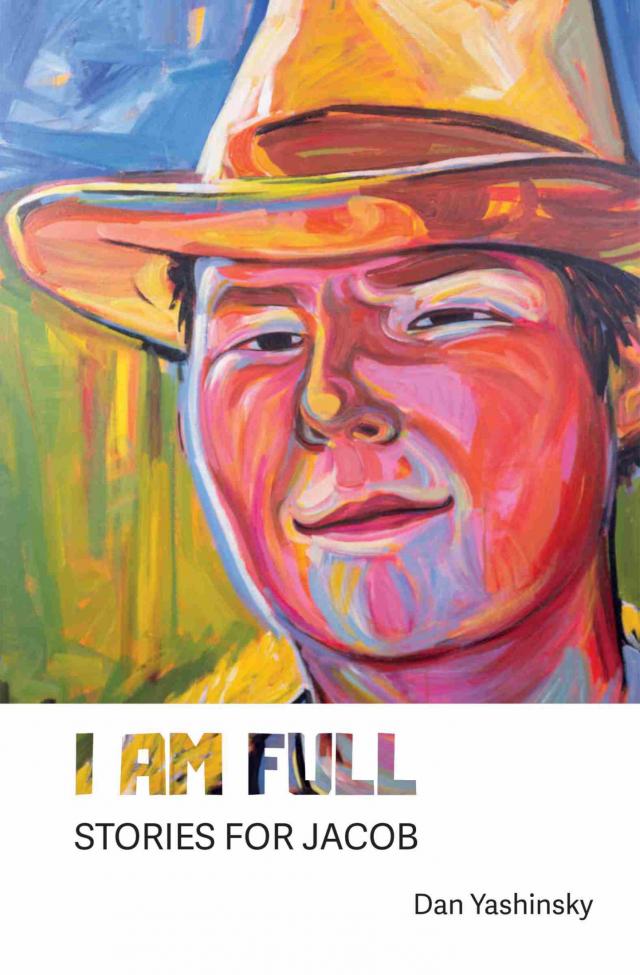
I Am Full
I Am Full
Stories for Jacob
Dan Yashinsky
© 2023, Dan Yashinsky
All rights reserved. No part of this book may be reproduced, for any reason, by any means, without the permission of the publisher.
Cover design by Doowah Design.
Cover image by Gabi Caruso, photo by Bernard Kelly.
This book was printed on Ancient Forest Friendly paper.
Printed and bound in Canada by Hignell Book Printing Inc.
We acknowledge the support of the Canada Council for the Arts and the Manitoba Arts Council for our publishing program.
Library and Archives Canada Cataloguing in Publication
Title: I am full : stories for Jacob / Dan Yashinsky.
Names: Yashinsky, Dan, author.
Identifiers: Canadiana (print) 20230526276 |
Canadiana (ebook) 20230526284 |
ISBN 9781773241272 (softcover) |
ISBN 9781773241289 (EPUB)
Subjects: LCSH: Yashinsky-Zavitz, Jacob—Fiction. |
LCGFT: Biographical fiction.
Classification: LCC PS8597.A85 I23 2023 |
DDC C818/.54—dc23
Signature Editions
P.O. Box 206, RPO Corydon, Winnipeg, Manitoba, R3M 3S7
www.signature-editions.com
For everyone living with Prader-Willi Syndrome, and all the people who love them.
“Your son Jacob is not an ordinary person.”
— Jacob, age 6, to his parents
Prologue
When our son Jacob was four he met a man at the corner of Vaughan Road and St. Clair Avenue West here in Toronto. The man had a tool belt and coveralls. Jacob looked him up and down, and asked: “What kind of man are you?” The man laughed, and said, “What kind of little boy are you?”
Jacob Evan Yashinsky-Zavitz had a brief twenty-six years to show us and the world what kind of man he was. He was generous, courtly, warm-hearted, compassionate. He had the gift of welcoming everyone, especially those who were, like him, physically and intellectually different. He had formidable patience when it mattered (good for fishing and pearl-knotting), a passion for beauty (good for jewellery-making and photography), a good head for patterns and games (he rarely lost at Scrabble or Settlers of Catan). He was a gifted poet, and an ardent boyfriend—especially if a date included Korean pancakes on Bloor Street, or sushi on St. Clair. He sold his pearl necklaces and earrings at craft shows across the city, schmoozing knowledgably with each customer. He used his hard-earned money to buy the finest fishing gear, and we have countless photos of surprised-looking, soon-to-be-released bass and pike to show how skilled he was on the water. He was the funniest person I’ve ever known, diving in and through language with exuberance and originality. And he lived his life with enormous courage, dealing every day with the intense, constant, demoralizing hunger—known as hyperphagia—that accompanies Prader-Willi Syndrome (PWS), a genetic condition affecting one in 15,000 people. We had never heard of it until he was diagnosed at the age of four. This is what we learned: According to the Ontario Prader-Willi Syndrome Association, PWS is the most common genetic cause of life-threatening obesity in children. People with Prader-Willi Syndrome have a problem in their hypothalamus, a part of the brain that normally controls feelings of fullness or hunger. As a result, they never feel full and have a constant urge to eat that they cannot control. Most cases of Prader-Willi syndrome result from a spontaneous genetic error in genes on chromosome 15 that occurs at conception. In very rare cases, the mutation is inherited.
Despite the daily challenges of this disability (I think of it as being “dys-labelled” instead of disabled), Jacob’s natural wit, sheer heart, and abundance of spirit helped him create, with the love of his family and friends and a circle of great support workers, a beautiful life. When he was six-and-a-half years old, he said to me, “Could you get me paper? I’m going to write about superheroes!” Jacob was and is the closest thing to a superhero I’ve ever known.
It was July 2, 2018. We were coming back from a great weekend in Montreal. Jacob and his best friend Effie had spent their time taking photos, sipping beers on patios, eating extravagant desserts (a very infrequent experience for someone with PWS), and generally having a wonderful time. My close friend Michael Pestel had come up from Connecticut to perform with me—I’m a storyteller and he’s a musician and sculptor—and to enjoy the city. It was the hottest weekend in a hundred years, and our bed-and-breakfast on St. Laurent was broiling. None of us slept much the night before the trip home. Jacob, Effie, and I set out on the drive down the 401 to Toronto. He ate a Cuban sandwich I’d found at a little place in the Plateau neighbourhood where we were staying, and he told me how delicious it was. Then he said, “I am full!”—a very rare statement coming from him—and fell asleep. Effie was dozing in the back seat. The air conditioning wasn’t working well, and the car was steamy, and I was glad to see there was a service station a few kilometres ahead. I’d pull over and have a little nap, I thought. I didn’t want to open the window or turn on the radio because I didn’t want to wake them up. I knew I was tired, but surely I wasn’t that tired. I was daydreaming about the cottage Jacob and I were planning to go to in two days for our annual fishing expedition. Then I fell asleep. The car ran off the road and flipped in the air. When it stopped turning and bouncing, it was resting with the driver’s side down. Effie told me afterwards she felt the spirit of her late father protecting her in the back seat. But Jacob was held in a position where the weight of his body was pressing against his heart. The trauma doctor who treated him when he was airlifted to Ottawa Civic Hospital told us this is what cut off the oxygen to his brain. The people who stopped on the highway to help us called the police, and we could even hear the sirens of the ambulance racing towards us as I held him in my arms and he lost consciousness. They arrived a minute too late. He didn’t wake up again. Jacob stayed alive for eight more days, and his mother and brother were able to come to Ottawa to keep a loving vigil, and to tell him how much we loved him, and to finally say goodbye.
We never imagine that we may become, through terminal illness or unspeakable accident, the legacy-bearers for our own children. And then the unimaginable happens and we are still somehow here and our child is gone and all that’s left are stories. “A person is not dead unless they have been forgotten,” says the old West African proverb. And so we become the storykeepers for our lost beloveds, because who else can be? When Jacob died I sought out other parents who’d lost their sons and daughters. They became my informal bereavement group. Incredibly to me, each mourner somehow found their own way to continue living. And not just living: holding jobs, working to do good in the world, volunteering, making music and art, continuing to love their other children and grandchildren, supporting their partners and community, helping other bereaved parents, keeping the stories of their loved ones alive.
We are all, ultimately, each other’s storykeepers. I learned about the value of storykeeping when I worked for five years as the storyteller-in-residence at Baycrest Centre, a geriatric hospital and long-term care centre in Toronto. My work at Baycrest involved sharing stories with psychiatry and palliative care patients, as well as people living with degrees of dementia. I did as much listening as telling, of course, and learned firsthand about the impact of such “storycare” on the people I met there. I hope that one day storycare will be recognized as an essential part of healthcare, especially when the people being cared for have lost—through death or illness—the ability to tell their own stories. At that point, we must become the storykeepers for our loved ones, ensuring that their memories, stories, and identities stay alive.
I started writing this chronicle about six months after Jacob’s death, trying to find a way to remember, to grieve, perhaps to find a shred of meaning in this unspeakable loss. It was sparked when I was swimming—because, yes, one somehow tries to carry on, even while living in the ruins of grief—at Joseph J. Piccininni pool, the very pool where Jacob first learned to swim. I passed the waterslide and remembered how, age three, he’d come squealing down at high speed into my father’s waiting arms. I began to imagine how he might tell me about those thrilling slides, and about how, as he was leaving us behind at the trauma centre so many years later, his grandfather Jack was still waiting to catch him and welcome him. With his imagined voice as my guide, I began to gather and create the texts that make up this requiem.
I’ve always kept a journal, and recorded many of our sons’ adventures and misadventures. I kept track of all the bons mots they spoke, and all of the silly things they mis-spoke. Jacob, like his brother, had a great gift of language, and many of his unforgettable expressions found their way into this book. You’ll also read a lot of his own writing, including a funny, moving keynote speech he gave at a Prader-Willi Syndrome fundraiser in Guelph, Ontario, two months before his death. As someone living with PWS, he faced tremendous physical and mental/emotional obstacles growing up, especially in adolescence. He dealt with psychosis, hard-to-control weight gain, social isolation, Fournier’s gangrene (successfully treated), his parents’ separation, Type 2 diabetes, and the destabilizing, unrelenting hunger that is part of the syndrome. Even though he brought immense courage to these struggles, they were, at times, overwhelming. It was in his last three years that he found peace, success, responsibility, balance, friendship, stability, and a blessed job working for the Toronto Police as a crossing guard. Though you will learn about the really hard st
At Jacob’s funeral his brother, Nathaniel, said something I’ve held on to in a heart-crushing time: love continues to exist in the world, even though his little brother has gone to be with his ancestors. Somehow, love remains.
A year after Jacob died, I did a reading of some of these stories at Itah Sadu’s bookstore A Different Book List. She is another one of Jacob’s many unofficial aunties. The occasion was an exhibit by our housemate and close friend Bernard Kelly featuring portraits of people wearing fedoras from Jacob’s impressive collection. Jaron Freeman-Fox played fiddle, Moyo Mutamba played mbira, and we laughed and cried and remembered together. Afterwards, Nathaniel told me the stories should be published so more people could learn about his extraordinary little brother. My older son is my go-to wise person, so I took his advice. He reminded me that Jacob’s early death is the least interesting thing about him. How he lived, the kind of man he became, is what matters, and what this book celebrates.
Two years after Jacob died, our friend Ron Evans led a ceremony in our back yard. Ron is a Metis Elder, storyteller, and tradition-keeper. He was one of Jacob’s uncles, if not by blood then surely by spirit. Ron lit a fire, burned tobacco, sang honour songs, spoke of how grateful we were for having such a great soul in our lives. We burned offerings of Jacob’s favourite foods (there were many, as you can guess by now) and, best of all, we told stories about him. Perhaps this book is a continuation of that ceremony, a thank-you offering made of loving words instead of carrot cake, apple pie, Jamaican roti, and Korean seafood pancakes. Ron and his partner came to live with me for a few months after Jacob died, knowing in their wisdom how much I needed a strong island in the storm of grief. When he came, he told me of a vision he’d had when he first heard about the accident—a vision of Jacob being carried gently and slowly away on the back of a great female turtle—and how that was when he knew Jacob would not survive. This vision, with Ron’s permission, is near the end of the book.
Despite the tragic roots of this book, I hope that some of Jacob’s astonishing wit and high spirits come through, and that you can laugh (and cry), and especially that they make you want to remember your own loved ones. It was written as a way to keep his stories alive and present, and also to encourage others to become storykeepers for your own lost beloveds.
So here is Jacob, wearing some of his many hats: as son, brother, grandson, friend, photographer, boyfriend, poet, crossing guard, dog owner, person living with a disability, advocate for all of our people who live with difference, fisher, joke-teller, jewellery-maker, St. Clair West boulevardier, collector of fedoras (and much else), games master, mensch.
I know so many things about myself that I don’t actually remember but they feel real to me because I’ve heard the stories so often. I know that when I am born I almost die. I have an APGAR score of two. I am in the neonatal intensive care unit at the Hospital for Sick Children. No one knows what’s wrong with me, and the doctors don’t expect me to live. The night I am born my dad runs alongside the transfer team nurses from Toronto General to Sick Kids, and when he gets to the neonatal intensive care unit he faints. He has a vision of a procession of people carrying torches and singing in the darkness, and is so surprised that their songs were so full of joy. My mom and dad stay with me all the time. They call me their “Star Boy.” They tell me that if I stick around I will come home to a nice house in a nice neighbourhood. My big brother keeps painting red flowers to tape over my crib. My dad tells me stories and reads aloud and my parents tell me that’s because they didn’t want my first words to be “beep beep beep.” I am too weak to cry but one day when my dad and Grandpa Jack hold me in a basin for my first bath, I manage to give out a little cry. Everyone jumps for joy. My great-grandmother Florence says I am fighting so hard to stay alive because I have a purpose in life. It takes me a long time to get strong enough to crawl and strong enough to walk. But I slowly become able to do all of these things. The doctor tells my parents, just before they bring me home, “sometimes the things we don’t understand clear up by themselves.”
The day we come home, the Italian neighbours bring over a crostata cake. Lillian, who made the cake, carries her own death certificate because when she was born she was so weak and tiny the doctors thought she was going to die. They wrote her death certificate. Then her dad brought her back to their farm and heated up stones and put her in the middle as if she was a sick calf. She lived, but she still carries her death certificate.
My dad says that sitting by my crib in the NICU and telling me stories he felt like an air traffic controller talking to a frightened passenger who takes the controls if the pilot gets sick, teaching them to fly and land a plane they’ve never flown before. He says he felt like he was talking me in, trying to convince me it is a good world to be born into, one where I will find warmth and love and beauty. And I do choose to stay and the world does have all of those things.
I am two and a half and already big and my dad and brother are sitting together on the floor and they brace themselves and shout, “Boiled egg!” And I am charging into them and we all fall backwards laughing. They never tell me why they shout “Boiled egg!”, and I’m not sure I ever asked. Again and again and again, laughing together as I crash into them knowing they will catch me and they always do.
I’m in the bathtub surrounded by bubbles. I’m two and a half. I scoop up them up in both hands and then they start talking to each other. My dad sometimes sits on the edge of the tub when I’m in the bath or even when I’m sitting on the toilet. He makes his hands into fists and they become two old Chinese gentlemen: Mister Hung and Mister Fang. They have long conversations while I’m sitting there. They bow to each other a lot and speak in a very polite and courtly manner. “Ah, Mister Fang, it is so very good to see you again!” “Yes, Mister Hung, it is my exceedingly great pleasure to encounter you here in Jacob’s bathtub.”
I am three years old and my mom and dad are singing:
Salome was a dancer
She danced the hootchy-cootch
She shook her shimmy shoulder
And she showed a bit too much
“Stop!” said King Herod
“You can’t do that there ’ere!”
Salome said, “Baloney!”
And she kicked him in the rear.
It’s usually after my bath, and as they sing I shake my bare shoulders, and they laugh. I don’t know what “shimmy” means, but I somehow know how to do it.
When I am four years old I’m running in the front door in the evening and I trip and fall face-first onto the banister leading up to our apartment. There’s blood everywhere. My dad picks me up and my mom and dad and I hurry down to St. Clair and go to the walk-in clinic. The Chinese doctor says I need stitches and my dad asks if he’s good at stitches because he’ll be doing it on my face, and the doctor says he’s good at stitching. They hold me down and give me painkiller with a needle and they start doing the stitches. My mom is holding down my legs and my dad is holding my head. Halfway through the stitches I manage to move my mouth and say, “I hate you, doctor! You’re a bum!” And then everyone starts laughing and it doesn’t hurt as much, and from then on that becomes something we all say when things go wrong. My parents always say something they heard before I was born, when a French mom in a Paris garden had a baby who was crying and crying. She said: “Ah cheri, la vie est plein d’emmerdements.” Life is full of little shittinesses.


