

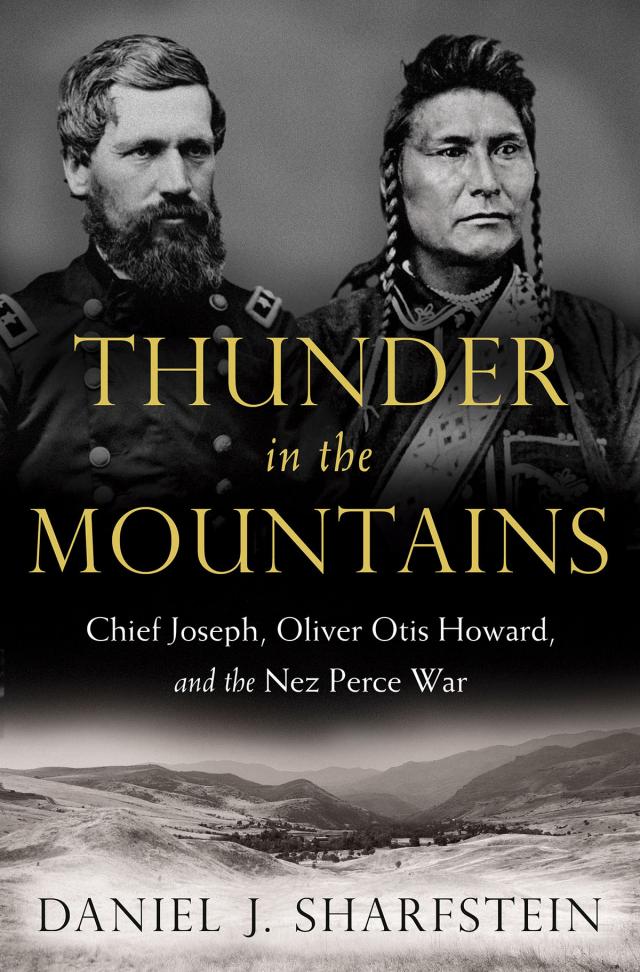
Thunder in the mountains, p.1
Thunder in the Mountains, page 1


For Ann, Saul, and Abe
CONTENTS
_______
AUTHOR’S NOTE
OVERVIEW MAPS
PROLOGUE: THE DREAMERS
PART I
CHAPTER 1:A Willing Exile
CHAPTER 2:New Beginnings
CHAPTER 3:Quite Good Friends
CHAPTER 4:Winding Waters
CHAPTER 5:The Wilderness of American Power
CHAPTER 6:Adonis in Blue
CHAPTER 7:Wind Blowing
CHAPTER 8:A Sharp-Sighted Heart
PART II
CHAPTER 9:Aloft
CHAPTER 10:Split Rocks
CHAPTER 11:Fait Accompli
CHAPTER 12:A Perfect Panic
CHAPTER 13:Death in Ghastly Forms
CHAPTER 14:Bullets Singing Like Bees
CHAPTER 15:Heart of the Monster
CHAPTER 16:Lightning All Around
CHAPTER 17:Fury
CHAPTER 18:A World of Our Own
CHAPTER 19:Through the Veil
CHAPTER 20:Where the Sun Now Stands
PART III
CHAPTER 21:The Best Indian
CHAPTER 22:Red Moon
CHAPTER 23:A Glorious Era
CHAPTER 24:Swing Low
EPILOGUE: ACTS OF REMEMBERING
BATTLE MAPS
ACKNOWLEDGMENTS
NOTES
ILLUSTRATION CREDITS
INDEX
It is natural . . . to wish to fight. We have always fought our enemies. We now engage in the biggest fight of all—the fight for our survival. If we must do it without weapons, so be it.
—JAMES WELCH, Fools Crow
The new men of Empire are the ones who believe in fresh starts, new chapters, clean pages; I struggle on with the old story, hoping that before it is finished it will reveal to me why it was that I thought it worth the trouble.
—J. M. COETZEE, Waiting for the Barbarians
AUTHOR’S NOTE
_______
IN 1865, THE UNITED STATES WAS A BEACON OF LIBERTY AND equality to the world. It had fought a war to abolish human bondage, and Congress was committing to a reconstruction of the South that would enable millions of people who had been held as slaves to claim the rights and privileges of citizenship. The values that constituted the nation had new strength and clarity, animated by a government with an unprecedented capacity to make those values meaningful for every American.
Just thirty-five years later, in 1900, the possibilities of the prior generation had given way to an entirely different consensus. The government at every level was engaged in a vast project of sifting and sorting, of guarding the boundaries of unyielding hereditary privilege. Much of the country was consumed with separating the races—black, white, yellow, red, brown. This segregation was not simply physical or geographical. Citizenship itself was divided and tiered. Being an American had no unified meaning. The very course of a life—whether one could expect to survive infancy, go to school, learn to read, earn a living, and avoid arbitrary arrest, coerced labor, and sudden and violent death—depended on whether one was white or of color, man or woman, rich or poor, native or foreign born. The country’s physical borders had become less places of entry than of exclusion, where the nation’s integrity—often explicitly defined as its white purity—was guarded, secured, and maintained. At the same time, the United States transformed itself into an imperial power conquering territories from San Juan to Manila, driven by ideas of the white man’s burden and a hard, racialized sense of manifest destiny.
The nation’s pivot from emancipation to Jim Crow and empire set the terms for more than a century of conflict over the contours and substance of citizenship and the proper size, scope, and purpose of government. Like other stories central to the American experience, it can be told in many ways. We can conceive of it as the defeat of Reconstruction and the triumph of the forces opposing it, the promise of the 1860s curdling in the economic depression of the 1870s, the North’s commitment to liberty and equality eclipsed by its own fears and hatreds, as immigrants remade the cities and workers engaged in increasingly bitter struggles against newly mechanized industries controlled by vast corporations. Or we can imagine the transformation occurring at the end of the nineteenth century as less a rejection than an extension of Reconstruction, a national project that above all succeeded in expanding the size and reach of the federal government.
One path from emancipation to empire went through the West. While the Union Army was crushing the Confederacy, soldiers in blue uniforms were massacring Native Americans from Colorado to California and developing elaborate justifications for the bloodshed. In the decades that followed, the West became a proving ground for conquest, the site of a massive exercise of state power to benefit one group at the expense of others. Understanding how a nation forged by Civil War and Reconstruction came to see the West—and how some of the same people who fought for one vision of America became the architects of a seemingly antithetical vision—is crucial to understanding the divisions that define modern America.
Thunder in the Mountains tells a story of the turn in American values and the clash over the nature of government through the lives and battles of two people, a general named Oliver Otis Howard and Chief Joseph, a leader of a band of Nez Perce Indians in the Far Northwest. It explores their continuing legacy through the stories of two men who were intent on remembering them both, a lieutenant named Charles Erskine Scott Wood and a Nez Perce warrior named Yellow Wolf. General Howard and Chief Joseph came from opposite sides of the country, worshipped competing gods, and saw the world—time, space, and history—through different eyes. But after their paths intersected in the mid-1870s, together they came to embody some of the defining struggles of the American experience. Their ideas and actions inspired generations of people to consider who belongs in America, what belonging should mean, and how liberty, equality, and citizenship can assume meaningful forms alongside a government capable of exerting total control over individuals. Their story plumbs the nature of political struggle in the United States and the ability of outsiders and dissenting voices to speak to and move sources of power that can seem remote and impossibly large, omnipresent yet invisible. In many ways we continue to live in their world.
General Howard emerged from the Civil War to play a key role in Reconstruction. As head of the Freedmen’s Bureau, the first big federal social welfare agency in American history, he led the government’s efforts to support and protect millions of newly freed people; Howard University was named for him. As Reconstruction collapsed, he rejoined the active duty military and was sent to command army forces in the Northwest. Although the nation’s values were changing, Howard was determined to stay in government and represent its shifting interests. He did not see his actions in the West as a betrayal of Reconstruction, but he was marked by Reconstruction’s failures as much as its successes.
Out west, Howard’s most formidable adversary was Joseph, a young leader who took it upon himself to convince the government to let his people keep their ancestral land. In the 1870s, very few Native Americans were regarded as citizens of the United States. They could neither vote nor bring suits in court. While most Americans were governed primarily by the laws of the individual states in which they lived, most Indians were subject to the plenary power—the full, unadulterated might—of the federal government. As a result, when Joseph argued for his land, he had to figure out how his arguments about liberty and equality and property rights—in essence, his people’s capacity for citizenship—could reach a government thousands of miles away.
In the summer of 1877, Howard commanded US forces in a small, brutal war against several Nez Perce bands, including Joseph’s, that had resisted moving onto a reservation. From the canyon country of north-central Idaho through the peaks and valleys of Montana and Wyoming and up to the Canadian border, Howard led a column of infantry and cavalry and sent orders to other columns of soldiers by telegraph. The people he called the “hostiles” were not simply an enemy military force. Rather, the vast majority of his foes were full families, men, women, children, and the elderly. Joseph was not a war chief; he spent most of his time among noncombatants. Through murders, massacres, and harrowing battles fought across some of the roughest and most remote terrain in the nation, Joseph’s war was less a series of military tactics than a cruel lesson on what the government could do to Americans as they tried to live the lives they wanted.
In the years to come, Howard wrote hundreds of pages about the Nez Perce War, and Joseph was widely celebrated, his words recited by schoolchildren, his speeches adapted into poetry. As the nineteenth century gave way to the twentieth, Joseph’s critique of what America had become worked its way into a new set of ideas that tried to resurrect government’s role as a force for equality while at the same time recognizing civil rights and civil liberties as sharp limits on its power and glorifying personal freedom over any single public morality. From one generation to the next, Joseph’s people kept his memory and the memory of the Nez Perce War alive, recognizing the sustaining power of words, how the stories we tell constitute the ways we live and how others let us live.
Thunder in the Mountains attempts to tell Joseph and Howard’s story—the story of their world—through the eyes of the people living in it. It recognizes that even as politics, ideas, economics, and law may transcend any one individual or place, the currents of history are filtered through personal experience, through the routines of everyday life and the ritu
THUNDER
IN THE
MOUNTAINS
PROLOGUE:
THE DREAMERS
___________
BATTLE OF FAIR OAKS—
SEVEN PINES, VIRGINIA,
JUNE 1, 1862
_______
BULLETS CRACKED AND SPLINTERED THE TREES OVERHEAD AS Oliver Otis Howard readied his men to fight. They gathered along railroad tracks that crossed their position, a rare straight line cutting through dense forest and deep mud ten miles east of Richmond. Howard’s New York volunteers—two regiments, about three thousand men—had never been under fire, so he resolved that he and his younger brother and aide-de-camp Charles would take the lead on horseback. The brigadier general mounted his brown horse, only to have it shot from under him within seconds. To keep the soldiers from running away, he screamed for them to drop to the ground. A few minutes later, he rose atop his second animal, large and gray, and shouted, “Forward! March!” Howard was short and thin, his fine features and sharp blue eyes blunted by a long black beard. His voice was high and reedy. But his command gained power as every officer down the long line shouted it in turn. Two words from him, and his men were roaring for battle.
The first advance was easy, straight to the forward Union lines. Even so, rebel fire reached them. A ball punched through Howard’s right wrist, leaving a small hole and a blood-soaked cuff. His brother’s horse was killed. Charles ran over and tied a handkerchief tight round Howard’s wound. Howard could no longer hold his sword, but he and the men kept moving. When they reached the front, he saw no point in stopping. On his say, they scattered an enemy position, saw soldiers in gray fleeing into the woods, then made for the crossroads called Seven Pines. A Union Army campsite the day before, it had been abandoned so quickly under overwhelming attack that the tents were still standing. It was midmorning. The air was already thick and hot. Howard and his men pushed through the tidy array of canvas straight into a waiting rebel line.
Howard could see the enemy kneeling thirty yards away. In their first concussive volley, his gray horse staggered, left leg broken. As each side opened fire, Howard did not notice he had been wounded again. It was hard to see and hard to breathe for all the smoke. Strong hands were pulling him from his mount. A New York lieutenant, barely old enough to shave, was leading him to cover. The junior officer called through the fight, “General, you shall not be killed,” then fell dead, in Howard’s words, “giving his life for mine.” Howard looked at his right elbow. It had been burst into tiny shards of bone.
On the battlefield by a large tree stump, a surgeon bound Howard’s shattered arm. Charles came limping over, his thigh mangled, an empty scabbard now a crutch. While his brother lay on a stretcher, draped with a fox-fur robe to prevent shock, Howard insisted on walking to the hospital that had been set up next to his corps commander’s headquarters. He fell in with a ragged troop of what he called the “wounded wanderers,” and after an excruciating half mile they approached a grand home ringed by large tents and berms of dirt piled over felled trees.
The army surgeons were overwhelmed. Their two field hospitals, with capacities of forty or fifty, each had five hundred patients. Most of the wounded had been hit low, in the abdomen, leg, or thigh, but dozens more had been shot in the head, chest, or face. A doctor recognized Howard, examined his wound, and guided the general to a tiny hut behind the house. Instead of a door, a blanket was hanging over the entrance. Eyes adjusting to the gloom inside, Howard saw an elderly black couple staring back at him, and he understood that he would live or die on a slave’s bed. Several more surgeons filed in and examined Howard’s elbow, until it was agreed: when the worst of the day’s heat passed, the arm would have to be amputated. It was eleven in the morning. He had six hours to wait.
The first time Howard had faced muskets and cannon, a year earlier at Bull Run, he had experienced a jolt of fear, immediately followed by feelings of shame for being weak and afraid. He prayed—“I lifted my soul and my heart,” he later wrote—and cried, “Oh God! enable me to do my duty.” From that point on, men would speak of Howard’s unsettling calm in a fight. Even so, enduring the slow hours leading up to his amputation was far worse than battle. The air inside the hut was humid and musty. It had poured rain two days before, and nothing was completely dry. Doctors were performing minor surgeries outside. Occasionally, someone would remark to a passerby that General Howard was inside the hut, soon to be relieved of his right arm.
Otis Howard knew from long experience that he could overcome any manner of affliction. His beloved father had died in 1840 when he was ten. At twelve he left his mother and brothers to live with an uncle and eventually board at a school forty miles from the family home in Leeds, Maine. Through constant study, he made it to Bowdoin College at age sixteen. After graduating near the top of his class in 1850, he was offered a commission to West Point. From the very first cannon blast that roused him out of bed at five in the morning, the academy’s hazing and harsh discipline and seeming celebration of what Howard called “the coarse & profane” were a constant affront. Ostracized and tormented by pedigreed classmates such as Custis Lee, son of the post superintendent Robert E. Lee, Howard worked—and sometimes fought—until he demanded their respect, eventually graduating fourth out of forty-six.
As a junior officer, he had to start over once more, posted at the end of 1856 to bleak and febrile Tampa, Florida. What he experienced there, radical and profound, would define the rest of his life. More than a thousand miles from his pregnant wife Lizzie and his baby boy Guy, with loneliness and melancholy “tugging & burning” in his heart, he went to a Methodist meeting and abruptly experienced a spiritual awakening that left him “trembl[ing] like a leaf.” “The choking sensation was gone,” he wrote his wife, “& for once I enjoyed present happiness. . . . I was saved through the goodness & mercy of Christ.” Barely able to sleep, feeling what he called “a new well spring within me, a joy, a peace & a trusting spirit,” Howard became convinced that God “pluck[ed] my feet from the mire & place[d] them on the rock” for a reason. Out of a life of struggle and redemption, he now knew that a greater purpose awaited him. “While, I am humiliated in view of a Being so great, so just & good,” he wrote home, “I cannot help rejoicing that He has so honored me, that He has granted me such a big boon.” It was like a waking dream.
When the southern states seceded in 1861, the thirty-year-old Howard had been planning to leave the army and go to seminary. Again his path revealed itself: the national call to arms would be his higher calling, blessed by God and nurtured by his constant prayer. He saw the transcendent possibilities of government service. Now he would help realize God’s kingdom on earth by devoting himself to the noble cause of Union. Elected colonel of a Maine regiment a month after the bombardment of Fort Sumter, Howard introduced himself to the volunteers and immediately started talking about the Ten Commandments. One of his soldiers wrote in a diary that Howard had “the tone and manner of an itinerant preacher.”
Showing a singular, meticulous, and even cheerful devotion to executing his orders, Howard was given command of a brigade before ever facing the enemy. During the war’s first year, he spent far more time out of battle than in. At his camp three miles west of Alexandria, Virginia, the struggle for the souls and sobriety of his men came to eclipse the remote military objectives of army command. Moreover, the whole nature of the war seemed to change as men, women, and children appeared in his camp, seeking to escape lives of bondage.
Although a decade earlier Howard’s southern rivals at West Point had accused him of being an abolitionist, initially he did not equate the Union cause with slavery’s demise. If “slave property” passed through his pickets, Howard assumed that he would follow orders, in his brother Charles’s words, “to have nothing to do with such cases.” But the reality proved more difficult. In August 1861, as Howard was finishing lunch with a few visitors from Waterville, Maine, a terrified woman ran into his camp. Charles wrote the next day that she was clutching “her babe & a boy about 10”; they admitted they were slaves and begged for freedom. On their heels, however, was a sallow woman, poorly dressed—by Charles’s description, “lowlived, ugly tempered, & revolting in appearance”—who demanded her property returned.


