

2240 return to planet ea.., p.1
2240: Return to Planet Earth, page 1


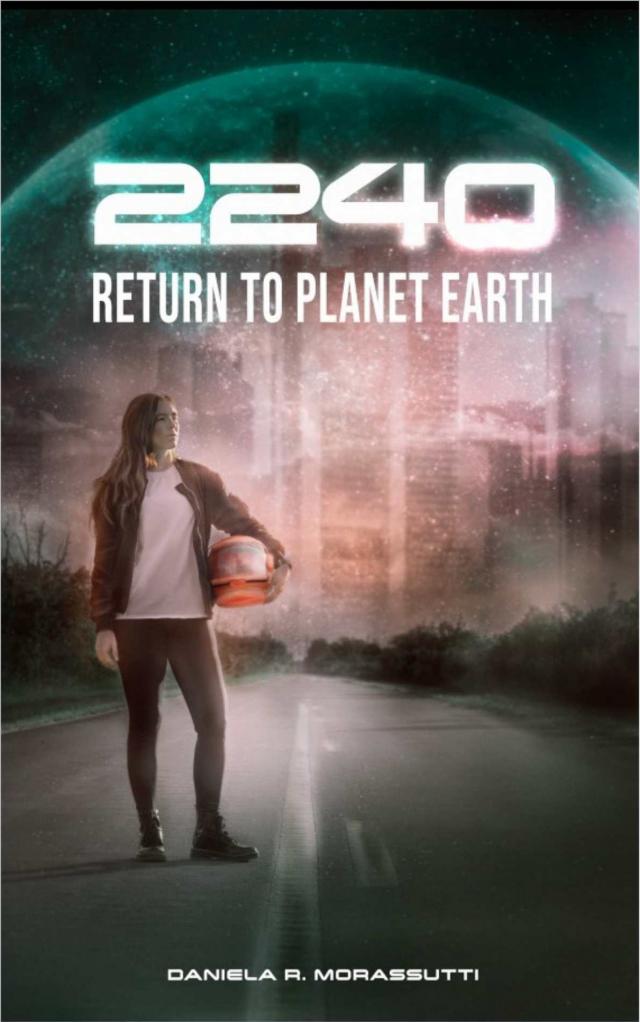
2240:
Return to the Planet Earth
By:
Daniela R. Morassutti
Cover by: Ileana Rincon
Copyright © Daniela R. Morassutti 2021
For my mom and dad, Claudio, my sisters and my sister from another mister, Maria Andreina. Thanks to Ileana, Mafe, Romina, Ricardo, Marcus and Cesar for the help through this journey.
EPISODE I
CHAPTER I
MIA: CRYOSLEEP
I was in my ship in the asteroid belt between Mars and Jupiter, talking through holotime with my boyfriend Marcus. He was on the space station in Earth orbit, waiting for our ship to come back from the belt with tons of liquid hydrogen to power cars, buildings and everything else.
“You’ll be here soon,” he said eagerly. “Your mission is almost over.”
“Where should we go after this?” I said while trying to hold Marcus’s holographic hand. “It’s been one straight year in space. I need a little bit of Earth adventure.”
“We should go to…” he began saying, when a loud fire alarm sounded in my ship which didn’t let him finish. The sound was accompanied by red flashing lights that almost blinded me. Just then I knew I was about to face the worst nightmare for any space military force.
“It’s happening” I screamed. “Fire on the deck! Red light, we need to go to cryosleep!”
“I love you, Mia…” Marcus said before the hologram disappeared. All communications stop in the event of catastrophic failure.
I ran out of the room to get to the cryosleep chambers. I only had three minutes to get to it, to be frozen for a long time. We would be ejected into space in the emergency pod, a ship with not that much power acting as the motherboard. It would take at least a year to get to Earth with that engine; and depending on any malfunctions or failures, there was a possibility we would never get back.
Running through the corridors, I bumped into Eliza. We had been friends since middle school, but we became inseparable in 2202, when humankind stepped foot in Proxima Centuri B, the closest planet to Earth, 4.2 light years away. It was thought to be habitable, but even if it wasn’t it gave hope to scientists to keep looking. We shared the dream to explore the stars. We both went to University of Wisconsin for aerospace engineering, and had registered together one year ago for the Space Force. This mission was our second together. I was a pilot and the second in command, and she was head of engineering for the extraction of liquid hydrogen in the asteroids.
“One of the liquid nitrogen tanks was not stored properly and had a reaction with…” Eliza said, almost crying and not finishing her sentence.
“It doesn’t matter now. Let’s go to cryo, we only have 120 seconds,” I said to her, pulling her arm.
“You don’t understand. The damage is too high. Most of the systems have failed, including the pod engine and navigation system. We may never get to Earth, or we may get there in years or decades,” she said with a desperate tone. Her brown eyes were wide open, showing how scared she was. I could see her long red hair starting to levitate lightly. The gravity generator in the ship must have also stopped working. My body felt light, almost if I was walking on the moon.
“Eliza, have faith and trust,” I responded. “We’ll get back home when we get there. They’ll look for us. Marcus will look for the pod.” We had met Marcus in college, and the three of us were great friends. We knew we would get to know space together, and we did. Our first mission together was to study Marcus’s favorite radioactive bacteria on Mars. He had a theory that the energy from these bacteria could be better than the hydrogen cells that currently powered Earth’s cities.
We both ran—or better said, we both jumped with low gravity force—to the pod. We had 40 seconds left before the pod would be ejected. There were eighteen in the crew but only four had made it to the pod—Gabriela, Robert, Eliza and me. Eliza started helping Gabriela and Robert to get into the cryosleep chambers, while I was scanning the pod’s damage in the holocom, a computer with a high definition 3D hologram screen. I could see in three dimensions the whole ship, and scan all its parts by scrolling with my fingers very quickly. I realized basically everything was down expect our artificial Intelligence. I knew that us returning to Earth was unlikely, but Sydney, our AI, was our only shot. When the clock hit zero, the system would close the doors automatically and fly away immediately, leaving everyone still in the mothership to die. For the few of us who had made it to the pod, we had to go into induced frozen sleep in a useless vehicle. There was not enough food, water or beds for all of us, for a trip of uncertain length, without cryosleep.
“Sydney is on,” I said to Eliza with hope, while I rebooted Sydney. Her hologram appeared in the pod two seconds after.
“You have twenty seconds before the doors close,” she said calmly. “You need to go to sleep. I will wake you up when we are back in the space station on Earth.”
“Sydney, pod engine is partially damaged,” Eliza said, scared. “Communications are out, navigation system, everything.”
“You have to trust me, commander. I will get you home,” she told me, looking directly into my eyes. When I heard that, I realized Henry, our first in command, was not there yet, which made me the officer in charge. I froze and I turned to Eliza to hug her.
“See you on the other side,” Eliza said with no hope of seeing each other again.
“May we meet on Earth,” I told her, while I heard the pod’s doors closing behind us. Only four of us would be trying to go back home, and I was the commander of a ship of death.
Eliza and I got into the cryosleep chamber, as we call it, but it was more like a glass closet. You stand up in the three-by-three-foot closet the whole time you’re in hibernation at 20 degrees, getting the minimal nutrients your body needs. The maximum amount a person has ever been in cryosleep was five years. This was in 2187 during the Saturn expedition, when there was a malfunction in the system because the mothership was hit by an asteroid. The emergency pod with the cryosleep chambers was ejected into space, and it took half a decade to bring eight Space Force members to Earth. My dad died on the wrong side of the door’s pod while my mom, with me in her belly, came back to Earth in cryosleep. Other than for emergencies, cryosleep is only used nowadays for long-distance missions out of the solar system. Our nuclear thermal propulsion (NTP) goes at half light-speed, which allows us to go anywhere in the solar system in hours, not needing cryosleep. However, since my parents’ accident, scientists have designed the chambers to be able to sleep for thirty years, since the malfunctions could be so severe that the pod could float in the solar system for years.
And here I was, seeing my pod getting frozen, just like my mom did twenty-two years ago, leaving my dad on the other side of the door without being able to do anything. I was leaving fifteen of my crew on the mothership to die, and Sydney had thirty years to get to Earth with a broken engine before we would die in our sleep. What I was most afraid of, actually, was to make it to Earth in five, ten, twenty years, to learn that my mother was dead and Marcus had moved on to someone else. But I woke up to something much worse than that.
CHAPTER II
MIA: THE INVISIBLE RADIATION
I woke up in my chamber while the ice on the walls was still melting at a rapid pace. I could see Sydney’s hologram on the other side of the glass. While I had been asleep, I had dreamed about this day so much. The only reason I knew this was reality was because I could feel the cold through my skin all the way to my bones. Even though the unfreezing of the chambers only took thirty seconds, it felt like an eternity. I had so many questions: Were we home? How long was I asleep? Was the crew safe? Where was Marcus and my mother?
As soon as the chamber finished the unfreezing the glass door opened, and I jumped out of the closet that had held me alive for who knows how long. I took a deep breath to get oxygen down into my lungs. In cryosleep, your functions are dialed down to a minimum and your oxygen intake is very low. I was breathless but still desperately asking all the questions I had.
“Commander, breathe first,” Sydney said peacefully while I was trying to lower my heartbeat by deeply inhaling and exhaling. “You and your crew are safe and back at the space station.”
When I recovered my breath, I said eagerly, “We’re back! I was so scared we wouldn’t make it. Take me to the lieutenant in charge of the space station and let’s wake up everyone. And please, call me Mia.”
“Mia…” the AI hesitated. “There is no one on the space station. You should come to the communications center before waking up your crew, if I may suggest.”
I was confused. There was always supposed to be someone on the space station. I looked in Eliza’s chamber and thought of waking her up; if there was a problem, she would be able to handle it correctly, since she felt responsible for the liquid hydrogen explosion in the belt. Despite the time we had spent in the chambers, this incident was like yesterday for all of us.
“Sydney, what year is it?” I asked, scared of what the answer would be.
“It’s 2240. You have been asleep for 24 years, 10 months and 23 days. Our propulsion system was so damaged that…” She continued but I stopped listening. I felt a pain in my chest. I knew this could be a possibility, but I had hoped it never came true. “Are you listening, Mia? Despite the damage of the navigation system, I estimated our location and an Earth trajectory. We were on track to reach Earth in nine months with the condition of the engine. However, propulsion was malfunctio ning. I couldn’t maneuver and we were attracted to the gravitational anomaly of Ceres, the dwarf planet in the belt. As our communications were down, I couldn’t send out our location. In the eyes of Earth, we disappeared twenty-five years ago. On year twenty-one, when Earth was the closest to our position, I created an escape plan with 85% failure probability. I pulled down to the crust of the planet and used 75% of our fuel to escape the anomaly. It took us four years to get to the space station. Could you please join me at the communication center? I need to show you something.”
“You saved our life, Sydney,” I said. “Thank you. Show me what you got.” I started running to the communication center. When I got there, Sydney’s hologram appeared next to me and turned on the hologram in the main computer, showing Earth.
“Oh, good, at least Earth is there. What could possibly be wrong? Connect me with The Hills in Hollywood. Maybe they built another space station and abandoned this one.” I stated.
“I am afraid I cannot do this,” she said. “The Hills are not there.”
“How can it not be there? I’m looking at it right now.” I pointed at Los Angeles. I could swear everything looked great on the map. I pulled up a hologram keyboard and started to get data about Earth’s condition. Everything looked like when I left it. Carbon monoxide levels and air quality were like before the Industrial Revolution. Water levels like after the big floods in 2085. I could see the coast of the city, right by the downtown area where it had been for decades. Everything looked great; we just couldn’t get anyone on the line.
“Why don’t I get any signals from Earth, Sydney? Get me someone on Mars, or in Houston. Get me someone,” I mumbled.
But I didn’t let Sydney respond, because I knew the answer. No one had lived on the red planet since we fixed Earth decades ago. There also hasn’t been a space command in Houston in over 150 years, because the entire industry moved to Los Angeles with the private spacecraft boom. However, all astronauts will always remember Houston, since it brought us to the moon.
“Just tell me what happened,” I said.
“This is where I was going, commander. Pulling up the last communication between station and the US.” The hologram of a 40-year-old man I didn’t recognize appeared, and his recording started playing.
“I, Kai Gray, President of the United States, have an uncomfortable and unwanted duty to carry out to our fellow Space Force members, who have done so much to make this country and this world better and safer. Given the invisible radiation that has been hitting our world in recent months, and the imminent destruction of humankind on Earth, I relieve you from your positions to spend the last days or weeks of our lives on our precious Earth with the people you love. I have executed Project SURVIVE, which will help humanity survive. In our special base in The Hills in California, we have cryosleep chambers to provide a chance to save humankind. Given the tolerance of astronauts to radiation, given their long exposure to gamma rays in space, 200 members of the Space Force were selected to stay at this facility. You can choose to go or not to go, there is no obligation. But please note that if there is a chance to save humankind, you of all of us will have the chance to make it. The chambers will open in twenty years when the radiation is estimated to be dissipated. I wish you the best of luck.” The President finished his speech and the holovideo ended. I felt my body go cold. I was scared, very scared, but I had to be calm.
“Sydney, when was this recorded?” I asked.
“2220, commander.”
“Please, call me Mia. I am not a freaking commander!” I paused to think for a second. “What is this invisible radiation? Did it kill everyone? Is Earth survivable?”
“They called it invisible radiation because no one understood where it was coming from, Mia. There was no nuclear bomb, and they didn’t find leaks in any nuclear plants. Earth was just suddenly being submerged in radiation. The answer to your second question is yes, it did kill everyone. It wiped out the human race in 11 months. And to the last question, I do not see any current radiation on Earth that you cannot survive. Remember, you astronauts are constantly exposed to ten times more radiation that anyone on Earth, so you slowly develop a tolerance for it.”
Her calm and hopeful face was irritating me. “They really didn’t program you with any sort of feelings, Sydney,” I said. “This is bad, very bad. This is like if I told you that you were the very last android in existence.”
“I am sorry I cannot relate to your pain, but I have some sort of good news. I logged into the system at Hollywood Hills, and I was able to track functioning cryochambers. I cannot tell if they are occupied or not, but the facility has been up and running for the past twenty-five years.”
“Thanks, Sydney. That actually is good news. It means there’s a possibility of more survivors. Let’s wake up the crew and touch down to Los Angeles. We’ll wear suits; I want to be sure we’re as tolerant to radiation as you say. But before we do anything, please log into the data center of the government and try to find any death certificate for my mom, Beatrix Bennet, and my boyfriend Marcus Carson. Also, any information about their last whereabouts. Check old social media records as well.”
“Mia, I’ve logged into the governmental data centers. No such data available. But also, please note that 15 billion humans died but only three billion deaths were officially recorded. They could be alive if they were part of Project SURVIVE, or if they hid for long enough from the radiation. Private data centers don’t have unlimited power, so all social media records were deleted.”
“At least that’s something good about this new world,” I said with a small laugh. “No more manipulative social media and online bullies.” I tried to get back into reality. I didn’t know what was stronger, my hope that Marcus and Mom may be alive, or my fear that they were, and were now twenty-five years older than me. Besides, I didn’t understand much of what had happened on Earth and whose fault was it. Killing all humankind doesn’t just happen by accident. I might never know what really happened, and that was terrifying.
I felt deeply sad, not only because I had probably lost all my loved ones except Eliza and Gabriela, but because a wonderful world had died. After so much war and our Earth almost going extinct, all nations finally worked together to save the planet, and we accomplished it. In the 22nd century humans created smart buildings made from biological materials mixed in the concrete, to eliminate carbon monoxide from the air. It was illegal to mine on Earth, and everything we needed for construction, technology, agriculture and transportation came from the asteroid belt. All flying cars, planes and smart buildings produced their own energy with engine cells that ran on liquid hydrogen, which was also brought in from the belt. And lastly, we brought all the extinct species back with genetic cloning. All our joint efforts led us to be a carbon negative society and we finally had an atmosphere like the one we had before the Industrial Revolution. The world was in balance again, and it somehow got destroyed in a matter of a few years by a mysterious invisible radiation. The idea that it was deliberately created by humans was almost too much to bear.
Before I ran more alternatives in my head, I went to the pod to wake up the crew. I really needed a little bit more humanity and a little less AI, given that we were possibly the last humans in the universe. I woke up Eliza first and told her everything. I thought she would take it worse than she actually did. She was so upset with what went wrong with us in the belt that I thought that the latest news would tear her apart, but it didn’t.
“Mia, I know this is extremely hard for you,” she said. “I’m so sorry you lost your mom and Marcus. I’ll miss Marcus too, with all my heart, because he was a great friend, but all the family I have is here. You’re my family and I don’t need anyone else.” Eliza had lost her parents when she was seven years old. They were from Scotland and emigrated to Chicago when Eliza was just a baby, persecuted by Scottish organized crime (better known as the “whiskey mafia”) because they had messed with the alcohol bootlegging enterprise back in Europe. They thought they were safe in America, but the mafia found them and were killed in their house in Chicago. The murderers took everything their family had, and it left Eliza in an orphanage until she was eighteen. Then she got a scholarship to go to college where we became best friends. She was the sister I never had.


