

Salma makes a home, p.1
Salma Makes a Home, page 1


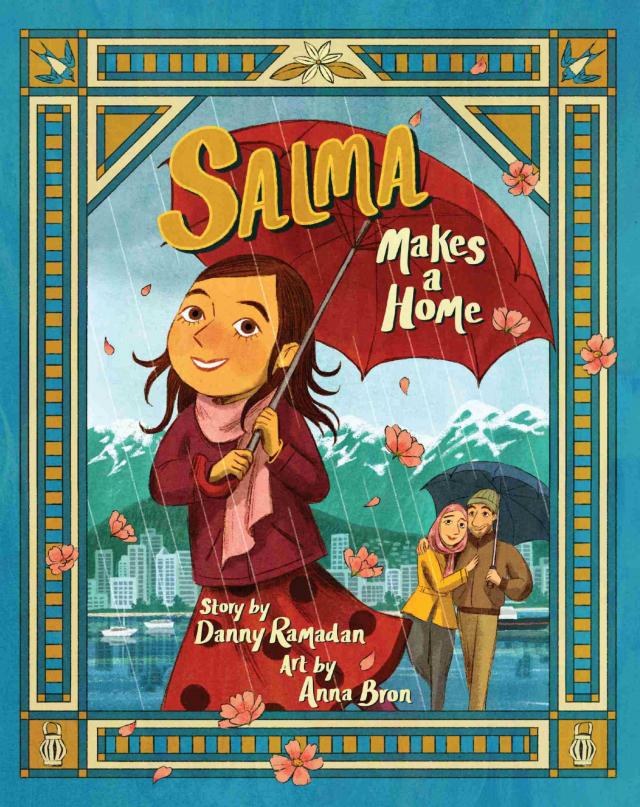
© 2023 Danny Ramadan (text)
© 2023 Anna Bron (illustrations)
Cover art by Anna Bron, designed by Sara Loos based on art direction by Paul Covello
Interior designed by Sara Loos and Paul Covello
Edited by Claire Caldwell
Copy edited by Erin Chan
Proofread by Eleanor Gasparik
Annick Press Ltd.
All rights reserved. No part of this work covered by the copyrights hereon
may be reproduced or used in any form or by any means—graphic, electronic,
or mechanical—without the prior written permission of the publisher.
Distribution of this electronic edition without the permission of the publisher is illegal. Please do not participate in electronic piracy of copyrighted material; purchase only authorized electronic editions. Annick Press ebooks are distributed through major retailers. We appreciate your support of our authors’ rights.
This edition published in 2023 by Annick Press Ltd., 388 Carlaw Avenue, Suite 200, Toronto, ON M4M 2T4
We acknowledge the support of the Canada Council for the Arts and the Ontario Arts Council, and the participation of the Government of Canada/la participation du gouvernement du Canada for our publishing activities.
Library and Archives Canada Cataloguing in Publication
Title: Salma makes a home / story by Danny Ramadan ; art by Anna Bron.
Names: Ramadan, Ahmad Danny, author. | Bron, Anna, 1989- illustrator.
Identifiers: Canadiana (print) 20220412898 | Canadiana (ebook) 2022041291X | ISBN 9781773217611
(hardcover) | ISBN 9781773217628 (softcover) | ISBN 9781773217642 (PDF) | ISBN 9781773217635 (HTML)
Classification: LCC PS8635.A4613 S23 2023 | DDC jC813/.6—dc23
Published in the U.S.A. by Annick Press (U.S.) Ltd.
Distributed in Canada by University of Toronto Press.
Distributed in the U.S.A. by Publishers Group West.
Annick Press's website
Danny Ramadan's website
Anna Bron's website
To Tala and her Mama and Baba, welcome home.
—D.R.
To Boudica, Iris, Rhea, and Maia.
—A.B.
Table of Contents
Chapter 1
Chapter 2
Chapter 3
Chapter 4
Chapter 5
Chapter 6
Chapter 7
Chapter 8
Chapter 9
Chapter 10
Chapter 11
Chapter 1
With her little scissors, Salma carefully snips off a final thread then looks at her beautiful handiwork: a colorful paper lantern she learned how to make online.
“Mama, look. I made this to celebrate the arrival of Ramadan.” She used red papers and drew little geometric designs along its edges. “Red for the Canadian flag, and mosaic like the mosques of Damascus.”
Mama lifts up the lantern and smiles, examining it in the living room light. “What a wonderful piece of art, Salma. A great way to celebrate the arrival of our holy month.”
“I based it on my own memories,” Salma says. She remembers seeing al-mesaher walking the alleyways of Damascus right before sunrise. His son walked beside him sleepily, holding a real lantern in his hand to light the way. Al-mesaher knocked on a little drum to wake people up to eat their suhour: the pre-fasting meal.
“Do you think al-mesaher will come to visit us in Vancouver, Mama?” Salma asks.
Mama returns the paper lantern to Salma. “Maybe when your Baba comes here, he will be your personal mesaher.”
Knock, knock knock knock, knock. Mama taps her knuckles on the coffee table then sings, “Wake up and eat suhour, let Ramadan visit you.”
Salma giggles.
“Now off to bed, young lady,” Mama says. “You have school tomorrow.”
In bed, Salma closes her eyes and wishes for Baba to come here soon. Vancouver has been a beautiful new home: Salma loves the seawall and its many seagulls. She learned how to skate at the ice rink, and she looks great in her purple rain jacket. But there is something missing that she can’t figure out. Is it how much she misses Baba? Is it how different this city is from her hometown back in Syria? She isn’t sure.
In her dreams, Salma walks the streets of Damascus with Baba. He wears a red fez on his head and a long silky shawl on his shoulders.
“Let’s go celebrate Ramadan’s return together, Salma,” Baba says. He holds his little drum by his chest and knocks on it.
Knock, knock knock knock, knock.
Salma looks around. This is her old school in Damascus, and that’s her favorite candy store. Over there is the little park where she used to climb the slide from the slippery side. At the end of the road is her old home.
Suddenly, as if they were made of clouds, the buildings blur then disappear. One after another, the buildings turn to smoke, and in a moment, they are gone. Salma’s heart aches. She feels a burn in her eyes.
“Baba, why is this happening?” Salma presses herself closer to Baba and squeezes his hand.
“Because you’ve forgotten what they look like, Salma,” Baba says. He pulls his fingers away from hers and walks away. He waves goodbye then knocks on his little drum.
Knock, knock knock knock, knock.
“Baba, please don’t leave me again.” Salma feels her heart fluttering like a bird trying to escape a cage. She runs after Baba, but her feet are heavy. The streets around her blur, and her little home in Damascus turns to smoke. She is scared. “Baba, come back.”
Knock, knock knock knock, knock.
Chapter 2
Salma opens her eyes, startled. That was a scary dream. She hears the knocking once more, as if it echoes back from her nightmare. Then she realizes it’s just Mama, knocking on her bedroom door.
“Is it morning yet?” Salma rubs her eyes as Mama comes into her room.
“I have such good news for you, Salma,” Mama says. Mama’s news makes Salma leap out of bed. She and Mama dance around the room before Salma has to get ready for school.
Salma races out of the apartment. Her best friend, Riya, runs to catch up.
“Salma, wait!” Riya says. “Why are we running?”
“I have such good news that I want to share with everyone!”
Salma rushes into her classroom and almost crashes into Ms. Singh’s chair. “Baba finally got his papers sorted,” Salma announces in front of the whole class. “He will join us in Canada soon!”
Riya squeezes Salma’s hands, a big smile on her face. “I’m so happy for you, Salma!”
“You have been waiting for so long,” Ayman says from the back of the classroom.
The other students cheer for Salma. Her heart beats so fast; it feels as if it’s going to jump out of her chest. She thanks everyone and squeezes Riya’s hands back.
“Why don’t you tell us about your father?” Ms. Singh asks.
Salma shares one of her favorite memories: the time Baba built them a swing on their balcony back in Damascus. At first, she was scared because the swing went too high. “But then, I grew up, and I wasn’t scared anymore,” Salma says.
She tells them about the yummy sandwiches he used to make her: he warmed the bread and melted the cheese first, then added a layer of strawberry jam on top.
“Mama makes really good sandwiches,” Salma adds, “but they are not like Baba’s.”
“When was the last time you saw your Baba?” Ms. Singh asks.
“A year, eleven months, and six days ago,” Salma says. “We were standing outside our old home in Damascus, and I asked Baba if we could just take the house with us.”
“The whole house?” Ms. Singh asks. “That’s a funny thought!”
“I just wanted to hide Baba in the house and bring him,” Salma says. She doesn’t know why, but she feels as if a fire burns behind her eyes. Her bad dream flashes in her mind. “It was the day we left Baba behind in Syria.”
“What did your house look like back in Damascus, Salma?” Natalie asks. “I’ve never been outside of Canada.”
“It had two bedrooms,” Salma says confidently. “No. Three? It was a three-bedroom home.” Salma suddenly feels unsure. What was the color of the walls in the living room? How many pillows did she have on her bed? What fabric were the curtains of her bedroom window? She can’t remember.
Salma feels small. She crosses her arms over her chest and looks at the ground. Tears gather in her eyes. Salma doesn’t understand why she is sad. It’s a happy day. Baba will be here soon, and he will love everything about Canada. She shouldn’t feel sad. She sniffs then makes herself smile. “I’m just so happy he’s coming,” Salma says. Her voice quivers.
“It’s okay to be sad that Baba is not around, Salma,” Ms. Singh cuts in before other students ask more questions. “Sometimes, we get sad in our hearts, but we know in our heads we will be happy when we see our loved ones again.”
“I’m not sad,” Salma insists, quiet at first, then louder as she continues. “Baba will be here soon, and he will love it here.”
But what if he doesn’t? The thought rushes through Salma’s mind. Quiet at first,
Chapter 3
On her way home from school, Salma can’t think of anything to talk about with Riya, like they usually do. She watches her steps so she doesn’t step in a puddle and silently gazes at the trees. Salma sees an empty bird’s nest on a branch.
“Are you mad at me, Salma?” Riya asks.
“No. No. Just thinking,” Salma says. “Do you think that’s a swallow’s nest?”
“What’s a swallow?” Riya is confused.
“It’s a small blue bird with a red head and white wings.” Salma is surprised that Riya doesn’t know her favorite bird.
“I’ve never seen one!” Riya says. “Are you sure you didn’t dream them?”
“They are everywhere in Damascus,” Salma mumbles. “Or at least I think so?” The burning in her eyes returns. Salma stops walking. She tightens her hand around her umbrella.
Riya looks back at Salma. “What’s wrong?” she asks.
“I don’t know. I’m really happy that Baba is coming but . . .” Salma pauses then confesses, “I feel scared, too.”
Riya takes Salma’s hand and steps closer to her. Their umbrellas smack against each other. Riya’s caring eyes make Salma feel warm inside. “Why are you scared?” Riya asks.
“I’m worried that Baba won’t like this new home,” Salma says. She feels the burn in her eyes again. She sniffles. “What if he hates the straight roads and prefers Damascus’s old alleyways? What if he dislikes the tall buildings and misses our small home? What if he misses my grandparents, the way that I miss him?”
Riya’s eyes tear up, too. She tightens her hand on Salma’s. Salma feels the warmth of her best friend’s fingers, even though both of their hands are cold. “Salma, when my family came here, I didn’t like it either,” Riya says. “I didn’t like the new language I had to learn and didn’t enjoy the cold, rainy winters.”
“You didn’t?” Salma is surprised. Riya is the smartest kid in their grade. She always reads in front of the whole class. She has an accent, just like Salma, but Ms. Singh, their teacher, also has an accent. And when it snowed last February, Riya and Salma played in the snow together for hours. They even built a snowman.
“The language was hard, but I learned it. The winters are cold, but I love my colorful gloves and my soft scarf,” Riya says. “Now I love Vancouver, and your Baba will, too.”
But what if he doesn’t? Salma feels the burning behind her eyes again. But maybe Riya is right. Maybe all it will take for Baba to love Vancouver is good language practice and some warm clothes. She takes a deep breath and nods at her best friend. They walk home holding hands the whole way.
Chapter 4
“WELCOME HOME!” Salma’s banner says, once in English and again in Arabic. The airport’s automatic glass doors slide open, and Salma raises her banner higher. The red and white balloons that Salma and Mama tied to a park bench bounce in the spring air and glimmer under the warm sun. But Baba doesn’t come through the doors. Salma sighs and lowers the banner.
“He will be here soon,” Riya reassures her. She came with her Maa to support Salma and Mama. “He is probably finishing his immigration papers.”
“I can keep an eye on the gates for you, Salma.” Ayman came to support them, too. He holds a large flower arrangement his father brought.
“You don’t know what my Baba looks like,” Salma insists.
A car parks in front of them, blocking their view. Salma wishes the people in the car would hurry up so she can keep her eyes out for Baba. The car doors open, and a small family steps out. A father, a mother, and two children.
“We’ll miss you,” the father says.
“Call us all the time,” the girl says.
The mother opens the trunk, and the father helps her pull out two large suitcases. She hugs her husband then leans down to squeeze her children close. “I will miss you, too,” the mother says. “But you know I have to go.”
The boy hugs his mother one last time. The girl nods then buries her face into her father’s side while her mother crosses the road, waves a final goodbye, and then disappears into the airport.
“She will be gone for so long,” the girl says. Salma sees tears on her face.
“You promised your mom not to cry.” The father pats her head as he opens the car door.
Salma’s hands feel weak. She lowers her sign again. She feels the burn return to her eyes. Salma promised Baba she wouldn’t cry when she said goodbye to him, too. No crying today, Salma reminds herself. Today is a happy day. She shakes her head and sniffles.
“Are you okay, Salma?” Mama asks. She tries to hug her, but Salma escapes the hug, nods quickly, and raises the sign even higher than before.
At the airport doors, a familiar figure appears.
“It’s Baba!” Salma shouts.
Mama looks up. Salma sees a tear sliding down her cheek. Baba waves at them, a huge smile on his face. Finally, he crosses the street, drops his luggage, and kneels down to give Salma a big hug. She dips her face into his shoulder and smells his familiar cologne.
“I missed you so much, Baba,” Salma says in English.
“Huh?” Baba looks confused.
“I missed you so much!” she repeats in Arabic, and he nods, taking Mama’s hand. “Baba, these are my friends and their families.” Salma introduces everyone to Baba in Syrian Arabic.
“I hope the trip wasn’t too hard on you,” Ayman’s father says in Egyptian Arabic. Salma understands Egyptian Arabic, even when Egyptians pronounce the letter G in a funny way.
“It wasn’t too bad.” Baba’s face lights up. “I’m happy to be with my family.”
Riya’s Maa offers to drive on the way home, and Salma sits next to her Baba in the backseat.
“How are you?” Baba asks Maa with his limited English.
“I am good,” Riya’s Maa says slowly to make sure Baba understands.
Salma wiggles in her middle seat. Baba is finally here. Canada is now his home. She has to make him love everything about it, or else he might go back to Syria.
“Baba, this is the Fraser River.” She points out the window. “You will love walking across the bridges on it. And that’s a park where people play tennis. Do you want to play tennis? That’s the road that takes you to Granville Island, where they have yummy grilled potatoes and funny hats. This is the ocean! Look at how big it is, and all the ships! Baba, you will love all of these things in no time.”
Baba looks back at Salma with confusion in his eyes, and Mama places a quick hand on her knee. “It’s very exciting that Baba is here, Salma,” Mama says. “We have all the time in the world to show him all of these new things.”
Salma pouts: if they wait too long, Baba won’t fall in love with Vancouver, and he might not want to stay. She has to make sure he enjoys this city as soon as possible.
“Baba, we will all go out and talk English to everyone,” Salma says. “You’ll try poutine, and we can go snowshoeing, too.”
“Salma, let Baba rest!” Mama insists.
Riya’s Maa pulls up outside their building. “You must be excited to show Baba your home, Salma,” Riya says. “I loved it when I visited last time.”
Salma smiles at Riya. That’s a brilliant idea! Baba will love our home here, Salma thinks. This will be the first step for him to love Vancouver, too.
Chapter 5
When they get to their apartment, Baba walks through the door with his right foot first.
“What’s Baba doing, Mama?” Salma asks.
“It’s for good luck.” Mama looks surprised. “It’s a Syrian tradition, Salma. Don’t you remember?”
Salma nods, but the truth is that she didn’t remember until Mama explained.
Baba slowly takes in the details of the home. The paintings that Mama got for cheap at an antique store; the large TV that a neighbor donated to them; the books Salma collects and organizes on her bookshelf; Salma’s drawings hanging on the silver fridge; and the blue and gold rocking chair.


