

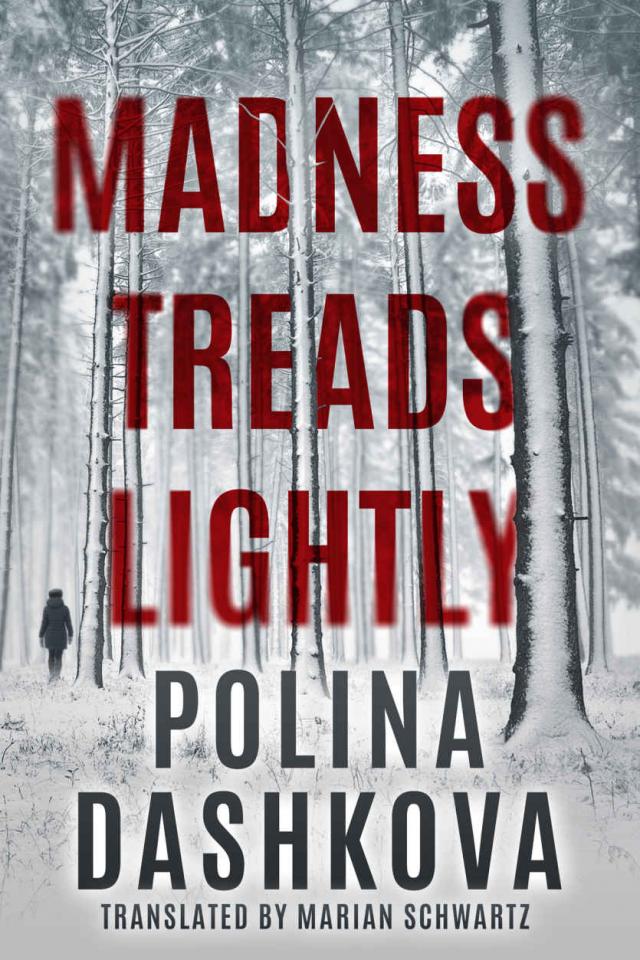
Madness treads lightly, p.1
Madness Treads Lightly, page 1


This is a work of fiction. Names, characters, organizations, places, events, and incidents are either products of the author’s imagination or are used fictitiously. Any resemblance to actual persons, living or dead, or actual events is purely coincidental.
Text copyright © 1998 Polina Dashkova
Translation copyright © 2017 Marian Schwartz
All rights reserved.
No part of this book may be reproduced, or stored in a retrieval system, or transmitted in any form or by any means, electronic, mechanical, photocopying, recording, or otherwise, without express written permission of the publisher.
Previously published as Легкие шаги безумия by Eksmo in Russia in 1998. Translated from Russian by Marian Schwartz. First published in English by AmazonCrossing in 2017.
Published by AmazonCrossing, Seattle
www.apub.com
Amazon, the Amazon logo, and AmazonCrossing are trademarks of Amazon.com, Inc., or its affiliates.
ISBN-13: 9781477823460
ISBN-10: 1477823468
Cover design by Damon Freeman
CONTENTS
CHAPTER 1
CHAPTER 2
CHAPTER 3
CHAPTER 4
CHAPTER 5
CHAPTER 6
CHAPTER 7
CHAPTER 8
CHAPTER 9
CHAPTER 10
CHAPTER 11
CHAPTER 12
CHAPTER 13
CHAPTER 14
CHAPTER 15
CHAPTER 16
CHAPTER 17
CHAPTER 18
CHAPTER 19
CHAPTER 20
CHAPTER 21
CHAPTER 22
CHAPTER 23
CHAPTER 24
CHAPTER 25
CHAPTER 26
CHAPTER 27
CHAPTER 28
CHAPTER 29
CHAPTER 30
CHAPTER 31
CHAPTER 32
CHAPTER 33
CHAPTER 34
CHAPTER 35
CHAPTER 36
CHAPTER 37
CHAPTER 38
CHAPTER 39
CHAPTER 40
EPILOGUE
ABOUT THE AUTHOR
ABOUT THE TRANSLATOR
CHAPTER 1
Moscow, March 1996
Lena Polyanskaya wrestled the stroller through the deep March slush and lumpy melting snow like a Volga boatman. The narrow street was lined with tall, hardened snowdrifts, and any speeding cars splashed the pedestrians with thick brown muck.
Two-year-old Liza kept trying to stand up in the stroller so she could walk on her own little feet. She thought she was too big for a stroller, and anyway, there were so many interesting things to look at: sparrows and ravens making a racket as they fought over wet bread crusts, a shaggy ginger pup chasing its own tail, and a bigger little boy walking toward them, gnawing on a bright red apple.
“Mama, Liza wants an apple, too,” the little girl informed her mother seriously, standing up yet again.
A big bag of groceries was hanging off the stroller handle, so the second Lena lifted Liza to seat her properly, the stroller tipped all the way back and the bag split open.
“All fall down,” Liza summed things up with a sigh, gazing from her mama’s arms to the groceries strewn through the muck.
“Yes, my love, all fall down. Now we’ll pick it all up.” Lena had carefully set her daughter on the sidewalk and was picking the groceries out of the slush and brushing them off with her glove when she noticed someone in a dark blue Volvo parked across the street, watching her intently. The tinted windows reflected the snowdrifts and pedestrians, so Lena couldn’t see exactly who was watching her, but she could feel that person’s gaze.
“We do make an entertaining spectacle.” She grinned as she managed to reattach the bag to the stroller handle, get Liza seated, and shake the dirt off her leather gloves.
When she turned into her own courtyard, she spotted the Volvo again. It drove by very closely, at minimum speed, as if the people in it wanted to remember exactly which door the young mother with the stroller entered.
There were two of them—a woman behind the wheel and a man in the passenger seat. Lena didn’t get a good look at them, but they got an excellent one of her.
“Are you certain?” the woman asked quietly after the door shut behind Lena.
“Absolutely. She’s barely changed in all these years.”
“She has to be thirty-six now,” the woman observed. “And that young mama couldn’t be over twenty-five. And the child’s so young. You haven’t mixed something up? It’s been a few years, after all.”
“No,” the man answered firmly. “I haven’t mixed anything up.”
The telephone trilled in the empty apartment.
“Can you talk now?” Lena barely recognized the voice of her dear friend and former classmate Olga Sinitsyna. The voice in the receiver was so strange, hoarse and very soft.
“Hi, Olga, what’s happened?” Lena pressed the receiver between her ear and shoulder and started untying the ribbons on Liza’s cap.
“Mitya’s dead,” Olga said very softly.
Lena thought she’d misheard.
“I’m sorry. What did you say?” she asked, pulling off Liza’s boots.
“Mama, Liza has to go,” her daughter solemnly informed her.
“Olga, are you home right now? I’ll call you back in fifteen minutes. I just walked in. I’ll get Liza undressed, put her on the potty, and call you right back.”
“Can I come over right now?” Olga asked quickly.
“Of course!”
Olga and Lena were the same age—thirty-six. Mitya Sinitsyn, Olga’s brother, was two years younger. How could a perfectly healthy thirty-four-year-old man full of strength and plans for the future who didn’t drink, use drugs, or have any connections to crime, drop dead?
Before Olga arrived, Lena managed to feed Liza lunch and put her to bed, wash the dishes, make a pot of cabbage soup, and start the laundry. Today she planned to translate at least five pages of a massive article about the latest psychological research on serial killers, “Cruelty and the Victim,” by the trendy American psychologist David Crowell.
Even though Liza was scarcely two, Lena worked a lot and still ran the same literature and art department at Smart magazine as she had before her daughter’s birth. The editor in chief had done his best to accommodate her and let her come in just two days a week. The lion’s share of her work she took home to finish at her computer at night. On her two in-house days, she left her daughter with a lonely old neighbor, since neither Lena nor her husband Sergei Krotov had living parents. Liza was growing up without grandmothers or grandfathers, and for Vera Fyodorovna, a well-educated pensioner, spending the day with a calm, loving child was sheer joy. And the money Lena and Sergei paid her came in handy, given her miserable pension.
“Don’t you think of sending my little Liza to day care!” Vera Fyodorovna would say. “As long as I’m on my feet and of sound mind, I’ll stay with her as much as you need.”
For Lena, having Vera Fyodorovna in the apartment across the way was a godsend. It wasn’t only that Sergei’s salary as a colonel in the Interior Ministry—he was deputy chief of the Criminal Division in the Domestic Counterintelligence Administration—barely supported them, but also that Lena herself couldn’t live without work. She realized she’d be replaced the instant she eased up even a little.
Lena’s time was scheduled down to the minute, and she was beyond exhausted, sleeping five hours a day at most. Now she only had one of her two precious hours of Liza’s afternoon nap left, that is, a good two pages of translation. But Lena didn’t even bother to sit down to her computer.
Ever since Olga’s call, all she could think about was Mitya. She imagined what must be going on now with his parents and his eighty-year-old grandmother, Zinaida Lukinichna, who, despite her advanced age, still had her wits and a keen perception of life . . . and death.
What could have happened to Mitya? An accident? Did a car run over him? Did a brick fall on his head? But everyone knows a brick doesn’t just fall on anybody’s head.
Lena had just turned on the electric kettle and poured coffee beans into the grinder when the doorbell rang.
Olga was standing in the doorway wearing a black kerchief, her grandmother’s, probably. Tousled, bright gold locks poked out helter-skelter. It was obvious at first glance that she hadn’t combed her hair or washed and had thrown on whatever was at hand. The news of Mitya’s death had caught her unawares. So it was an accident?
“He hanged himself,” Olga said in a dulled voice as she took off her coat. “He hanged himself last night, in his apartment. He looped his belt around the gas pipe above the kitchen door.”
“Where was his wife?” Lena asked quickly.
“Sleeping. Sleeping peacefully in the next room. She didn’t hear a thing.”
“Who found him?” Lena wanted to say “his body” but faltered. It was hard to refer that way to Mitya, who recently had dropped by for a visit and sat right here, on the kitchen sofa, sparking energy, health, and plans for the future.
“His wife. She woke up, went into the kitchen, and saw him.”
All of a sudden Lena noticed that Olga had stopped calling her brother’s wife by her name. Before she’d had nothing but praise for her.
“What happened next? At least have some coffee. Do you want me to ladle out some soup for you? I just made
it.”
“No.” Olga shook her head. “No, I can’t eat anything. Or drink. Open the window a little and let’s smoke while Liza’s asleep. What really happened, no one saw.” Olga shrugged nervously and took a deep drag. “We only know what she said, and she doesn’t remember anything. She pulled Mitya out of the noose herself.”
“Wait a sec,” Lena interrupted her. “But Mitya was six feet tall and solidly built. Katya’s like Thumbelina, half his weight and three heads shorter.”
“Yes, she said it was very hard. But she couldn’t leave him like that, and she was hoping he might still be alive. Don’t worry, I’m thinking straight. I realize that anything’s possible, but out of the blue like that, without even a note. And Mitya had always considered suicide a terrible sin. This is not enough to tell the police, of course, but Mitya was baptized, he was Orthodox, he went to confession and took communion. Rarely, but still. Now there can’t even be a funeral because suicides don’t get funerals. Any sin can be prayed away—except this one.”
Olga had dark circles under her eyes, and her hand holding the dead cigarette was trembling.
“He dropped by to see me about a month ago,” Lena said softly. “He had so many plans. He was telling me he’d written five new songs, he’d gotten in to see some famous producer, and now he said he’d have one music video after another coming. I don’t remember exactly what we talked about, but I got the impression Mitya was doing great. Maybe a little too excited, but in a good way. Did some hopes he had connected with that producer fall through?”
“Those hopes of his were born and died ten times a month.” Olga grinned sadly. “He was used to it and took it totally calmly. All kinds of producers, big and small, were endlessly popping up in his life. No, if we’re talking about what truly worried him, then it was his own art, not in terms of popularity and money, but whether he could—or couldn’t—write. The last month he’d been writing like never before, and for him that was the main thing.”
“You mean you’re not ruling out that Mitya didn’t do it himself?” Lena asked cautiously.
“The police assure me he did.” Olga lit another cigarette.
“Have you eaten anything at all today? You’re smoking like a chimney. Want me to make coffee?”
“Go ahead.” Olga nodded indifferently. “And if I can, I’ll take a shower here. I haven’t even washed today, and I’ve already been to the morgue. Forgive me for showing up here with this nightmare, but being home right now is so tough. I have to get my bearings and then take care of my parents and grandmother.”
“Come on, I’ll give you a clean towel.”
“Lena, I don’t believe he did it,” Olga said softly, standing in the bathroom door. “It’s all so bizarre. Their telephone was out all day. I checked at the station, and the line was completely fine. Something happened to the phone itself, and this morning a neighbor fixed it in a minute. His wife called the ambulance and police from their neighbors’ at five in the morning. It was the neighbors who called me. By the time I got there, they’d already taken Mitya away. You see, that night his wife was . . . well, high. They told me Mitya was, too. They said it was suicide from drug psychosis. They found needles in the apartment and tracks on his arm. So the police didn’t try too hard. ‘Ma’am, your dear brother was an addict,’ they told me. ‘So is his wife. It’s perfectly clear!’”
“Mitya wasn’t an addict,” Lena said slowly. “He didn’t even drink. And Katya . . .”
“She’d been shooting up for a year and a half. But not Mitya. Never.”
“Did you see him in the morgue?”
“No. I couldn’t. I was scared I’d faint. He was already in the cold locker. They said there was a line for viewing. There are an awful lot of bodies. If I write a petition to the Prosecutor’s Office, he’ll stay there, waiting his turn.”
“What have you decided?”
“I don’t know. But if he’s going to lie there in the cold locker, my mama and papa and my grandmother are going to have heart attacks over my brother. And they explained to me that a petition wasn’t going to do much. They’d hand the case to some girl working off her Moscow residency permit in the District Prosecutor’s Office, since they don’t have enough investigators. She won’t go and do any digging. It was so clearly a suicide. They have so many unsolved murders now, and this one, just some addict . . .”
She made a hopeless gesture and closed the bathroom door.
While Olga was taking a shower and putting herself in order, Lena stood by the window, holding the buzzing coffee grinder, and thought about Mitya Sinitsyn. What had they talked about then? He’d been over for a couple of hours, after all. He’d been telling her that he’d written five new songs and he’d even left a cassette. Lena had never gotten around to listening to it. She had to find it.
Yes, yet another megaproducer had appeared on his horizon. But Mitya hadn’t said his name, he’d said, “Terrifically famous, you wouldn’t believe it! I’m afraid I’ll attract the evil eye!”
Then they’d eaten dinner and talked about something else for a long time. We were just reminiscing about our student days, Lena thought.
Mitya graduated from the Institute of Culture and studied to be a theater director. It was an odd major, especially these days, and he never did work in his field. He wrote his songs, sang them for a small circle of friends, and had some gigs in clubs in the late 1980s. He was always in talks about some record, or some CD, or music videos for television.
Nothing ever came of the talks, but Mitya never gave up. He believed he had good songs, that they just weren’t pop. But there was demand for more than just pop. Mitya wasn’t counting on stardom, but he wanted to find his audience, and not through concerts in underground crossings but through more respectable channels—radio, television. For that, though, he not only had to compose good songs and perform them well, he also had to build up the right acquaintances and contacts, hobnob with producers, and offer himself as a product. And Mitya didn’t know how to do that.
Lately he’d been working as a guitar teacher at a children’s drama school. The money was pathetic, but the kids loved him. That was important to Mitya because he and Katya couldn’t have kids, though they’d wanted to badly.
If Lena was to assume what Olga said was true, and Mitya had been murdered, then her first question had to be who benefited? Who could have felt threatened by someone who taught kids classical guitar and wrote songs?
She had to find that cassette and listen it, only not now, around Olga. That might be painful for her. As it was, she was barely keeping it together.
Wet snow was falling outside. Looking into the courtyard, Lena mechanically noted that Olga hadn’t parked her little gray Volkswagen very well. She was thinking about how Olga was going to have a hard time getting out and might get stuck in a snowdrift when her gaze slipped over the dark blue Volvo, parked only a few meters from Olga’s car and already lightly sprinkled with snow.
“There, you see?” the woman sitting behind the wheel of the Volvo said quietly to her companion. “I never doubted they were still in touch, and pretty close touch, too. Close enough that after what happened, she rushed straight here.”
“I’m afraid,” the man murmured with dried lips.
“It’s all right.” The woman fondly ran her short, well-manicured fingers over his cheek. “You’re doing great. You’ll calm down and realize that this is the last push. Then it’s all over. I know how scared you are right now. Fear comes from deep inside, it rises from the belly to the chest. But you’re not going to let it rise any higher. You’re not going to let it into your head. You’ve been able to stop that thick, burning, unbearable fear lots of times. You’re strong now and you’ll be even stronger when we make this push—difficult and essential, but the last. I am with you.”
Her short, strong fingers slid slowly and gently over his smooth-shaven cheek. Her nails were polished a matte red, which looked garish against his very pale cheek. While continuing to speak quiet, lulling words, the woman was thinking that she mustn’t forget to remove this polish tonight and use something more muted, more elegant.
The man shut his eyes. His nostrils flared slowly and rhythmically. His breathing was deep and calm. When the woman felt his face muscles relax, she turned on the engine, and the dark blue Volvo slowly left the courtyard, came out into the side street, and from there onto the main road, where it got lost in the crowd of cars speeding under the slow, wet snow.


