

Smarter not harder, p.1
Smarter Not Harder, page 1


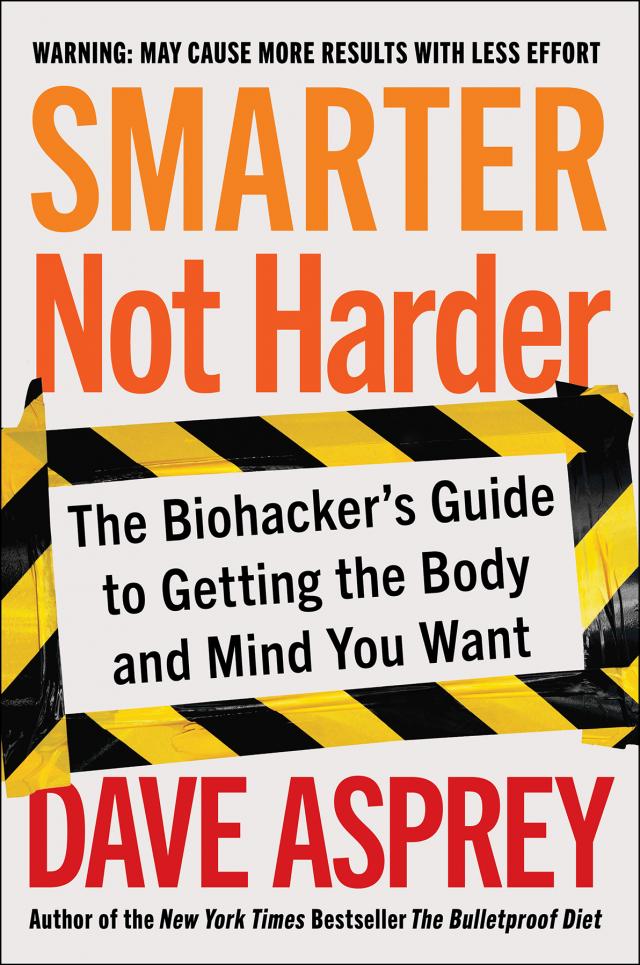
Dedication
Dedicated to every drop of sweat you ever shed that didn’t get you the results you expected.
Contents
Cover
Title Page
Dedication
Introduction: Better than Normal
Section I: Resources for Life 1: Tap the Power of Laziness
2: Remove Your Friction
3: Load Up on Raw Minerals
4: Supplement Your MeatOS
5: Charge Up with Minerals
Section II: Targets and Goals 6: Pick Your Target
7: Hack Target: Strength and Cardiovascular Fitness
8: Hack Target: Energy Level and Metabolism
9: Hack Target: Brain and Neuro-Fitness
10: Hack Target: Resilience and Recovery
Section III: Endless Improvement 11: Spiritual Strength
12: The Next-Level Upgrade
13: You Do You
14: Evaluate, Personalize, Repeat
Conclusion: An Offering to the World
Acknowledgments
Notes
Index
About the Author
Also by Dave Asprey
Copyright
About the Publisher
Introduction
Better than Normal
Stay curious and grounded.
Be the monk who can meditate at the center of chaos.
Respond with kindness when you see things that feel stupid.
What kind of person do you want to be? Whatever your answer is, this book is designed to help get you there. It is a book about health and fitness, yes, and it is also a book about all the things that you could do if you had more strength and energy. It is ultimately a book about how to be the best version of yourself—you, unleashed.
Everyone talks about empathy and compassion, but you have to combine them with curiosity and equanimity, a profound mental serenity, if you want to hold on to your best self and continue to improve even when things get weird. That combination of qualities is what allowed me to navigate confidently through the past few years of truly weird global disruption. Those qualities, blended together, are also the core principles of living a good and happy life. They are essential in times of crisis, but equally essential when our lives seem superficially dull. And they are, as I’m sure you know, extremely difficult to maintain consistently. Without even realizing it, most of us let them slip away. Sure, we may achieve them from time to time, but then the grind of daily life gets the better of us. We are too exhausted to allow ourselves to be at peace.
Over and over during the pandemic, I’ve heard people talk about yearning to “get back to normal,” and it sounds wrong to me every time. That ambition is just so ridiculously small. All my life, I’ve worked to improve my physical and mental resilience—to become better than normal—and to help other people do it, too. The goal is to reach a higher baseline, make that your new normal, and then reach higher again. A period of crisis is the perfect time to move forward. Why would you want to regress to an old normal?
I want other people to have what I have. To be inspired instead of depleted. To be dangerous instead of afraid. By dangerous, I don’t mean that you should do stupid things such as crashing your car or burning down your house. I mean that you can take bold risks, pursue dreams, and be unpredictable because you feel free to act like yourself. It sounds like a paradox, but it’s actually an extremely important truth: Being dangerous makes you safe and calm. Being dangerous blows away the sense of impending doom.
Being dangerous also requires a lot of energy and resilience, which is the reason why so many people imagine that a weak “normal” is the best they can hope for. Fortunately, there is another truthful paradox that can help you out. It is technically known as slope-of-the-curve biology, but I prefer to call it what it really is: the laziness principle. It is the central idea of this book, and it can transform your life. It boils down to one simple but revolutionary idea:
Laziness can make you strong.
I know, that sounds hard to believe. The reason it’s hard to believe is that your body has a secret, one that it doesn’t want you to know. Your body is faster than you are. It senses, reacts, and responds to stimuli about a third of a second before your brain even knows what it’s up to. Before your rational human brain can apply courage or willpower and hard work, your body has already sabotaged you. It pumps you full of adrenaline that makes small fears feel like big ones. It transmits pain signals to convince you that little tasks are actually going to require a lot of work, which then gives you lots of reasons not to do them.
Why would your body sabotage you like that? Why would Mother Nature create such an unkind system? Because that is the only way things can be in the natural world. Your body is designed to maximize the likelihood that you will survive, have babies, and perpetuate the species. As a result, there are really only two things your body cares about. The first is not dying. The second is being fantastically lazy, so that you use as little energy as possible in the process of not dying.
Your body won’t wait for you to decide what to do when a predator is about to eat you. It will start moving you away to safety long before you can make a carefully considered decision about how to react. Your conscious brain is simply not fast enough to respond to threats, which is why it is not responsible for your survival on a second-by-second basis. The autopilot function in your body provides an amazing advantage for keeping you alive over the long haul. It’s the reason that humans are still around on this planet. But it comes with some major drawbacks.
During the course of the pandemic, we experienced those drawbacks in full force. We saw how our bodies reacted to the constant onslaught of uncertainty and scary news. At the beginning, our bodies registered the threat and responded with a flood of stress hormones and powerful feelings of anxiety. When the threat didn’t go away, our bodies felt as though we were being relentlessly hunted by an unseen predator. They responded predictably—first with stress, then with depression. The reason so many of us were hit so hard is not because we are stupid. It’s not because we are weak. It’s simply because we are all equipped with an ancient biological system that is trying to keep us alive by making us think we are in charge, when in actuality we aren’t.
Who Is Really in Control?
Once you realize that your body makes decisions before your brain does, everything looks different. You can now understand the counterproductive responses that hold you back in life. Better yet, you can start to devise ways to hack your body’s systems so that you are in control for real—so that you can make your body do what you want it to do.
The key to taking control is learning how to bend the laziness principle to your advantage. Maintaining laziness is one of the primary biological functions of every cell in your body. No cell wants to use any more energy or resources than the absolute minimum necessary. In response to any stimulus, big or small, all the cells in your body decide how to allocate their energy during that precious one-third of a second before you collect your thoughts. Without fail, they choose the path of less work. That makes sense as a survival strategy: if your cells demanded any extra, unnecessary energy, you might run out of food or you might be too tired to run away from a predator. When in doubt, the safest thing to do is to kick back and relax. If you let them, the cells in your body would be perfectly content to spend their lives living in your grandmother’s basement playing video games.
That overwhelming tendency toward laziness is the reason why so many people gained weight during the pandemic.1 We could all have used the huge amounts of downtime we spent locked in our houses to work out, to meditate, to learn new skills, or to improve ourselves in a hundred different ways, but few took that path. Our bodies didn’t want us to do those things; improvement requires energy, and our bodies were in a state of anxiety, focused on using less energy, not more. The laziness principle made binge-watching Netflix seem like a great idea.
The pandemic was different for me. I already knew that my body is designed to feel fear before I get to think about it. I had trained my mind to resist that fear, and I had trained my body to do a better job of distinguishing real threats from small threats. More important, I had begun developing strategies to outwit my body’s laziness by working with it rather than trying to fight it.
I want my body to be ready to handle extreme stress and to maintain itself forever. Who doesn’t want those things? But my body doesn’t want to do that. No one’s does. The body automatically resists any demands that require a state of higher-than-necessary energy. I’ve never been good at exercising for an hour a day or even a half hour a day for long periods. You probably know that feeling; the laziness of the body eventually overcomes willpower for most people. Over the years, I’ve developed a set of biological hacks to guide my body to a more energetic, resilient state, but I always had the feeling that some important element was still missing.
I used the pandemic time to crystallize an idea that’s been percolating in my mind for the last twenty years of my biohacking work. There is a more effective way to tell our bodies what we want them to do while still honoring the genetic drive for laziness that keeps all animals alive when things are tight. In fact, we can embrace laziness as a way to develop more energy. It’s a brilliant shortcut. I didn’t want to exercise, but I wanted the results of the exercise. I wanted more results with less effort. By applying the laziness principle the right way, it is possible to do just that.
The standard way people think about exercise is th
What I’ve come to realize is that there’s a way out of this fight. In fact, we can sidestep it entirely, and the laziness principle shows us how. You can trick the very fast but very lazy system that runs your body to get off its lazy ass by approaching exercise (and any kind of work, really) in a totally different way. The standard approach of pushing yourself really hard for as long as possible just sets you up in opposition to your built-in laziness. Instead of working harder, you want to work smarter. To hack your laziness, switch tactics and focus on the inputs that laziness understands:
How quickly an intense stress comes on
How quickly you return to calmness
A high-intensity stress tells your body that it absolutely must respond; laziness is not an option. And a quick return to calm tells your body that it does not need to send you into a state of anxiety, because you are not facing a metabolic energy crisis. In fact, a short, sharp stress followed by an immediate break programs you for less anxiety by training your body to get back to its baseline level more rapidly and efficiently.
If you give your body an intense stress and show your lazy cells that they need to get their asses off the couch, they will. It’s just that they will do it a lot more easily and willingly if you let them get right back onto the couch afterward. The speed of a new stress and the speed of your recovery are far more important than the amount of stress. Fast-on and fast-off tell your laziness systems to make you stronger and more adaptable—to give you much better results than you’d achieve if you were doing the slow grind, and to do it a lot more quickly. Creating change in the body becomes vastly easier once you understand this technique.
The laziness principle allows you to reshape your body and mind radically without wasting your time. Along the way, it builds up your power and destroys your stress. It gives you access to the dangerous state I was describing. Powerful people are inherently dangerous. Who knows what they might do? They can handle anything the world throws at them. They can stand up to authority. They can control their emotions so that they are hard to manipulate. They can protect their family and their community. They have the strength to be generous and kind.
Some call that state of energetic flexibility resilience, but there are other names for it. In the Buddhist teachings I received in Nepal and Tibet, it is called equanimity, which has a richer meaning. Equanimity is the state in which you can remain in control of yourself and be perfectly composed no matter what is happening around you. A lesser state than equanimity is compassion, which itself has value. A lesser state than that is empathy, which has value as well.
Smarter, Not Harder
Attaining these elevated states carries a special meaning to me because I grew up with Asperger’s syndrome. As a kid, I didn’t know how to feel empathy, compassion, or equanimity. I didn’t have a clear comprehension of what those things were. In truth, I didn’t know how to feel much except the most important survival impulses, fear and laziness. I certainly didn’t understand that they were both coming from my body or that they got stronger when my body wasn’t healthy. It was a difficult and confusing way to grow up, but that outsider’s perspective ultimately helped me understand how to hack the laziness principle.
When I was young, I did what everyone said I should do to get strong: I bought a bike, and I rode it all the time to get in my obligatory sixty minutes per day of steady-state cardio. I slaved away in the gym for hours and suffered through a bland, low-fat, low-calorie diet. I tried to use willpower to overcome my laziness, but my laziness kept getting the best of me as I was left feeling tired and burned-out. Growing up immersed in the fundamental impulses of the body forced me to pay extra attention to the obstacles holding me back. That focus led me to a lifetime of biohacking, to ever deeper investigations of how the body manages energy, and eventually to the book you are reading right now. It took me decades of research and experimentation to reach my better-than-normal state. I’m sharing what I’ve learned so that you can blow past the obstacles and get there much faster.
A crucial thing to understand is that what is holding you back in life is not an issue of willpower. It is not an issue of weakness or cowardice. It is the laziness principle at work, operating outside your conscious experience, and the only way to beat the laziness principle is to embrace it and make it work for you: give your body the right foods and nutrients; apply the right kind of short, intense stimuli; train your body to return quickly to a baseline state. You can train your laziness so that it improves your energy, calms your mind, and expands your possibilities.
Once you embrace the smarter-not-harder approach, you unlock the hidden potentials inside you. Then you can become whatever you want to be.
Section I
Resources for Life
1
Tap the Power of Laziness
Mother Nature abhors waste. That’s why she encoded every cell in your body with programming that instructs it to use as little energy as possible. Think of that programming as a core part of your “meat operating system,” or MeatOS. The operating system on your computer does all sorts of stuff that’s invisible to you, things that are invisible even to the applications that run on your computer. Likewise, your MeatOS operates undetected in the background. You don’t know it’s there, but you feel its influence constantly.
The computer analogy makes more sense than you might think. After all, when you click on a screen icon to open your email, you probably don’t know which electrons are being sent to what parts of your central processing unit—your “CPU.” Maybe you don’t even know what a CPU is, and that’s fine. The whole point of an operating system is to hide bogglingly complex processes from you. All that matters is the end result: you can run an application that does what you want, without any need to think about how it does it.
Obviously, your fleshy body doesn’t run exactly like a chips-and-wires computer, but it must have something like a hidden operating system. Otherwise you wouldn’t be able to do things such as take a shot of tequila and break down the alcohol, even if you don’t know what your liver is. Your body breathes even without your instruction. Your eyes blink on autopilot when you’re not paying attention. The MeatOS works in the background all the time, and it remains entirely invisible to you—at least, until it breaks.
Your MeatOS is not just invisible, it is autonomous. Your brain is not in control of your operating system. Your conscious mind is more like a separate application sitting on top of the many complicated processes that keep your body alive. You never have full awareness of even a tiny percentage of what’s happening inside your body. In fact, your limited self-awareness is always out of date. Studies show that your brain doesn’t electrically recognize things that happen until about one-third of a second after they happen. Using your primitive MeatOS programming, your body is already taking action1 about 300 milliseconds before your conscious mind knows what you are doing or why you are doing it.
As a computer hacker, I learned early on how to take over a computer by changing the inputs to its operating system. Later I realized that just as you can hack a computer system, so, too, you can hack your MeatOS. This is biohacking, a concept I introduced in 2010.
Hacking is inherently about taking control of a system to make it do what you want it to do—getting the results you want with the least amount of effort. It is the essence of the smarter-not-harder approach. Most of the great early computer innovators were hackers. If something wasn’t working the way they wanted it to, they would go into the machine, take it over, and control it. Steve Wozniak and Steve Jobs, the cofounders of Apple Computer, sold an illegal phone-hacking device called a blue box2 four years before they started their company.


