Paddavissie, p.1
Paddavissie, page 1


PADDAVISSIE
DAVE FREER
About the author:
Dave Freer is the author or co-author of some 20 novels (hard to keep track) including SLOW TRAIN TO ARCTURUS, which was listed as a Wall Street Journal sf bestseller. Various other books have been on Locus bestseller lists. He is also the author of a large number of shorter works. For a complete list and work which will be available nowhere else see Dave’s site.. He lives on a remote island off the coast of Australia. For more about this and links to other sites see his Amazon Author’s page..
Paddavissie ©2014 Dave Freer
Electronic edition published by Magic Isle Press, October 2014
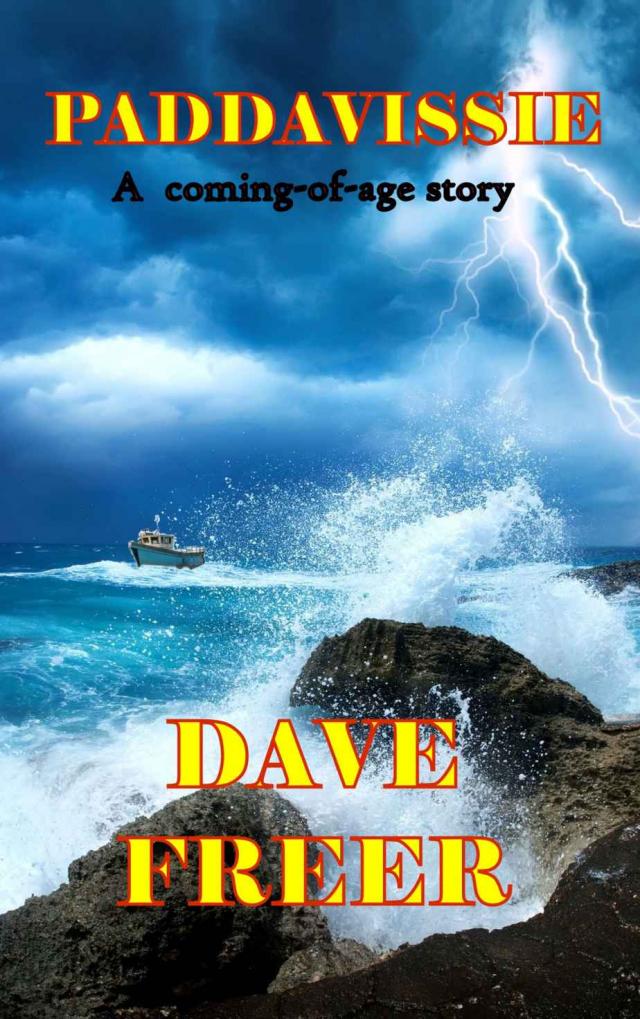
Cover Art: Storm Beginning with lightning ©Subbotina
Cover Art insert Abandoned Fishing Boat © Honourableandbold
Interior Art Shark Photo © Topaz777
All art from Dreamstime.com
Proof reading by Periwinkle Proofs
All rights reserved, including the right of reproduction, in whole or in part in any form. This novel is a work of fiction. Names, characters, places and incidents either are products of the author’s imagination or are used fictitiously.
Amazon Edition, License Notes
This ebook is licensed for your personal enjoyment only. This ebook may not be re-sold or given away to other people. If you would like to share this book with another person, please purchase an additional copy for each recipient. If you’re reading this book and did not purchase it, or it was not purchased for your use only, then please return to Amazon.com and purchase your own copy. Thank you for respecting the hard work of the author.
AUTHOR’S NOTE
My thanks go to my test readers Itai Pomerantz and Yael Pomerantz for making me decided to go ahead and publish this story. There are certain autobiographical elements to this fictional story, so I can’t say that it bears no resemblance to persons living or dead. However, it is a work of fiction, and there is no resemblance to any living person, but the Bess was the boat my father, Eddie Freer, fished on. This story is dedicated to him.
CHAPTER 1
WHO I AM, AND ALL THAT STUFF
My dad’s a fisherman. So was his dad. His dad’s dad was too. My dad says our family have always been fishermen, even before great-great-great grandfather was brought to the Cape. Real fishermen. Not just people who go fishing on Sunday for fun, but people who fish to live. That’s what I’m going to be too.
My name’s Abdul Smit. My family calls me ‘Little Abie’ because my Dad’s called ‘Big Abie’. At school they call me Smitty. On the boat they call me ‘Paddavissie’. That means tadpole. One day I guess I’ll be called Padda – frog. It’s not a name most boys would like, but I’m proud to wear it. That is what this story is all about; about shark-fishing; about the boat and about how I came to be called Paddavissie.
I don’t go to the same school as most of the other kids around here. This is my Mom’s idea. She hopes that if I go away from the sea, I won’t want to be a fisherman. Huh. No chance. Anyway, every school day I go with my Mom’s brother, Uncle Jacob, into town, and he drops me at my school. I catch the train home. None of the kids there are fishing people except me. I’ve got some friends at school, but they think you go fishing with a fishing rod, on the beach! School is OK, and we have some fun, but in the holidays and on the weekends I go to sea. That is the best.
My Dad went to sea as a deckie on a trawler when he was sixteen. It was a ‘wet-fish’ boat, where they pack the fish on ice. It is like putting the fish in a fridge. They have to come into harbor every week or ten days or so to unload, or the fish would go bad. Then he became bo’sun, the guy who tells the other deckies what to do, and he moved to a freezer boat. That is a bigger boat, and they freeze the fish as it’s caught. They stay away at sea for three weeks, or a whole month, or even longer, until the freezer hold of the boat is full.
You sleep on the boat, and are fed on the boat, so living doesn’t cost you anything. When the boat comes in you get paid, and get your share of the catch bonus, and you feel rich for a week, until you are broke, and go back to sea again. Well, in one of those weeks on shore my Dad met my Mom. They got married, and then they had me. My Mom said my Dad must come home from the sea, because a boy needs a father, for more than just one week every month. So my Dad got a job in a shop, but he said that being inside all the time made him crazy, so he and three other guys took every cent they had, and bought the Bess. Now they fish every day, but at least they come home every night.
I think the Bess is the best boat in the world, but she is old. She’s a forty-eight foot wooden boat, with a Hall-Perkins diesel engine. In school we measure in meters, but at sea the sailors still talk in feet and fathoms (depth) and knots (that’s speed). The Bess was built for the shark-liver fishery in 1940, and she’s been working ever since. She’s not fast, and she rolls a lot, but I love her. So does my Dad, even if he shouts a lot when he’s working on the engine.
We fish for snoek, when there are snoek. We fish for hotties and silvers and roman when there aren’t. And when things are really bad, and the sea is cold, we fish for sharks. You don’t get much money for sharks, but you can sometimes catch quite a lot. The skipper says that in the olden times, when he was a boy, you could catch a lot more, but you couldn’t sell the meat. They just took the livers out and threw the dead sharks back into the sea. He says if he had a cent for every shark he’d caught he’d be a rich man now. I wish he had left more for us to catch now!
I’m eleven now, and I started going to sea with Dad last year. Before that I’d just go and make a pest of myself when they were working on the boat. Some of the men on the boat didn’t like my Dad bringing me along. One third of the catch goes to the boat, to pay for diesel, and fixing things. So you see, if somebody doesn’t catch much then the whole boat suffers. So places on the boat are for good fishermen only. A place is called a ‘site’, and you put your own catch into your ‘laaitjie’ or drawer for the shares to come out of. Some of the men with a site on the boat didn’t want a kid in their way, and they used to give me a hard time.
Geel Jan was the leader of those me. He’s big and he’s got a face like an old raisin. He’s got tattoos on his arms, and you never see him without a cigarette in his mouth. He can’t say three words without swearing, and he’s been in prison. My Dad says he’s still trouble, but… he is a very good fisherman. He always catches more than any other man on the boat. I used to just try to keep out of his way. He and some of the others played some mean tricks on me, and teased me a lot. But I still loved going to sea, and didn’t let the tricks, like old rotten bait in my lunch-box, stop me.
CHAPTER 2
SHARK FISHING
It was on a shark fishing trip last summer that I earned my name. The South-easterly wind had been blowing for days and the sea was very cold. Even colder than in winter. You see the water from deep down gets sucked up to the surface then. It’s water that hasn’t seen the sun for a couple of months and it is icy. The sea turns a sort of dirty red-brown. Most of the fish are off the bite then. So we go fishing for sharks.
We went down to the Bess at about half-past four on a Saturday morning, Dad and I, to get the long-lines ready. The crew began to come on board as we worked. Geel Jan came late, nearly an hour later, just as we were about to cast off. He shouted to his friend “I’ll get you a couple!” Jan was still a little bit drunk and looking for trouble. He doesn’t usually pick on my Dad, but he saw me working next to him. “Hey, Abie,” he said, pointing at me with his thumb. “I see you brought the bait.”
My Dad just looked at him. Then he spoke in a quiet voice. The kind of voice he only uses if he’s really mad. “Can you swim, Geel?”
Geel can’t swim. Very few of the men on the boat could. I can. I learned how at school. “I was only joking, Abie. Can’t you take a joke, hey?” he said quickly.
My Dad just looked at him again, and Jan went off to do something else in a hurry.
My Dad just shook his head and went back to putting new hooks on the long-line. We sailed out into the bay, and started setting long-lines. A long-line is a long rope with short little pieces of line tied on to it every few meters. Every short little piece of line has a hook on it. The long-lines we use have about a hundred hooks on them. At both ends of the rope there is an anchor, and tied to the anchor is another rope with a big float on it. The hooks are big, bigger than my hand, size 13/0. You put a whole fish on each hook, and then put the line out where the schools of sharks move. The crew feed the line out as the boat drifts. My Dad won’t let me help setting line. It is very dangerous. If you get one of those big hooks into you, it will pull you overboard. You will be down at ten fathoms before they can cut the line or stop the boat.
Once the lines are set then we wait for a few hours and fish with hand lines before we pick up the floats again.
Then we pull up the lines, and the sharks are gaffed and pulled onto the boat. Sometimes we hit the “dik” (thick) and there are thirty or forty big sharks on the deck, all threshing, and biting and bleeding. Then we sort out the long-line, bait up again and set the line in the same place.
We usually lie off nearby and fish for the sharks with hand-lines then. I remember catching my first shark. Nothing had happened for a while, and I suppose I was sort of dreaming. A big shark doesn’t take softly, tik, tik, tik, like a fish, to give you warning. He just gulps the hook. I nearly lost my hasper (the thing we wind the line on) overboard. My Dad saw what was happening. He grabbed it and shouted “pull” and I just had to keep pulling t
Anyway, that day we had only caught two big sharks. We set the lines again, and went to fish for hotties in the crayfish reserve area. You’re not allowed to catch crayfish there, but it is a good place to fish. Geel Jan had been in my fishing box and tangled my lines, just to be mean. I spent the next twenty minutes untangling them. It didn’t make much difference. The fish were not biting. I noticed that Geel Jan and his friend, Hennie, were not fishing either. They were up to their usual tricks, poaching crayfish with a hoop-net at the stern (the back of the boat). Jan never had any money, so he used to pay for things in poached crayfish. They thought that nobody knew. Huh. You’d have to be as stupid as they are, not to know what they were doing.
I had been fishing for maybe ten minutes when Geel Jan came past. He looked like he’d eaten something nasty. He climbed the ladder up to the bridge very slowly. From the bridge I could just hear the Skipper’s voice. He was really angry. They both came down the bridge ladder with a clatter, and went past me to the back of the boat. The Skipper was cursing much worse than Geel Jan usually does. So I went to have a look. Everybody else on the boat did too.
Geel Jan and Hennie had been crayfishing with the hoop-net. That is a net with bait that you let down to the bottom on a long rope. The current had pulled the rope under the boat. It was stuck. It could only get stuck on one thing: the propeller. Somehow a loop of rope must have gone over the propeller, and wrapped itself around the propeller shaft. If the Skipper started the engine, the rope would wind up around the shaft. More and more rope would pack onto the shaft between the propeller and the boat. Eventually the tight-packed rope would force the propeller off the end of the shaft. We had a real problem.
That wasn’t all. The Skipper pointed to the horizon. It was thick with cloud. The weather was changing. A storm was coming.
CHAPTER 3
STUCK
“Geel Jan, you are going to have to swim under there and get it off,” said the Skipper. His face was grim.
Geel looked really frightened. “I can’t,” he said. He sat down on the deck, as if he was scared the old man would throw him overboard. “I’ll drown.” I heard later that he had nearly drowned when he was a boy. He had fallen into the harbor, and could not even swim enough to get back to the boat. Somebody else had pulled him out.
The Skipper looked at him and shook his head. “You’re nothing but trouble, Geel. Now I have problems. What will come first? That storm, or the Sea Fisheries patrol boat? If I radio for help, they are sure to come and check us out. Then I am in trouble, and you are in trouble… again. This time the Magistrate is going to lock you up.”
He turned to look at the rest of us. “Can anybody swim well enough to get that rope loose? What about you, Big Abie?”
My Dad shrugged his shoulders and then shook his head. “I can’t swim, Skipper. Hennie can swim a bit,” he said. A lot of fishermen can’t swim. My Dad says that it is because in the old days, sailing ships couldn’t turn around in a hurry. So, if a sailor fell overboard the ship couldn’t come back and fetch him. It was better that he couldn’t swim, so that he drowned quickly.
Geel Jan’s big friend took the hat off his head, and looked down at his feet. “Not underwater, Skipper. I couldn’t go under the water. It is deep here,” he said, in a quiet little voice, not like the way he usually shouted.
“Somebody’s got to go, Hennie.”
“Not me, please Skipper. Can’t Abie’s boy go?” he asked. “He was telling us how he can swim.”
“No,” said my Dad, “My son is not going to do something dangerous like that.”
The Skipper sighed, “Hennie, you and Geel try with the shark gaff. If you can’t get it right in ten minutes you’ll have to swim.”
I walked away with my Dad. We sat down at his laaitjie. “Dad,” I said, “What does the Skipper mean, he is in trouble, and Geel is in trouble?”
My Dad looked over the side, at the storm. Already the wind was getting stronger. “The Skipper is supposed to stop Geel from doing that kind of thing. And Geel has been caught before with undersized crayfish. He hasn’t got the money for a fine. He’ll have to go to jail.” He sighed. “That will be hard for his wife and children.”
I stood up. “Dad. You know that I can do it. I am the second best in my class at swimming underwater.”
My Dad smiled. I could see he was proud. “So you tell me.” He pointed at the sea. “But this isn’t a swimming pool, son.”
“I can hold onto the rope. It will be easy.” I said, as if I did this kind of thing every day. I wasn’t really so sure it would be easy, but I was showing off a bit, I suppose.
My Dad looked doubtful. “You know, Abie, it is not just straight down. It is underneath the boat. Remember when we were painting the bottom? It is on the other side of the rudder. That is a long way to swim.”
“I can do it, Dad,” I said.
My Dad stood up. “Come. Let’s go and see how they are doing with the gaff. Then we will talk to the Skipper.”
Well, Geel and Hennie hadn’t got anywhere with the gaff. The bottom of the boat was too round, and it was too deep.
Then Hennie spoke to me in a way he never had before. “Little Abie, please, will you swim down there for me?” He said please.
“Ag, he’s too scared,” said Geel. “Come. Pass me the gaff again.” He reached for the shark gaff. It is a long bamboo pole about five meters long with a hook about the size of my head on the end.
My Dad took Geel by the shirt-front. “That shows that you don’t know anything about my son. He’s just told me that he’s going to dive under the boat to save your useless skin.” For once in his life I think Geel Jan was too surprised to say anything. He just looked at me, at the sea, and at the rope that went deep down into the water under the boat. So now I had to do it.
The sea looked cold, deep, and very scary.
CHAPTER 4
DIVING
So that was how, five minutes later I was shivering in my underpants on the stern of the boat. Hennie gave me a thumbs-up sign. “Jo, Big Abie, don’t you feed the boy properly? He’s all ribs,” he said to my Dad, all happy now that he wasn’t going over the side.
“It is because you guys keep putting old pilchards in my lunch,” I said.
Hennie looked a bit ashamed. “It was only a joke,” he said. “It is because your Ma thinks you’re too good to eat with the rest of us.”
I had never thought about that before. I was so busy thinking about it that I didn’t even think about jumping overboard. I just did it.
I hit the water with a splash. It had looked cold, but believe me, it was a lot colder that it looked. It was cold… like fire. That sounds crazy, but it is true. It was so icy cold it almost seemed to burn my skin. It was scary too. The water looks close when you are looking down over the side of the boat. Now that I was looking up from down in the water the side of the boat looked like a big cliff. A big, overhanging cliff.
I took a few deep breaths. I grabbed the hoop-net rope. Closed my eyes. Plunged under the water.
After a few moments I realized I would have to open my eyes. I could see, but not clearly. The water was red from the algae, and everything was blurry. I pulled myself down on the rope. As I got deeper and further under the boat, it got darker. I felt closed in. Trapped. All I wanted to do was to turn around. Then my hand touched the big hinge of the rudder. I was nearly there.
My reaching hand felt the big brass propeller. I could only dimly see it. Feeling the rope I found that there was not one loop around the propeller shaft, but at least three. The current that had pulled the rope under the boat, had also turned the propeller. Already it was winding loops of rope around the shaft. I tried to pull the rope over the propeller. The heavy net was pulling it down from the bottom, and it was tied off at the top. At last I got one loop over. I was seeing green and yellow stripes from being underwater too long. I knew I had to swim up for air, but my hand was trapped in a loop of rope. I pulled at it in panic. Somehow my hand came free.