

She murdered me with sci.., p.1
She Murdered Me with Science, page 1


Praise
“In She Murdered Me with Science, Dave Boop has created a wonderful, alternate-history thriller. Boop deftly weaves together influences like Phillip K. Dick and Raymond Chandler, marries them to the grand tradition of pulp adventure stories, to produce a story that is a joy to read. He’s definitely an author to watch for in the future, and She Murdered Me with Science promises much for his career.”
—Mike Stackpole, New York Times bestselling author of I, Jedi
“She Murdered Me with Science is fast-paced, stopping for the occasional breather as Glass tries to piece together clues, scientific-method style. If you're looking for a great combination of the private-eye novel, historical and science fiction, then you should find all those tastes satisfied here.”
—Josh Vogt, author of Enter the Janitor, Forge of Ashes
“I absolutely loved this book. It was great to be able to read something that was written like this. I have never read the “pulp science fiction of the Forties and Fifties” and this was a great experience for me. David’s characters were very in-depth as was the plot. I hope David continues to write books like these.”
—Melissa Cornwell, Romancingthebook.com
“She Murdered Me With Science showcases David Boop's storytelling talent in a tale of intrigue when a disgraced scientist turned forensic analyst uncovers a conspiracy to take over the United States … enthusiastically recommended for fantasy and science fiction enthusiasts, and would make [an] enduringly popular addition to community library collections.”
—Midwest Book Review
“Boop goes beyond the usual suspects when the conspiracy is uncovered for an interesting alternative history twist. There’s nonstop action showing a love for private eyes, mad scientists and blues music.”
—The Denver Post
“A delightful mix of hard-boiled detective story and good old fashioned pulp science story, with a dash of Jazz thrown in for flavor.”
—Mark Urbin, The Urbin Report
“Classic deadpan noir … with a sci-fi twist. David Boop will keep you guessing—and laughing—to the end.”
—Mario Acevedo, author Rescue from the Pleasure Planet, Nymphos of the Rocky Flats
“She Murdered Me With Science takes the best parts of the pulp era and infuses them with witty dialog, intriguing characters, and real world 1950’s events.… David Boop’s novel is a fun, wild ride that you’ll have trouble putting down once you start reading it.”
—Bobby Nash, author Evil Ways, Domino Lady: Threesome
Book Description
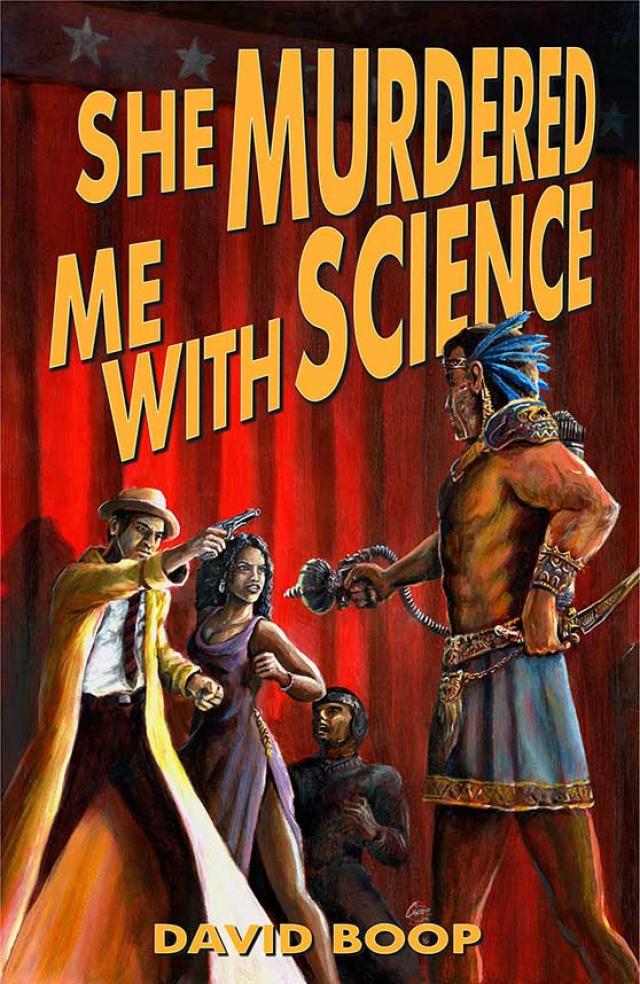
My name is Noel Glass. I once was a respected scientist and madly in love. All that ended in a splash of scarlet. I can never forget, and I will never forgive myself.
It’s 1953 and I’m a shamus working the streets of Industry City. I don’t rely on instinct; science is my game. The cases I get, and the booze I drink, keep oblivion just a step away. That is, until some rich recluse walks in and tells me that accident from all those years ago was a set-up, a frame job, and I was meant to take the fall.
Now I have to clear my name … like that’s easy. Everyone’s keeping secrets. Who can I trust? My neighbor, the mysteriously connected Wan Lee? Or the songbird Merlot Sterling? Her lies are almost as beautiful as her voice. Even the muscle-bound bodyguard I inherited can’t keep the hit men, spies—or my own government—from trying to put me six feet under.
You see, this secret organization believes I know something and wants to keep me quiet. All I do know is they’re aiming to remake the world into their own twisted image using a device I created. They’ve already axed one world leader, and Ike could be next.
God, I could use a shot of bourbon and some answers, but neither comes cheap these days.
Kobo Edition – 2017
WordFire Press
wordfirepress.com
ISBN: 978-1-61475-563-0
Copyright © Copyright © 2017 David Boop
Originally published by Flying Pen Press 2008
“T’aint Nobody’s Bizness If I Do”
Words and Music By Porter Grainger, Clarence Williams, Jimmy Witherspoon,
Everett Robbins, and Robert Prince.
Original Copyright (c) 1922
Public Domain
“Who'll Chop Your Suey (When I'm Gone)”
Words by Rousseau Simmons
Music by Sidney Bechet
Copyright (c) 1926 UNIVERSAL MUSIC CORP.
Copyright Renewed
All Rights Reserved Used by Permission
Reprinted by Permission of Hal Leonard LLC
All rights reserved. No part of this book may be reproduced or transmitted in any form or by any electronic or mechanical means, including photocopying, recording or by any information storage and retrieval system, without the express written permission of the copyright holder, except where permitted by law. This novel is a work of fiction. Names, characters, places and incidents are either the product of the author’s imagination, or, if real, used fictitiously.
This book is licensed for your personal enjoyment only. This ebook may not be re-sold or given away to other people. If you would like to share this book with another person, please purchase an additional copy for each recipient. Thank you for respecting the hard work of this author.
Cover design by Rob Carlos
Cover artwork image by Rob Carlos
Edited by Peter J. Wacks
Kevin J. Anderson, Art Director
Kevin J. Anderson & Rebecca Moesta, Publishers
Published by
WordFire Press, an imprint of
WordFire, Inc.
PO Box 1840
Monument, CO 80132
Contents
Praise
Book Description
Title Page
Dedication
Prologue
Chapter One
Chapter Two
Chapter Three
Chapter Four
Chapter Five
Chapter Six
Chapter Seven
Chapter Eight
Chapter Nine
Chapter Ten
Chapter Eleven
Chapter Twelve
Chapter Thirteen
Chapter Fourteen
Chapter Fifteen
Chapter Sixteen
Chapter Seventeen
Chapter Eighteen
Chapter Nineteen
Chapter Twenty
Chapter Twenty-one
Chapter Twenty-two
Epilogue
Afterword One
Afterword Two
Afterword Three
Afterword Four
About the Author
If You Liked …
Other WordFire Press Titles with David Boop
Dedication
Dedicated to Margaret “Peggy” Boop
June 21, 1936 – January 21, 2013
Prologue
Rain could wash the filth from Industry City, but it couldn’t cleanse the smell born of manufacturing and human waste.
To the completely hairless man running down the alley, it smelled like death.
He didn’t want his name, yet he was born with it. He didn’t want the job life had given him, yet that job was going to get him killed.
He didn’t want enemies, but they were there … hot on his trail. How could they find him, he thought, in the darkness, in the rain?
The man tried blending into a wall or hiding behind a garbage can, but nothing he did could shake his pursuers. He had been tagged and now was as good as dead.
The short time he had been running seemed like hours. Noise drew him down another alley. The unmistakable sounds of a party lit a fire under his feet. Fear found an untapped reserve of strength hidden inside his soul. He spent the last of his adrenalin sprinting the final leg. The splashes of his steps fell in unison with his erratically beating heart.
He stumbled from the alley’s opening into sensory overload. There were lights and music and voices. Disorientated, he pushed his way through a throng of people only to be shoved and kicked in return. His peripheral vision caught an Atlantic Brewing Company banner announcing 1953 St. Patrick’s Day Celebration Tonight!
He cloaked himself in the revelry, shielding himself from his attackers. He pulled the collar of his soggy raincoat up, exposing as little of his smooth exterior as possible. Tilting his head to the sky, he let the deluge cleanse his soul. Despite the temperature, he felt warm. Maybe it was his blood, no longer running cold at the thought of capture and death. As the stress drained with the pouring rain, a chuckle erupted from the back of his throat. The scientist laughed louder as conviction grew inside of him. He would live for another night and seek help tomorrow. He’d find the man who could save his life … if he would.
A group of partygoers noticed the hairless man and patted him on the back. He reveled in their camaraderie, something he was not used to. They slapped a beer into his hand, and he drank it down heartily. He still had some cash on him, so he offered to return the favor. He moved through the crowd to the beer stand. The scientist thought that if he stayed with the crowd, stayed low and inconspicuous, he might be able to leave when they left and get back to his apartment unnoticed. He was happy Fortune had smiled upon him at last.
At least, until his head exploded from the inside.
The police would find no one else hurt. Psychological scars would be the only damage to those bystanders that had to pick pieces of flesh and brain from their hair and
On the top floor of the tallest building in the city, one man knew the answers. He knew the name of the hairless man, what had killed him, and why.
He also knew that knowledge would mean his death, as well.
Six Months Later
Chapter One
The first thing I realized, as the synapses fired in the gray matter I called a brain, was that I couldn’t feel the left side of my face. I was semi-sure this was due to the metal table I had fallen asleep on … again.
I was also pretty sure the feeling would return to my cheek if I’d just get up from my slumped position; however, one could never be too sure. I mean, this had happened almost every night for two years now and blood would flow freely through my cheek as soon as I moved, but what if …
What if this was one time too many? What if, by passing out at my lab table for the umpteenth time, I had permanently damaged the nerves in my face? I could have a drooping left side that would forever keep me from finding the future Mrs. Noel R. Glass.
Oh, well. There were always call girls.
I sat up and slowly rubbed life back into my stagnant cheek. I flexed my jaw, blinked my eyes at the morning sun streaming in, and stretched. When all my body parts were working to expectations, I concluded that this morning was already starting out much better than yesterday.
The day before had begun with Mrs. Lupton and a third scolding about late-night noises wafting from my apartment. It’s unfortunate that no one has invented a quieter centrifuge machine, but try to tell her that. She also took the opportunity to remind me that I was two weeks overdue on my rent.
No, yesterday had not started out well.
Today, however, things were looking up. Last night I had solved a nasty problem on The Atlantis, my hydro-car. I know the idea of a car that runs on water must sound like something straight out of a Flash Gordon serial, but it was flights of fancy that led me to become a scientist in the first place. I wanted to make the unreal, um … real.
The Atlantis was one of a select few blueprints I had managed to abscond with when I had been removed from my position at the Theoretical Science Department of the New Mexico Institute of Technology. My job had been to take scientific discoveries and design practical uses for them. I was the bread and butter for the college. Both the government and the private sector paid well for anything I designed. Until … until I made the unforgivable error, the one all scientists fear, and it cost six people their lives. Guilt would forever be my mistress. I’d lost everything that mattered to me.
Even after the inquest cleared me of negligence, I was surprised I didn’t do jail time. I’d been a golden boy for so long that without serious proof to convict, the government and the college just let me slip away once the hoopla died down. My reputation in ruins, I knew I might need a bargaining chip someday. Those blueprints were the chip, and today was the day.
As I looked around, I spotted the bottle of Old Johnny already empty in the trash. I guess I celebrated before passing out. That would account for the hangover I was feeling the first inklings of.
It was weird thinking of the libation as a celebratory device. I had been using it for so long as a sedative, something to settle down my rage, that it now seemed a part of the inventing process. If these designs brought me out of this mediocrity I called a life, I might have to give up the stuff.
Or, at least, buy better stuff.
You owe yourself this, Noel, I thought. Today you can start showing your face in public again.
Of course, I still needed money, lots of it. First I’d have to get a prototype car made. Nobody would take me seriously without proof. Then I’d need good clothes. I had hocked all my good clothes for food when my savings had previously run dry. Now all I owned was a trench coat, a hat, and some respectable street clothes.
The snoop jobs I took since becoming a private investigator were barely enough to keep a roof over my head, some food in my gut, and to supplement my personal research.
I stretched again, farther than before, and finally felt something pop in my back. I shook out my arms and legs, feeling the last vestiges of my poor sleep habits slide from my body. I needed to move around, so I walked through my three-room cell. I had converted both bedrooms into workspaces: one for the lab, the other as an office. When I did actually fall asleep like normal people did, it was on an old couch in the combined living room/kitchen. I left all the windows covered, save for the kitchen. That way I’d have a rough idea what time of day it was when I woke.
Despite being early morning, the Little Osaka district buzzed with the daily chaos. The barbecued-duck vendor bullied passersby on the sidewalk; carts rushed down side streets hauling herbs, roots, and rice to the restaurants before they opened; and kids pushed giant hoops down the middle of the road, much to the consternation of motorists.
It was 1953 and the view out this window didn’t look much different than 1952 had, nor the eleven years prior to that. The world had changed, though. Communists had replaced Nazis as the “big bad.” Police regularly raided Russians’ homes on tips called in from little old ladies who swore their Chechen neighbors planned to kill the president because they never “talked proper American.” The problem was more people had televisions, which fed the hysteria. The networks were all tuned in to Senator Joseph McCarthy’s hearings and watched him proclaim that the “Red Menace” was around every corner. Meanwhile, the leathernecks had just finished ruining the landscape in Korea and were coming home. We hadn’t dropped the bomb, but then the Russians and Chinese had stayed in the shadows, not forcing our hand. And to top everything off, the price of milk was up.
Good thing I drank hooch.
As I put stuff away, I scanned my rows of test tubes, beakers, and retorts. Each cent spent on them was worth it. Science was the tool for both my short and long-term goals. I used my genius to solve crimes, all the while designing the key to the prison of my own making.
One more snoop job—a big one—and that’s it. I was out.
The phone rang as if destiny had a wiretap in my mind. The voice I heard didn’t carry with it the dollar signs I needed, though, but it might be enough to get old lady Lupton off my ass.
“Glass? You conscious?”
“Yeah, Sweet. I’ve been up for close to thirty seconds.”
Police Chief Charles Sweet was anything but. He was worse when he had to call me. That meant he was up shit creek and using his hands to row.
“I need that crap you fling around. What’s it called? Foreplay?” The rhetorical question came accompanied by a small, sarcastic chuckle. He knew what it was called. Sweet loved yanking me around.
“Forensics.”
“That’s it. Be here in a half while the scene is still fresh.”
He gave me the directions and rang off. I’d never make it in thirty minutes, so I didn’t try. If Sweet was going to be moodier by the time I arrived, oh well. He hated science and loved instinct. He’d throw a guy in jail for murder just by smelling him. That is, if the courts would let him.
I checked to see if the communal bathroom was open. Unfortunately, it was. It must’ve been all-you-can-eat night at the Thai place down the street. I had wanted to get in and out, not spend ten minutes decontaminating it first.
After my shave, the smile that blessed my face held promise, like it might be there a while this time. I tightened my tie, slipped on my jacket and bundled my toiletries in a towel.
As I walked down the hall, the door next to mine opened. The nearly midget form of Mr. Wan Lee backed out slowly, not sensing my presence. Once the door was closed, Lee turned, startled.
“Ack, Glass! You frighten me. You lucky I not packing.”
I always laughed internally at Lee’s broken English interpretations of gangster slang. His regular English was not bad, but since he started watching Cagney, he tried too hard to incorporate that image into his lifestyle.
I firmly held on to the notion Lee was somehow involved with the Japanese mafia. He kept odd hours, had plenty of money, and brought home dozens of people at a time, and they all had the same last name: Lee.


