Lords of the earth, p.1
Lords Of The Earth, page 1


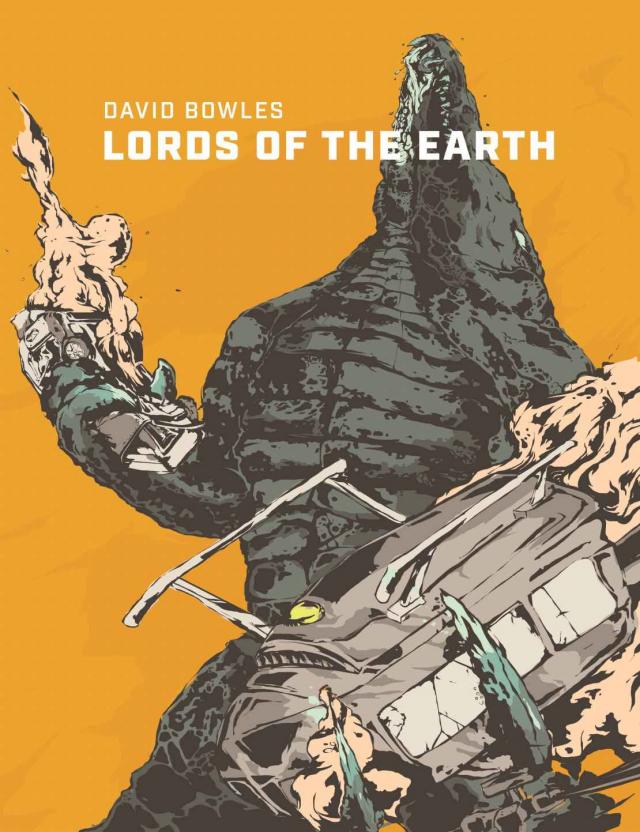
LORDS OF THE EARTH
David Bowles
Copyright 2016 by David Bowles
PROLOGUE: POPOCATEPETL
Popocatepetl had reverted to relative calm after the eruptions of 2016, but CENAPRED, the National Center for Disaster Prevention, continued its constant vigil of the volcano, aided in these telemetric observations by the Mexican Secretariat of the Interior and experts from the National Autonomous University of Mexico (UNAM), as well as the collaboration of the US Geological Survey’s Cascades Volcano Observatory.
A week before the First Emergence, all fifteen stations on the slopes of Popocatepetl began to detect seismic activity as well as a spike in the levels of SO2 and CO2. The telemetry, analyzed by CENAPRED’s processing hub, triggered a series of automated messages to private cell phones and email addresses. Within the hour, the Scientific and Technical Advisory Committee—made up of researchers from UNAM and CENAPRED—met to review more than fifty telemetric signals. The committee immediately recommended the government institute a phase-3 yellow alert and evacuate a radius of twenty kilometers.
The decision saved thousands of lives, a relatively small comfort given the millions of deaths to come.
For four days, nearby Mexico City and Puebla experienced a tremor or two every twelve hours, the shocks hovering around 2.5 in magnitude. Then, on the morning of the fifth day, Popocatepetl erupted violently with the force of 18 megatons of TNT, sending a column of ash fifteen kilometers into the air and a wave of lava—the pyroclastic flow—rushing down the slopes at 300 km/h.
Everything in a ten-kilometer radius was obliterated. For another fifteen kilometers beyond that, trees and structures were cropped close to the ground. Mere minutes after the eruption, the entire Izta-Popo Zoquiapan National Park had been laid waste, and several nearby towns were scorched and shattered.
As the plume spread tephra into the stratosphere over the next eight hours, it triggered torrents of volcanic ash rain through which lightning jagged ferociously, kindling fires among felled trees throughout the park.
Beneath the ugly bruise of the sky, relief efforts began in the seared zone around the blast area, and prevailing winds off the Gulf pushed the ash toward Mexico City, where fifteen centimeters soon coated cars and streets, exacerbating the accustomed smog and causing multiple deaths from respiratory failure and collisions. The day after the eruption, the sun never shone on the capital. During that ominously long night, citizens were urged to remain indoors at all costs. Private automobiles were prohibited from circulating.
The seventh day after Popocatepetl’s quickening, the flow of magma suddenly ceased. To investigate, a CENAPRED technician named Julio Quintero Flores guided a drone over the smoking caldera. Its camera captured something truly inexplicable.
Buoyed by black slag was a huge ovoid stone, two hundred meters from tip to tip.
The director general of CENAPRED, Miguel Ramos Zepeda, immediately reconvened the Scientific and Technical Advisory Committee, and initial hypotheses were put forth in a barrage of data-driven speculation as members drew on their own expertise and robust webs of research connections.
None of them could have possibly guessed at the truth.
At 7:49 a.m. on the third day since the explosion, as the committee watched in silent horror, the massive stone split like a cocoon. Wedging themselves into the crack came six sapphire talons the length of pickup trucks, glinting in the half-light as they slowly pried the ellipsoid open. Then, through that gaping crack, something unspeakably massive clawed its way out into the pumice-choked, steaming air.
The drone caught a quick glance at a white-hot impassive eye before the signal went dead.
CHAPTER ONE: ELENA
For Elena, it was as if her very heart had been wrapped in a funeral shroud. The oppression of the ashy darkness triggered horrible memories, experiences that she normally kept at bay with work or drink. The city shrank until it was the confines of a closet, the strange men just outside the door, laughing as she cried, gagging her when she screamed.
Her voice had not been strong enough to save her as a child. As a woman—respected scientist, author, TV host—she strove with every passing day to remedy that weakness. Yet Don Goyo (as she and her colleagues lovingly referred to Popocatepetl, living embodiment of Mesoamerican grief) had burst his heart at last, plunging the central highlands of Mexico into bereft black. She once again felt trapped, cut off, enervated.
The short blast of a horn sounded faintly, cutting through the gloom.
“No rest for the wicked,” she muttered to no one, shaking off the doldrums as she slid her tablet into her bag. Dropping a broad hat onto her loose brown curls, she locked the door to her condominium and headed for the elevator.
A car from Canal 22 was waiting for her at the curb just outside her apartment building. The driver inclined his head toward her as he opened the back door, a handkerchief clapped to his mouth against the ash.
“Morning, Dr. Baz,” he said, his eyes crinkling with a hidden smile. “Weather sucks, doesn’t it?”
“Pretty much, Juan, yeah.” She slid into the seat, taking her hat off and shaking the ash off onto the sidewalk. “That’s what happens with plinian eruptions, even a VEI 4 like this one.”
He squinted. “I’d ask what the hell all that means, but I guess I’ll just wait for your show this Sunday.”
“Every viewer counts,” she quipped, arching an eyebrow.
“Well, there’ll be no show if we don’t get moving. Watch your foot.”
Soon he was behind the wheel and they were headed to Churubusco Studios, just a short distance from Elena’s home in the Country Club neighborhood of Mexico City’s Coyoacán borough. On one of the smaller soundstages, her weekly science program Muñecos Cósmicos was filmed for broadcast on Canal 22, a channel managed by the Secretariat of Culture. When she had taken over hosting duties three years earlier, the series had been tottering on the verge of cancellation—several misguided studio changes had reduced it to the worst sort of pseudoscientific pabulum. Elena, with her government contacts, had fought to bring empirical rigor back to the show without destroying its quirky sense of fun. Part of that transformation had been moving production out of the station facilities to this more cutting-edge studio, nestled in the sprawling complex that now loomed in the half-light like a besieged castle.
The streets were mostly empty, save for a few pedestrians with medical masks, and the gloomy parking lot seemed like the set of some post-apocalyptic horror film, replete with cars on which volcanic ash had settled like nuclear winter. Protecting herself as best as she could with her hat, Elena made her way inside. No sooner had she cleared security when her assistant Ramona approached, tablet in hand, an accustomed look of hurried concerned stamped on her features.
“Eddie wants to talk to you,” the younger woman said breathlessly, reaching out to brush ash off her boss’s shoulders. “He made changes to your changes.”
“Typical,” Elena muttered with chagrin, handing Ramona her bag and hat before heading to find the show’s producer. She had known Edgardo Santayana Creel since childhood—they had both attended Colegio Williams, one of the best private schools in Mexico City. He was a talented businessman with a sharp, creative mind.
He was also a sneaky little bastard.
“Alright, Eddie,” she sighed when she found him near craft service, sipping coffee. “What didn’t you like about my changes?”
“Not dramatic enough. The eruption is a massive story, the biggest in decades. People will be tuning into this episode like they never have before, Elena. It’ll be a ratings landslide. The tweaks you made on the science are fine, all that stuff about the sonic boom and so forth, but I want to stress the dangers. The graphics department is working on some truly epic animation to go along with the video clips, and I need you to—”
She arched an eyebrow. “Doesn’t all this strike you as being in really bad taste, given the rising death toll from people who ignored the evacuation order? Changing the episode at the last minute to explore the science behind volcanoes? That makes sense. But you’re pushing the limits of decency, Eddie.”
“Casualties. Exactly. Don’t you get it? We have an obligation to share worse-case scenarios with people, Elena. That way they’ll stop ignoring government instructions. We’re saving lives.”
Giving a half-hearted laugh, Elena shook her head incredulously. “You’re so full of shit, Eddie. Fine. Leave in my additions, and I’ll read your weak exercise in theatrics.”
He smiled. “Deal. Now go get yourself prepped. Sandra’s meeting with the camera guys, but she’s anxious to start shooting already.”
At make-up, Diego clicked his tongue at her as he picked ash from her hair and blouse. “Doc, really? You’re pale enough without coating yourself with a layer of grey. Ah, well. Nothing that some strategic rouge can’t fix.”
While he went to work on her, Elena closed her eyes and reviewed key points from the script. The words would scroll through a teleprompter, of course, but she’d found that she came off much more natural if she essentially had her talk memorized. She preferred not to loop anything in ADR if she could help it, not beyond the voice-overs required to narrate animation and video.
“Elena?”
It was Sandra Rivera Katz, the director for most of this season’s episodes, frizzy hair pulled loosely back in a ponytail.
“Hey.”
“So it looks like we might have to film the third segment before the second. Your guest has been delayed by
Diego pulled away the bib protecting her blouse, and Elena stood, nodding. “No problem. Ready when you are.”
Sandra hesitated a moment, looking down at the physicist’s right hand. “Um, Elena?”
“What?”
“Can you take off the glove?”
Annoyed, feeling that old powerlessness creeping in at the edge of things, Elena flexed the fingers of her prosthetic. “It’s ridiculous, you know. What matters is my knowledge. That’s what they’re tuning in for.”
“Come on, don’t be naïve. You get the fan mail. You know they love to see your myoelectric hand. You’re the ‘cybernetic scientist’ to millions of viewers, Elena. I know it feels exploitative, but you can’t accept their adulation on your own stuffy terms. That’s not the way this works.”
Cybernetic scientist. It wasn’t the only nickname people had for her. But Sandra’s larger point was well taken—she had sought the limelight, after all. Along with her eager work as a consultant to the military, it had given power to her voice, had lessened her sense of weakness. Her words and ideas were wielded on the national and international stage to combat many ills. The scales were by no means balanced, but it was a start.
The price, of course, was this objectification, this othering of her disability. At the end of the day, however, she preferred that dull ache to the impotence of her childhood memories.
“Fine,” she grunted, thrusting her sleeve up past her elbow and rolling down the silicon sheath that covered her military-grade prosthesis, all glittering black and silver. “If they want Star Wars, that’s what we’ll give them.”
Ramona swooped in from seemingly nowhere to take the glove, and Elena followed the director to the soundstage. Technicians fitted her with a lapel mic, and she sipped water while everyone ran through a systems check.
Sandra signaled everyone to silence, and then cameras began to roll.
“Good evening, friends. It’s a black day for Mexico, but science is a candle in the dark. Today on Muñecos Cósmicos, we’ll be discussing the eruption of Don Goyo and its repercussions for our country. I’m your host, Elena Baz Dresch.” Here, she reached out her metal and carbon hand to the camera, beckoning gently. “Won’t you walk with me on the edge of Occam’s Razor?”
“Jesus Christ!” someone shouted.
“Cut!” Sandra called. “Quiet on the set! Who the hell was that?”
The gaffer was gesturing at his smartphone. Other members of the crew had begun to cluster around him.
“It’s Amecameca. Somebody’s streaming live. There’s a … a freaking monster wrecking the city.”
Sandra scoffed. “No time for bullshit hoaxes, people. We have a show to film!”
One of the technicians switched the large monitor in the back to a news feed, catching a newscaster mid-sentence.
“… smashing houses underfoot, its tail digging enormous furrows in the earth. We go now live to our reporter Samuel Amador at the Amecameca city plaza.”
The image switched to a distressed man standing before the arch that led into the plaza. In the distance rose the charred and glowing slopes of Popocatepetl. As Amador spoke, the camera panned away to something that appeared larger—a lumbering behemoth obscured by drizzle and ash.
“I’m here in the heart of this vacation spot. Fortunately, most of the population was evacuated before or immediately after the volcano’s eruption, because … though it seems crazy to say it … the city is under attack by an enormous creature.”
Lightning cracked overhead, illuminating the monstrosity for a moment. It was covered with a rough, jagged carapace that scintillated with impossible hues of blue in the brief light. Elena could make out two staggeringly huge legs that towered as high as the Monument to Independence in downtown Mexico City.
Before she could contemplate the thing’s vastness further, the camera operator zoomed in on the Parish of the Assumption just as an enormous claw reached down and scooped it out of the ground, hefting the former monastery into the air and heaving it into the distance. Jerking and shaking, the camera followed the trajectory of pink stone as it shuddered apart mid-flight and went smashing into a distant part of the city.
Then there was a view of the ground as the camera operator began to run.
The news feed plugged in several other views of the destruction, live streams from social media and the like. The monstrosity’s tail, which appeared to end in talons or pinchers, flicked against the colonial-era arch. A smartphone caught the image of the medallion of Humbled Christ set in the keystone, cracking and exploding outward as the sandstone disintegrated.
The newscaster’s voice cut in, shaky and breathless.
“For those just tuning in, about forty-five minutes ago, something enormous emerged from the caldera of Popocatepetl. After making its way down the lava flows, it headed for the city of Amecameca, to which it is presently laying waste.”
Diego gasped. “That’s only a freaking hour away!”
Sounds of explosions and gunfire rattled the speakers. The television camera operator and field reporter had found a safer vantage point, and the screen now showed multiple impacts against the behemoth as arriving military began to pound it with mortar, rockets, and other projectiles. Elena recognized a dozen ERC-90 armored cars as they burst into the plaza, their 90-millimeter canon hurtling shell after shell.
The monstrosity shuddered under this barrage, bending over to present its awful face to the soldiers. White eyes like blazing suns peered from over a long, serrated jaw like that of a prehistoric crocodile. With a single almost dismissive motion, it swept the armored cars aside, sending them tumbling among the rubble in its wake.
The gargantuan thing took few more lumbering steps, and the newscaster began to speculate.
“The creature appears to be heading toward Sacromonte Hill, where…” a pause as someone muttered in his earpiece “…the Sanctuary of the Lord of Sacromonte was erected during colonial times over an ancient Aztec shrine.”
The behemoth slammed its claws into the hill and ascended quickly. From its silhouette against the slope, Elena judged it to be nearly 150 meters tall.
Impossible.
Nonetheless, the vast torso soon towered over the old church. That long jaw opened wide, and another, blunter snout—flashing blue-white and slimy with every flash of lightning—pushed forward and vomited a flood of iridescent bile that burst into flame as it hit the air and rained down on the sanctuary like napalm, reducing the buildings to slag in a matter of seconds.
The silence in the studio was absolute. Everyone stared at the screen, stunned. What could be said? What could be done?
In that quiet, Elena heard her phone ring, playing the theme to Carl Sagan’s Cosmos. Those sparse notes by Vangelis echoed ominously throughout the studio. She heard Sandra sob softly.
Ramona rushed toward Elena, clutching the phone like a holy relic.
“Dr. Baz, it’s for you. Urgent, he says.”
Elena took the phone in her myoelectric hand without thinking. The grip adjusted with a few twitches of her bicep.
“Who?”
“General Quiroga.”
Nodding, Elena lifted the phone to her ear.
“Marco. Let me guess. You want my help stopping it.”
CHAPTER TWO: ALFONSO
Alfonso Becerra Cruz pulled his headphones off at last, nodding as he scrolled back up through his proposal. He’d been working for nearly eighteen hours straight, shutting out the world with music, deliberately turning off his internet router and smartphone in order to resist the temptation to waste time with trivialities. He was aided in his focus by the perpetual gloom from Popocatepetl’s explosion, though he’d had to turn up the volume several times in the last two hours as a few slight tremors had spawned shrill sirens. This was Mexico City, after all. He knew the drill. It would take more than an uneasy metropolis to distract him.
His seclusion was not the idiosyncratic tic of a quirky archeologist. Alfonso had learned the hard way, putting himself through college while working a full-time job and moonlighting in restaurants as a mariachi singer—distractions sapped his intellectual energy. During crunch time, he removed himself from the world completely. And today definitely qualified as crunch time. It was vital that the Council of Archeology from the National Institute of Anthropology and History approve his proposed dig near Toluca, where he had recently discovered evidence that Olmec influence had spread even further into the highlands than Zazacatla.