A troubled course, p.1
A Troubled Course, page 1


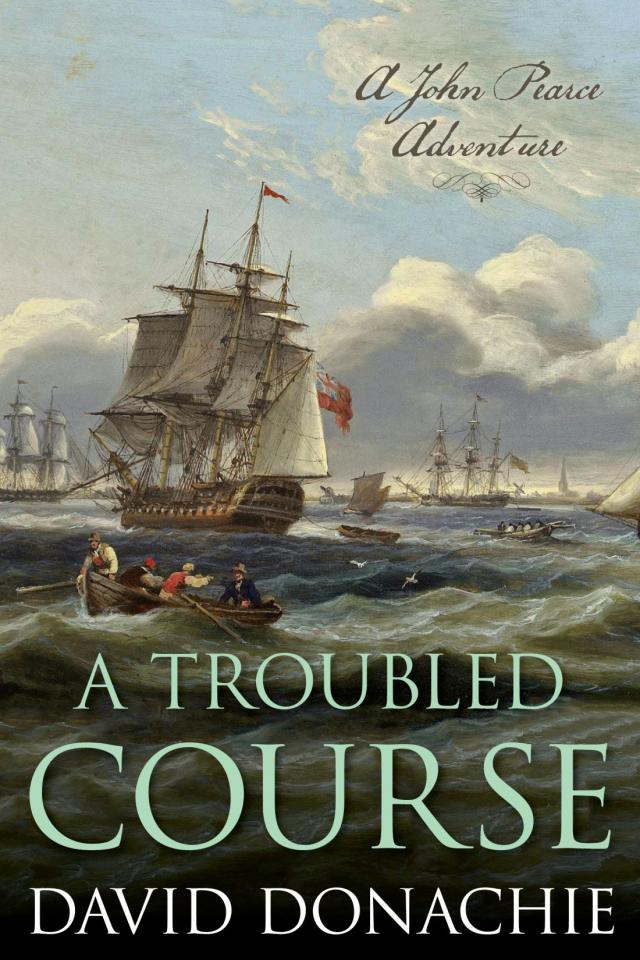
A Troubled Course
David Donachie
Essex, Connecticut
An imprint of Globe Pequot, the trade division of The Rowman & Littlefield Publishing Group, Inc.
4501 Forbes Blvd., Ste. 200
Lanham, MD 20706
www.rowman.com
Distributed by NATIONAL BOOK NETWORK
Copyright © 2023 by David Donachie
All rights reserved. No part of this book may be reproduced in any form or by any electronic or mechanical means, including information storage and retrieval systems, without written permission from the publisher, except by a reviewer who may quote passages in a review.
British Library Cataloguing in Publication Information available
Library of Congress Cataloging-in-Publication Data
Names: Donachie, David, 1944– author.
Title: A troubled course / David Donachie.
Description: Essex, Connecticut : McBooks Press, [2023] | Series: A John Pearce Adventure | Summary: “John Pearce discovers that Madrid plans to desert the British-led coalition and join the enemy. In company with Lord Langholm, he has taken a Spanish treasure ship. But a violent Atlantic westerly forces them into a deep bay overlooked by Spaniards, who have created a trap with cannon on the heights aimed at the narrow entrance. Pearce must find a way to get Lord Langholm’s frigate and the damaged Santa Leocadia through the same bottleneck. Will he succeed, or will John Pearce, HMS Hazard, and the Pelicans pay the ultimate price of failure?”—Provided by publisher.
Identifiers: LCCN 2022014206 (print) | LCCN 2022014207 (ebook) | ISBN 9781493068883 (hardcover : alk. paper ) | ISBN 9781493070664 (electronic)
Classification: LCC PR6053.O483 T76 2023 (print) | LCC PR6053.O483 (ebook) | DDC 823/.914—dc23
LC record available at http://https://lccn.loc.gov/2022014206
LC ebook record available at https://lccn.loc.gov/2022014207
The paper used in this publication meets the minimum requirements of American National Standard for Information Sciences—Permanence of Paper for Printed Library Materials, ANSI/NISO Z39.48-1992.
To David and Margaret Rose
and in memory of
their lovely librarian daughter
Caroline
Chapter One
John Pearce was sure everything would have gone as planned if the weather had not changed so drastically. Such an occurrence could hardly be a surprise given the position they occupied on the Atlantic shore of the Iberian Peninsula. It was an area subject to huge rollers at the best of times, as well as being at the mercy of sudden changes in the conditions. Severe storms could come in from the Caribbean or the Southern Ocean, creating the kind of monstrous and crashing waves which had, over millennia, shaped the rocky shoreline and, no doubt, the character of the people.
It was only later he reflected on this, reasoning that folk who lived by and depended on such an unpredictable sea, and too often died from the way it behaved, had a natural resilience not gifted to everyone. Yet, even if the increase in the strength of the wind was noticeable, creating the need to watch out for the unexpected movement of plates and goblets at the dining table, there was no expectation of danger. Neither he nor his fellow commanding officer, Captain Lord Langholm, felt the need to react to the changing circumstances.
The need they might be obliged to do so was flagged up by both the sailing masters, of Lord Langholm’s vessel HMS Lively and Mr Williams of HMS Hazard, who were alarmed not just by the increasing wind but also by the cloud formations visible on the horizon. The news was imparted in a whispered exchange by his man to Langholm, he being the senior, and this happened as the officers of both vessels were near to completing, in all respects bar one, what had been a capital dinner.
The circumstances surrounding the recent taking of the Spanish frigate, the Santa Leocadia, less than twenty-four hours earlier, welcome as the result had been, provided a raw memory for John Pearce and his two lieutenants, Hallowell and Worricker. This applied as well to the acting-lieutenant he had mustered under the name of Macklin. The braying self-congratulation of the Lively’s officers meant that bitter recollections had to be kept hidden, nothing less than the relative merits of who had done what to affect the said capture.
The bulk of the action and the danger therein had been borne by the crew of HMS Hazard. It was they who had engaged the Spaniard in an exchange of gunfire, which had prevented it from making its escape. Then Langholm and his much larger complement (Johnnies come lately) claimed the glory and the prize at practically no cost to them in terms of either the effort or casualties sustained.
It was telling that the surgeon of Lively was present and busy getting drunk. His opposite number, Mr Cullen, was still aboard Hazard, dealing with the casualties the action had engendered in a fiercely contested and opposed boarding. Naval good manners might demand that such a variation in recent experience could not be openly referred to, but it would have been a blind man who failed to notice the peaked expressions from the Lively’s guests, when their hosts loudly praised their own gallantry.
Offsetting such justifiable pique was the nature of what the Santa Leocadia had been carrying, and indeed the reason why she, an ostensibly allied vessel, had been intercepted. In her holds she was transporting an extremely high-value cargo of South American silver, needed by the Spanish government to facilitate a policy of betrayal. If she was accepted as a prize, it could make a great deal of money for all attending the dinner.
It was impossible not to compare the rewards with that which had been awarded to the frigate Active, in company with the sloop Favourite, in the year ‘62. They had taken the Spanish vessel Hermione only to find, in her holds, bags of gold dollars and ingots of silver. This and the ship cannon and head money together led to the largest payout of prize money in the history of King George’s Navy.
In the case of both captains, who were entitled to a three-eighth share of the proceeds of the recent capture, it would render them seriously rich, though Langholm would be obliged to pass on one-eighth to his commanding admiral. John Pearce, sailing under Admiralty orders, had no such requirement. Their inferior officers and midshipman, also well rewarded, could go from impecunious lieutenants to sought-after fellows in the article of matrimony, while the crew, from warrants down to the meanest waister, could look forward to sums that would match years of pay.
Both captains knew it would be necessary to manage expectations, there being a process in such matters, which could take years to reach a conclusion. Prize courts could be fickle and pernickety, while there were any number of people dipping their beaks into the trough along the way: assessors, lawyers and, not least, the agents acting on their behalf, who would extract a high commission. It was also the case for the common seaman; they were signed up for the duration and no amount of prize money would alter this.
‘Gentlemen,’ Langholm said as he got to his feet, something which attested to both his youthful appearance, allied to his lack of inches, ‘The King.’
A toast which was mandatory also served as an indication that the gathering was nearly at an end. So, once the monarch had been acknowledged and praised, the conversation flagged and the well-wined guests slowly made moves to disperse, no doubt still discussing how they would spend their windfall. It required no obvious signal from Langholm to John Pearce that he should hold back, with the latter being naturally curious as to what had been whispered in his colleague’s ear.
‘I am bound to say,’ was the reply, when told, ‘I have a limited amount of faith in Mr Williams.’
In imparting this, John Pearce saw no need to elaborate, to say the master of HMS Hazard, on one previous occasion, had come up seriously short in his weather predictions. Langholm’s response was to insist that the opinion he held on his man, McAllister, was the polar opposite: he trusted him absolutely. He then invited Pearce to look at the barometer, pointing out the mercury had fallen considerably.
‘So, I suggest we take a look at Mr McAllister’s troubling sky ourselves.’
The words were accompanied by a wry smile. This implied, Pearce thought, it would be more for appearance than any desire to question those held to be expert or the mercury reading just taken. Coming on deck, the change in the weather was many times more obvious than it had been when seated in the great cabin, where the only evidence had been an increase in the rocking motion. The warm wind, previously steady, was now much stronger and gusting, tugging at both their coats and the anchor cables, at its peak requiring a hand hold on to their hats.
The sun, previously bright in a clear sky, now had a watery quality, it being partly obscured by haze. But it was what lay far out to sea which presaged a severe deterioration, high banks of cloud, in which the darker tumult of activity was obvious even at a distance. Also, outside the cove in which they were anchored, the increasingly disturbed sea state was palpable, while the run of the waves and their increasing height raised questions as to the safety of their present anchorage.
The outer part of Pontevedra Bay was protected from an easterly gale by the Island of Ons, but it was dangerously open to anything approaching from the southwest, the quarter from which the menace threatened. It was natural for Pearce to cast an eye over their capture, which lay alongside Lively, and take in once more the damage inflicted on the Spanish frigate by Hazard’s cannon. He then had good cause to wonder if the repairs so far undertaken, work which was continuing as he watched, would be sufficient to stand, out in open water, the kind of blow which appeared to be in the o ffing.
The massive damage to the stern of the Santa Leocadia was easy to hide by the use of planks and stretched-over canvas, visually reassuring, but hardly sturdy enough to cope with a heavy following sea. More importantly, the wounded masts, both main and mizzen, would be a worry. It had been the intention, following an inspection by bosuns and carpenters, to use battens and frapping to make them more secure. But again, would this hold through what might be a proper tempest?
‘An opinion, Mr Pearce?’
It was, in a sense, a reprise of an earlier exchange, which referred to the notion of HMS Lively escorting the Spanish frigate back to England. Pearce had posited it would be risky for such a damaged vessel to spend too much time at sea, a danger made worse by the waters through which they would be required to sail. Apart from the risk of interdiction by a vessel of the French fleet, based in Brest, the waters off the Brittany were among the most treacherous in creation. Safer, he maintained, to take the shorter route to Gibraltar.
For Pearce, this posed a conundrum outside what the damaged vessel would and would not withstand. Having established, without doubt, that Spain intended to desert the coalition fighting Revolutionary France and to instead ally with Paris against Britannia, his duty and orders were clear. He was to proceed immediately to Corsica to advise Sir John Jervis, the admiral in command of the Mediterranean Fleet, of the peril he now faced from such a naval combination. He had the ships necessary to contain France and Spain piecemeal, but it was seriously questionable if he had the force required to face them both.
Quite apart from the inadvisability of Langholm weighing for Pompey with a serious storm brewing, added to the other dangers to be faced, Pearce was looking at a vessel full of the said Peruvian silver, the value of which he could only guess. He was loath to part company and leave what would follow in the hands of the man he was standing next to, being far from prepared to repose so much trust. Also, there was more the possibility of substantial wealth to be gained once the cargo was landed in England.
A degree of glory and public approbation would ensue as well, which might be to advantage in his personal relations. Although Pearce might insist that such a thing as fame and glory held no attraction for him, there had to be a residual desire to share in any which was going. Quite apart from his private life, it would serve as a poke in the eye to those numerous officers who hated his very name. This ill will arose not only for the way he had risen from midshipman to his present rank of lieutenant, but also the employment and good fortune he’d enjoyed since.
‘Would it be sensible to take an already damaged vessel to sea, carrying the cargo at present in her holds, regardless of the proposed destination, when we know, the weather is set to deteriorate?’
‘With which I can only agree,’ Langholm drawled.
Pearce was wondering what thoughts were going through his mind, behind a bland expression, for another possibility must have occurred to Langholm, namely, to transfer the silver to Lively. The option of Pearce using his own ship was impossible. Hazard was too small, not that the frigate was gifted with an excess of space. With such a cargo taking up what little existed, it would be a severely overcrowded ship, one which would be required to plough its way to whatever end point was agreed upon.
And there was another problem. Silver in such quantity was heavy, so would affect the sailing qualities of any vessel which had it aboard, dangerous should a recapture be attempted. This would lead to a fight, or flight, if the opposition was too strong. Indeed, both men had failed to realise, in the recent action, how this very problem must have impacted on the decision making of their Spanish opponent.
‘I think my cabin, Mr Pearce,’ was a very non-committal response, from a man who could draw as many conclusions as the person addressed.
They entered a space clear of the extra leaves in the dining table, with a bulkhead thrown up to turn the foremost section into a place of work. Langholm, after another quick look at the barometer, followed by a frown, whipped off his hat, took his chair and invited Pearce to follow suit. This was done silently, which continued as the man began to tap fingers on his desk, clearly deep in thought.
‘Would I be permitted to enquire as to your thinking?’ Pearce asked finally.
‘If the mercury is telling the true situation, we are in for the kind of blow to make any notion of putting to sea inadvisable even for our own ships.’
‘I would counsel such, if asked.’
Was there a note of resentment in the response? A full post captain, Langholm seriously outranked Pearce and, in normal circumstances, would have been in a position to issue orders. But with HMS Hazard sailing under an Admiralty pennant, Langholm’s seniority did not apply. John Pearce could ignore admirals if he so chose, but it seemed wise for him to be emollient.
‘And I would most assuredly have asked, sir.’
‘It is paramount we preserve both our own vessels as much as the Santa Leocadia?’
It seemed an odd point and obvious, to which there was only one answer, and it was in the affirmative. At which point Langholm called out, ‘His master should be asked to attend.’ The fellow who obliged, the one who’d whispered in his captain’s ear at dinner, was not long in coming. He was a bulky fellow with wild grey hair topping a face so ruddy, it evidenced the extent of the weather to which it had been exposed.
‘Mr McAllister, have you had a chance to survey the holding ground?’
‘Put a couple of my mates to it right off, soon as we anchored.’
‘And?’
‘It’s not where I’d want to be a’laying in a south-westerly gale. Seabed is soft sand and, under pressure, we could drag our anchors.’
‘Which is what you reckon we’re going to have to contend with?’
‘Looks that way, sir, and Mr Williams concurs.’
The languid Langholm eyes took in Pearce’s then, obviously an invitation to comment, and one which was declined. Opinions vouchsafed to a fellow ship’s commander were not to be shared with others of a lesser rank.
‘And your solution?’
There was a moment where John Pearce felt a tad uncomfortable. It was as if the question posed was one to which Langholm already knew the answer. The whisper at dinner had not been either one sided or overly short in duration. Yet he had such a laconic manner it could easily be that he had misread it.
‘You know what the risks are as well as I gentlemen,’ McAllister replied, his look taking in both officers. ‘This is no bay in which to be cast loose, what with the rocks not far off in the southern part of the roads, just awaiting to rip out a keel. Best off inside the bar protecting Pontevedra Bay, there not being any weather known to man to cause us bother there.’
Pearce required no deeper explanation. He had been made aware of those very dangers just alluded to before he engaged the Santa Leocadia, information which had dictated much of his subsequent actions. The actual bay was a deep bight surrounded by high hills, but to access it required any vessel entering the inner section to dogleg through the said bar, by way of a narrow channel. Relatively safe at high tide, the bay was much less so at low, the factor which had so seriously disadvantaged his Spanish opponent.
‘I’d suggest that’s where we should anchor till the storm blows itself out. Tide will be full afore the first dog watch and it will be light till after eight bells.’
‘You believe we should act so quickly.’
The ruddy countenance took on a troubled look. ‘Milord, I believe the devil waits for no man, be he ever so high and holy.’
‘The Spaniard?’
Given the work being carried out on the Santa Leocadia, she was not in a fit state to employ sail.
‘We has boats enough to warp her through the channel.’
‘Mr Pearce, it is a course I suggest we should follow, do you concur?’ Responded to with a degree of hesitation, as the man asked was still pondering on his orders, Langholm added, ‘I intend to follow Mr McAllister’s advice.’
‘It seems the safest way to act. I will return to Hazard and set things in motion.’
‘Can I suggest you lead the way, being the vessel drawing the least water?’