Kanazawa, p.1
Kanazawa, page 1


Published by
Stone Bridge Press
P. O. Box 8208, Berkeley, CA 94707
TEL 510-524-8732 • sbp@stonebridge.com • www.stonebridge.com
Book design and layout by Peter Goodman.
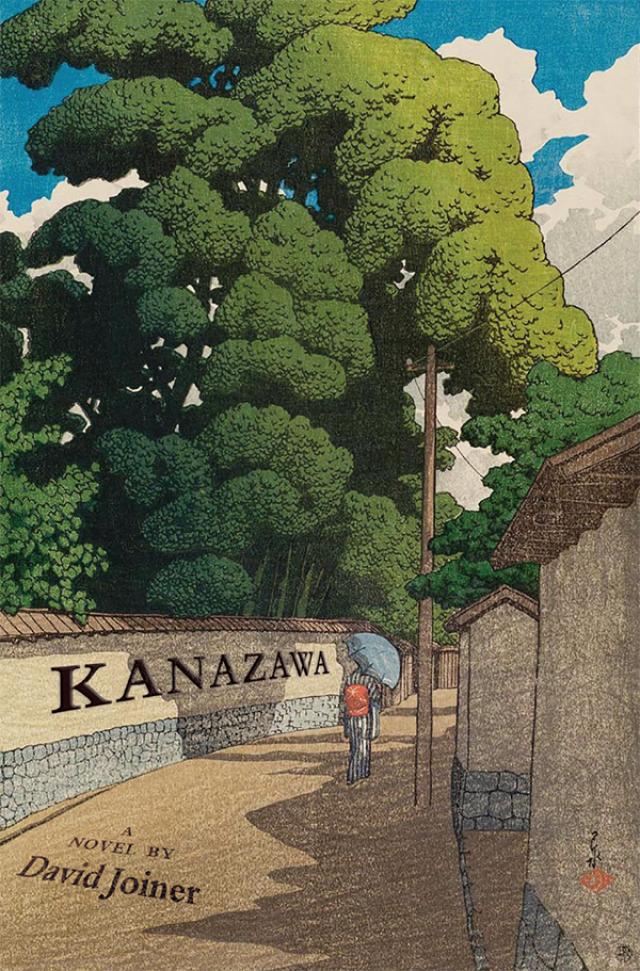
Front-cover illustration by Kawase Hasui: Shimohonda-machi in Kanazawa (Kanazawa Shimohonda-machi) from the series Souvenirs of Travel II (Tabi miyage dai nishū); in public domain. Map background from Shutterstock.com. Snowflake-crystal designs from Sekkazusetsu, published in 1832 (National Diet Library Digital Collection).
The translation “All living things . . .” is from The Manyoshu: One Thousand Poems Selected and Translated from the Japanese (Tokyo: Iwanami Shoten, 1940).
Text © 2022 David Joiner.
All rights reserved.
No part of this book may be reproduced in any form without permission from the publisher.
Printed in the United States of America.
First printing, 2022.
p-ISBN 978-1-61172-071-6
e-ISBN 978-1-61172-953-5
for Harue
KANAZAWA
“Time flows in the same way for all human beings; every human being flows through time in a different way.”
KAWABATA YASUNARI, BEAUTY AND SADNESS
1
OVER THE COURSE OF Kanazawa’s long winter, February was the whitest month.
As Emmitt stood before the living room window, a heavy snowfall muted the wail of a passing ambulance and the illumination of its red emergency light. Although the ambulance’s interior was brightly lit, he couldn’t see anyone in the vehicle, not even the driver at the near window.
A moment later the ambulance dissolved in the snow. What remained was the reflection of his wife Mirai and her mother cooking dinner behind him, and he resumed his surreptitious observation of them.
Over the sounds of cooking, and the TV his father-in-law was watching, a brief conversation arose.
“You’re quiet tonight, Mirai. Is everything all right?”
“Am I? Maybe I’m a little tired.”
“Haven’t you been sleeping?”
“I’m fine, Okāsan.”
Half an hour ago, when Emmitt was changing out of his university teaching clothes upstairs, Mirai had confessed to having second thoughts about the lease they were to sign in two days. They had agreed to renovate and rent for fifty years the one-hundred-and-twenty-year-old machiya his friend in real estate, Kimura, had introduced them to in December. The owners had surprised Emmitt and Mirai by agreeing to the fifty-thousand yen monthly rent Kimura suggested. They wanted to find someone to take the traditional townhouse off their hands so they could create a fund for their grandchildren, who eventually would inherit the property. For Emmitt and Mirai, the contract ensured low rent for most of their lifetimes, and the nonrefundable deposit, though equal to two years’ rent, was negligible compared to their total investment. That they would assume the financial burden of renovating it gratified the owners, too.
“What happened?” he said, watching her reach behind her head to retie her short ponytail. “I thought we were ready to do this.”
“I’m worried about the money. And what happens if one day we want to move?” They had discussed this before, and Mirai had seemed content with committing long-term to Kanazawa. What was more, she had always agreed with him that living in an old machiya was a more exciting prospect than living in a modern house, which offered little charm in its design and materials. “But we like Kanazawa. Where would we move, anyway?”
Not long ago they had considered spending a few years in America. The plan was for both of them to return to school, but after a spate of mass shootings in the state they wanted to move to, and then an unexpected presidency they wished to keep far away from, their enthusiasm for this plan dissipated. Since then, from their far-off perspective, the whole country seemed to have caught on fire. America was no longer a viable alternative.
“I have no idea where,” Mirai said. Then, as if the idea just occurred to her: “Tokyo, possibly. Especially if Asuka settles down there.”
Emmitt looked at her, speechless for a moment. “Your sister’s being there isn’t a reason for us to move there, too.”
She shook her head, as if to say there was no point arguing over it. “My biggest worry is money. You’re planning to walk away from your job, and the renovations loan we were offered is less than what we’ll need.”
Then her mother had called her into the kitchen. Mirai had hurried downstairs, leaving Emmitt half-dressed and baffled by what had transpired.
He continued to watch Mirai in the window’s reflection, wondering how serious her concerns were about signing the lease. After disagreements like this, living with her parents and younger sister increased his agitation and restlessness. Although he got along well with his in-laws, and the arrangement helped him and Mirai save money, he didn’t want to live like this forever. He was convinced that without their own house they couldn’t feel as confident about the future, and he feared that if they relinquished this dream they shared, one thread that helped connect them might unravel.
Over two months of negotiations, he thought in annoyance, and now she changes her mind?
“Your machiya will be cold on winter nights,” his father-in-law said, gesturing to the printed photographs of the machiya in Emmitt’s hand. “I expect you’ll want to stay here then.” He set down the remote he’d been holding to refill a small cup with hot sake—unwilling, apparently, to admit his own house was freezing.
“When the machiya’s ours, we’ll make sure to insulate it well.”
“Let’s just hope we can afford a renovations company,” Mirai said. “Eiheiji should hire one. Those temple rooms look uninhabitable in winter.”
She was referring to a temple in Fukui Prefecture where Emmitt had suggested they stay after signing the lease. Eiheiji offered Buddhist meditation classes and lectures on Buddhist life. He was happy that the basic accommodations didn’t deter Mirai from wanting to go.
His mother-in-law turned to Mirai, who was wrapping a short towel around the neck of a sake carafe she had heated to replace the one her father now drank from. “I didn’t know you were interested in Buddhist retreats.”
“I’m not,” she said, laughing. “I’d prefer to visit in the spring or summer. But it’s always nice to see someplace different.”
“I may be too busy in the summer,” Emmitt reminded her. They had talked about him fixing what he could of the machiya, then hiring specialists to finish what he wasn’t able to do. He hoped to work on it starting in April. This was an argument for quitting his job, one his in-laws didn’t yet support: The money they would save by having Emmitt, rather than a renovations company, work on the house for one year would equal what he’d earn teaching at the university. And surely there were ways to stretch the renovations loan they’d been offered to make the house livable.
“The house isn’t ours yet,” Mirai said, carrying the towel-wrapped carafe into the dining room. “Don’t get ahead of yourself.”
His mother-in-law called everyone to dinner.
As Emmitt sipped his miso soup his mother-in-law said to him, “Do you remember the Izumi Kyōka stories my literary club asked you to help translate in November?”
“Of course,” he said, feeling guilty still for having turned the request down, though his work schedule had left him no choice. “Why do you ask?”
“I gave a copy of them to a native English speaker last week.”
The stories were part of a collection of Kyōka translations the city had helped fund. She and Emmitt had avoided talking about them over the last three months.
“Who did you find to translate them?” he asked.
“An American housewife in Tokyo; she’s a friend of a member in our group. But she doesn’t have a formal background in literature, and we had to work with her closely on each story. It was more troublesome than we’d anticipated.”
Of the various novelists Kanazawa had produced, Kyōka was its most famous, but for some reason he lacked the readership many of his peers enjoyed. Emmitt’s mother-in-law once told him that Mishima Yukio, Tanizaki Jun’ichirō, Akutagawa Ryūnosuke, and Kawabata Yasunari, among other important Japanese writers, credited Kyōka with being “the most Japanese” writer from before World War II. Mishima even claimed that Kyōka’s writing represented the apotheosis of the Japanese language. From what Emmitt understood, the only surprise in the city’s push to translate more of his works into English was that it had taken this long. He found it hard to believe that he hadn’t yet read any of them—but then, his university teaching left him with neither the time nor energy to read for pleasure. It was one of his biggest frustrations. Until a few years ago, he had read other Japanese authors of Kyōka’s time and found their work fascinating—the lives depicted in them antiquated yet familiar, connecting him to a simpler, less Westernized time. They brought him deeper into a culture that in certain respects remained a mystery to him.
For his birthday last month his mother-in-law had bought him all the Kyōka books she could find in English and a few, too, in Japanese, and even a critical biography of the author’s life. Her effort and generosity had astonished him. And although he knew she’d done so, at least in part, with ulterior motives, he felt ashamed for not having read them yet.
“I never thought a translation could be completed so quickly,” he said.
“She’d been working on his stories for two years. That’s one reason we thought she’d be ideal. But this afternoon the English reader told me the translations weren’t as engaging as other translated Kyōka stories she’d read. She suggested that the ones we chose might not have been as good, but she doesn’t read Japanese, so how can she judge the original stories? When I asked if the English read smoothly at least, her hesitation confirmed my fears.”
She served her husband salad from a bowl and added, “It would have been nice if you’d contributed. My group still doesn’t understand why my own son-in-law wouldn’t help.”
“But would his Japanese have been up to the task?” Mirai said, smiling archly. “Weren’t you in the living room last night when our first date came up in conversation?”
“It’s the only language we’ve ever used with him,” her mother answered. “I trust Emmitt’s Japanese completely. Besides, that was a long time ago. Since then he’s worked hard to become fluent.”
Smiling, Emmitt said to her parents, “It’s amazing how a single blunder marks you for life.”
Tugging her sweater sleeve, Mirai leaned into him playfully and exposed the pale underside of her arm. “Even though it was eight years ago, it still makes me laugh.”
She was referring to their first date at a café near the language school where she’d studied with a colleague of Emmitt’s, when she had complained that her skin wasn’t as white as Asuka’s. Trying to assure her that her skin was beautiful as it was, he’d confused the word gyūnyū with gyūtan, and his statement that her skin color resembled “cow tongue” rather than “milk” made her (and two women at a table nearby) burst out laughing. Mirai retold the story often.
“I’m not sure what I could have contributed,” Emmitt said, nearly explaining again that he possessed neither training nor experience as a translator. His mother-in-law had told him before, however, that his literature degree and fluency in Japanese was sufficient; he would come to translating as a beginner, but one had to start somewhere. Emmitt thought that if he’d been involved, she would have had the same criticisms of him she had just expressed about the American woman in Tokyo.
“Anyway,” his mother-in-law said, mercifully changing the subject, “I was going to suggest visiting Renshōji temple this weekend, but with this bad weather and your work schedule, I’m afraid we’ll have to try another time.”
“Why Renshōji?” Emmitt asked.
“It’s the setting for Rukōshinsō, the last story Kyōka wrote. But maybe it’s better to go in the spring or summer when its grounds are lush and full of life—even though the story takes place on a warm winter day.”
Emmitt knew the story by its English translation, “The Heartvine.” If not for the pile of essays he had to grade by tomorrow, he would have been willing to go. Several months had passed since he’d been able to make such an excursion, and he felt desperate to find a way past the chronic overwork that was affecting his health and spirits.
“Isn’t Kyōka buried there?” Mirai asked.
“He’s buried in Tokyo,” her mother said. “I guess you’ve forgotten, but my literary club visited his grave shortly after you and Emmitt got married.”
Mirai protested lightly: “There are monuments to him all over Kanazawa. If the city wanted to claim him, why is he buried there?”
“It was his decision, not the city’s. Although he sometimes wrote about Kanazawa, he didn’t much like it. He wouldn’t have succeeded as a writer if he’d stayed.”
“I used to feel that way myself when I was younger,” Mirai said.
Her mother nodded as if remembering. “Even now, anyone ambitious from Kanazawa would probably feel drawn to Tokyo. That’s why it’s important for Asuka to go there. She may find it hard at first, but nothing like what Kyōka went through starting out.”
Emmitt expected his mother-in-law’s comment to anger Mirai, but she didn’t react as he thought she might.
“But you were reluctant to support Asuka when she first said she wanted to work in Tokyo,” Mirai said.
“Otōsan persuaded me.”
Mirai’s father looked at her tiredly. He seemed to be rewinding in his head a conversation he’d only been half-listening to. After a moment he said, “She’ll be able to realize bigger dreams there than here. She asked for our permission, and I felt she needed to make her own decision.”
“Better late than never.” Mirai laughed, as if realizing that her words could be interpreted in more than one way.
Her parents both glanced at her, almost sympathetically.
Emmitt recalled the family talks about Asuka’s future. For her plan to move to Tokyo after graduate school, Asuka had sought her parents’ support. Had she not been so talented, it might have been more difficult. Then again, Mirai had been an excellent artist, too, but in her case her father had opposed her leaving Kanazawa. It had taken Mirai a long time to forgive him.
That Mirai’s father was once a promising artist—better than both his daughters, his mother-in-law had told him privately—never stopped surprising Emmitt. Lately Emmitt had pressed him to explain why he’d given up drawing, and why, now that he was retired, he didn’t pick it up again. “It’s no longer in me,” he’d answered, only to be told by his wife, “Nonsense. It’s like the Buddhist woodcarver who seeks an image in a block of wood: The image is already there, waiting to be brought to the surface. But you have to make the effort.” Nothing anyone said made a difference. Most days he sat around drinking sake and watching TV.
“Otōsan,” Emmitt said, “did you ever want to go to Tokyo when you were trying to be an artist?”
His father-in-law shook his head.
“He was too conservative,” his wife said. “He gave up art to become a salaryman. It was probably a wise decision, because all of us have had good lives. Although he possessed natural-born talent, he lacked an artist’s drive.”
Her husband didn’t reply, and Emmitt guessed that meant there was truth in his wife’s statement.
“If only you and Otōsan had supported me more . . . ,” Mirai said.
Emmitt was surprised to hear his father-in-law’s voice rise. “You were too headstrong. You weren’t ready when you were Asuka’s age.”
Under the table Emmitt touched Mirai’s leg. He knew that the grudge she’d held for nearly a decade hadn’t disappeared completely, and he didn’t want her father’s comment to reawaken it. She touched Emmitt’s hand reassuringly before replying.
“That’s not what it was,” she said softly. “Not entirely, anyway.”
“It was more complicated with you,” her mother said. “You weren’t as easy to support—that’s one thing—but it’s also true that Otōsan and I weren’t prepared to let you go. Maybe we were selfish, but we’ve always worked hard on your behalf.”
The conversation gave way to eating, and the table became quiet.
A minute later, from the corner of his eye, Emmitt noticed Mirai’s father staring at him. He was chewing strangely, as if he’d just broken a front tooth, but then Emmitt realized that his mouth was only twitching. His face did that sometimes after he drank too much, though Emmitt hadn’t thought he’d reached that threshold tonight. He seemed either angry or terribly sad.
“Why do you need to spend two days at Eiheiji?” the old man said.
Emmitt saw he wasn’t the only one bemused by the return to their earlier conversation. Mirai and her mother laughed at the clumsy question.
“Do you plan to become a monk one day? If not, it sounds like the dream of a young man pretending he has no responsibilities, and I can’t help but say it’s a waste of money. Even if you rent this machiya so cheaply, you’ll still spend far more than if you lived here.”
Emmitt poured his father-in-law a cup of sake then filled his own. Gazing at the cups, he remembered giving them to him on his birthday last year, bought on a one-day trip to Kurashiki and the Inland Sea for an ikebana exhibit Mirai had participated in. The cups were beautiful examples of bizenyaki pottery.
“I’m salaried until the end of March,” Emmitt reminded him. “That’s a month and a half of getting paid to do nothing. But I’d rather not do nothing. I’d rather look for some way to improve myself and better our lives.”
“I still don’t understand your plans,” his mother-in-law said. “University teaching is good money, and it’s respectable. Also, you have another year on your contract. Even if you can’t continue there, you could parlay that into a position somewhere else. It saddens us to see you throw that away after working so hard for so long.”