

Sherlock holmes and the.., p.1
Sherlock Holmes and the Adventure of the Ghost Machine, page 1
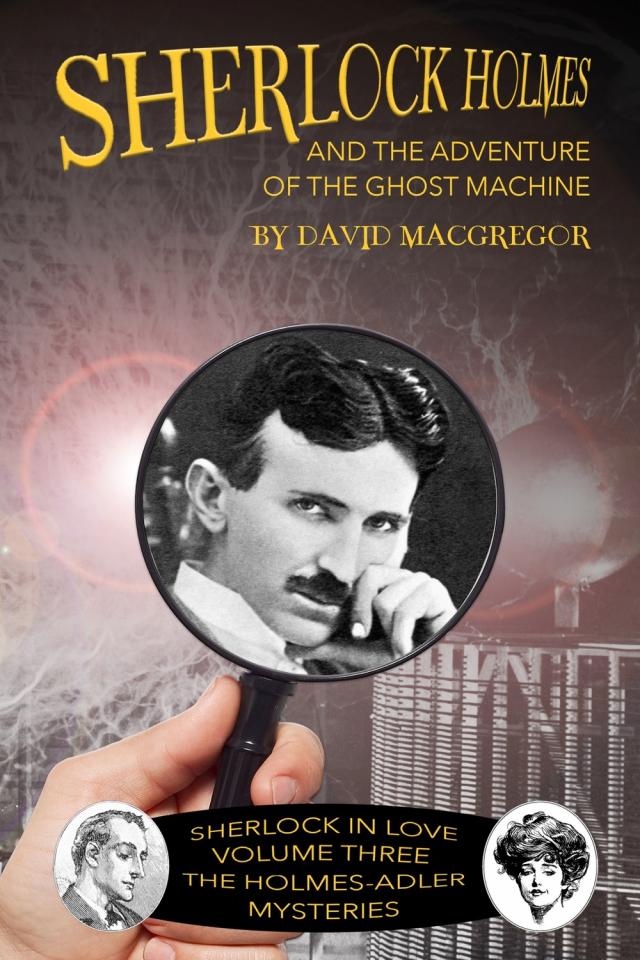


Sherlock Holmes and the Adventure of the Ghost Machine
David MacGregor
Published in 2022 by
MX Publishing
www.mxpublishing.co.uk
Digital edition converted and distributed by
Andrews UK Limited
www.andrewsuk.com
Copyright © 2022 David MacGregor
Cover design by Brian Belanger
The right of David MacGregor to be identified as the author of this work has been asserted in accordance with the Copyright, Designs and Patents Act 1988.
All rights reserved. No reproduction, copy or transmission of this publication may be made without express prior written permission. No paragraph of this publication may be reproduced, copied or transmitted except with express prior written permission or in accordance with the provisions of the Copyright Act 1956 (as amended). Any person who commits any unauthorised act in relation to this publication may be liable to criminal prosecution and civil claims for damage.
All characters appearing in this work are fictitious. Any resemblance to real persons, living or dead, is purely coincidental.
For Kelsey
Acknowledgments
This story, along with its companion pieces, “Sherlock Holmes and the Adventure of the Elusive Ear” and “Sherlock Holmes and the Adventure of the Fallen Soufflé,” began life as a play at The Purple Rose Theatre Company in Chelsea, Michigan. First and foremost, my eternal thanks goes to my friend and colleague Guy Sanville, who directed “Elusive Ear,” and always pushes me to make the story better. My gratitude also goes toward the dozens of talented and highly skilled collaborators who made these plays successful. And of course, my thanks to actor, playwright, composer, and musician Jeff Daniels for founding The Purple Rose Theatre Company in 1991 and providing a home for innumerable artists.
Special thanks goes to Hope Shangle, who offered an attentive ear and thoughtful insights over coffee and pastries, then volunteered her considerable web wizard talents as needed. Thanks also to the Amateur Mendicant Society of Detroit and Holmesian guru Howard Ostrom, whose enthusiasm for this new version of Sherlock Holmes was deeply appreciated. My brother Iain MacGregor and good friend Peter Morris were kind enough to cast a careful eye over the text, and I am extremely grateful to Steve Emecz, Richard Ryan, and the team at MX Publishing for gracefully ushering these stories into a different medium and giving them an entirely new audience.
Finally, a deep and heartfelt bow to Sir Arthur Conan Doyle for creating, as Vincent Starrett poetically expressed it, “two men of note who never lived and so can never die.”
Sherlock Holmes and the Adventure of the Ghost Machine
Introduction
Despite being a medical doctor, I would never describe myself as a particularly scientific man. While I had dutifully slogged through my courses on biology and chemistry while at university, the scientific world had never excited my interest to any undue extent. As a physician, my focus was on helping my fellow man, whether in private practice or on the battlefield during my service in Afghanistan.
This usually involved setting broken bones, stitching up wounds, digging Jezail bullets out of my comrades, or prescribing medication for this or that ailment. However, it would never have occurred to me to invent a reagent to test for the presence of blood, as my friend Sherlock Holmes had done shortly after we met and as I related in “A Study in Scarlet.” For whatever reason, I simply don’t have that turn of mind.
However, with every passing day, it was now abundantly evident that the minds of many of my fellow citizens were most definitely devoted to experimentation and innovation. What had begun as a trickle of inventions in the middle of the nineteenth century had assumed the proportions of a veritable cataract, and one couldn’t open a newspaper these days without reading about some astonishing new device or discovery.
Communication had become much easier thanks to the invention of the telegraph in 1837 and the telephone in 1876; transportation had been transformed, thanks to trains and then the invention of the automobile in 1889; and organization and tidiness had received its own godsend by way of the paperclip in 1899. Perhaps most astonishingly, only two years before the story I am about to relate took place, the Wright brothers had successfully flown the first aeroplane at Kitty Hawk, North Carolina, and just last year Thomas Sullivan sent a shiver through every right-minded Englishman when he announced that he had invented the teabag.
***
Still, human nature being what it is, this outpouring of brilliance and enterprise did not mean that the consulting practice and talents of Sherlock Holmes had been consigned to oblivion. Far from it. Driven by ignorance, prejudice, and boundless greed, humanity simply developed different and more efficient ways to prey upon one another, all in the name of progress. Like the famous Dutch boy with his finger in the dike to prevent a deluge, Holmes held fast in his determination to uphold the values of truth and justice to the best of his ability, although it must be said in all candour that he seemed to have grown somewhat weary of this role as of late, taking more and more comfort in reading, obscure chemical experiments, and his relationship with Miss Irene Adler, the American opera singer, who initially came to our attention due to the fact that she was blackmailing the King of Bohemia (entirely due to his own monstrous behaviour, I might add).
For readers new to these posthumously published tales of Sherlock Holmes, I should explain that far from passing away after the conclusion of “A Scandal in Bohemia,” Miss Adler had moved in with Holmes and I under the guise of being Mrs. Hudson, our housekeeper. Not to belabour the point any more than necessary, Holmes and Miss Adler had fallen madly in love with each other practically upon first sight, and although my nose was put a bit out of joint to find her belongings being unpacked in our rooms, I soon came to admire and respect her intelligence, discretion, and the manner in which she was able to keep Holmes grounded in ways that I never could. Faced with the necessity of explaining the constant presence of a woman on the premises, I simply presented her in the stories I wrote for “The Strand Magazine” as Mrs. Hudson, a neat little bit of invention which she didn’t mind going along with.
Subsequently, Miss Adler had been of invaluable assistance in any number of cases, especially those that involved the brilliant and wicked daughter of the late Professor Moriarty—Marie Chartier—who had first come to our attention in “The Adventure of the Elusive Ear,” when a bloodied and desperate Vincent Van Gogh had showed up on our doorstep. We had then matched wits with her again in “The Adventure of the Fallen Soufflé,” a case that involved not only the scandal-ridden Prince of Wales, but also Auguste Escoffier, the most celebrated chef in the world.
I’m happy to say that Miss Adler’s presence at 221B also had the edifying effect of expanding my musical horizons beyond the stylings of Gilbert and Sullivan to include the stirring marches of John Philip Sousa, as well as a number of catchy ditties from New York’s Tin Pan Alley. I was especially fond of a new American composer, George M. Cohan, whose popular tune, “Give My Regards to Broadway,” had caught my ear a week or two before the story you are about to read began.
As for this tale, I never for a moment considered writing it up for “The Strand Magazine.” My Edwardian readers would have been shocked to the core at some of the revelations herein, and His Majesty’s government would have insisted that a number of crucial sections be removed in the interest of national security. Still, as it does present several features of interest insofar as the career of Sherlock Holmes is concerned, upon completion I plan on consigning it to my battered despatch box at Cox and Company for the delectation of future generations, should it ever see the light of day at all. I sincerely hope it does, for I believe it shows my good friend Sherlock Holmes at both his best and his worst; in short, at his most human.
***
(Editor’s Note: In the original Sherlock Holmes stories, astute historians noted occasional factual errors and timeline discrepancies, which were invariably put down to the unreliability of Dr. Watson. This tendency did not diminish as the good Doctor entered his later years, but it does not detract in any meaningful way from the pleasure to be had in this long-hidden tale from the annals of Sherlock Holmes.)
Chapter One: The Fallen Hero
London: November 29, 1905.
As it turned out, Bernard Darwin is a damned good egg. And yes, when I refer to Bernard Darwin, I am speaking of none other than the grandson of the great English naturalist, Charles Darwin himself. Things had been particularly slow at 221B of late, and so on the evening in question I took myself out to the Royal Society to listen to a lecture on Darwin by his quite accomplished son, Francis. Rather surprised and delighted to find myself seated next to Bernard, Francis’ son, we got to talking and I quickly discovered that Bernard was an avid reader of my Sherlock Holmes stories. This alone marked him as a man of nice judgement and good taste, and while I would have been interested to learn more about his upbringing and experiences in such a remarkable family, I was too busy answering his quite perceptive and intelligent questions regarding “The Five Orange Pips” and “The Adventure of the Second Stain.”
The lecture itself was, as you might expect, fascinating in the extreme, with Francis offering any number of insights and
“What now, Watson, old fellow?” he asked. “Back to Baker Street to assist Mr. Holmes in one of his mysteries?”
“I wish that were true,” I returned, “but we’re actually between cases at the moment.”
“Ah, pity. Then perhaps I could interest you in a stroll out into a foggy London evening? See what kind of trouble we can find?”
“Bernard!” I exclaimed, surprised to receive such a proposition from a member of one of the most acclaimed families in England. “Are you quite serious?”
“Completely,” he answered. “I’m afraid excursions into the unknown run in the bloodline. Can’t be helped. And please, do call me Bernie. What do you say?”
Faced with such a charming invitation and the prospect of not much of interest going on back in Baker Street, I nodded my enthusiastic acceptance, and a few minutes later Bernie and I were in a cab rattling down cobblestone streets towards sections of London quite far removed from the staid and scholarly crowd of the Royal Society. It was the time of night when the decent, respectable side of London closes up its drapes and doors, and a quite different side of the city comes to life.
To get ourselves in the proper mood for whatever might come our way, our first stops were a couple of pubs, where I was much impressed with Bernie’s familiarity with the area and the clientele. Things got progressively hazy after that, although I recall one conversation with a man who could pull his lower lip over his nose, and being cornered by a well-endowed matron who insisted that she was actually Persephone, Queen of the Underworld, and would I like a tour of her kingdom.
As a writer, my interest was quite naturally piqued at such an intriguing offer, but as a man of some experience, I made sure that my wallet was secure as I sidled away with a regretful shake of my head. At any rate, my overall sense of the evening was having a rattling good time with Bernie by my side. Yes, there is a somewhat disreputable side of London, but if you can swirl on the outskirts of it without being drawn into the vortex, there are a great many interesting things to be done and observed. Humanity at its best and worst unfolds in a kaleidoscope of tastes, smells, and sights. The most astonishing thing was how time seemed to speed up and then slow down, so that at one moment Bernie and I had sworn our determination to depart for the Galapagos Islands with a barmaid named Agnes the very next morning, and the next moment I was disconcerted to find myself standing alone at the bottom of our stairs at 221B.
Looking upward, to my dismay, I could see that the stairs were weaving in a steady, sinuous motion, and the prospect of getting up them in one piece was a daunting one. Getting a grip of the handrail, the popular tune from America, “Give My Regards to Broadway,” popped into my head, and it was by singing this and focusing on the task at hand that I was able to methodically make my way up the stairs and enter our rooms. And it was then, to my utter astonishment, that I found both Holmes and Miss Adler looking at me in surprise.
“Good Lord!” I exclaimed. “You’re still up!”
Holmes’ eyes narrowed. “Watson, it’s eight o’clock in the morning.”
Looking out the window I could see that it was, in fact, daylight, a detail that appeared to have eluded me only moments earlier when I must have been dropped off at our rooms. A quick check of my pocket watch confirmed the time.
“Well, well, well…” I heard myself saying, for lack of anything better to say.
“We thought you were still asleep in your room,” said Miss Adler. “Have you been out all night?”
“Apparently,” I answered. “And now it’s morning! Isn’t that remarkable? The way the sun goes around the earth like that… day after day. Astonishing.”
“Actually,” Miss Adler corrected me, “if Mr. Copernicus is to be believed, it’s the earth that revolves around the sun, I believe.”
“Well, what’s the difference, eh?” I responded, dimly aware that there was a massive difference, but not caring enough to worry about it at the moment, as my biggest concern was the peculiar way Holmes and Miss Adler were looking at me. I therefore felt that it was my duty to set their minds at ease.
“I’m not drunk, if that’s what you’re thinking. Not a bit of it.”
“Weren’t you going to some talk at the Royal Society last night?” enquired Miss Adler.
“Yes! Precisely! Francis Darwin! Talking about his father Charles and evolution and whatnot. And do you know who I found myself sitting next to? Bernard Darwin! Charles’ grandson. Charming fellow! Superb golfer, apparently. Oh, and you’ll never guess! Bernie Darwin is a Sherlock Holmes fan! He’s read all of my stories in ‘The Strand Magazine’ and he was absolutely delighted to meet me. So, we went out. Bernie and I.”
“Out where?” asked Miss Adler.
“Oh… here and there. Things have been a bit quiet around here lately, and I fancied a bit of adventure.”
Miss Adler leaned forward, keenly interested. “And did you find it?”
“Miss Adler, there are some parts of London, you turn a corner, find yourself walking down a dark alley, you hear some kind of mysterious noise up ahead, and the hairs on the back of your neck stand straight up. God, I miss that feeling!”
“Where did you go exactly?”
I started to reply, but thankfully the cotton wool in my brains had started to clear just a bit. “Oh no. Nicely played, but you won’t catch me out that easily. I went where I went, did what I did, and I’m not saying another word!”
Holmes approached me, looking me up and down in that disconcerting fashion of his, then took hold of my jacket lapel and sniffed it. His eyebrows arched upward as he turned to Miss Adler. “Opium.”
“Dr. Watson! You spent the night in an opium den?” Miss Adler appeared to be quite surprised at Holmes’ deduction, and I have to admit I was a bit surprised myself.
“No!” I answered. “Well, not all night. And don’t you two get on your high horses with me! Ask Holmes about all the times I had to drag him out of some filthy drug den or another.”
“On cases!” Holmes fairly shouted.
“Oh, we had some fine dust-ups together! Remember that night at the Bar of Gold in Swandam Lane? There must have been a dozen of them, wharf rats from the vilest corners of London, tattooed head to foot, but we sorted them out, didn’t we Holmes? You should have seen him, Miss Adler! The finest exhibition of boxing and baritsu I have ever seen in my life! There wasn’t a man he couldn’t drink under the table or a scrape he couldn’t get out of. My God, those were the days!”
I’m not entirely sure what kind of response I expected from Holmes as I reminisced about the halcyon days of our early cases, but it certainly wasn’t what came out of his mouth next.
“My coddled eggs!” he exclaimed in alarm, and then he was out of the room and clattering down the stairs in a rush. I turned to Miss Adler, not quite certain that I had heard Holmes correctly.
“Is that a clue of some kind?” I asked.
“No, it’s breakfast,” she explained. “But sit down! Tell me more about your evening!”
“I’m not sure I can,” I returned.
“Oh really? Does that mean that some sort of criminal activity was involved?”
“It means that copious amounts of various dubious substances were ingested more rapidly than good sense would indicate, and that I can’t recall much in terms of our escapades, save for the fact that I was invited for a tour of the underworld by a large woman claiming to be Persephone, the daughter of Zeus and Demeter.”
Miss Adler pursed her lips and gave a small shake of her head.





