Path lit by lightning, p.1
Path Lit by Lightning, page 1


Thank you for downloading this Simon & Schuster ebook.
Get a FREE ebook when you join our mailing list. Plus, get updates on new releases, deals, recommended reads, and more from Simon & Schuster. Click below to sign up and see terms and conditions.
CLICK HERE TO SIGN UP
Already a subscriber? Provide your email again so we can register this ebook and send you more of what you like to read. You will continue to receive exclusive offers in your inbox.
In memory of Alice Mayhew, the editor whose inimitable voice I still hear in my head, with the wisdom and vigor that kept me going through twelve and a half books… and also to the wondrous voices that herald a better future—grandchildren Heidi, Ava, Eliza, and Charlie.
Preface
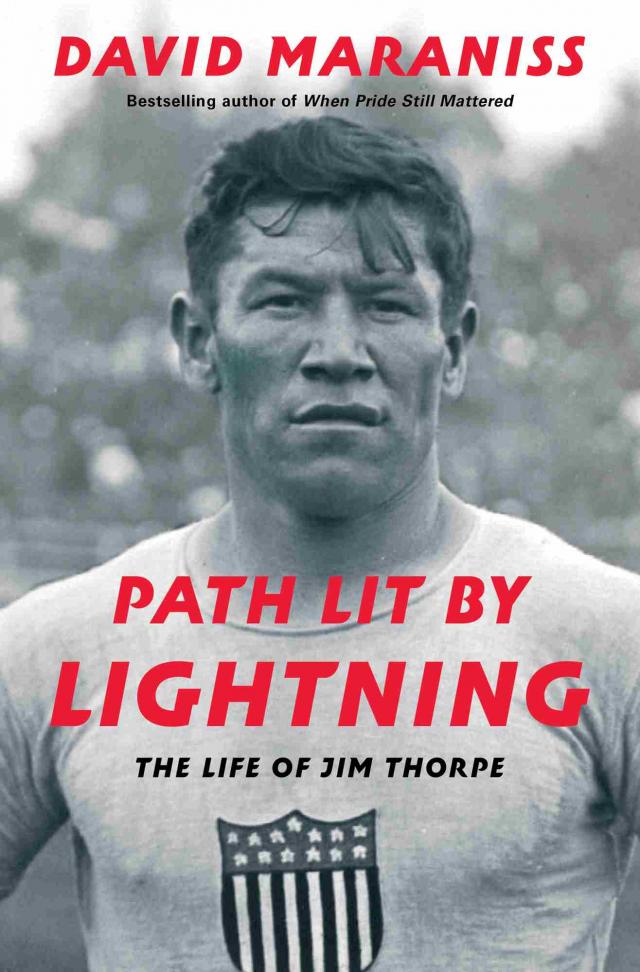
THE LATE REUBEN SNAKE, ONETIME chairman of the American Indian Movement and member of the Winnebago nation, said that to be an Indian meant “having every third person you meet tell you about his great-grandmother who was a real Cherokee princess” and “nine out of ten people tell you how great Jim Thorpe was.” Thorpe, in that sense, was one of the few Native Americans of the twentieth century whom people could cite and praise even if they knew little else about the indigenous experience. From the moment I started telling acquaintances that I was writing a book about Thorpe, the reply was often some variation of “Oh, I read a book about him in fourth grade.” Many of those people were in fourth grade long before there was much effort to diversify school libraries. Thorpe was an archetype, a gifted athlete, and a stereotype, the romanticized noble Indian. He was a foundation story of American sports.
As with most public figures of that sort, the man became shrouded in myth. As a biographer, I am interested in both—the making of the man and the creation of the myth. Born in 1887, in the Indian Territory of what later became Oklahoma, Thorpe was the quintessential underdog who rose from nowhere to become the greatest athlete in the world, the Natural who could do anything on the fields of play. He was an Olympic champion decathlete in track and field, a football All-American, a star pro and first president of what became the National Football League, and a major league baseball player, a seemingly indestructible force who ran like a wild horse thundering downhill yet was also a graceful ballroom dancer and gifted swimmer and ice skater.
When people display such rare physical gifts, there is a tendency to lift them into the realm of the superhuman, as if human magnificence is insufficient. That was certainly true with Thorpe. The hyperbolic stories told by writers and sports fans over the decades could fill many notebooks. As is also often the case, there were times when Thorpe became the storyteller of his own legend. Jim loved to recall the tale of how at Carlisle he brilliantly ran a punt back for a touchdown against Army, and when the score was nullified by a penalty, he simply repeated his touchdown gallop on the next play. He was indeed the dominant player in that game, but the back-to-back touchdown runs never happened. Nor is there any truth to his boast that during a baseball game in Texarkana he hit three home runs into three separate states, Arkansas, Texas, and Oklahoma. He did hit three home runs, but the three-state hat trick was a geographic impossibility. Mythmaking in the American tradition of George Washington, Paul Bunyan, Davy Crockett, and Babe Ruth.
But there was another myth at the center of the Thorpe story, a deeper and more pernicious myth that had to do with the history and treatment of the American Indian: the myth that the Great White Father knows best. Thorpe’s life spanned a sixty-five-year period when the dominant society believed the best way to deal with Indians was to rid them of their Indianness and make them as white as possible. It was that mentality that shaped Thorpe’s life. Much of the territory of his Sac and Fox and Potawatomi people was lost when the federal government moved to strip them of communal property, opening up vast swaths of territory to the land rushes that white Oklahoma settlers and their descendants celebrated as Boomer Sooner frontier derring-do. As a teenager, he was sent away to the Carlisle Indian Industrial School in Pennsylvania, the federal government’s flagship Indian boarding school, where the focus was more on forced acculturation than on education and the methods were crude, cruel, and dehumanizing. Football, as a college sport then largely the province of Ivy League good old boys, was considered a central component of the assimilation process.
A biographer’s responsibility is to acknowledge the complexity of human existence, its many contradictions, crosscurrents, and nuances. For all of Carlisle’s failings and questionable intentions, some of its students considered their boarding school years among the best of their lives. Jim sometimes claimed that himself. It is fair to say that few would know or care about him had he not gone there and shown his unmatched athletic skills to the nation and the world. Whether he would have had a happier life without the surrounding hoopla of fame is another matter. He was not a loner and had a touch of mischief to him, but he was innately modest and comfortable away from the limelight. He was most relaxed while stalking the woods or sitting on a riverbank or ocean pier, hunting or fishing. In the years after his playing skills faded, his life was troubled by alcohol, broken marriages, deferred dreams, lost opportunities, and financial distress resulting from a generosity that lapsed into wastefulness. He was the American nomad, migrating from job to job, state to state, in search of a peace he never found before he died of a heart attack in a trailer park in southern California in 1953 at age sixty-five.
At times Jim was his own worst enemy, yet throughout his life he had to deal with powerful white men who tried to control his fate. Some presented themselves as his savior, others as his moral superior. The most notable example of the savior type was Pop Warner, Jim’s coach at Carlisle. In Jim Thorpe—All-American, the 1951 movie version of his life, Thorpe (played by movie star Burt Lancaster) is the main character but Warner, who consulted on the script, is portrayed as the hero and wise man who discovered the raw athlete, molded him into a superstar, and then tried time and again in later years to save Jim from his worst impulses. The true story is less flattering. Warner was a hypocrite if not a coward. At the time of Jim’s greatest peril, when his Olympic medals were being taken from him because he had played bush league baseball, Pop lied and feigned innocence to save his own reputation while portraying Jim as the ignorant native. There is strong evidence that James E. Sullivan, then the big man of American amateur athletics and the person most responsible for the decision to deny Thorpe his medals and records, was also duplicitous during that ordeal even as he claimed to be upholding the righteous cause of pure amateurism.
And then there was Avery Brundage, once a decathlete himself, a teammate and rival of Jim’s at the 1912 Stockholm Olympics. Brundage performed miserably there and dropped out of the competition when the going got tough, an early refutation of his later bromide that in the Olympic ideal participation was what mattered, not performance. He went on to a high-flying career as the holier-than-thou arbiter of all things amateur in the world of sports, and for decades as he rose through the ranks from president of the U.S. Olympic Committee to head of the International Olympic Committee, he consistently refused to reconsider the injustice done to Thorpe, often complaining that he, not Jim, was the victim of unfair treatment. In the long list of Brundage misdeeds, others were more inexcusable, especially his cozying up to the Nazi organizers of the 1936 games in Berlin, but his condescending and dismissive attitude toward Thorpe stood as Exhibit A in the hypocrisy of moral superiority.
Thorpe’s unparalleled athletic accomplishments did not make his life triumphant. His days were marked by loss. The loss of tribal lands. The loss of his twin brother in childhood. The loss of his namesake son at age three. The loss of his Olympic medals and records. His loss of money and security and equilibrium. There is a temptation, then, to view his story as tragedy, but I emerged from my study of his life with a different interpretation. It is also a story of perseverance against the odds. For all his troubles, whether caused by outside forces or of his own doing, Jim Thorpe did not succumb. He did not vanish into whiteness. The man survived, complications and all, and so did the myth.
1 “The Stuff His People Are Made Of”
PEOPLE WERE EAGER TO SEE “The Big Indian” as soon as he returned to America. He was a celebrity now, a global sensation after winning two gold medals at the 1912 Olympic Games in Stockholm, where the dapper king of Sweden was said to have called him the greatest athlete in the world. The first public stop on home soil was in Boston, where a local newspaper heralded his exalted status by suggesting he pose as the Indian on the flip side of the buffalo nickel. Boston’s mayor, an avid sports fan nicknamed Honey Fitz, challenged him to a race in the hundred-yard dash at the Elks Club picnic on August 11. John Francis Fitzgerald, almost fifty, and five years away from becoming the grandfather of a future president, jocularly boasted that he might not need a head start to keep up with James Francis Thorpe.
Speechwriters for William Howard Taft, the current president, a sporty walrus who weighed 350 pounds, were already drafting a letter of praise on behalf of the nation, asserting the fond hope that Jim Thorpe’s Olympic victories in the pentathlon and decathlon would “serve as an incentive to all to improve those qualities which characterize the best type of American citizen.” The White House seemed clueless about the fact that the United States government did not yet consider Thorpe any type of citizen, best or otherwise. From Boston it was on to Carlisle, New York City, and Philadelphia, where exuberant crowds jostled for the best view of the new American colossus.
An American India n mythologized into spectacle. It was a familiar scene that had played out in strikingly parallel fashion almost eighty years earlier, in 1833, when Black Hawk was paraded through cities on the East Coast. At the height of their fame, Black Hawk and Jim Thorpe, warrior and athlete, were the best-known Indians in America, and they would remain among the most renowned of all time. But the connection was deeper and more spiritual. Black Hawk and Thorpe, both members of the Sac and Fox nation, also came from the same clan, the Thunder Clan; they were connected in lineage through Thorpe’s paternal grandmother, No-ten-o-quah, who might have been Black Hawk’s grand-niece, although the documentation is imprecise. As a boy growing up in the Indian Territory that later became part of Oklahoma, Thorpe was told by his mother that he was the reincarnation of Black Hawk. Both Thorpe and Black Hawk were curiosities to the dominant Anglo-Saxon society, alternately noble and tragic—and often inscrutable, as seen through the distorted cultural lens of whiteness.
Black Hawk, carrying with him a mystical medicine bag made from the skin of the raptor from which he took his name, made his eastern tour as a manacled prisoner of war, an exotic Indian leader who had rebelled against the ever-expanding reach of white settlers into ancestral tribal lands in the Middle West. He lived during a time when an American president, Andrew Jackson, gained notoriety as an Indian killer, and killing Indians was part of the nation’s providential plan.
Thorpe, carrying with him the medals and trophies from which he took his fame, made his tour as a prisoner of his own athletic success, an Indian who in his youth had been shipped off to a school in Pennsylvania run by the federal government, the Carlisle Indian Industrial School, where the official policy was to exterminate Indians not in body but in language, dress, behavior, tradition, and soul. Cut their hair and outfit them in uniforms resembling those worn by the enemies of their forefathers, the U.S. Cavalry. Kill the Indian, save the man.
* * *
WHILE IN BOSTON, Thorpe received a telegram from Pop Warner, his track trainer in Stockholm and the football and track coach at Carlisle. Glenn Scobey Warner was an imposing figure in the athletic world of the early twentieth century, as well known in that subculture as his most prominent player for turning little Carlisle into an athletic marvel that competed on the fields of play with the elite colleges of the East, from Penn to Harvard to Syracuse to Yale to Army. Warner had sailed home from Stockholm with most of the U.S. Olympic delegation directly after the games, disembarking from the SS Vaderland in New York on July 30, while Thorpe stayed behind with a few teammates for an extra round of exhibition track meets on the Continent, ending in Paris. Somehow, uncharacteristically, Pop had lost track of his prize pupil and searched frantically for him in New York, thinking wrongly that he must be there, until finally learning from the newspapers that Thorpe was in Boston hanging out with Honey Fitz.
Get to New York soonest, came the message. A welcome home celebration was being planned back in Carlisle that had been delayed once already awaiting the hero’s return. When Thorpe reached New York by train he was met by Pop and Lewis Tewanima, a rail-thin Hopi distance runner with uncommon stamina who, as Thorpe’s Carlisle teammate, had also excelled in Stockholm, winning a silver medal in the 10,000-meter run. Of more interest to Thorpe was something else Warner brought with him—a passel of letters sent to Jim at the Carlisle address from his sweetheart, Iva Margaret Miller, who had graduated from the Indian school that spring. Since then she had worked at a mission school in Oklahoma before heading out to southern California to live with her siblings. Iva’s older brother Earl was especially wary of Thorpe’s romance with their intelligent and cultured sister—and had gone so far as to return many of his letters before Iva could see them. Now, with Jim’s global fame, the protective family chaperones seemed to be relenting.
The festivities in Carlisle started at two on the soft summer afternoon of August 16 with a parade from the station across from the James Wilson Hotel at the corner of Hanover and High Streets to the Indian school half a mile away. This was the biggest thing that had ever happened in Carlisle, and the “gorgeously decorated” town shut down to celebrate. A carriage carrying Thorpe, Tewanima, and Warner rolled just behind the parade marshals, followed by a marching formation of ninety-one Indian students militarily attired in their cadet uniforms, then an assortment of town bigwigs and council officials and more students accompanied by Moses Friedman, the Indian school’s superintendent. The sidewalks were lined ten deep along pockets of the route out to Biddle Field, the new athletic grounds, where the Eighth Regiment band performed as seven thousand students and locals filled the bleachers and grandstands for speeches.
Superintendent Friedman spoke first. He called the day a national occasion of which the entire country should be proud. These were “real Americans,” he said of Thorpe and Tewanima, whose forebears were “on the reception committee which welcomed to this soil and this glorious New World the famed first settlers who arrived on the Mayflower.” No sooner had Friedman recited the founding fable of racial conciliation than he shattered it, perhaps unwittingly, with an undeniable truth about forced acculturation. His subject was the little runner, Tewanima.
“One of these young men came to this town and to the Indian school five years ago virtually as a prisoner of war,” the superintendent said. “His people, the Hopi tribe of Arizona, had been giving the government much trouble and were opposed to progress and education. It was finally decided to send twelve of the men and most influential of the tribe to Carlisle to be educated in order to win them over to American ideals.” Tewanima was one of the twelve Hopi prisoners the U.S. government had sent to Carlisle. “They came with long hair and some of them with earrings. They were pagans and opposed to education and American civilization.” As he looked toward his Hopi student, Friedman busted with pride about all that Carlisle and that half decade had accomplished. “Louis Tewanima here is one of the most popular students at the school and has an enviable record. You know of his athletic prowess—I wanted you to know of his advancement in civilization and as a man.”
Friedman then turned to Thorpe. “There is another here today who is now known over all the world. The world’s greatest athlete is also an Indian. We welcome you, Jim Thorpe, to this town and back to your school. You have covered yourself with glory. By your achievement you have immeasurably helped your race. By your victory, you have inspired your people to live a cleaner, healthier, and more vigorous life.”
As further testament to Thorpe’s achievement, letters were shared from the highest officials in Washington, D.C. There was the one from President Taft, an almost identical letter from Walter L. Fisher, secretary of the Interior, and finally one from Robert G. Valentine, commissioner of Indian Affairs. It was a deputy in Valentine’s office who had instigated the letter-writing by noting in a memo: “It seems to me that when an American Indian wins honors of this kind against all the world he has done something to show the stuff his people are made of, at least physically, and that some personal recognition from you might not be amiss.”
Warner spoke next. Friedman had introduced him by praising the coach for turning out “clean and strong athletic teams.” At the time, Pop was regarded as the father of Carlisle’s success, overseer of the Olympians, and responsible for victories on the football field year after year, all of which brought outsize recognition to the school. In a few years, like Friedman, he would depart Carlisle shadowed by scandal. Now, by some accounts, he received the loudest ovation at Biddle Field. He talked about how celebrations for the U.S. Olympic team would be held in many cities, but “none will have a greater right to celebrate than Carlisle.” He said that he and Thorpe had “fought it out” over who would speak first until Thorpe relented. Unlikely, given Thorpe’s reserved public nature, and that when Thorpe’s turn came he limited his speech to twelve words: “All I can say is that you showed me a good time.”
That night, after an exhibition baseball game between Carlisle and Chambersburg, another band concert, and an informal banquet in town attended by the chief ethnologist from the government in Washington, the Olympians were escorted back to school by a raucous battalion of students festively dressed in nightshirts and white caps. A team of boys pulled a carriage carrying Thorpe and Tewanima down the streets, hollering as they danced in the glow of bloodred and golden lights, the school colors. The school newspaper described the scene as “somewhat beautiful, and slightly weird, but surely noisy.”